83 Jean St, Grange QLD 4051
Mon-Fri 07:30 AM - 04:00 PM - Sat - 8:00 - 12 - Sunday Closed

Your power goes out on a humid Brisbane evening. The fridge is off. The Wi-Fi drops. The air conditioning stops. Then the next bill lands and it’s no easier to swallow.
That’s where most battery conversations start. Not with chemistry, not with acronyms, and not with sales brochures. They start with a household trying to get more control over power costs and a bit more confidence when the grid doesn’t behave.
For homeowners looking up best home batteries australia, the hard part isn’t finding brands. It’s sorting through competing claims, half-explained specifications, and quotes that look similar until you inspect what’s included. A battery can be a smart upgrade. It can also be a poor fit if it’s oversized, undersized, badly integrated, or installed onto a switchboard that wasn’t ready for it.
The practical view is simple. The right battery is the one that suits your home’s load, your existing solar, your tariff, your backup expectations, and your electrical infrastructure. The wrong battery can still be a premium model.
A lot of Brisbane homeowners are reaching the same point. Solar is already on the roof, power bills are still climbing, and the evening peak is when the house needs the most energy. That is exactly where a battery starts to make financial sense, provided the system is sized properly and connected to a switchboard that can handle it.
Battery uptake is no longer limited to early adopters. In the second half of 2025, Australian households installed a record 183,245 home battery units, taking the national total to 454,753 installations by year-end, according to the Clean Energy Council. By early 2026, the same update reported more than 250,000 installations under the federal program and 6.3 GWh of distributed storage capacity nationally.

The timing matters. Households are no longer asking whether batteries work. They are asking whether the numbers stack up for their home, their tariff, and their backup needs.
Three factors are pushing battery decisions in 2026.
Brisbane homes often follow a familiar pattern. Solar production is strongest in the middle of the day, but household demand ramps up later. Air conditioning, cooking, hot water, laundry, pool equipment, and device charging tend to hit after the sun starts dropping. A battery shifts solar into those hours. If you want a plain-English explanation of the process, this guide on how solar batteries work covers the basics well.
The main mistake is treating 2026 as a brand race. It is not. A premium battery can still be the wrong choice if the backup circuits are poorly planned, the inverter pairing is wrong, or the switchboard needs work that was never included in the quote.
Brisbane properties vary more than many online comparison tables allow for. A smaller single-phase home with modest overnight use needs a different battery setup from a larger three-phase house running ducted air, pool pumps, and an EV charger.
Installation details shape the outcome just as much as the battery brand. Battery location, heat exposure, cable runs, backup configuration, metering, and switchboard capacity all affect safety, performance, and final cost. In practice, the wrong installation can waste the value of the right battery.
That is why 2026 stands out. The technology is more common, the incentives are stronger, and homeowners are paying closer attention to resilience. The better question is no longer “Which battery is popular?” It is “Which system will work properly in this house, on this switchboard, under these loads?”
Spec sheets confuse homeowners because they mix storage, output, chemistry, and software into one page. The easiest way to read them is to treat a battery like two things at once. It’s an energy tank and it’s a power delivery system.
If you only compare one number, you’ll miss how the battery will perform in your house.
Battery capacity is measured in kWh. That tells you how much energy the battery can hold.
Imagine a water tank. A bigger tank stores more. It doesn’t tell you how fast the water comes out, only how much is available.
You’ll often see two versions:
Usable capacity is the one that matters most in day-to-day planning. If your home uses a fair chunk of power after sunset, that figure tells you how long the battery can carry the load before the grid steps back in.
Power is measured in kW. This is about output speed, not storage volume.
A battery may have plenty of stored energy but still struggle if too many appliances start at once. That’s why households with air conditioning, cooking loads, pumps, or larger simultaneous demand need to look carefully at power output and backup configuration.
A practical example:
A battery that looks large on paper can still feel small if its output doesn’t match the house.
No battery gives back every unit of energy that goes in. Round-trip efficiency measures that loss.
According to Aussie Solar Tech’s battery comparison and benefits guide, LFP batteries have become the preferred chemistry in the Australian residential solar market, with leading models showing 95 to 97% round-trip efficiency. The same source notes that a 2% efficiency difference on a daily 10 kWh cycle can lead to over 73 kWh of lost energy annually.
That doesn’t mean one small efficiency gap should decide the whole purchase. It does mean efficiency is worth taking seriously when you compare similar systems over years of use.
If you want a plain-English primer on battery basics before comparing models, this guide on how solar batteries work is a useful starting point.
Most residential buyers will come across LFP and occasionally NMC.
LFP has become the common choice in home systems because it suits residential use well. In practical terms, homeowners usually choose it for its strong safety profile, broad market adoption, and good compatibility with modern modular designs.
That doesn’t mean chemistry is the only factor. A well-designed battery with good support and proper installation matters more than chemistry alone. Still, if you’re comparing mainstream residential products in Australia, you’ll notice LFP appears again and again for good reason.
This refers to how much of the battery’s stored energy is intended to be used. Homeowners don’t need to obsess over this in isolation, but it helps explain why nominal and usable capacity differ.
Some batteries are fixed-size units. Others are modular and expandable. That matters if your energy use may increase later because of a renovation, pool equipment, or EV charging.
Not every battery backs up the whole house the same way. Some systems are better suited to essential circuits. Some offer broader backup capability. Some are much more flexible in three-phase homes than others.
The best home batteries australia search usually lands people in a brand war. Tesla versus Sungrow. BYD versus Sigenergy. Then a few newer names get thrown in and the comparison turns into noise.
A better approach is to compare each option against real household needs. Capacity is one part. Backup behaviour, scalability, electrical compatibility, and installation complexity matter just as much.
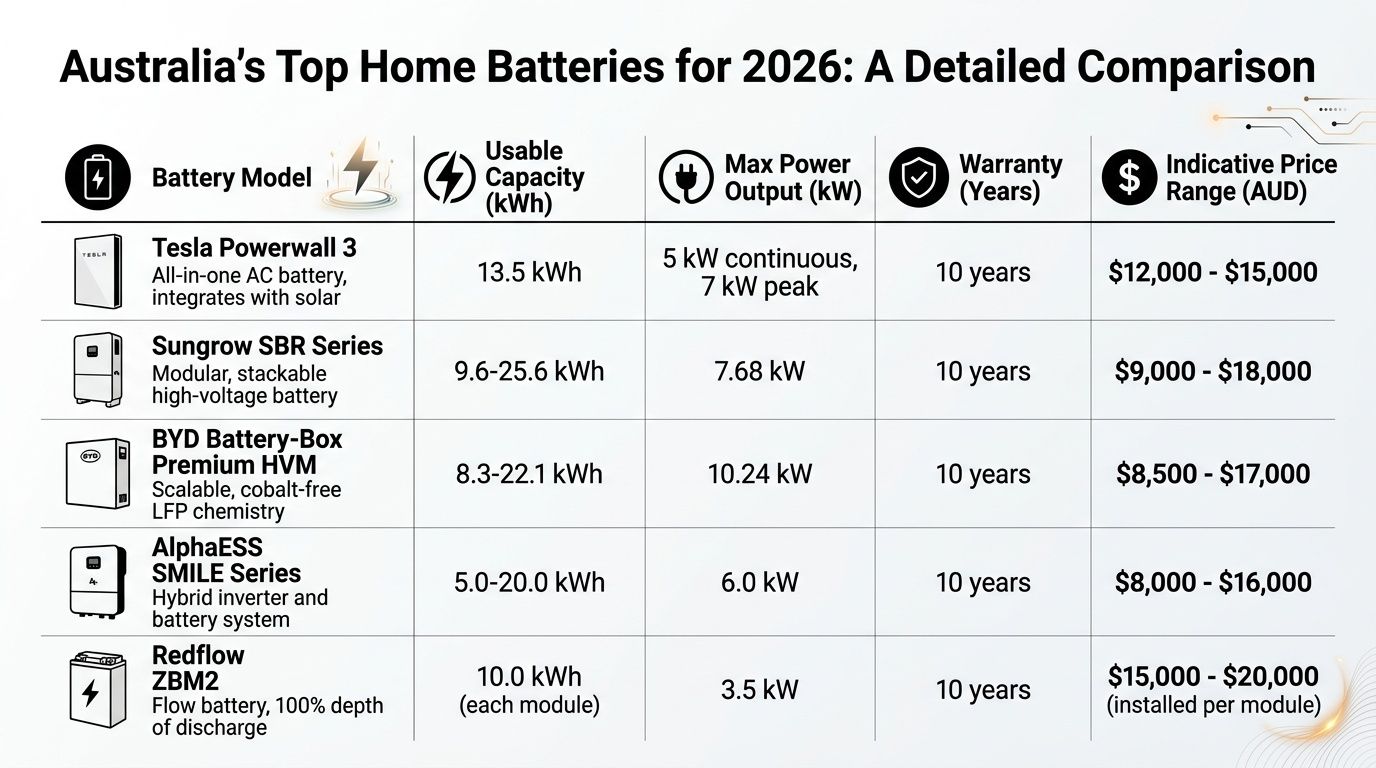
| Battery brand | Best fit | Main strength | Main trade-off | Indicative hardware price cited in verified data |
|---|---|---|---|---|
| Tesla Powerwall | Single-phase homes wanting a familiar all-in-one style system | Strong recognition, clean ecosystem, around 97% round-trip efficiency | Three-phase backup limitations in larger homes | Not provided in verified data for Powerwall hardware alone |
| Sungrow SBR HV | Homes wanting modular growth and full three-phase backup capability | Expandable design, 95 to 96% efficiency, broad fit for future upgrades | System design still needs to match inverter limits and load profile | $9,500 for 12.8 kWh |
| BYD HVM | Owners who want a scalable LFP option with established market presence | Modular platform and LFP chemistry | Needs careful system matching and brand support review | $10,600 for 13.8 kWh |
| Sigenergy Sigenstor | Households planning for backup, modular expansion, or EV integration | Strong installer adoption, integrated design, three-phase capability | Newer market entrant, so quote quality and installer skill matter a lot | $11,500 for 13 kWh |
| GoodWe Lynx Home U | Off-grid or climate-exposed scenarios needing resilient hardware features | LiFePO4 chemistry, IP65-rated enclosure, auto-reboot functionality | Less often the first choice for standard metro backup discussions | Not provided in verified data |
Sigenergy isn’t just getting attention. It has already moved into the front rank. According to Stage Electrical’s summary of SunWiz and SolarQuotes market data, Sigenergy became Australia’s top-selling residential home battery brand by installed capacity in 2025. The same source says an independent installer survey in SolarQuotes’ 2025 awards gave Sigenergy 17% of votes.
That’s a significant shift in a market long shaped by Tesla and Sungrow.
Most important differentiator: Sigenergy stands out when the homeowner wants one system that can be built out over time rather than a fixed battery decision made on day one.
In practical terms, Sigenergy often appeals to households thinking beyond simple solar storage. If backup, EV charging integration, and future expansion are all on the table, its architecture makes sense. The caution is straightforward. Integrated systems still need careful design. A feature-rich battery won’t rescue a poor install.
Tesla remains a familiar benchmark because many homeowners know the brand before they know any battery details. That familiarity isn’t meaningless. Simplicity matters. Software experience matters. Installer familiarity matters too.
Tesla Battery is also cited in the verified data at around 97% round-trip efficiency with about 13.5 kWh usable capacity. For single-phase homes wanting a tidy, established option, it remains a logical shortlist candidate.
The limitation comes up in larger or more complex Brisbane homes. Verified data notes that Tesla Powerwall 3 has documented three-phase backup limitations, which can constrain some larger installations or future expansion paths.
That doesn’t rule it out. It means the house has to fit the battery, not the other way around.
Sungrow wins a lot of real-world comparisons because it solves common homeowner problems without forcing the household into an oversized upfront spend.
Verified data describes Sungrow’s modular LFP systems as spanning 9.6 to 25.6 kWh and delivering 95 to 96% efficiency. It also notes full three-phase backup capability and modular scalability.
Sungrow often makes sense when the brief is simple: good performance, expandable storage, and a system that can grow with the house.
That’s particularly relevant in Brisbane homes where owners know today’s load but not tomorrow’s. Maybe there’s no EV yet. Maybe a renovation is planned. Maybe the pool equipment is coming later. A modular platform gives the homeowner room to move.
BYD doesn’t usually dominate the marketing conversation, but it stays in serious consideration because of its modular battery approach and LFP chemistry. Verified data places BYD third in the cited installer survey with 12% of votes.
For homeowners, the appeal is usually practical rather than flashy. BYD often enters the conversation when the buyer wants a known modular platform, values scalable storage, and is willing to assess the full inverter-and-install package rather than just the battery shell.
Its fit comes down to system design and installer competence. In battery work, “compatible” and “well integrated” are not the same thing.
GoodWe Lynx Home U is specifically noted in the verified data for off-grid applications, with LiFePO4 chemistry, IP65-rated enclosure, and auto-reboot functionality. That makes it relevant where environmental protection and recovery features matter.
For standard suburban battery installs, it won’t always be the first battery on the shortlist. But if the property has a more specialised brief, it deserves a proper look rather than being dismissed because it’s less visible in mainstream buyer chatter.
Here’s the blunt version from an installation perspective.
What tends to work well
What often disappoints
A Brisbane homeowner sees a battery advertised at one price, then the installed quote lands several thousand dollars higher. That gap usually comes down to the parts of the job that decide whether the system performs properly. In real homes, battery cost is tied to inverter compatibility, switchboard condition, protection devices, cabling runs, monitoring, backup setup, and the amount of integration work needed to make the whole system safe and compliant.
That matters for payback.
A battery that looks cheaper on paper can end up being poorer value if the install leaves you with limited backup, awkward solar charging behaviour, or switchboard constraints that should have been addressed from the start. The wrong installation can ruin the right battery, and it can also distort the numbers homeowners use to justify the purchase.
The financial case has improved because rebates and battery incentives have lowered the entry cost for many households, and buyer demand has followed. As noted earlier, battery uptake has risen sharply across Australia. That does not make every system a good buy. It does mean more homes can now reach a sensible payback where the numbers were marginal a few years ago.
The key point is simple. Better incentives improve the starting position, but the result still depends on system design, tariff structure, and installation scope.
A useful payback estimate starts with four practical checks:
How much surplus solar do you export on a normal day?
A battery needs regular charging opportunity. If the solar system is small or daytime loads already absorb most generation, storage savings can be limited.
How much power do you use after sunset?
Evening usage is where home batteries usually earn their keep. The closer the battery capacity matches that usage, the more often it offsets grid power.
What does your tariff charge you at night?**
Payback improves when stored solar replaces expensive imported electricity, especially on time-of-use tariffs.
What electrical work sits outside the battery brochure?
Switchboard upgrades, backup circuit separation, meter panel changes, internet setup for monitoring, and inverter replacement can all shift the total project cost.
If you want a broader homeowner framework before running the numbers, our guide on are solar batteries worth it covers the decision from a practical household perspective.
The cleanest way to assess value is to look at avoided grid purchases, not marketing payback claims.
If your solar would otherwise be exported cheaply during the day, and the battery lets you use that energy during the evening peak, the savings can be meaningful. If the battery rarely fills, regularly hits reserve settings, or is oversized for the household load, the payback stretches out fast.
Installers frequently observe this trade-off:
That last point gets missed too often. A quote that excludes necessary board work may look better upfront, but it can leave the homeowner with added variation costs later or a system that does not do what they expected during an outage.
Practical rule: Good payback usually comes from a battery that fills regularly, discharges into genuine evening demand, and is installed into a switchboard setup that suits the system properly.
Batteries work best in homes that have already addressed obvious waste. If air conditioning is inefficient, pool pumps run at the wrong times, or old appliances are dragging up consumption, you may get a better result by fixing those issues before increasing storage.
If you are also looking at practical ways of reducing overall household electricity costs, efficiency upgrades can improve the battery case and may reduce the size you need to buy.
Rebates help with upfront cost. They do not correct poor system design.
A battery that is too large for the available solar, too small for the backup brief, or awkwardly matched to the existing switchboard can disappoint even after incentives are applied. The better approach is to ask your installer to justify the battery size against your daytime generation, night-time demand, and the condition of the existing electrical infrastructure.
That is where professional assessment matters. The payback calculation should reflect the installed system, not just the battery brochure.
The best battery isn’t one universal product. It depends on what problem you’re trying to solve.

Some households want lower bills from better solar self-consumption. Others care more about blackout protection. Some are planning for an EV and know their load profile will change.
This household already has decent solar and wants to use more of it at night instead of exporting it away during the day.
The right battery here is usually one that:
A simple, reliable system often beats an elaborate one. If the home is single-phase and backup expectations are modest, a straightforward battery with solid efficiency and predictable app control can be the right answer.
Some households care less about maximum financial return and more about keeping core circuits alive when the grid drops out.
That changes the battery brief. Backup capability, essential load design, switchover behaviour, and inverter architecture matter more than marketing.
You should ask:
A battery that only looks good in normal operation may disappoint badly during a blackout if the backup side of the design wasn’t handled properly.
This is common in larger Brisbane homes. The owners may not need a large battery today, but they know there’s a pool, renovation, growing family, or EV charger on the horizon.
Verified data points to a key issue here. Three-phase backup capability and modular scalability are major differentiators for larger Brisbane homes. The same source notes that Sungrow and Sigenergy offer full three-phase backup and modular scalability, allowing owners to start with a base system and expand later without replacing the whole setup.
That matters more than many buyers realise. A battery shouldn’t lock you into today’s load if you already know tomorrow’s load is coming.
Here’s a useful walkthrough before you shortlist systems:
| Homeowner type | What matters most | Battery traits to prioritise |
|---|---|---|
| Energy saver | Better use of daytime solar | Good efficiency, right-sized usable capacity, simple integration |
| Blackout-focused buyer | Reliable backup for key circuits | Strong backup architecture, sensible power output, careful load planning |
| Future-proofer | Expansion without replacement | Modular design, three-phase capability where needed, upgrade path |
If you live in a larger home with three-phase supply, don’t treat backup as an afterthought. It needs to be designed in from the beginning.
Most online battery comparisons stop at the product. That’s where real-world performance problems start.
A premium battery can still underperform if it’s placed badly, wired badly, configured badly, or connected to a switchboard that should have been upgraded first. Brand choice matters. Installation quality decides whether the system delivers what the owner paid for.
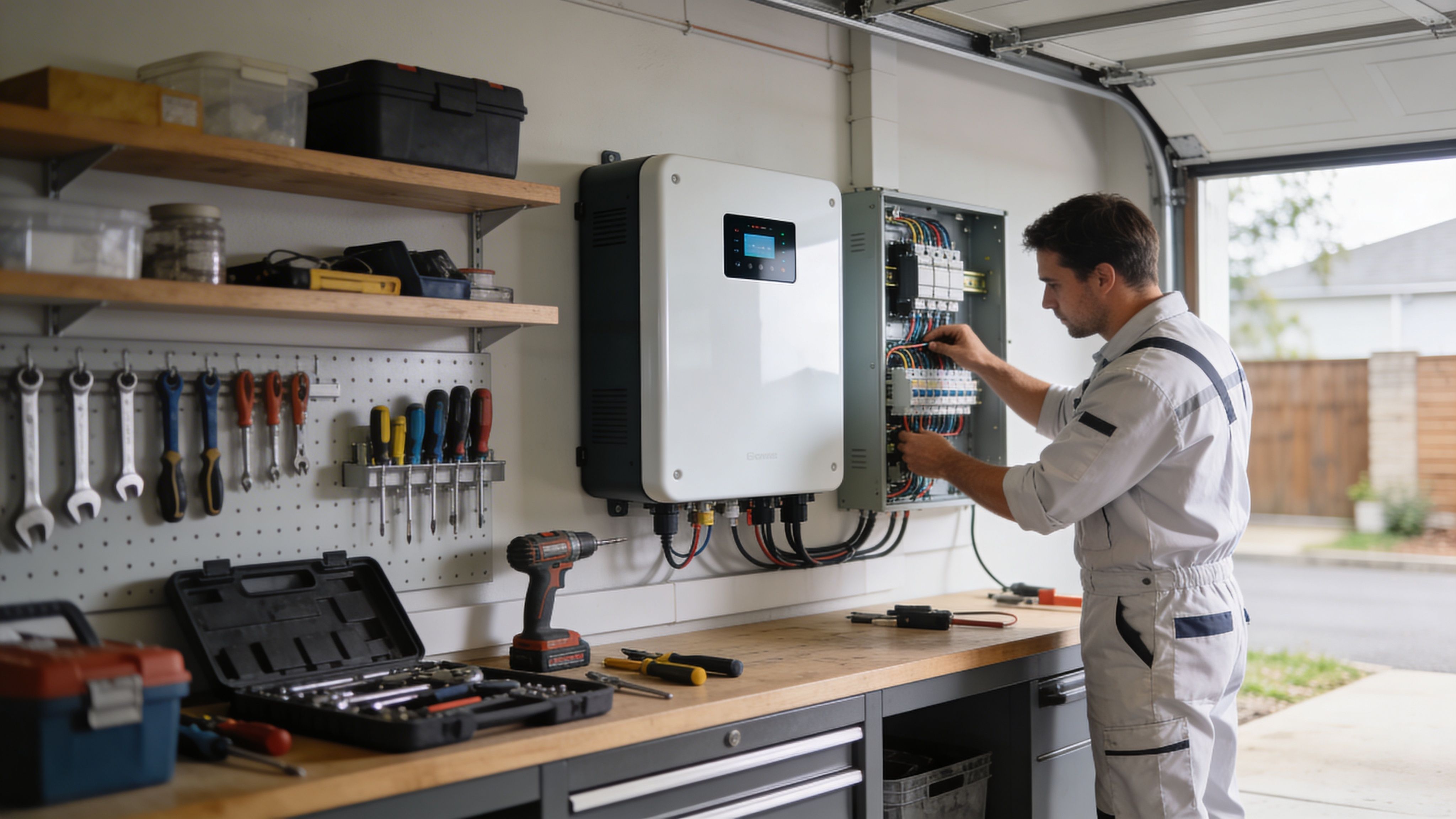
The verified data is blunt on this point. Solar Calculator’s battery storage guidance notes that improper installation by unqualified electricians can void a 10-year warranty, compromise LiFePO4 battery safety, and significantly reduce system performance and lifespan.
That’s not a small technicality. It changes the whole buying decision.
A battery is not a plug-and-play appliance. It’s a permanently integrated electrical system with protection requirements, load management considerations, communication setup, and site-specific compliance rules.
Homeowners often assume “backup” means the whole home runs normally during an outage. In practice, many systems are designed around essential circuits only.
If that distinction isn’t explained clearly at quoting stage, the handover becomes a disappointment.
Older Brisbane homes commonly need switchboard attention before a battery should be added. If the board is crowded, outdated, poorly labelled, or lacking the right protection arrangement, a battery install can become unsafe or unnecessarily messy.
Battery placement affects temperature exposure, service access, protection, and future maintenance. A neat-looking location isn’t automatically a suitable one.
Even when the hardware is fine, poor commissioning can leave the system operating below expectation. Backup reserves, charging behaviour, export logic, and app visibility all need correct setup.
A battery doesn’t fail only when hardware breaks. It also fails when the installation never lets it operate as intended.
If any of these sound familiar, the battery quote should include a proper board assessment:
For homeowners wanting to understand that side of the job, this guide on electrical switchboard upgrades explains what to look for.
A proper install starts before any equipment is mounted.
It should include:
That process is what separates a battery that performs well for years from one that causes ongoing frustration.
Some low-looking quotes stay low by excluding the awkward parts. They price the battery. Then the switchboard work, backup changes, protection devices, or extra labour appear later.
That’s why homeowners should ask direct questions:
One option Brisbane homeowners can consider for this sort of integrated assessment is DLG Electrical, particularly where the job may involve switchboard upgrades, battery integration, and broader residential electrical work.
The strongest battery outcome usually comes from a simple formula. Pick a battery that suits the house. Then make sure the electrical design and installation suit the battery.
If you’re weighing up home battery options for your Brisbane property, the smartest next step is a site-specific assessment, not another generic comparison chart. A licensed electrician can check your switchboard, backup requirements, solar compatibility, and installation constraints before you commit. For that, you can contact DLG Electrical for a quote and practical advice based on how your home is wired.

Master Electrician with over 30 years of experience. Founded DLG Electrical in 2005 after international project work including electrical installations at Stamford Bridge Stadium, London(Home of Chelsea FC).

Local Electricians that can fix all Electric Hot water Systems.
Motion sensor lights are a versatile addition to any home, offering nu
