83 Jean St, Grange QLD 4051
Mon-Fri 07:30 AM - 04:00 PM - Sat - 8:00 - 12 - Sunday Closed
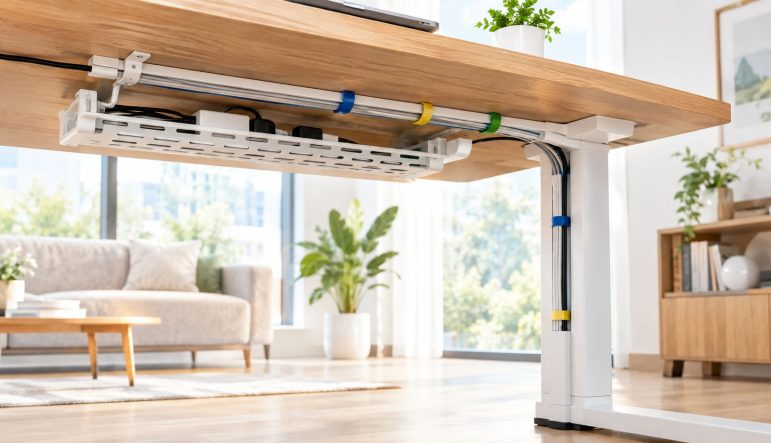
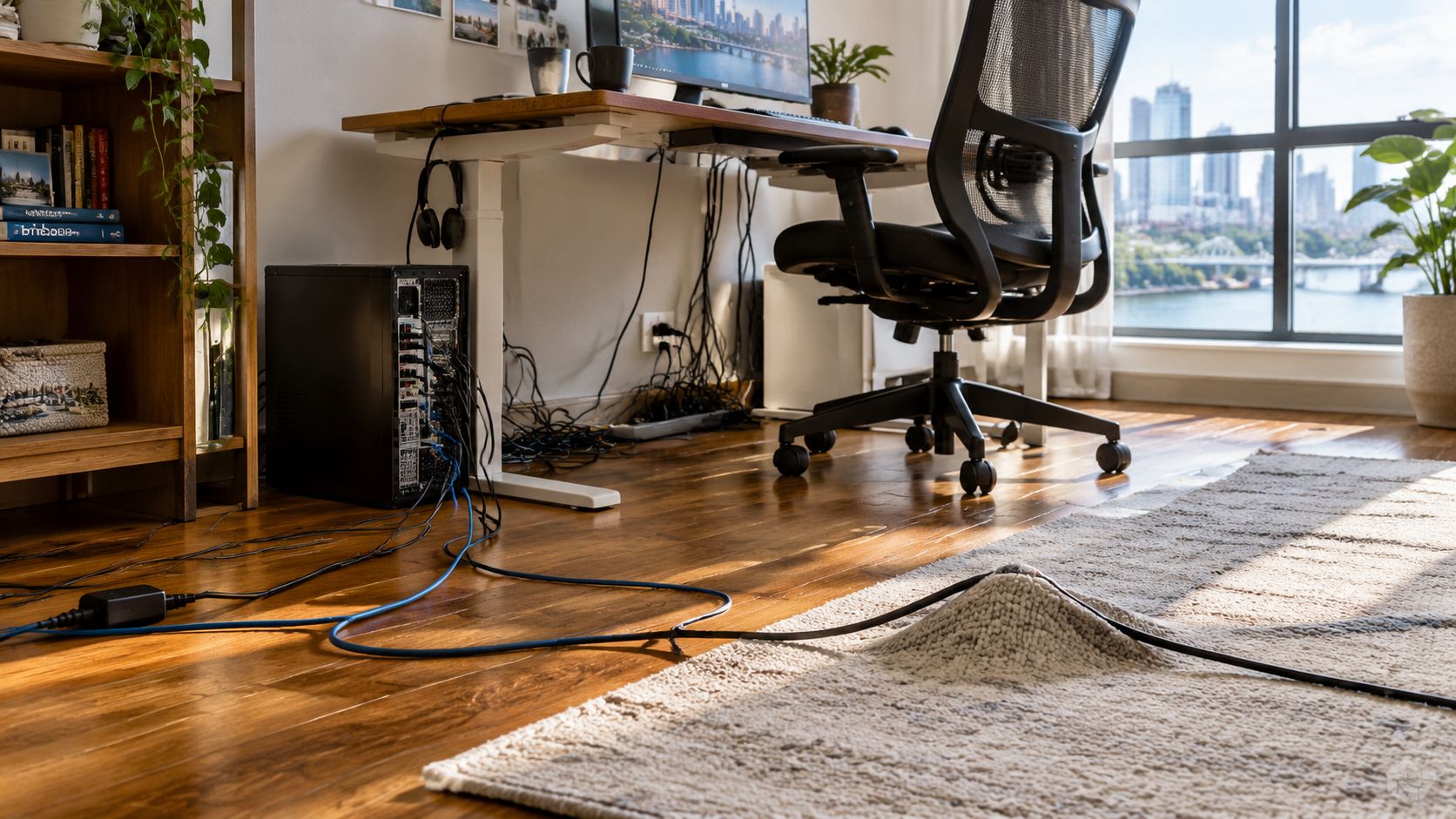
You're halfway through cleaning the Brisbane house when you find them: power leads crossing the floor behind the sofa, network cables bunched under a desk, and an extension lead disappearing beneath a rug. In a small shop, the same problem might sit behind the counter or above a suspended ceiling. Everything works, but the arrangement makes cleaning harder, future repairs slower and the space less safe.
That's where cable management systems earn their keep. They aren't just plastic covers chosen to hide an untidy bundle. A properly planned system creates safe pathways, protects cables from damage, leaves room for maintenance and provides records that another electrician can understand later.
In the sections ahead, you'll see how trunking, conduit, trays, raceways and smaller organising products differ. You'll also learn why pathway sizing, outdoor burial requirements, labelling and cable registers matter just as much as appearance. If you're unsure whether an existing arrangement is safe, an electrical safety inspection can help identify issues before a renovation or new installation makes them harder to correct.
A home office often grows one device at a time. First there's a monitor and computer, then a printer, router, speakers, chargers and perhaps a docking station. Cables multiply behind the desk, power boards sit where dust collects, and a lead may be pushed under a mat because there's no obvious route to the outlet.
The same pattern appears during renovations. A television moves to a different wall, a new internet service arrives, security cameras are added or a home battery system changes how equipment is arranged. If each addition is treated as a separate fix, the result is usually a bundle that works today but becomes difficult to inspect tomorrow.
Good cable management links safety, compliance and presentation rather than treating them as separate jobs. A neat route can reduce snagging and accidental damage, while a serviceable route lets an electrician trace, test or replace a cable without dismantling half the room. The best systems also leave clear evidence of what was installed and where it goes.
Queensland homes and small businesses can include timber framing, masonry walls, roof cavities, garages, outdoor areas and tight service spaces. Each environment changes the sensible choice. A surface raceway may suit a study, while durable conduit may be more appropriate for an exposed garage route or an external run.
Australian installations also sit within a national standards and regulatory framework. Standards Australia's AS 3085.1:2022 information shows how communications cabling guidance has developed through earlier editions, reaffirmations and revision work, while ACMA identifies the wider mix of wiring and cabling requirements that shape the sector.
The practical lesson is simple: cables shouldn't just disappear from view. They should travel through a route that suits the building, the cable type, the environment and the people who'll need to maintain the installation later.
Think of a building as a small city. Roads carry vehicles to homes and businesses, barriers separate traffic from pedestrians, signs identify destinations and access points let workers repair damaged sections. Cable management systems perform a similar job for electrical, data, communications and control cables.
A tray, conduit, trunking section or ceiling pathway forms the route. Clips, brackets and supports keep cables in position. Covers and protective materials shield them from impact, moisture, sharp edges and other hazards. Labels and records tell the next person what each route contains.
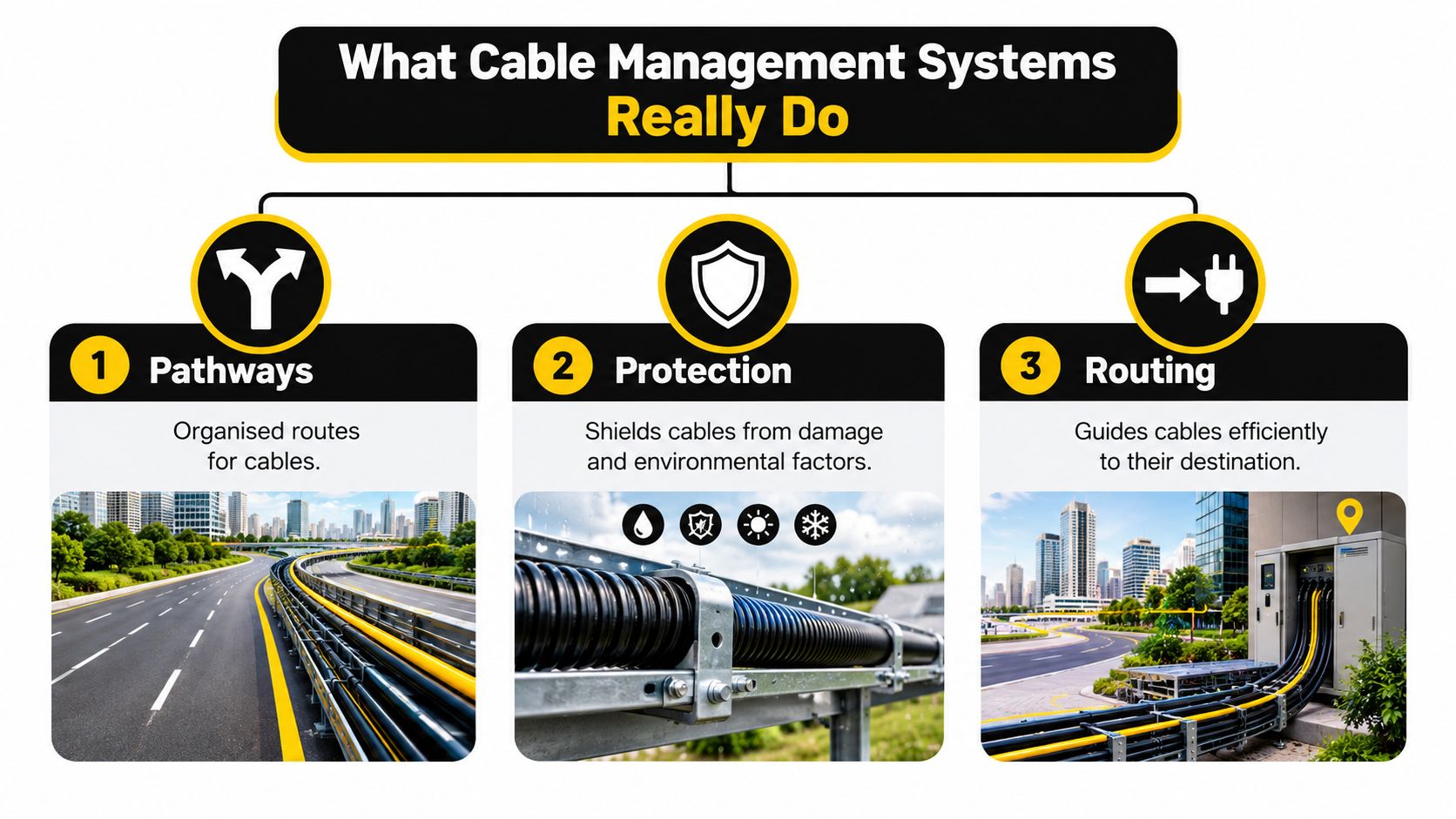
Pathways give cables a controlled route from one point to another. Instead of letting a lead run wherever gravity takes it, the installer plans where it enters a wall, crosses a ceiling, passes through a cabinet or reaches a communications point.
Protection reduces exposure to knocks, abrasion, heat, moisture and accidental pulling. Protection doesn't make an unsuitable cable suitable for every environment, but it can prevent ordinary building activity from damaging a correctly selected installation.
Separation helps keep different services organised. Electrical wiring, communications cabling and other building services may need appropriate spacing, barriers or separate routes. The right arrangement depends on the installation and applicable requirements, so a product label alone isn't enough to make a route compliant.
Access allows future work. A covered trunking system with a removable lid, or a tray that can be reached without destructive work, is generally more useful than a sealed cavity that nobody can inspect.
Practical rule: If a system hides a cable but makes inspection, identification or replacement harder, it may be tidy without being a good lifecycle solution.
Australia's cabling framework has moved beyond just deciding how to administer individual cables. Guidance such as AS/NZS 3084:2017 addresses the physical pathways and spaces that planners, builders, installers and building owners need to consider when accommodating communications infrastructure. That means cable management belongs in building design discussions, not only at the final tidy-up stage.
Cable size matters as well. A pathway must cope with the cables it carries without creating excessive crowding, friction or heat. For a plain-English introduction to the relationship between conductor size, current and installation conditions, see this guide to electrical cable sizing.
For another practical view of how organised routes support security and communications installations, the Securitec Security cable management guide is a useful resource. The important distinction is between cosmetic concealment and an organised system that supports safe access, clear routing and reliable records.
No single product suits every room. A cable sleeve might be perfect behind a desk but unsuitable for a cable route through a roof space. A metal tray may work well in a plant area but look out of place in a living room. Start with the environment and access requirements, then choose the material and finish.
Trunking is a usually rectangular channel with a lid. Surface-mounted plastic trunking can conceal television, data or control cables along a wall and may be available in finishes that blend with the room. It's practical for retrofits because the installer doesn't need to open the wall, but corners, joins and capacity still need careful planning.
Conduit is a round or flexible tube that protects cables along walls, ceilings, slabs and external routes. Rigid conduit offers a firm, durable path, while flexible conduit helps with awkward connections. Conduit can provide strong protection, but bends and fill must be planned so cables can be installed and serviced without excessive pulling force.
Cable tray creates an open support route, commonly using metal or a rigid polymer. It suits garages, plant areas, commercial ceilings, communications rooms and other locations where several cables need a defined path and regular access. Because the cables remain visible, tray installations depend on good routing, support and labelling.
Raceways are enclosed or semi-enclosed channels used to guide and protect surface-mounted cables. In a home office or retail fit-out, a raceway can provide a cleaner alternative to loose leads while preserving access for later changes.
Cable ties, hook-and-loop straps and clips organise smaller bundles. They're useful for fixing a cable to furniture or grouping leads behind equipment, but they aren't a substitute for a properly designed pathway where cables face heat, impact, moisture or building movement.
Underfloor and ceiling systems use existing voids to route services out of sight. These approaches can produce a clean finish, although access panels, penetrations, fire considerations and future identification become especially important.
| System Type | Best For | Aesthetics | Access for Maintenance |
|---|---|---|---|
| Trunking | Surface retrofits, television points and small office routes | Clean when matched to the wall | Good with a removable cover |
| Conduit | Protected wall, ceiling and external routes | Visible unless concealed or colour-matched | Depends on bends, draw points and access |
| Cable tray | Garages, plant areas, communications spaces and commercial fit-outs | Industrial and functional | Very good when reachable |
| Raceway | Desk areas, retail counters and surface-mounted data runs | Neat, with many finish options | Good if the cover can be removed |
| Ties, straps and clips | Short bundles and equipment organisation | Minimal visual improvement on their own | Very good for frequent changes |
| Underfloor or ceiling pathways | Larger building routes and concealed services | Highly discreet | Variable, based on access panels and records |
A home internet problem also shows why routing and service selection shouldn't be confused. If Wi-Fi struggles in a particular room, a wired connection may help, but the route still needs to be protected and secured properly. This guide to using an extension cable for internet offers useful background on wired alternatives and their practical limitations.
Cable management earns its place through everyday outcomes. A loose cable across a walkway can catch a foot, pull equipment from a desk or become a tempting chew point for a pet. Bundles pressed beneath rugs can also be difficult to inspect and may be exposed to heat, crushing or wear.
Organised routes make cleaning simpler because fewer leads sit on the floor. They also make it easier to see damaged insulation, loose plugs, water exposure or an overloaded connection before those issues become more serious.
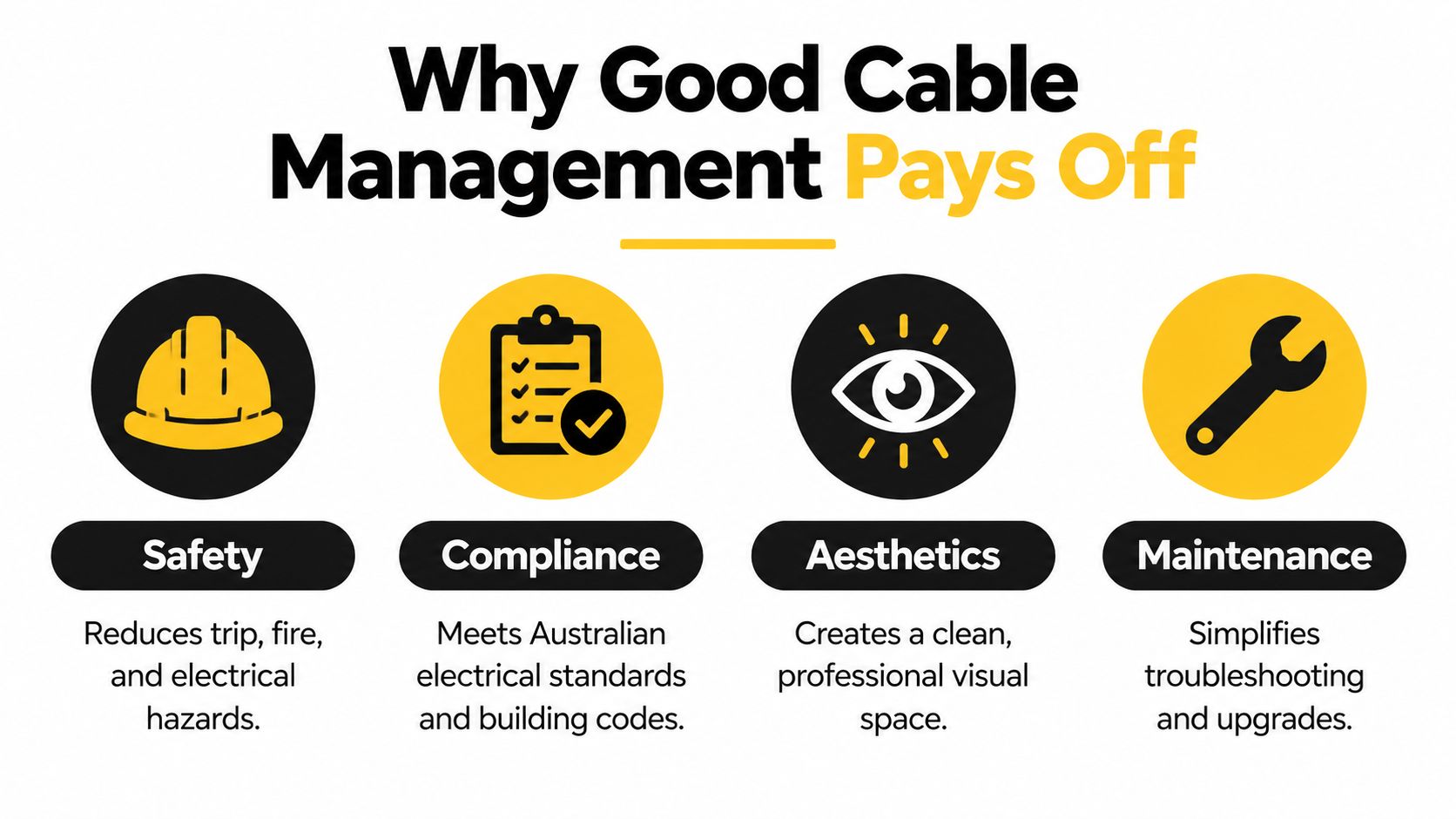
A tidy cable route can reduce trip and snag hazards, but appearance shouldn't drive unsafe shortcuts. Cables still need appropriate protection, support, separation and termination. A neat bundle held tightly against a sharp edge is still a poor installation.
Safety first: Never use tidiness as proof that an electrical installation is safe.
Pathway capacity is another safety and serviceability issue. The guidance summarised by AIMS Industrial explains that AS/NZS 3000 conduit fill limits restrict conduit fill to 40% when three or more cables are installed, leaving at least 60% empty under that condition. The empty space helps reduce crowding and supports easier pulling, replacement and fault-finding.
A compliant system gives an owner something more valuable than a clean photograph. It provides a route that can be checked, a layout that can be understood and, where required, records that support handover and maintenance.
Good presentation still matters. A concealed or colour-matched route can make a living room calmer, a reception area more professional and a home office easier to use. The difference is that aesthetics become the final layer, not the only objective.
When cables have identifiers, logical routes and accessible pathways, an electrician can narrow down a fault without disturbing unrelated services. Future additions can also be planned around the existing route instead of being draped across the nearest floor.
That matters during NBN work, office changes, rental inspections and renovations. The property owner gets a system that can evolve rather than a collection of temporary fixes.
Start with the job the route must perform, not the product displayed on a shelf. A cable management system for a single television may be simple, while a mixed-use building with electrical, data, security and communications services needs a documented pathway strategy.
Count what exists now, then allow space for realistic additions. Include power leads, data cables, coaxial cables, control wiring and any equipment likely to be installed during the next renovation. Don't size a conduit or trunking section so tightly that the first upgrade forces a complete replacement.
The Australian guidance on conduit fill is a useful reminder that spare room has a practical purpose. Overfilled pathways increase friction during installation and make later work more difficult, so a designer should consider usable capacity rather than treating the maximum as the target.
Indoor living areas prioritise discreet finishes and easy access. Garages may need stronger protection from impact, dust and tools. Roof spaces bring heat, restricted movement and difficult access. Outdoor and underground routes add moisture, excavation and mechanical damage to the list of concerns.
Queensland underground work needs particular care. The Queensland electrical safety code of practice specifies underground cable cover of at least 750 mm beneath roadways and 600 mm beneath other ground surfaces, with additional mechanical protection where those depths can't be achieved. That requirement can affect trench planning, service separation, duct selection and future access.
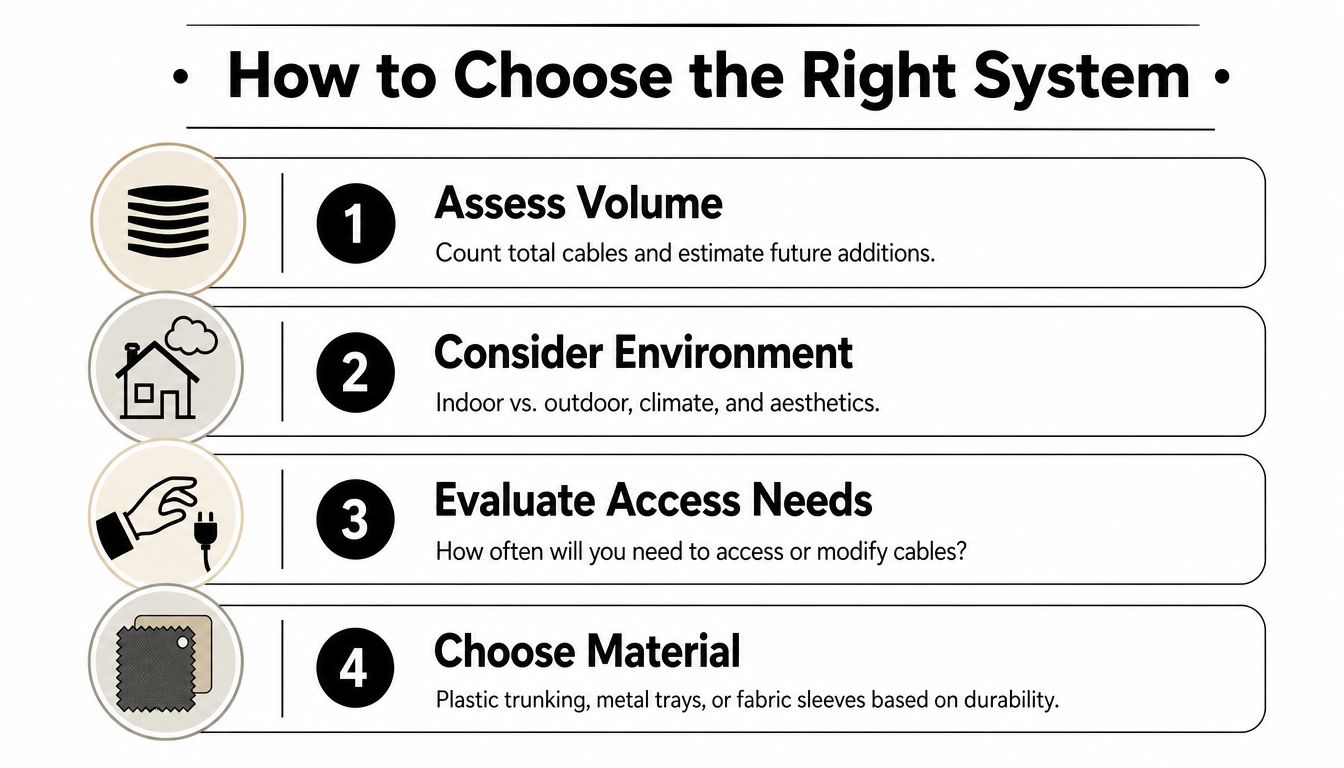
Finally, decide how much access you'll need. A fixed, concealed route suits a stable installation, while a removable cover, tray or accessible ceiling pathway is better where equipment changes regularly. The cheapest product isn't necessarily the lowest-cost system if it must be removed and rebuilt during the next upgrade.
There's a sensible boundary between organising existing leads and carrying out electrical work. A homeowner can often use a suitable cable clip, hook-and-loop strap or surface raceway to tidy low-voltage equipment leads, provided the work doesn't damage the cable or create a hazard. Even then, avoid pinching cables, drilling into hidden services or placing leads where they'll be walked on.
New circuits, switchboard connections, fixed wiring, concealed cable runs and changes to electrical outlets belong with a licensed electrician. The same applies when a route passes through building elements, enters an outdoor area or connects equipment that forms part of the electrical installation. A professional can assess the cable type, isolation requirements, route, support, protection and testing obligations together.
A competent installer normally begins by identifying each service and its destination. They'll assess the building structure, inspect likely access points, plan separation from other services, select suitable containment and allow for future work. The finished route should be secure, accessible where required and documented clearly enough for later maintenance.
External projects need extra planning. Underground routes can cross driveways, gardens, stormwater lines, gas services and telecommunications infrastructure. In Queensland, required cover and mechanical protection can't be treated as an afterthought. A shallow trench or poorly protected duct can create a serious risk during future digging and may fail inspection requirements.
Call an electrician if you're unsure whether a cable is electrical or communications, if the route enters a wall or ceiling, if you need a new outlet or circuit, or if an existing cable appears damaged. Don't rely on a cable tie or decorative cover to solve overheating, exposed conductors, water ingress or overloaded power equipment.
For Brisbane homeowners arranging upgrades, repairs or inspections, this guide to an electrician in Brisbane provides useful context on choosing local professional help. A licensed installation protects safety and gives you clearer evidence of what was done, which can matter for future repairs, insurance discussions and property handover.
Cable management costs vary with route length, access, containment material, surface finishes, testing, documentation and whether walls, ceilings or ground need to be opened. A short surface raceway behind a desk is a different job from a multi-room communications pathway or an underground route across a driveway. Ask for an itemised quote that separates materials, labour, testing and any remedial building work.
Maintenance starts with records. Australia's communications infrastructure guidance calls for a cable register containing each cable's identifier, colour, classification, source, destination, location and seal numbers. It also specifies building management cables labelled black on yellow at five-metre intervals, as described in the Australian Signals Directorate communications infrastructure guidance.
Keep the register updated after every alteration. Photograph concealed routes before closing walls, label both ends where practical, keep access covers clear and arrange inspections if cables have been exposed to heat, water, building work or physical impact. In a strata or commercial property, include the records in the handover pack so the next manager isn't left guessing.
For Brisbane homes and small businesses, the strongest approach is straightforward: plan the route, leave useful capacity, protect the cables for their environment, label what you install and have licensed work completed by a qualified electrician.
DLG Electrical provides licensed and insured cable management, electrical installation and maintenance services for homes and small businesses across Brisbane, including North Brisbane, Grange and Windsor. Visit DLG Electrical to request a free quote and discuss a practical, compliant route that suits your property and future needs.

Master Electrician with over 30 years of experience. Founded DLG Electrical in 2005 after international project work including electrical installations at Stamford Bridge Stadium, London(Home of Chelsea FC).

Local Electricians that can fix all Electric Hot water Systems.
Motion sensor lights are a versatile addition to any home, offering nu
