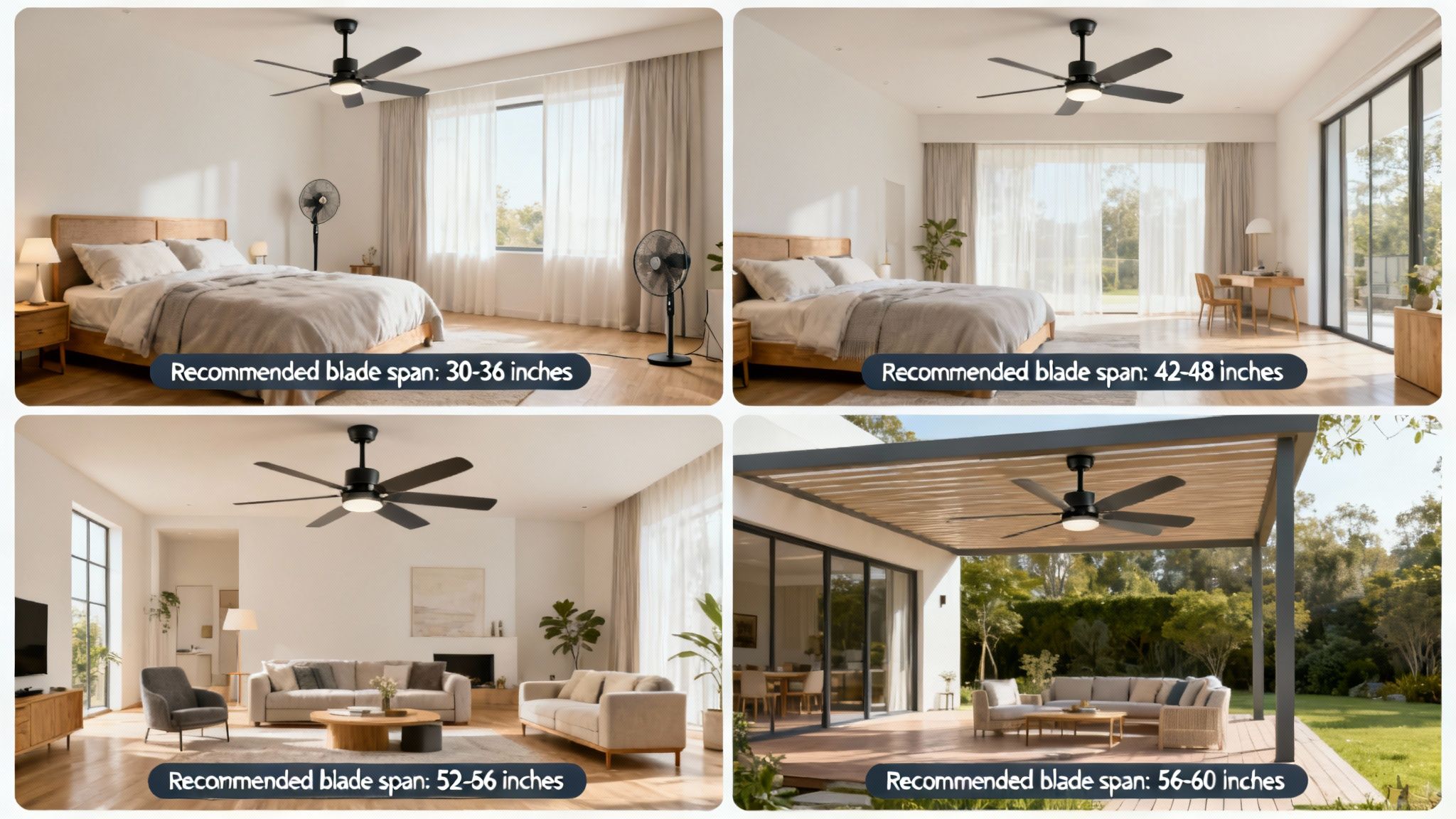
Struggling to figure out what size ceiling fan you need? It’s a common stumbling block, but getting it right is crucial. The whole point is to match the fan’s blade span—the full diameter from tip to tip—to your room’s dimensions.
Go too small, and you’ll barely feel a whisper of air movement. Go too big, and you’ll create an annoying, disruptive wind tunnel instead of a gentle breeze.
Find Your Fan Size in Seconds
If you’re after a quick, no-fuss answer, you’ve come to the right place. We’ve put together a simple guide to help you pick the perfect fan without getting bogged down in technical details. Think of it as your cheat sheet to achieving that sweet spot of balanced airflow and great looks.
This handy reference chart lines up common Aussie room sizes with the ideal fan blade span.
Your Ultimate Ceiling Fan Size Guide 4
As you can see, it’s pretty logical: smaller rooms need smaller fans, while larger living areas need a wider blade span to move air effectively.
Getting the sizing right is a game-changer for both comfort and energy efficiency here in Australia. For example, a small bedroom around 2.8m x 2.5m feels best with a 44” to 48” fan. On the other hand, a standard living room usually needs something in the 48” to 56” range to do the job properly.
If you want to dive deeper, you can discover more insights about choosing the right fan for the Australian climate in this excellent guide.
Quick Guide to Fan Size by Room Dimensions
To make things even easier, here’s a table that breaks it down for you. Just find your room’s general size to see our recommendation.
Room Dimensions (m)
Recommended Blade Span (inches)
Room Type
Up to 3.0m x 3.0m
42″ – 48″
Small Bedroom, Study, Kitchenette
Up to 4.0m x 4.0m
48″ – 52″
Standard Bedroom, Dining Room, Small Lounge
Up to 5.0m x 5.0m
52″ – 56″
Master Bedroom, Living Room, Large Kitchen
Above 5.0m x 5.0m
56″ – 72″
Open-Plan Living, Large Alfresco, Great Room
Remember, this is a starting point. Ceiling height and room shape can also play a part, but this table will get you headed in the right direction for most standard Aussie homes.
Why the Right Fan Size Matters
Picking a ceiling fan isn’t just about finding a style you like; it’s about engineering comfort into your home. The right size fan is a quiet hero, working efficiently behind the scenes to circulate air and make your space feel just right. It’s the difference between a gentle, consistent breeze and a noisy machine that just spins its blades without doing much at all.
Think of it like choosing an engine for a car. A tiny motor in a big ute is going to struggle, burn way too much fuel, and never really get the job done properly. In the same way, a small fan in a large living room will be forced to run on its highest setting, guzzling energy without ever creating that cooling effect you’re after. It simply can’t move enough air to make a difference.
Performance and Efficiency
On the flip side, a fan that’s too large for a space can be just as much of a problem. An oversized fan can create an unpleasant wind tunnel, making the room feel drafty and uncomfortable rather than refreshing. It can also lead to that annoying wobble you sometimes see, as the powerful motor and long blades might not be properly supported for the room’s smaller scale.
The goal is to find that sweet spot: optimal airflow without wasted energy. A correctly sized fan moves air efficiently, creating a wind-chill effect that lets you nudge your air conditioner’s thermostat up a few degrees. This simple adjustment can lead to real savings on your cooling bills throughout the year.
This perfect balance of performance and savings is a big reason why ceiling fans are becoming more popular across the country. In fact, the Australian ceiling fan market has hit USD 397.88 million and is expected to keep growing. This trend really highlights the smart economics of using fans to cut down on cooling costs—a clever move for any homeowner.
The Impact on Your Home
Beyond just moving air, getting the fan size right affects the entire feel and safety of your room.
Aesthetic Balance: A fan should look like it belongs. One that’s too small can look a bit lost and silly, while one that’s too large can completely dominate the space and feel overwhelming.
Quiet Operation: Properly sized fans run more smoothly and quietly. They aren’t overworked or creating a heap of air turbulence, so you get the breeze without the buzz.
Safety and Clearance: A fan needs enough space to operate safely. It must have adequate clearance from walls, furniture, and people to be effective and avoid any accidents.
For a deeper dive into how proper sizing impacts your fan’s performance and energy use, this detailed article on Choosing the Right Ceiling Fan Size for Maximum Efficiency is a great resource.
Ultimately, taking a few minutes to select the correct size ensures your fan becomes a valuable asset, enhancing both the comfort and the design of your home.
How to Measure Your Room for the Perfect Fit
Choosing the right ceiling fan is a lot like buying a new pair of shoes. Get the fit right, and you’re guaranteed comfort and performance. But get it wrong, and you’re in for nothing but trouble. Translating your room’s dimensions into the perfect fan size is a simple process that helps you avoid common mistakes, like an undersized fan that barely moves the air or an oversized one that creates an unwelcome wind tunnel.
Let’s walk through the simple steps to get it right.
Calculating Your Room’s Square Meterage
First things first, you need to figure out the total area of your space. Don’t worry, this isn’t complicated – all you need is a tape measure.
Measure the Length: Run your tape measure along the longest wall in the room. Jot this measurement down in metres.
Measure the Width: Next, do the same for the width of the room, from one wall to the other. Write this number down, too.
Now for the easy part: multiply the length by the width. The answer is your room’s total area in square metres (m²). For example, if your room is 4 metres long and 3 metres wide, you have a total area of 12 m².
This one number is the most important piece of the puzzle. It’s the foundation for making a smart, informed decision.
This infographic shows just how getting the fan size right translates into real benefits for your home.
Your Ultimate Ceiling Fan Size Guide 5
As you can see, the correct fit directly leads to better comfort, more efficient performance, and ultimately, savings on your power bills.
Don’t Forget About Clearance Rules
Beyond your room’s floor area, safety clearances are completely non-negotiable. Australian homes have specific legal requirements you must follow to make sure your fan operates safely and effectively. The most critical rule is that fan blades must be installed at least 2.1 metres above the floor.
This clearance isn’t just about safety to prevent anyone from accidentally hitting the blades. It’s also crucial for performance. A fan that’s hung too low can create choppy, uncomfortable airflow instead of that smooth, circulating breeze you’re after.
When you’re choosing your fan, it’s essential to factor in both your room’s dimensions and these safety standards. For instance, a 52-inch fan is a popular choice for average-sized bedrooms, while larger living areas might need a fan up to 60 inches to move enough air.
The simple act of measuring carefully sets you up for the best results, whether it’s for fans or other home fixtures. For example, getting precise measurements is just as important when you need to know how to accurately measure for blinds.
By taking a few minutes to get these simple measurements, you’re setting yourself up for success. You’ll end up with a fan that not only looks great but also delivers the perfect amount of airflow to keep your space comfortable all year round.
Positioning Your Fan for Maximum Airflow
Choosing the right fan size is only half the battle. Where you decide to hang it is just as crucial for getting that perfect breeze. The best way to think about it is to picture your ceiling fan as the sun in a mini solar system. Placing it right in the centre of the room ensures its “rays” of airflow reach every corner evenly for balanced, consistent circulation.
This central spot is the gold standard for most standard square or rectangular rooms. It’s the simplest way to prevent those awkward dead spots where the air feels stuffy and stagnant, making sure everyone in the room feels the benefit. Before you drill any holes, take a moment to find the true centre of your ceiling.
Handling Standard and High Ceilings
For standard Aussie ceiling heights of around 2.4 metres, a flush-mount or “hugger” style fan is usually your best bet. These models sit close to the ceiling, giving you plenty of airflow while maintaining the required safety clearance.
But when you’re dealing with higher or vaulted ceilings, the game changes completely.
A common mistake is hanging a fan way too high. If it’s too far up, the breeze will completely dissipate long before it ever reaches you, rendering the fan pretty much useless. The solution here is a downrod—an extension pipe that lowers the fan to an optimal height.
The sweet spot for a ceiling fan is between 2.4 and 2.7 metres from the floor. This position is low enough to create a noticeable breeze but high enough to circulate air effectively throughout the entire room.
As a rule of thumb, for every metre of ceiling height you have above 2.7 metres, you’ll want to add about 30 centimetres to your downrod length. This simple calculation gets your fan positioned perfectly for maximum airflow and comfort.
Solutions for Tricky Layouts
So, what do you do when your room isn’t a simple square? For those long, narrow rooms or large, L-shaped living areas, a single fan plonked in the middle might not cut it. Instead of trying to find one enormous fan, you’ll often get much better results by installing two smaller fans.
The trick is to mentally divide the room into two separate, squarish zones and then place a fan in the centre of each one.
Here’s how to space them out for the best performance:
Distance From Walls: Make sure the tips of the blades are at least 45 centimetres away from any wall or obstruction. Any closer and the airflow will get chopped up and inefficient.
Spacing Between Fans: The distance between the centres of two fans should be roughly double the blade span of one fan. This stops them from competing for air. For example, if you have two 132 cm (52-inch) fans, you’ll want to space them about 2.6 metres apart.
This multi-fan strategy is the key to achieving even air distribution across complex spaces, eliminating dead spots and keeping the entire area comfortable.
Matching Your Fan to Your Home’s Style
Once you’ve nailed the technical stuff like size and placement, it’s time for the fun part—choosing a fan that actually looks good in your home. A ceiling fan shouldn’t just be an appliance you stick on the ceiling; it’s a major design feature that can either pull the whole room together or stick out like a sore thumb.
Think of your fan as a piece of functional art. It hangs right in the centre of the room, so its style sets a powerful tone. Are you going for a breezy, coastal vibe or something more sharp and industrial? The materials you choose will make all the difference.
Choosing Your Materials and Finish
The fan’s material and finish can completely change the feel of a space. Each option has its own personality and works best with certain design styles.
Classic Timber Blades: These are perfect for creating a warm, natural, and inviting atmosphere. Timber works beautifully with everything from traditional and rustic homes to relaxed coastal decors.
Sleek Metal Blades: A go-to for modern, industrial, or minimalist spaces. Finishes like brushed nickel, matte black, or chrome add a clean, sophisticated edge.
Contemporary ABS Plastic: This is a surprisingly versatile and durable choice, often shaped into clean, aerodynamic designs. They’re a breeze to clean and fit perfectly in contemporary homes.
But it’s not just about the blades. The finish on the fan’s motor housing is just as important. For a really polished look, try matching the fan’s metallic finish to other hardware in the room—things like your door handles, tapware, or window frames. It’s a small detail, but it makes the design feel intentional and harmonious.
A well-chosen ceiling fan does more than just move air; it reinforces your home’s unique style. It should feel like an integrated part of the decor, not a mechanical appliance that was simply added on.
To Light or Not to Light
Another big decision is whether to get a fan with a built-in light. This usually comes down to the lighting you already have in the room.
A fan with an integrated light is a brilliant two-in-one solution for bedrooms or living areas where it will be the main overhead light source. It keeps the ceiling looking uncluttered and makes the installation process a bit simpler.
On the other hand, if your room is already well-lit with downlights or lamps, a fan without a light can offer a cleaner, more minimalist aesthetic. If you’re weighing up how to layer your lighting, you might find some helpful ceiling light ideas for bedrooms to guide your decision.
Ultimately, the goal is to find a fan that’s both a hardworking appliance and a beautiful design feature that completes your space.
Putting It All Into Practice: Real-World Scenarios
Theory is one thing, but seeing it in action is where the real understanding kicks in. Let’s walk through some common Aussie home scenarios to show you how these principles come together.
We’ll break down the perfect ceiling fan solution for four distinct spaces, from a snug guest room to a sprawling alfresco area. Think of this as a practical blueprint you can adapt for your own home.
Your Ultimate Ceiling Fan Size Guide 6
These case studies will help you visualise how room size, ceiling height, and layout all influence your final choice.
Case Study 1: The Cosy Guest Bedroom
First up, the classic spare bedroom. It’s a space that needs to feel comfortable and inviting, but these rooms are often on the smaller side. The right fan choice here is crucial for both airflow and visual balance.
Room Dimensions: 3.0m x 3.5m (10.5 m²)
Ceiling Height: 2.4m (Standard)
In a room this size, a big fan would feel totally overpowering and just churn the air too aggressively. We need to aim for the smaller end of the spectrum.
A fan with a blade span between 44 to 48 inches is the perfect match. It’s large enough to move air across the whole room but small enough that it won’t dominate the space.
With a standard 2.4m ceiling, a flush-mount or “hugger” fan is a must. This keeps the fan tight to the ceiling, ensuring you meet that crucial 2.1m safety clearance from the floor while still getting great airflow.
Case Study 2: The Spacious Master Suite
Next, let’s tackle a modern master bedroom. These rooms are usually larger and might have higher ceilings or tricky features like a walk-in robe entrance that can mess with air circulation.
Room Dimensions: 4.5m x 5.0m (22.5 m²)
Ceiling Height: 2.7m
This larger square meterage needs a fan with a bit more muscle and a wider reach to make sure you feel a consistent, gentle breeze everywhere in the room.
Recommended Fan Size: A 52 to 56-inch blade span is ideal here. This size has the grunt to move a much greater volume of air, which is exactly what a room of this scale needs.
Mounting Solution: With a 2.7m ceiling, you’ve got the headroom to use a short downrod (around 15cm). This little extension drops the fan into the sweet spot for air circulation, making it way more efficient than a flush-mounted fan would be at this height.
Case Study 3: The Big Open-Plan Living Area
Everyone loves open-plan living, but it throws a real spanner in the works for air circulation. A single, central fan almost never cuts it for a large, L-shaped area that combines your lounge, dining, and kitchen.
Room Dimensions: 6.0m x 9.0m (L-shaped, 54 m²)
Ceiling Height: 2.5m
For a big, complex layout like this, a multi-fan strategy is far more effective than trying to find one giant fan to do all the work. The goal is to create distinct zones of airflow.
Zone Your Space: First, mentally slice the area into two squarer sections. In this case, we can create a “living zone” and a “dining/kitchen zone.”
Select Two Fans: Now, install one 52-inch fan in the centre of each zone. Using two medium-sized fans gives you much better and more consistent coverage than a single oversized one.
Position Them Right: Make sure each fan is placed centrally in its zone and that there’s enough space between them to stop the airflows from fighting each other and creating turbulence.
Case Study 4: The Covered Outdoor Alfresco
An outdoor entertaining area needs a fan that can create a serious breeze—not just to keep you cool on a hot arvo, but also to help keep the mozzies away. These spaces also have special safety rules.
Area Dimensions: 4.0m x 6.0m (24 m²)
Ceiling Height: 2.8m
Because this space is exposed to the elements, your first priority has to be choosing a fan with the correct weather rating.
For a covered patio, you must use a fan that is at least “damp-rated”. If there’s any chance it might get hit with rain, you’ll need a fully “wet-rated” model. These are built to handle moisture and humidity without rusting up or failing.
Size-wise, go for a powerful 56 to 60-inch fan. You need that extra oomph to generate enough airflow in an open-air environment. It’s a similar principle to bathrooms, where moisture is a key concern and choosing the right type of fan is critical for safety and longevity. You can find out more about selecting fans for these tricky spots in our detailed guide on bathroom ceiling fans.
Got Questions About Your New Ceiling Fan?
Even after you’ve measured your room, a few questions might still be swirling around. That’s perfectly normal. Let’s walk through some of the most common queries we hear from homeowners to make sure you’re completely confident in your choice.
What’s the Minimum Ceiling Height for a Fan?
Safety is always the top priority, and Australian regulations are crystal clear on this one. To prevent any nasty bumps or accidents, the blades of your ceiling fan must be installed at least 2.1 metres from the floor. This clearance gives even the tallest person in your family plenty of room to walk underneath safely.
If your ceilings are higher than the standard 2.4 metres, you’ll definitely want to look at getting a downrod. This is just an extension pole that lowers the fan into the sweet spot for air circulation—ideally between 2.4 and 2.7 metres from the floor—making it much more effective at moving air where you can feel it.
Do More Blades Mean More Airflow?
This is a classic myth! It feels like it should be true, but more blades don’t automatically mean a bigger breeze. The real heroes of airflow are the fan’s motor and the pitch (or angle) of its blades. A powerful motor and a well-designed blade angle will move air far more effectively than just adding more blades.
A fan’s main job is to shift air, and a simple three-blade design is often the most efficient at doing just that. However, fans with more blades can run a bit quieter, which is why they’re often a popular pick for bedrooms or quiet studies where peace and quiet is key.
Can I Put a Big Fan in a Small Room?
You could, but we wouldn’t recommend it. While it might seem like a shortcut to maximum cooling, an oversized fan in a small space can create an overpowering, choppy airflow. Instead of a gentle breeze, you’ll feel like you’re in a wind tunnel.
Aesthetically, it can also throw the room’s proportions off, making the space feel cramped and unbalanced. It’s always best to stick to the recommended blade span for your room size to get that perfect blend of performance and style.
Do Ceiling Fans Actually Cool a Room Down?
This is a great question. Technically, no—a ceiling fan doesn’t lower the room’s temperature like an air conditioner does. What it does do is create a wind-chill effect on your skin, which makes you feel cooler and more comfortable.
By using a fan, you can often turn your air conditioner’s thermostat up a few degrees without even noticing the difference in comfort. This simple trick can lead to some serious savings on your power bills, especially during those long, hot Aussie summers. The fan’s motor type also makes a big difference in running costs; you can dive deeper into that by comparing DC fans vs AC fans.
For a professional and safe ceiling fan installation that’s perfectly suited to your home, trust the experienced team at DLG Electrical. Visit us at https://dlgelectrical.com.au to get your free quote today.
David Gilmour
Master Electrician with over 30 years of experience. Founded DLG Electrical in 2005 after international project work including electrical installations at Stamford Bridge Stadium, London(Home of Chelsea FC).