83 Jean St, Grange QLD 4051
Mon-Fri 07:30 AM - 04:00 PM - Sat - 8:00 - 12 - Sunday Closed
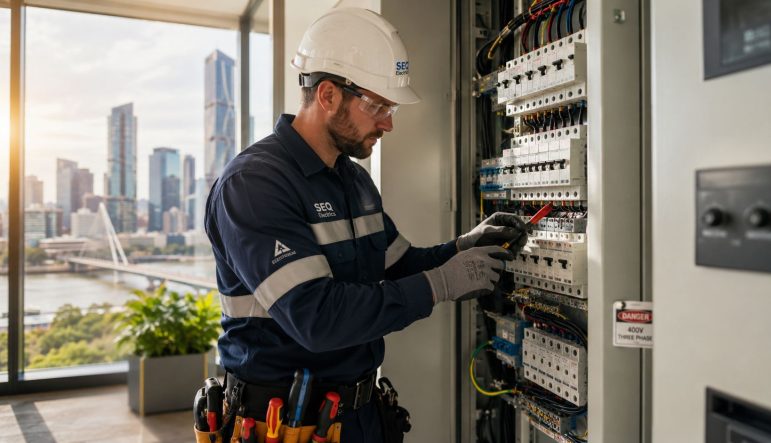
You're probably dealing with one of three situations right now. A shop fit-out is underway and the builder wants electrical decisions signed off fast. An office upgrade has exposed an ageing switchboard, patchy emergency lighting, or data cabling that no longer suits how your team works. Or you manage a rental or mixed-use property and need to know whether the current setup is compliant, not just “working”.
That's where choosing the right commercial electrical contractor matters. Commercial work in Brisbane isn't just bigger residential work. It carries different load demands, different documentation requirements, different safety obligations, and a much higher cost if the job is done wrong. Lost trading hours, failed inspections, tenant complaints, call-backs, and avoidable rework all start with the same mistake: hiring for price alone instead of suitability.
A lot of electrical advice online assumes you're building a warehouse, working on major infrastructure, or managing a heavy industrial site. That leaves a gap for the Brisbane business owner who needs a retail tenancy wired properly, an office upgrade signed off, or a hospitality venue kept safe and operational.
That gap is real. In Queensland, 68% of commercial electrical inquiries relate to non-industrial projects like retail fit-outs and office upgrades that need specific guidance on switchboards, smoke detectors, and security systems, according to IBISWorld industry data on electrical services businesses.
A suburban office, medical suite, café, showroom, or rental property often sits in an awkward middle ground. It's too complex for a basic domestic approach, but too small to attract advice written for large industrial projects.
That's where owners get caught. The project looks straightforward on paper, but the real questions are practical:
Small commercial sites often fail for ordinary reasons. A rushed fit-out, undocumented changes, and a contractor who treats the job like a house instead of a business premises.
Commercial work in Brisbane also has a local operating reality. Access windows are tight. Tenants need to stay open. Shopping strips and mixed-use buildings don't give you endless shutdown time. A specialist commercial electrician plans around business continuity, not just installation.
What works in practice is a contractor who can look at the site and think beyond the cable run. They should understand tenancy turnover, landlord obligations, after-hours scheduling, emergency faults, and how to stage upgrades so your business can keep moving.
What doesn't work is generic advice, generic quoting, and generic workmanship. In commercial settings, those shortcuts surface later as delays, defects, or compliance headaches.
A house and a business may both need lighting, power, safety switches, and repairs. That doesn't make the work interchangeable. The difference is in the system design, the power demand, the fault risk, and the consequences of getting it wrong.
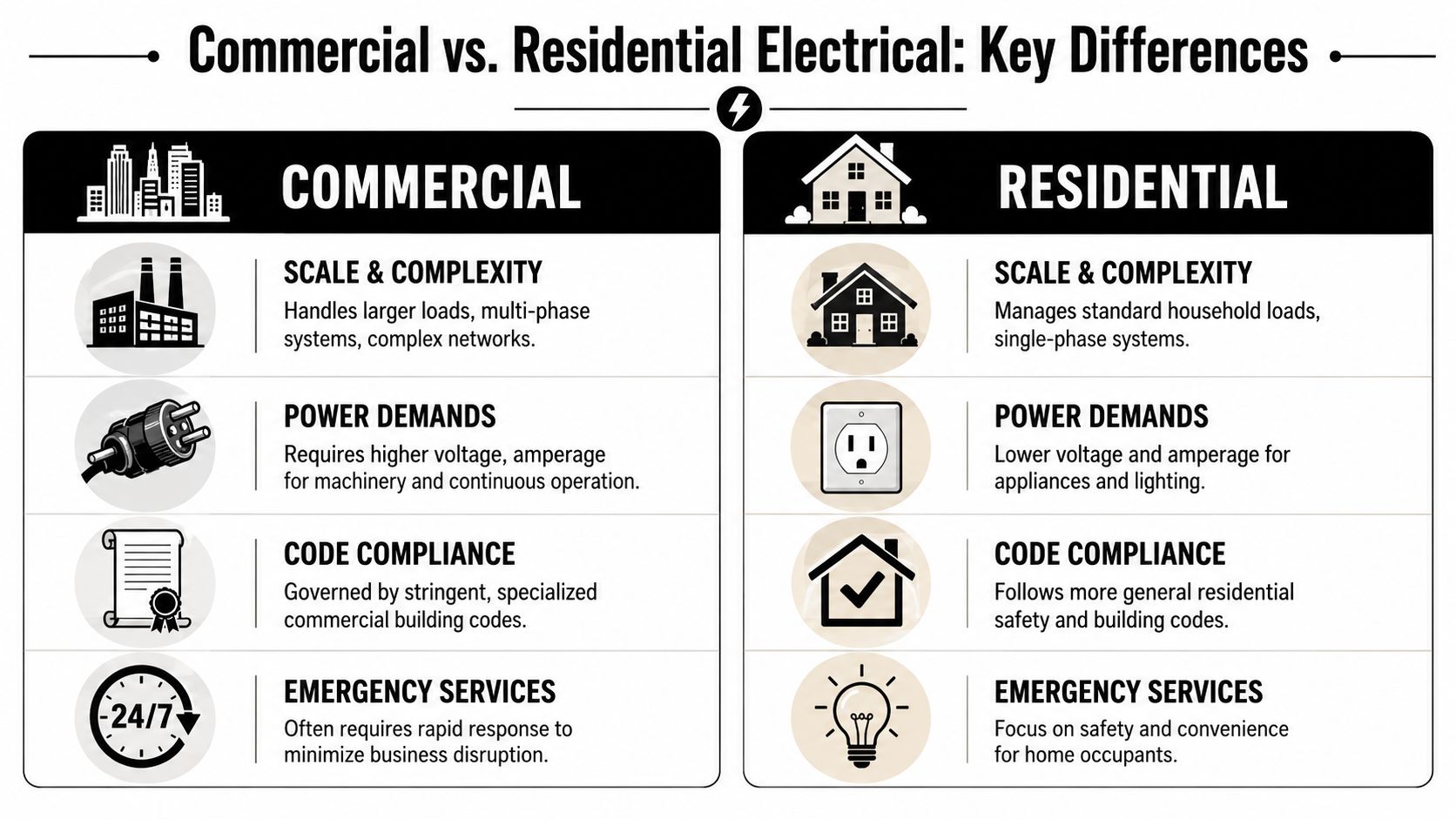
Residential electrical systems are usually designed around everyday household loads. Commercial systems often need to support longer operating hours, heavier equipment, more circuits, more users, and a wider mix of services in one building.
That changes everything from switchboard layout to cable selection to protective devices.
A common dividing line is three-phase power. Many commercial premises need it for larger air conditioning systems, plant, kitchen equipment, workshop gear, lifts, or machinery. If you're not sure where that fits into your premises, this guide to three-phase power installation for Brisbane properties gives a useful practical overview.
| Area | Commercial | Residential |
|---|---|---|
| Load profile | Higher and more varied, often across longer operating hours | Lower and more predictable |
| Power setup | May involve three-phase supply and more complex distribution | Usually simpler single-phase arrangements |
| Fit-out needs | Lighting, power, emergency systems, data, security, tenancy-specific requirements | Standard lighting, GPOs, appliances, household circuits |
| Downtime impact | Can interrupt trade, staff productivity, tenant use, and compliance | Usually affects household convenience and safety |
| Documentation | Greater need for records, testing, verification, and coordination | Important, but usually less layered |
A residential electrician can be excellent at home rewires, switchboard replacements, and fault finding in houses. That still doesn't mean they're the right person for a commercial tenancy.
Commercial jobs often involve:
Practical rule: If your electrician talks only about wiring and price, but not operations, shutdown windows, testing, or documentation, they're probably approaching a commercial job the wrong way.
The biggest mistake business owners make is assuming “licensed electrician” means “right for any electrical environment”. Licensing matters. Specialisation matters just as much.
A good commercial contractor doesn't just install gear. They solve operational problems before those problems interrupt trade. In Brisbane, the most useful services are the ones that reduce downtime, remove compliance uncertainty, and leave the site easier to maintain.
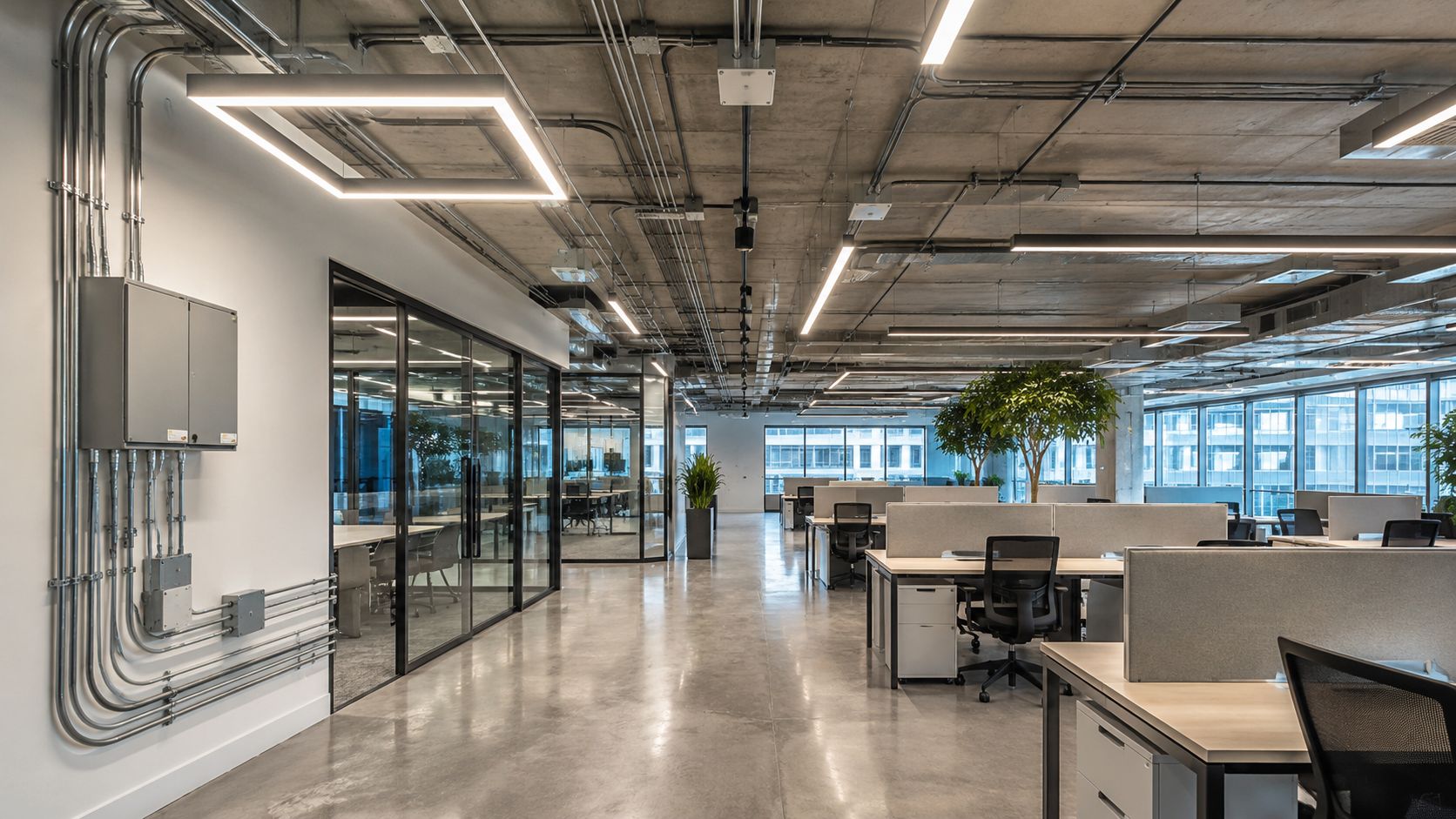
A switchboard upgrade usually becomes necessary when a business adds equipment, reworks a tenancy, or discovers the existing board no longer suits the load or layout. In older premises, the problem isn't always visible until nuisance tripping, heat damage, poor labelling, or limited spare capacity starts getting in the way.
A proper upgrade does more than replace old components. It should answer practical questions:
What works is planning for the next fit-out, not just the current one. What doesn't work is squeezing new circuits into a board that's already telling you it's had enough.
This is one of the most overlooked parts of small commercial work. Many sites assume that if alarms exist, they're compliant. That's a risky assumption.
Recent data cited by SE Electrical on Queensland compliance issues reports a 24% increase in commercial electrical safety compliance failures in Queensland, especially in rental properties. The same source says 52% of small commercial property managers in Brisbane are confused about whether their contractor meets the 2025 AU Regulatory Update for smoke alarm interconnection, including the requirement for hardwired, 10-year lithium battery alarms.
That confusion shows up on real sites. A tenancy changes use. A fit-out alters room layout. An owner replaces one device but not the rest of the system. Suddenly the installation is neither clearly compliant nor easy to defend.
If a contractor can't explain how the smoke alarms, emergency lighting, and tenant use all connect, they haven't looked at the property closely enough.
Most businesses don't want separate contractors blaming each other when something fails. They want access control, CCTV, alarms, data points, and power laid out so the premises functions.
That means thinking through:
Security and data work can look minor during a fit-out. It becomes major when cable routes are blocked, power is missing where devices need it, or the final layout doesn't match how the team uses the space.
For businesses that also need periodic appliance safety checks, electrical testing and tagging for workplaces is another useful part of a broader maintenance plan.
Commercial maintenance isn't glamorous, but it's often what saves the most money. Faults with lighting circuits, hot water services, external lighting, or safety systems can hurt staff productivity and customer experience long before they become outright failures.
The best maintenance approach is targeted and site-specific. Keep records. Fix recurring faults properly. Replace worn components before they fail during trading hours. Don't wait for a minor defect to turn into an emergency call-out.
Business owners don't need to memorise every clause in the rules. They do need to understand one thing clearly. Compliance is not a paperwork extra added at the end of a job. It's part of the job from the first design decision.
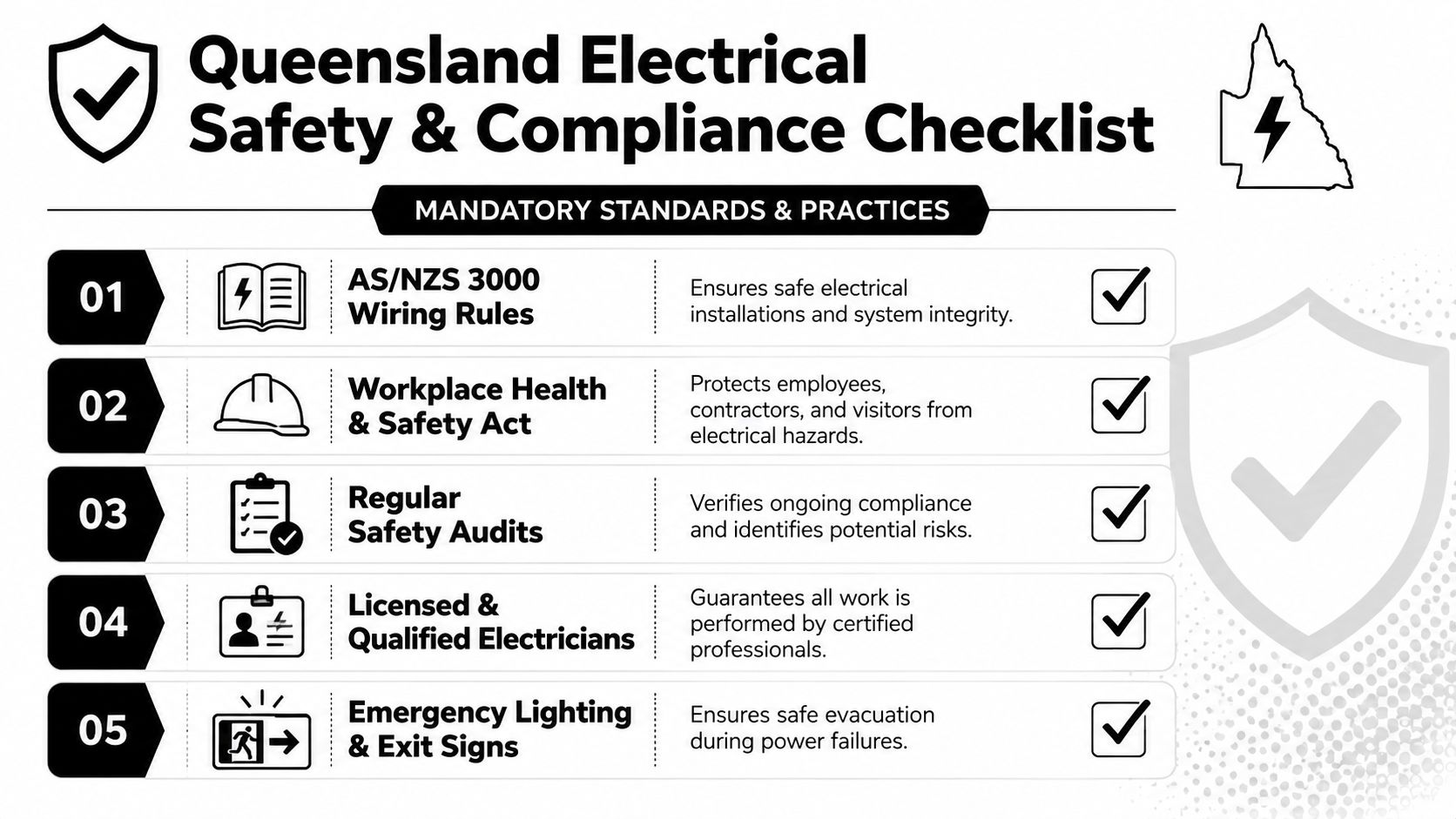
All commercial electrical work in Australia must comply with AS/NZS 3000, and that standard requires the design and installation to be verified in writing by a competent person, as outlined in this summary of commercial wiring standards and AS/NZS 3000 obligations.
That written verification matters for a simple reason. If a problem appears later, people will look at what was installed and what was documented. If those two don't line up, the owner can be left with defects, delays, and hard questions from insurers or regulators.
The trouble usually isn't one dramatic failure. It's a chain of smaller decisions:
That's why a certificate matters, and why many owners ask for one after any substantial commercial job. If you want a plain-English explanation of the handover side, this guide to an electrical certificate of compliance in Queensland is worth reading.
Some commercial environments involve work near energised equipment or higher-risk installations. In those settings, safe work can't start with “we've done this before”. It starts with isolation, risk assessment, and a Safe Work Method Statement prepared by a competent person.
The Electricity Safety General Regulations guidance from Energy Safe Victoria spells out the basics clearly. The Responsible Electrical Contractor must ensure the isolation point is clearly marked and accessible, and work must be done using properly tested tools and personal protective equipment under the required safety process.
Written verification protects the business twice. It helps prevent the wrong installation, and it proves the right checks were actually done.
A commercial contractor who treats compliance as a burden will usually leave you with loose ends. A contractor who builds compliance into design, installation, testing, and handover saves you trouble later.
Most business owners ask the same question first. What's this going to cost? Fair enough. But commercial electrical pricing only makes sense when you understand what sits behind the hourly rate.
In Brisbane, commercial electricians typically charge between $80 and $120 per hour for standard work, according to IECI workforce research covering electrician earnings and commercial rates. The same source notes median weekly earnings for a licenced electrician are $2,191. That tells you straight away that you're not only paying for labour on the tools. You're paying for qualified trade capacity in a regulated environment.
A commercial quote usually includes more than the person you see on site. It also reflects:
Emergency work costs more for the same reason commercial disruptions cost more. If a fault stops trade, affects refrigeration, shuts down lighting, or leaves a tenancy unsafe after hours, response time matters.
A cheap quote usually strips out one of three things. Time. quality of materials. Or proper compliance process.
Here's a simple way to read a quote:
| Ask this | Why it matters |
|---|---|
| Is the scope clear | Vague scopes create disputes and variations later |
| Does it mention testing and certification | If not, the handover may be incomplete |
| Are shutdowns and after-hours access allowed for | Commercial timing affects labour and planning |
| Are materials suited to the environment | Cheap fittings fail sooner in busy premises |
The right commercial electrical contractor won't always be the lowest number on the page. They should be the quote that makes sense. Clear scope, realistic allowances, proper compliance, and a plan that avoids rework.
That's the standard worth paying for. Business owners usually don't regret paying for work that was done once and done properly. They regret paying twice.
Australia's electrical services industry is highly fragmented, with approximately 45,850 businesses, and the largest company holds less than 4% of market share, according to this industry overview of Australian electrical services contractors. For a Brisbane business owner, that means one thing. You'll see plenty of options, and not all of them are equal.

A professional contractor should be easy to verify. If you have to chase basic information, that's already a warning sign.
Use this checklist:
A café, medical suite, office, school building, and mixed-use rental property all count as commercial work. They don't carry the same practical risks.
Ask specific questions:
That's also where broader risk thinking helps. Facility teams that manage multiple trades can get value from these expert insights on contractor risks because they focus on vetting, documentation, and operational exposure rather than marketing claims.
A good contractor usually sounds practical, not flashy. They ask about access, existing load, equipment, operating hours, shutdown constraints, and future use of the space. They don't rush straight to price before they understand the premises.
For a visual overview of what a professional contractor relationship should look like, this short video is a useful reference.
The right contractor lowers risk before the first cable is pulled. The wrong one creates risk that only becomes visible after handover.
If you're comparing two similar quotes, choose the contractor who gives clearer answers, defines the scope better, and treats compliance like part of the workmanship. That's usually the safer decision.
When we take on a commercial job, the process starts with listening before quoting. We ask what the site is used for, what's changing, what can't be interrupted, and whether there are existing problems that need to be fixed while the work is underway. That first conversation saves time because it shapes the job properly from the start.
The next step is a site visit. We inspect the existing installation, identify any obvious issues with switchboards, circuits, access, safety systems, or layout, and talk through the practical options. If a staged approach makes more sense than doing everything at once, we'll say so. If the scope needs to be tightened up before works begin, we'll flag that too.
Once the job is approved, we schedule the work around your operating needs as closely as possible. For some sites that means standard access during business hours. For others it means careful shutdown planning, tenant coordination, or completing key parts of the work with minimal disruption. We keep communication direct so you're not left guessing what's happening on site.
At handover, we don't treat testing and paperwork like an afterthought. We finish the physical work, verify the installation, and make sure you know what was done, what was upgraded, and what to keep an eye on in future. That's how commercial electrical work should be handled. Clear scope, tidy execution, proper sign-off, and no loose ends.
If you need a reliable DLG Electrical team for a Brisbane office, retail space, rental property, or commercial upgrade, get in touch for a free quote. We're fully licensed, insured, practical to deal with, and focused on doing the job safely and properly the first time.

Master Electrician with over 30 years of experience. Founded DLG Electrical in 2005 after international project work including electrical installations at Stamford Bridge Stadium, London(Home of Chelsea FC).

Local Electricians that can fix all Electric Hot water Systems.
Motion sensor lights are a versatile addition to any home, offering nu
