83 Jean St, Grange QLD 4051
Mon-Fri 07:30 AM - 04:00 PM - Sat - 8:00 - 12 - Sunday Closed

When you start thinking about the cost of rewiring a house, the numbers can feel a bit all over the place. In Australia, most projects land somewhere between $6,000 and $20,000, but that’s a huge range. What you’re really paying for is peace of mind—knowing your home’s electrical system is safe, efficient, and ready for all the tech we rely on today.

Before we get into the nitty-gritty details that make quotes go up or down, it’s good to have a ballpark figure in mind. This gives you a realistic starting point for your budget. The easiest way to get a rough idea is by looking at the number of bedrooms in your home.
It’s a bit like getting a quote for a paint job; more rooms mean more materials and more time on the tools. A small two-bedroom unit simply has fewer circuits, power points, and light fittings than a big four-bedroom family home, and that directly affects the bottom line. This gives you a solid baseline before we factor in other things like tricky wall access or a full switchboard upgrade.
Let’s break down what you can expect to see on a quote. While prices can vary, we’ve seen enough jobs across Australia’s major cities to notice a pretty consistent pattern based on property size.
A typical 2-bedroom home, for example, often comes in between $4,000 and $6,000. Jump up to a 3-bedroom house, and you’re usually looking at the $6,500 to $9,000 range. For larger properties with four or more bedrooms, it’s not uncommon for costs to climb past $9,000 and head towards $12,000 or more. If you’d like a deeper dive, you can find more detailed pricing insights from industry experts to get a feel for the market.
To make it even clearer, here’s a quick reference table.
| Property Size | Average Cost Range (AUD) |
|---|---|
| 2-Bedroom Apartment/Unit | $4,000 – $6,000 |
| 3-Bedroom House | $6,500 – $9,000 |
| 4-Bedroom House | $9,000 – $12,000 |
| 5+ Bedroom House | $12,000+ |
Just remember, these figures are a guide. The final quote will always come down to the specific conditions of your home, which we’ll get into next.
Having these baseline numbers in your head is the key to planning properly. It helps you:
With this quick guide, you’ve got the foundational knowledge to tackle your rewiring project with confidence. Now, let’s dig into the specific details that can shift these numbers one way or the other.
Trying to budget for a house rewire is a bit like planning a major renovation. You know the big picture, but the final cost can swing wildly depending on what’s lurking behind the plaster and the specific finishes you choose. The size of your house is a starting point, but it’s the hidden details that truly dictate the final quote from your electrician.
Several critical factors can add thousands to your bill, turning what seems like a simple job into a far more significant investment. Getting your head around these variables means you can read a quote properly, ask the right questions, and understand exactly where every dollar is going.
The single biggest unknown is often what’s already inside your walls. An electrician needs to understand what they’re up against before they can give you an accurate price. Not all old wiring is the same, and some types are a nightmare to deal with.
An outdated electrical system isn’t just an inconvenience; it’s a liability. Homes with knob-and-tube or old rubber wiring often face challenges with home insurance, as many providers see it as an unacceptable fire risk.
How easy is it for a sparkie to run new cables from your switchboard to every light and power point? The answer has a huge impact on labour costs, which can easily make up 50-70% of your total bill.
Think of it like this: running a garden hose across an open lawn is easy. Threading it through a dense, thorny hedge is not.
Brick and plaster walls are far tougher and more time-consuming to work with than plasterboard. Likewise, homes with poor roof space or underfloor access force electricians to get creative, which takes more time and costs more money. Every tricky access point adds hours to the job.
This is where you have the most control over the budget. What do you actually want your new electrical system to do?
A basic, bare-bones rewire might just be a like-for-like replacement of the existing circuits. But let’s be honest, most people use this as a chance to modernise and upgrade their setup. This can involve:
This principle of scope driving the final price applies across all trades. For example, this guide on decoding office cleaning service costs in Australia shows how the size of the space and the specific tasks required are the biggest factors in the final bill—just like with a rewire.
When you get a quote for a full house rewire, the final number can seem a bit overwhelming. But it’s not just one big, arbitrary figure. It’s actually made up of three key components, and knowing what they are is the first step to understanding exactly where your money is going.
Think of it like the bill at a nice restaurant. You’re not just paying for the meal that lands on your table. You’re also paying for the quality ingredients (materials), the chef’s skill and time (labour), and the fact the kitchen meets all its health and safety obligations (permits and compliance). Each part is crucial, and each has its own cost.
This is usually the most tangible part of the quote. It covers all the physical gear your electrician needs to buy to get the job done right. While the price of commodities like copper can change with the market, the list of items needed for a rewire is fairly standard.
Your materials list will almost always include:
This infographic gives a great visual breakdown of what drives up the need for more materials and, in turn, more labour.
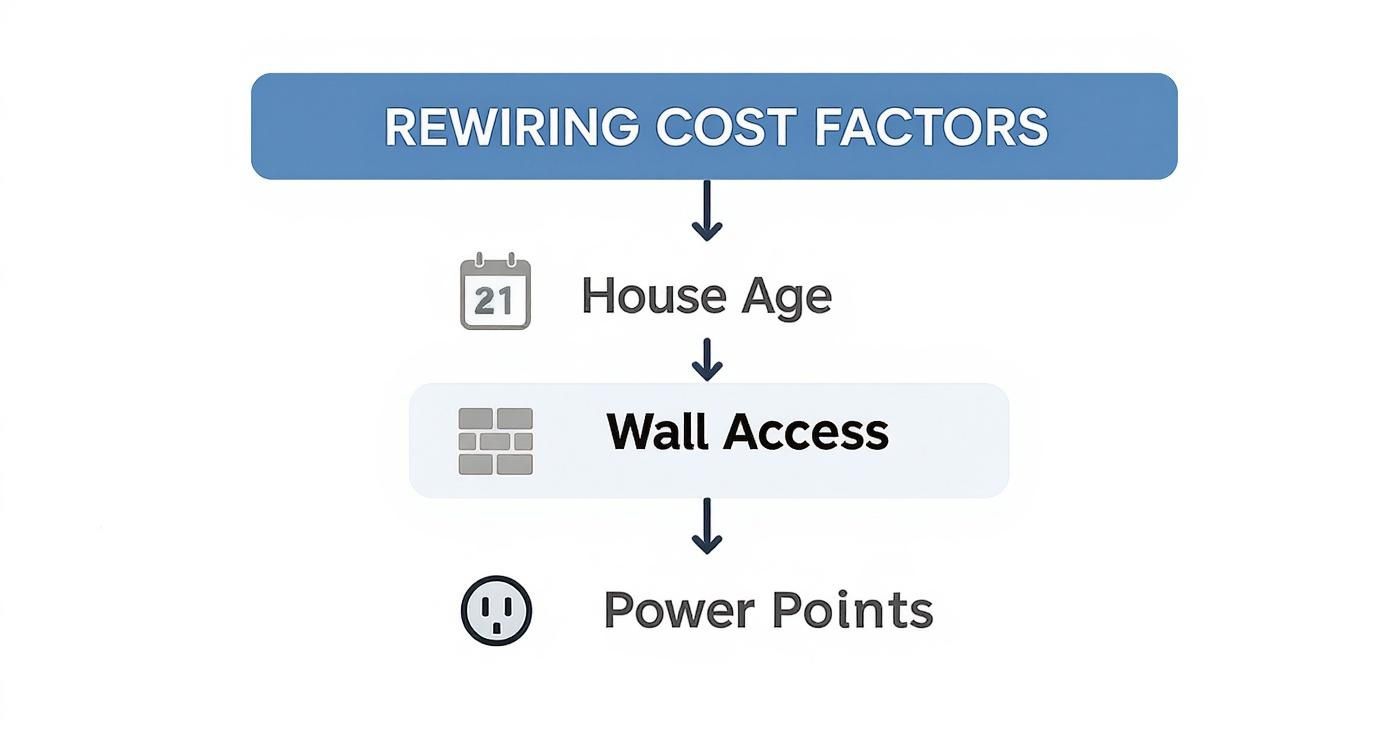
As you can see, things like the age of your home or wanting more power points directly increases both the materials needed and the time it takes to install them.
To give you a clearer picture, here’s a rough itemised look at what you can expect to see on the materials bill for a standard project.
| Component | Average Cost (AUD) |
|---|---|
| New Switchboard (including RCDs) | $800 – $1,500 |
| Copper Wiring (per metre) | $2 – $5 |
| Power Points (per unit) | $10 – $30 |
| Light Switches (per unit) | $10 – $25 |
| Circuit Breakers (per unit) | $20 – $50 |
| Conduit and Fittings (total) | $100 – $300 |
These are, of course, just ballpark figures. The final tally will depend entirely on the scale and specifics of your home’s rewire.
Labour is almost always the biggest chunk of a rewiring quote, often making up 50% to 70% of the final invoice. This is what you pay for a licensed electrician’s expertise, experience, and time on the tools. It’s not just about pulling cables; it’s about navigating challenges, ensuring every connection is safe, and doing it all to code.
The complexity of the job is the biggest factor here. A straightforward rewire in a modern home with easy access to wall cavities is going to take far less time than a job in an old Queenslander with brittle walls and tight roof spaces. Electricians bill for their time, so the more hurdles they have to clear, the higher the labour cost will be.
While the context is different, reviewing a detailed understanding project cost breakdown for something like a security system can be insightful. The core principles are the same: you have hardware costs, installation time, and compliance requirements that all add up.
Finally, a slice of the quote goes towards the paperwork and compliance side of things. This isn’t an optional extra—it’s a legal requirement designed to protect you, your property, and anyone who lives there in the future.
In Australia, every single legitimate electrical rewire must be signed off with a Certificate of Compliance (or a state-based equivalent). This is your official proof that the work was done by a licensed pro and meets strict national safety standards.
These costs cover a few key things:
Trying to cut corners here can void your insurance policy and cause major legal headaches down the line. To get a better handle on the strict rules your electrician is bound by, our guide on electrical wiring standards in Australia provides a detailed rundown. It’s precisely these standards that make professional labour and compliance costs you simply can’t afford to skip.
When you’re trying to budget for a full house rewire, it’s a common mistake to think the price is more or less the same everywhere. While the actual materials—like copper wiring and switchboards—don’t fluctuate much across Australia, the single biggest factor that will change your quote is labour. Believe it or not, your postcode can have a huge impact on the final price.
This all comes down to the local market rates for licensed electricians. Things like demand, the general cost of living, and how many qualified sparkies are in the area all play a part in setting the hourly rate. It’s why the exact same rewiring job in a major city like Sydney or Perth, where business overheads are through the roof, can cost significantly more than it does right here in Brisbane.
When it comes to the cost of electrical labour, Queensland—and Brisbane especially—is in a bit of a sweet spot. The local market is competitive enough to keep prices fair for homeowners, but not so cutthroat that you have to worry about sacrificing the quality and expertise you need from a professional. For you, this means real, tangible savings on your project.
To put it in perspective, electrician hourly rates vary a lot state by state. Here in Queensland, you’ll find competitive rates ranging from $75 to $110 per hour, which is often more affordable than what you’d see in the major southern cities. For a standard 3-bedroom home needing about 40-60 hours of work, the difference between a Queensland rate ($75/hour) and a Western Australia rate ($100/hour) could easily add an extra $1,500 to $3,000 to your bill. You can discover more insights on rewiring costs across Australia to see a broader comparison.
This regional price gap is a massive factor. It really highlights why getting local, Brisbane-based quotes is the only way to build an accurate budget. Relying on national averages is a recipe for a nasty surprise, as they’re often skewed by much pricier markets.
Beyond just the labour rates, the style of your home plays a huge role in the cost, and Brisbane is full of unique properties. The iconic Queenslander, for example, comes with its own set of challenges that can definitely influence an electrician’s quote.
These beautiful, historic homes have character in spades, but that character often demands a more careful and time-consuming approach to rewiring.
A seasoned local electrician knows Queenslanders inside and out. They can see these potential hurdles a mile away and factor them into your quote from the start. This prevents nasty surprise costs down the track and ensures the historical charm of your home stays intact.
At the end of the day, understanding these local dynamics—from the favourable labour market to our unique architectural quirks—is the key. It lets you create a much more realistic budget and gives you a clear picture of why a one-size-fits-all estimate for the cost of rewiring a house just doesn’t cut it.

Once you’ve got your head around the factors that drive the cost of rewiring a house, the next step is finding the right professional for the job. This is about more than just chasing the lowest price; it’s about finding a skilled, licensed, and reliable partner who will guarantee your home’s electrical system is safe for years to come.
Think of it like hiring a builder for a renovation—you wouldn’t just go with the first person you meet. You need to do your homework to find someone whose expertise and credentials match the importance of the work.
You wouldn’t buy the first car you test-drive, and the same logic applies here. Getting at least three detailed, written quotes is a non-negotiable part of the process. The goal isn’t to pit sparkies against each other to slash the price, but to get a clear picture of the market rate for the work needed at your property.
Multiple quotes are incredibly revealing. If one comes in way lower than the others, it’s a potential red flag that they’ve missed something or are cutting corners. On the flip side, an unusually high quote might mean they’re over-engineering the job. When you see a few quotes clustered around a similar price point, you can feel confident you’re in the right ballpark.
Before you even glance at the dollar figures, you need to verify the credentials of the electrician providing the quote. A cheap price from an unqualified person is a shortcut to disaster.
Here’s a simple checklist to run through for every potential electrician:
A professional and trustworthy electrician will happily show you their licence and insurance details. If you get any pushback or vague answers, take it as a major warning sign and move on.
A vague, one-line price is not a professional quote. To properly compare your options and dodge surprise costs down the track, you need a fully itemised breakdown that spells out every part of the job.
A good quote will clearly detail:
Insisting on this level of detail makes comparing quotes a whole lot easier. More importantly, it protects you from misunderstandings and ensures everyone is on the same page before a single wire is touched.
Even after breaking down the costs, it’s completely normal to have a few big questions swirling around. A full house rewire is a significant investment, after all. Getting straight answers is the only way to move forward with confidence.
Let’s clear up any lingering uncertainties. We’ll tackle the most common questions we hear from Brisbane homeowners, from spotting the warning signs of old wiring to understanding how the project impacts your property’s value.
This is the big one. Is a full rewire genuinely on the cards, or can you get away with a few smaller fixes? While only a licensed electrician can give you a definitive verdict after a proper inspection, your house will often drop some pretty obvious hints that its electrical system is past its use-by date.
Keep an eye out for these classic red flags:
If your home was built before 1990 and has never had a major electrical overhaul, it’s a very good idea to book a professional inspection. Electrical systems weren’t built to last forever, and what was considered safe 40 years ago often falls dangerously short of today’s standards.
Knowing what to expect can make the whole project feel a lot less daunting. While every home is different, a full house rewire follows a fairly predictable path and usually takes between three to ten days, depending on the size and complexity of your property.
The process generally unfolds in a few key stages. First, your electrician will cover furniture and lay down drop sheets to minimise dust. Then, they’ll start running the new cables, which often requires cutting small, neat access holes in walls or ceilings. The power will need to be off, but this is usually managed in sections to keep the disruption to a minimum.
Once all the new wiring, outlets, switches, and the new switchboard are in place, the electrician performs thorough testing on every single circuit. Finally, they’ll issue a Certificate of Compliance—your official guarantee that all the work is safe, compliant, and up to code.
Absolutely. It might not have the same visual appeal as a new kitchen, but a full rewire is a massive selling point that smart buyers and their building inspectors actively look for. An updated electrical system gives your home a significant edge on the market and can directly influence its final sale price.
The value comes from a few key areas:
A house with old, potentially dangerous wiring is a major liability in the current property market. Investing in a rewire removes that risk and turns it into a tangible asset, giving peace of mind to both you and any future owners.
Ready to ensure your Brisbane home’s electrical system is safe, modern, and up to code? The team at DLG Electrical has over 19 years of experience delivering five-star residential electrical solutions. Get your free, no-obligation quote today!

Master Electrician with over 30 years of experience. Founded DLG Electrical in 2005 after international project work including electrical installations at Stamford Bridge Stadium, London(Home of Chelsea FC).

Local Electricians that can fix all Electric Hot water Systems.
Motion sensor lights are a versatile addition to any home, offering nu
