83 Jean St, Grange QLD 4051
Mon-Fri 07:30 AM - 04:00 PM - Sat - 8:00 - 12 - Sunday Closed

The real difference between single phase and three phase power boils down to consistency and raw capacity. Single-phase is what you’ll find in most older Brisbane homes, delivering power in a single wave. Three-phase, on the other hand, is the heavy lifter, offering a more powerful and continuous supply with three overlapping waves, perfect for properties with serious energy demands.
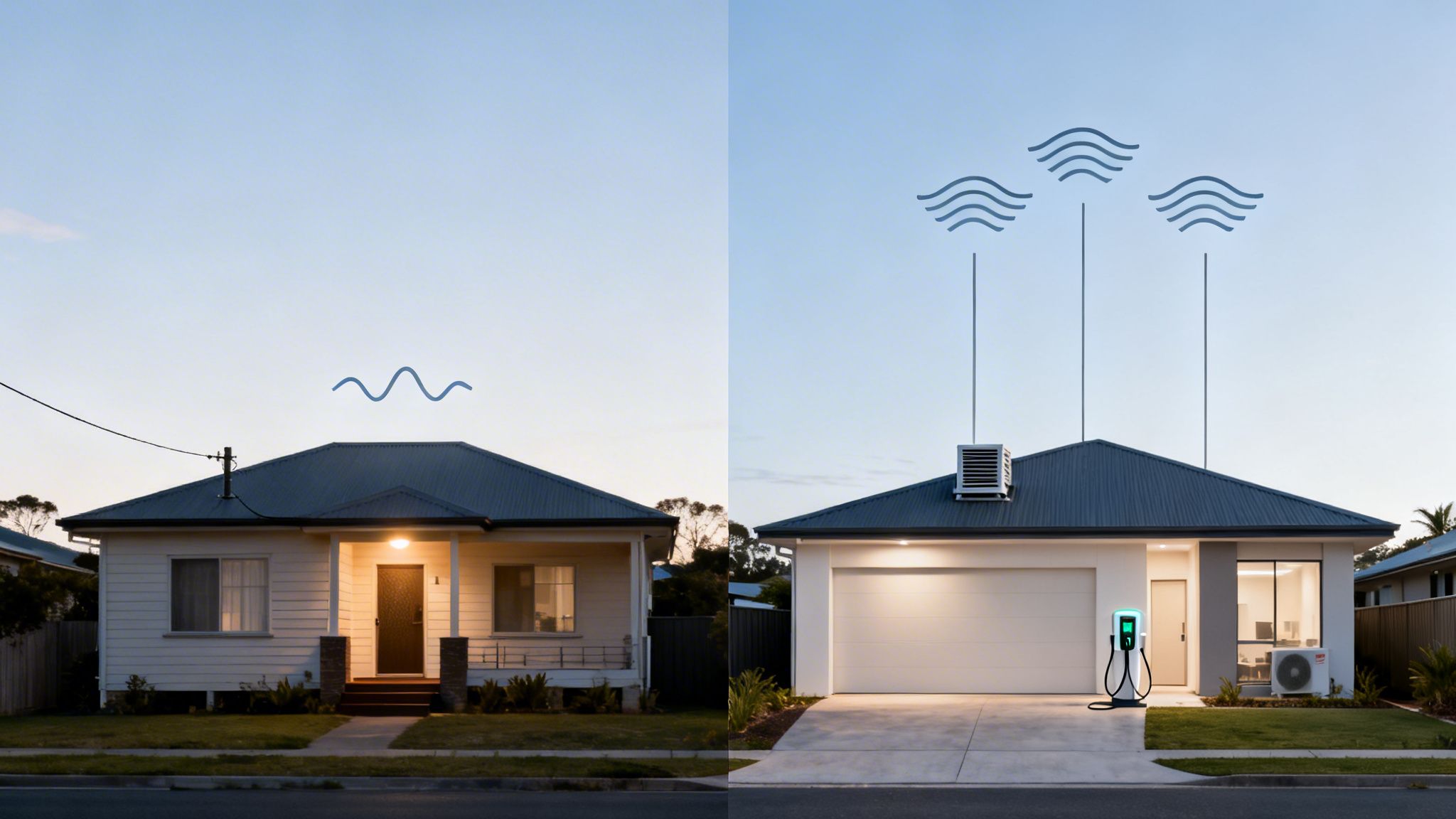
If you’ve ever seen your lights dim for a second when the air con kicks in, you’ve witnessed the classic signature of single-phase power. It delivers electricity in a single, alternating current (AC) wave that constantly peaks and dips. For decades, this was all anyone needed, but it’s definitely showing its age in modern, power-hungry homes.
In Australia, single-phase power at 230V has been the standard since the post-war building boom, and it was perfectly fine for the simple electrical needs of the time. We often see original switchboards in suburbs like Grange and Windsor that were built for this two-wire setup. Today, those same boards are seriously struggling to keep up with EV chargers, ducted air conditioning, and solar batteries. You can find more on the evolution of residential power on Carda Electrics.
Three-phase power is a completely different beast. It delivers electricity through three perfectly synchronised AC waves. This triple-wave supply means the power delivery is always constant—there are no dips, just a smooth, efficient, and much more robust flow of energy.
The most important takeaway is that three-phase power can handle much bigger electrical loads far more efficiently. This is what makes it essential for running powerful equipment without putting your home’s entire electrical system under strain.
To make the choice clearer, let’s quickly break down the key differences between the two systems. This table will help you see at a glance which setup is the right fit for different residential and commercial needs here in Brisbane.
| Attribute | Single-Phase Power | Three-Phase Power |
|---|---|---|
| Typical Voltage | 230V | 400V |
| Power Delivery | One AC wave; experiences power dips | Three AC waves; provides constant power |
| Wiring Setup | Two wires (Active and Neutral) | Four wires (Three Active and one Neutral) |
| Common Use | Standard homes, lighting, small appliances | Large homes, commercial buildings, workshops, EV chargers |
| Load Capacity | Lower; suitable for everyday residential use | Higher; supports heavy machinery and multiple large appliances |
As you can see, while single-phase has served us well, three-phase is undoubtedly the future for any property with high energy consumption. It offers the capacity and stability needed for modern technology and high-draw appliances.
Most homes across Brisbane, particularly those built more than a couple of decades ago, are running on single-phase power. The simplest way to think of it is as a basic, two-lane road for electricity, using two wires to bring power from the street pole to your switchboard: one active wire and one neutral wire.
This straightforward setup supplies your home with electricity in a single, continuous alternating current (AC) wave, delivering a standard 230V. This wave pattern, however, isn’t a flat line of power—it’s constantly rising to a peak before falling to a trough. For many years, this was more than enough to handle the lights, a TV, and a fridge in a typical Aussie household.
But this design has its limits. Because the power delivery isn’t perfectly constant, it has tiny, momentary dips in supply between each wave cycle. This is exactly why you might notice your lights flicker or dim for a second when a big appliance, like your air conditioner or an older washing machine, kicks into gear.
Your home’s electrical system is being asked to supply a sudden, large burst of power from a supply that naturally fluctuates. While it’s not necessarily dangerous, it’s a clear signal that your system is straining to keep up with the demands of modern living.
Those small flickers and stumbles are symptoms of a system that’s starting to hit its practical ceiling. While single-phase power can safely run your day-to-day essentials, it really begins to struggle when multiple high-draw appliances are switched on at the same time. It simply wasn’t designed to handle the combined load of ducted air conditioning, a big pool pump, and a high-power kitchen oven all running at once.
Getting your head around how your current system works is the first step in knowing when it might be time for an upgrade. It also helps to be familiar with the wiring itself. To better understand the cables running through your walls, you can learn more about standard Australian electrical wiring colour codes in our detailed guide.
This basic two-wire system has served Brisbane homes well for a long time, but as our houses get smarter and more electrified, its limitations are becoming much more apparent. The real difference between single-phase and three-phase power comes down to a simple question: do you need a simple road, or a multi-lane highway for your home’s electricity?
While single-phase power has been the dependable standard in Australian homes for years, a three-phase supply is the high-performance option built for modern energy needs. Think of it this way: instead of one fluctuating power wave, you get three synchronised alternating currents.
These waves are perfectly staggered. Just as one wave starts to dip, another is rising to take its place. The result is a smooth, constant, and uninterrupted supply of power. This consistent delivery creates a much more robust 400V supply, completely getting rid of the power dips you see in single-phase systems. It’s the difference between driving on a bumpy country road and cruising down a smooth, multi-lane highway.
The biggest win with a three-phase system is its ability to run large, power-hungry equipment without putting your entire electrical system under strain. For homes and businesses in Brisbane, this delivers real, tangible benefits.
The consistent power delivery of a three-phase system means motors run more efficiently, generate less heat, and ultimately last longer. This reduces mechanical stress and improves the lifespan of your most expensive appliances.
For industrial settings or homes with heavy-duty machinery, the ability to use a 3ph motor starter is a major advantage. These devices are specifically designed to handle the higher electrical loads that only three-phase power can provide.
Essentially, upgrading to three-phase power gives your property a powerful and reliable electrical backbone. It isn’t just about getting more power; it’s about delivering that power in a more efficient, stable way. By balancing the electrical load across three wires instead of just one, the whole system operates with far greater stability and less risk of overload, making your home ready for whatever technology comes next.
Knowing the difference between single-phase and three-phase power is one thing, but figuring out when your home actually needs an upgrade is a far more practical question. The answer almost always comes down to your current and future electricity demands. For most Brisbane homes, single-phase power does the job just fine, but certain lifestyle changes and new technologies are clear triggers for considering a change.
If you’re constantly dealing with tripping circuit breakers, that’s a big red flag. This often happens when you try to run multiple power-hungry appliances at the same time—a common scenario in a modern household. It’s your switchboard’s way of telling you it simply can’t handle the combined electrical load safely.
The need for a three-phase system usually becomes obvious when you plan to install specific high-consumption equipment. If any of the following are on your radar, it’s time to have a serious conversation about an upgrade.
Think about it this way: if you’re planning to run a pool pump, a large oven, and ducted air conditioning all at once, you are pushing the absolute limits of single-phase power. An upgrade isn’t just about convenience; it’s about ensuring the long-term safety and stability of your home’s entire electrical system.
This decision tree helps visualise the common triggers that lead to a power upgrade.
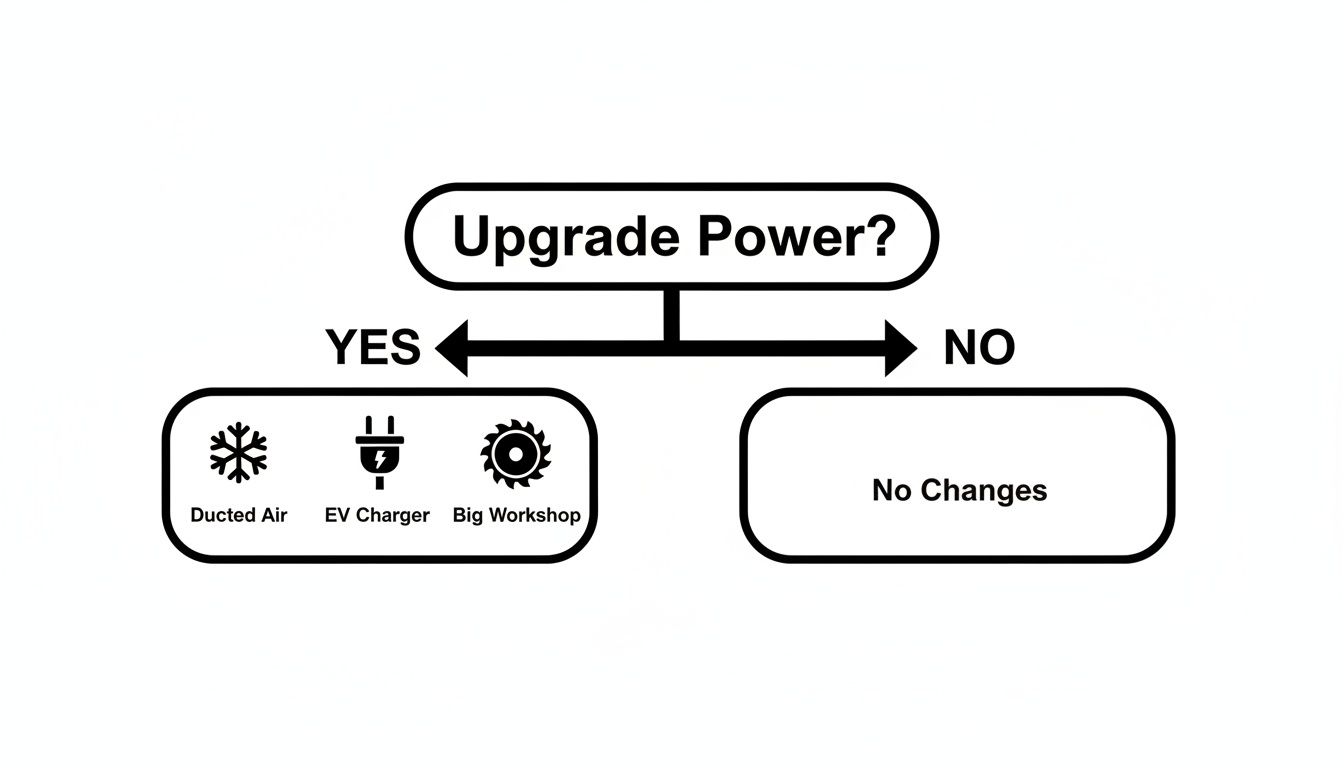
As you can see, it’s the addition of high-power appliances that are the primary drivers for moving away from a standard residential connection.
Here in Brisbane, we’re seeing this shift happen more and more, especially in new constructions and large-scale renovations. While standard single-phase 230V power is still adequate for about 90% of Australian homes, it really struggles when you have several big appliances running at once.
In contrast, three-phase power delivers a more balanced 400V supply that’s perfect for everything from commercial kitchens to the powerful pool pumps you find in large homes in suburbs like Grange. As experienced electricians, we’ve noticed that builds post-2010 in metro Queensland increasingly specify three-phase. It’s now found in an estimated 15-20% of new Brisbane homes as people look to future-proof their properties.
If you’ve identified your needs and are ready to explore the next steps, it’s crucial to understand the process. You can learn more about what a professional three phase power installation involves in our dedicated guide.
Making the switch to three-phase power is a big decision, and it’s natural to wonder about the costs and what the installation actually involves. For Brisbane property owners, this isn’t just a simple bill—it’s a major investment in your home or business’s capacity, future-proofing its value and capabilities.
The whole process starts with a formal application to Energex, our local electricity distributor. Getting their approval is the first step, but the real work and the bulk of the cost comes from the physical upgrades required at your property, which is where a licensed electrician like us comes in.
The total cost can vary quite a bit, depending on what your current electrical setup looks like. However, any three-phase upgrade in the Brisbane area will typically include a few key components you need to budget for.
While the upfront cost is definitely a factor, it’s important to see it as an investment. A three-phase system doesn’t just run powerful gear like fast EV chargers; it can genuinely increase your property’s resale value by making it far more appealing to future buyers with high energy demands.
Projects like the Zero-Emission Co-Living development in Brisbane show just how essential three-phase power is for modern, energy-intensive builds. To get a better idea of the costs involved with the board itself, you can learn more about what an electrical switchboard upgrade costs in our detailed guide.
Once you give us the green light, the installation process is very structured to make sure everything goes smoothly. As your electrician, we manage the entire project from start to finish, so you’ll always know what’s happening.
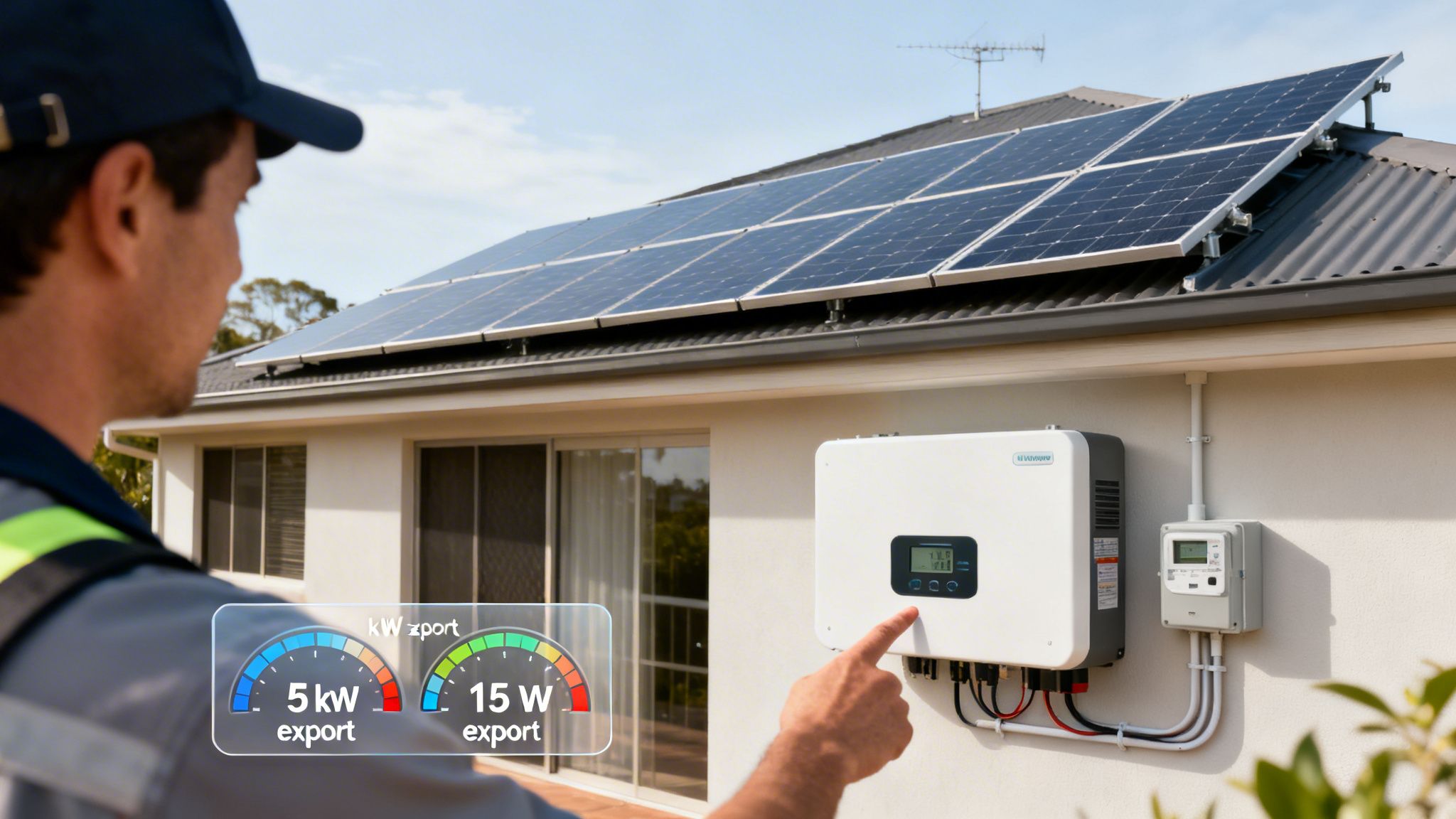
For homeowners in Queensland with solar panels, the difference between single-phase and three-phase power isn’t just a technicality—it’s a financial one. Putting a decent-sized solar system on your roof is a brilliant way to take advantage of all that Brisbane sunshine, but the type of power connection you have can seriously throttle your return on investment.
The problem comes down to a critical rule from our local network provider, Energex. If your home has a standard single-phase connection, you’re stuck with a hard 5kW limit on the amount of excess solar you can export to the grid.
This creates a major bottleneck for anyone with a larger system. Let’s say you’ve got a popular 10kW solar array on your roof. On a sunny day, if your house is only using 2kW of power, you’re generating 8kW of excess energy. But because of that 5kW cap, 3kW of that clean, valuable power is simply thrown away. It has nowhere to go.
This is exactly where an upgrade to three-phase power becomes a financially savvy move. When you upgrade your connection, you unlock a much higher export capacity. Instead of being capped at a measly 5kW, Energex allows a three-phase property to export up to 15kW (5kW per phase).
All of a sudden, that 8kW of excess solar from your 10kW system isn’t going to waste. Every single kilowatt is sent back to the grid, earning you feed-in tariffs. This simple change makes your solar investment work much harder for you and can dramatically slash its payback period.
Upgrading to three-phase power is like removing the choke from your solar system’s engine. It ensures the power you generate actually translates into money in your pocket, instead of being lost to frustrating network limits.
With the solar boom across Queensland, this has become a make-or-break issue for many households. On a standard single-phase connection, a 10kW rooftop system can easily waste up to 50% of the power it generates on sunny days with low household use.
Analysis shows that homes with three-phase power can recover their solar investment 20-30% faster, with the payback period often dropping from 7-8 years down to under 5 years. You can learn more about how three-phase connections transform solar profitability in this detailed article.
By allowing you to sell more power back to the grid, a three-phase connection also future-proofs your home. It ensures you’re ready to take full advantage of current and future solar technology, maximising your financial returns and making your investment work as efficiently as it was designed to.
Thinking about making the jump from single-phase to three-phase power is a big step, and it’s completely normal to have a few questions. We get asked about the practical side of these upgrades all the time by Brisbane homeowners, so we’ve put together some clear, straightforward answers to the most common queries.
Yes, absolutely. We find that almost any older home can be successfully upgraded to a three-phase supply. Even beautiful character homes in suburbs like Windsor or Grange are routinely upgraded without issue.
The process does involve running new, heavier-duty cabling from the street pole to your house and installing a brand-new switchboard. Our licensed electricians will carry out a full assessment of your property to find the least intrusive route for the new consumer mains and manage the entire project for you, including all the coordination with Energex, to make sure it’s a smooth transition.
This is probably the biggest misconception we come across. The answer is no. Your electricity usage is billed per kilowatt-hour (kWh), and that rate is exactly the same whether you have a single-phase or three-phase connection. The real difference is in your system’s capacity, not the unit cost of the energy you use.
The upgrade itself is a one-off investment in your home’s electrical capacity and safety. Your appliances won’t cost more to run, but they will operate more reliably and efficiently with a stable power supply, which can even help extend their lifespan.
The physical installation work at your property usually takes a full day to complete. However, it’s important to understand the full timeline. The entire process, which includes lodging the initial application with Energex and waiting for them to complete their external network connection, can take several weeks from start to finish. We manage this entire timeline for you to keep disruptions to a minimum.
Yes, a switchboard upgrade is a non-negotiable part of any three-phase installation. A single-phase switchboard is fundamentally incompatible with a three-phase supply and simply cannot be adapted.
Your new, larger switchboard will be specifically designed to safely handle the three active connections. It will also be fitted with the correct circuit protection (RCDs and circuit breakers) needed to manage the much higher electrical load capacity safely and in compliance with current Australian Standards.
Ready to find out if a three-phase upgrade is the right move for your Brisbane home? The expert team at DLG Electrical is here to help. We provide free, no-obligation quotes and clear, practical advice tailored to your property and your needs. Contact us today to discuss your project.

Master Electrician with over 30 years of experience. Founded DLG Electrical in 2005 after international project work including electrical installations at Stamford Bridge Stadium, London(Home of Chelsea FC).

Local Electricians that can fix all Electric Hot water Systems.
Motion sensor lights are a versatile addition to any home, offering nu
