83 Jean St, Grange QLD 4051
Mon-Fri 07:30 AM - 04:00 PM - Sat - 8:00 - 12 - Sunday Closed

When you first get into electric vehicles, the different charger types can seem like a whole new language. But it’s actually a lot simpler than it looks. At its core, there are just three main categories you need to know: Level 1 (slow), Level 2 (medium), and DC Fast Charging (rapid).
Think of it like filling up a swimming pool. You could use a standard garden hose, a much bigger fire hose, or call in a water tanker for the fastest job. Each has its place, and EV chargers are exactly the same.
Understanding these charger levels is the first step in making your switch to an EV a completely seamless one. Each type offers a different balance of speed, power, and convenience, designed for very different situations.
The EV market here in Australia is booming, and the charging infrastructure is growing right along with it. The market was valued at USD 97.17 million back in 2022 and is on track to hit a massive USD 813.66 million by 2030. This growth is built on these three key charger types: Level 1 (up to 2.3 kW), Level 2 (3.7 kW to 22 kW), and DC fast chargers (over 50 kW).
This diagram gives you a great visual breakdown of how the charger types stack up, from slowest to fastest.
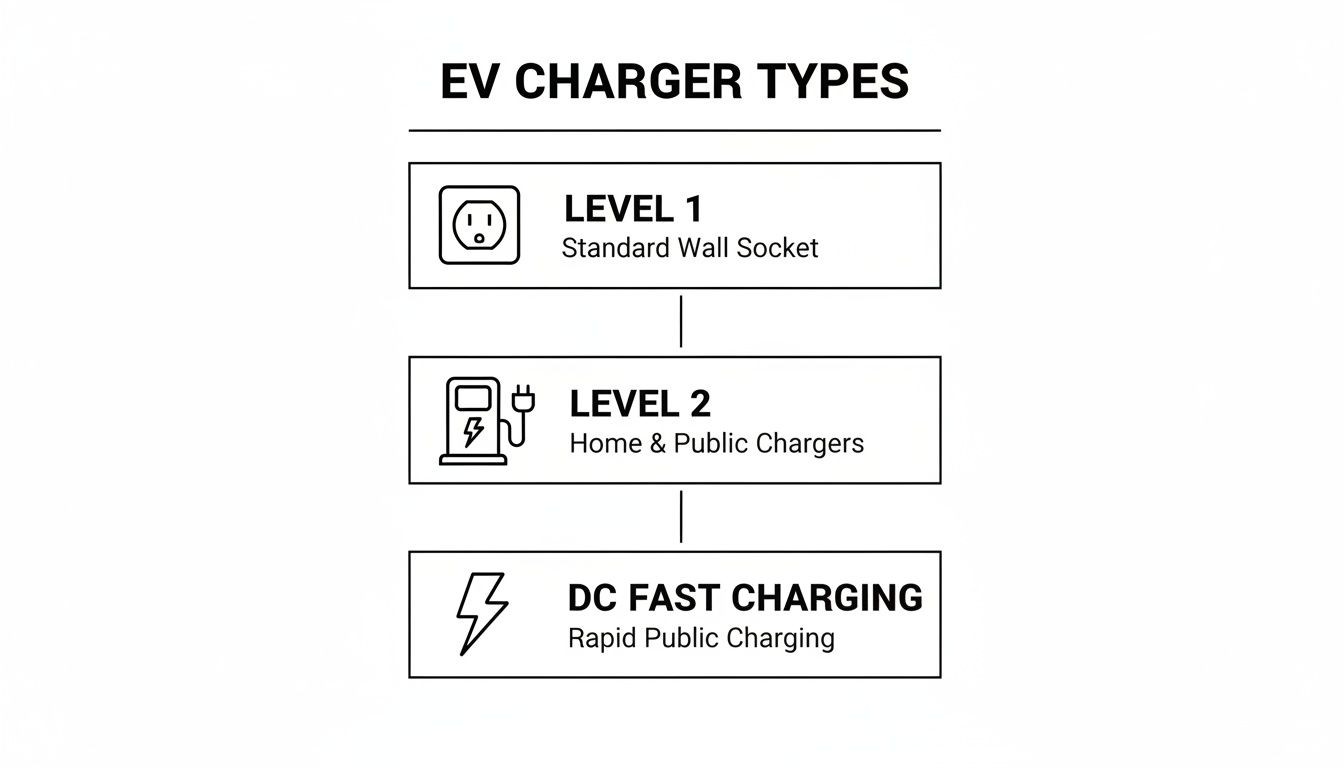
As you can see, the power ramps up significantly from a basic wall socket for Level 1, to a dedicated station for Level 2, and finally to the high-powered units needed for DC Fast Charging.
The core idea is simple: Level 1 is for a basic top-up, Level 2 is the perfect solution for daily home charging, and DC Fast Charging is what you use for quick power-ups on long road trips.
While we’re focused on cars, the principles of charging apply across all electric vehicles, and it can be useful to see how they compare with things like electric bike chargers.
To make it even clearer, here’s a quick comparison of the three main EV charger levels you’ll encounter.
This table provides a quick comparison of the three main EV charger levels, their speeds, and where you’ll typically find them.
| Charger Level | Power Output | Charging Speed (km/hour) | Best For |
|---|---|---|---|
| Level 1 | Up to 2.4 kW | 10-20 km/hr | Overnight top-ups at home for short commutes. |
| Level 2 | 7 kW – 22 kW | 40-100 km/hr | Daily home charging, workplace, and public car parks. |
| DC Fast Charge | 50 kW+ | 200-1000+ km/hr | Public stations for long-distance travel and quick top-ups. |
This gives you a solid starting point for figuring out what you’ll need at home versus what you’ll use when you’re out on the road.
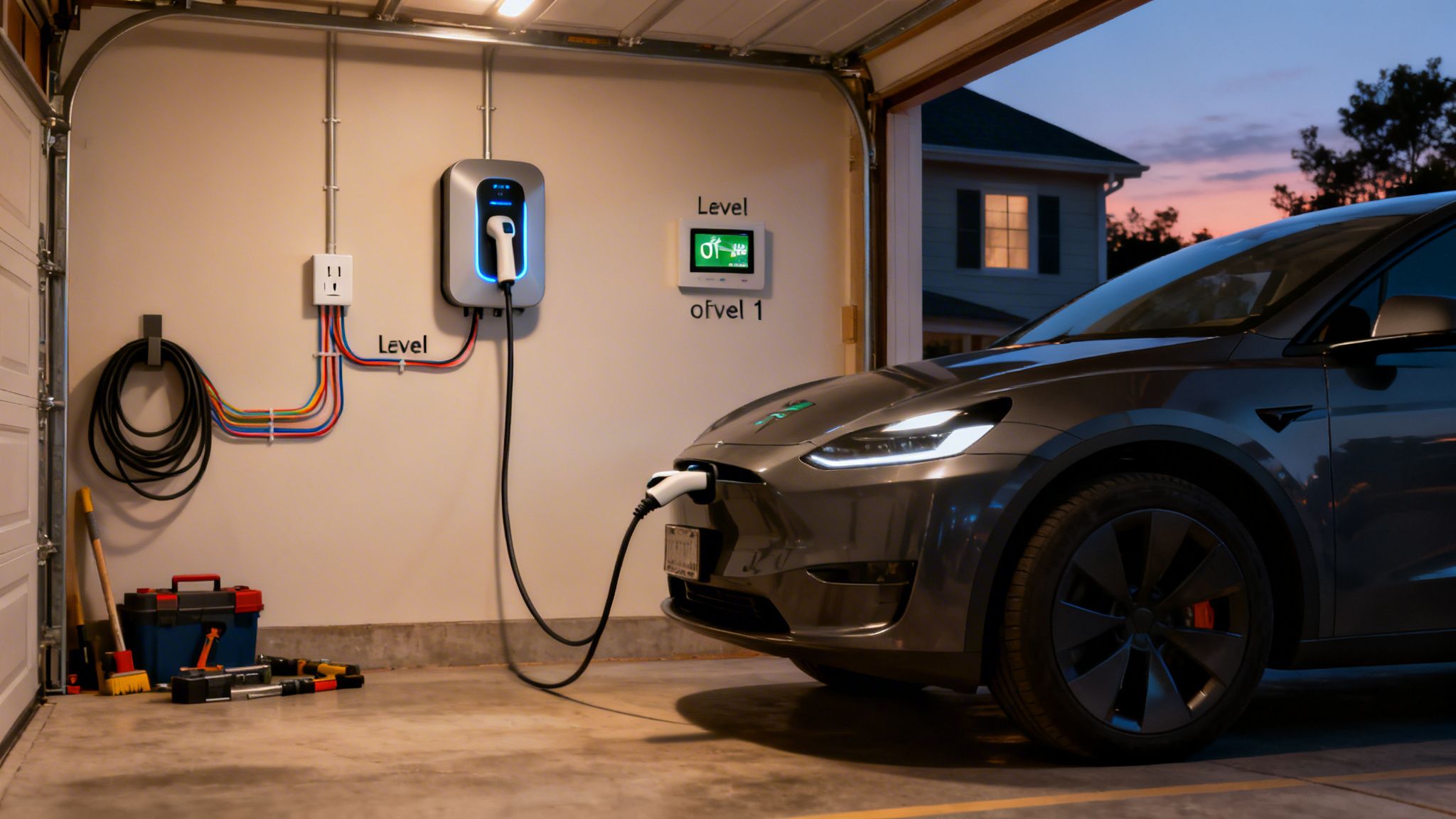
For most EV drivers, charging at home is the biggest perk of ownership. It completely changes the game. Your garage becomes your own private service station, ensuring your car is topped up and ready to go every single morning. The two main electric vehicle charger types for home use are Level 1 and Level 2, and both use the AC power your home already runs on.
Think of it like this: a Level 1 charger is a standard garden hose, while a Level 2 is more like a firefighter’s hose. One gets the job done slowly, while the other does it with serious speed and power.
Level 1 charging is as basic as it gets. It uses a portable cord that plugs directly into a standard 240V household power point—the same kind you use for your kettle or phone charger.
While it’s incredibly simple, its biggest downside is speed. A Level 1 charger will typically only add about 10-20 kilometres of range per hour of charging. This “trickle charge” might be enough for a plug-in hybrid (PHEV) with a small battery, or maybe for someone who only drives short distances and can leave the car plugged in all weekend.
For the majority of pure EV drivers here in Brisbane, a Level 1 charger simply can’t keep up. Trying to fully charge from empty could easily take more than 24 hours, making it impractical as your main charging solution.
This is where the real convenience of EV ownership kicks in. A Level 2 charger is a dedicated, wall-mounted unit that has to be professionally installed by a licensed electrician. It’s the solution we recommend for nearly every EV owner because it provides a massive boost in charging power.
A Level 2 unit completely transforms your charging experience, delivering anywhere from 40 to 100 kilometres of range per hour. This means even if you get home with a nearly empty battery, you’ll have a full charge waiting for you in the morning, without fail.
A properly installed Level 2 charger gives you a few key advantages:
Installing a Level 2 charger isn’t just a plug-and-play job. It requires a proper look at your home’s electrical system, including your switchboard’s capacity and whether you have access to single-phase or three-phase power. You can learn more about the difference between single-phase and three-phase power in our detailed guide. This is exactly why a professional assessment from a qualified electrician isn’t just a good idea—it’s essential for safety and performance.
When you’re out on the open road or just need a quick top-up around town, public charging stations offer a completely different beast: DC Fast Charging, also known as Level 3. This is the heavy-hitter in the world of EV charging, designed specifically for getting you back on the road in minutes, not hours.
Unlike the AC charging you’d have at home, where your car’s onboard system has to convert the electricity, a DC fast charger skips that step entirely. It feeds high-voltage direct current (DC) power straight into your vehicle’s battery.
Here’s a simple way to think about it: your home AC charger is like sending your car a recipe book written in another language. Your car’s internal converter has to sit there and translate it before it can start cooking. A DC fast charger, on the other hand, delivers the recipe book already written in the battery’s native tongue. The whole process is far more direct and, as a result, dramatically faster.
DC fast chargers are the powerhouses of our public charging infrastructure, built for pure speed and convenience when you’re away from home. You won’t find these in a residential garage—their massive power requirements and cost make them completely unsuitable for home installation.
These units are seriously powerful, with outputs starting at 50 kW and pushing well beyond 350 kW in modern stations. This raw power is what gives you real-world convenience, especially for drivers travelling between cities like Brisbane and the Gold Coast.
While the speed is impressive, it’s important to see DC fast charging as a specific tool for a specific job. Its higher cost and intense power draw make it the perfect fit for highway service centres and dedicated public hubs, not for your daily charging routine.
For your day-to-day needs, a professionally installed Level 2 charger at home is still the most sensible and cost-effective choice. It gives you all the power you need for a full overnight charge at a fraction of the cost of public DC charging. This way, your car is ready to go every morning, without putting unnecessary strain on your home’s electrical system or your wallet.
Think back to the days when every mobile phone had a different, unique charger. It was a mess. Thankfully, like the shift to USB-C for phones, the world of electric vehicle charger types is also getting simpler.
Knowing the different plugs, or connectors, is just as fundamental as knowing whether your old car took unleaded or diesel. If you pull up to a station with the wrong plug, you’re not charging anywhere. The good news is that here in Australia, the industry has largely settled on a few key standards, making life much easier for EV drivers.
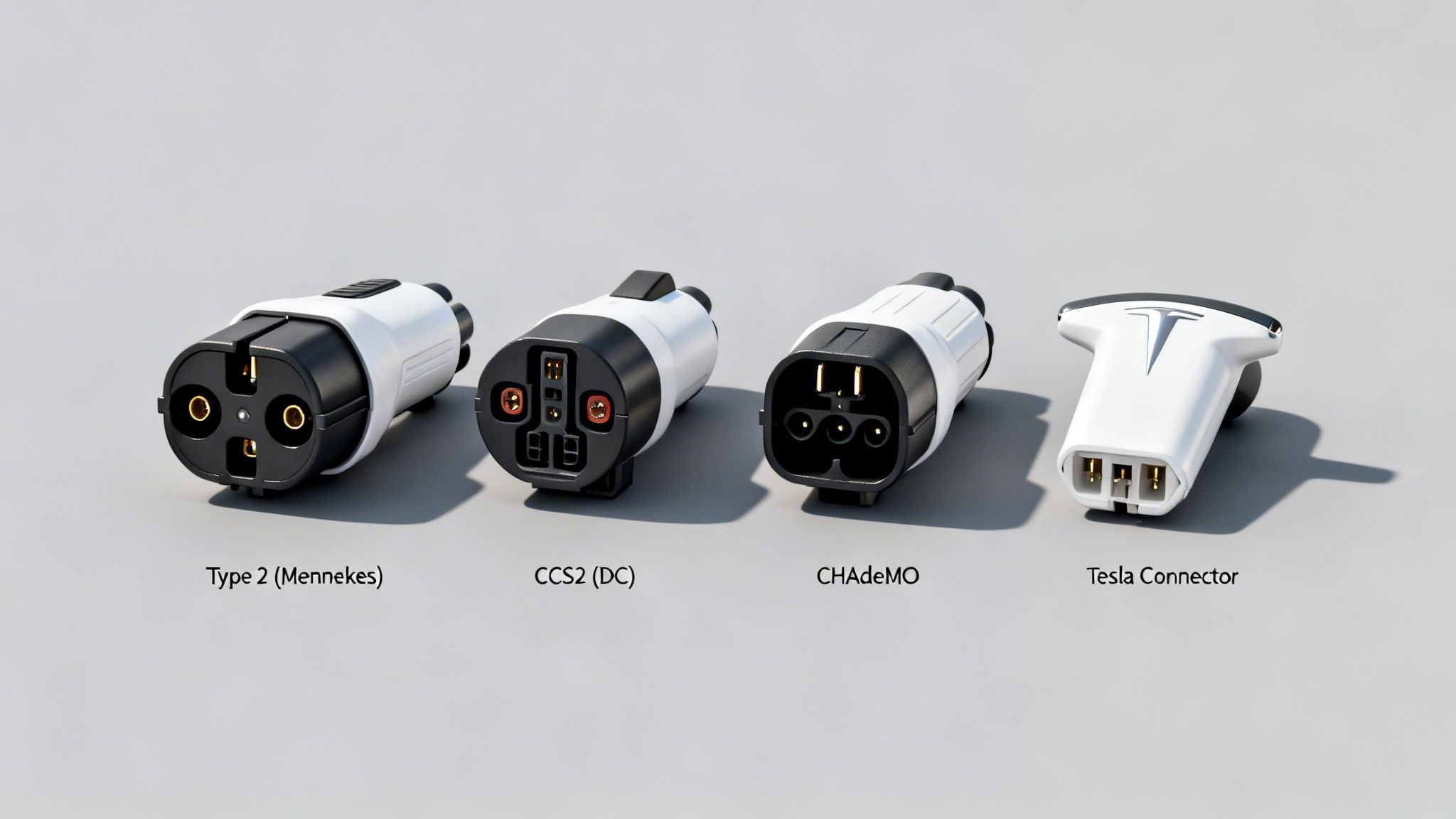
For almost all your day-to-day charging at home or at public AC stations across Australia, the Type 2 connector is the undisputed king. You might hear it called a “Mennekes” plug, and this versatile seven-pin connector is the standard across Australia and Europe.
If you get a Level 2 charger installed at your home, it will almost certainly have a Type 2 plug. This is what you’ll be using for convenient overnight top-ups, giving you a full “tank” every morning.
When you’re on a road trip and need to charge up fast, you’ll be using a DC fast charger. These use bigger, beefier plugs to handle the huge amount of power. In Australia, the dominant standard by a long shot is the Combined Charging System (CCS2).
The CCS2 plug is a really clever bit of engineering. It’s basically a standard Type 2 port with two extra-large DC pins underneath. This brilliant design means a single socket on your car can handle both slow AC charging (using the top part) and lightning-fast DC charging (using the whole plug).
You’ll also still see the CHAdeMO connector at some public charging stations. This was a popular choice for earlier Japanese EVs, like the Nissan Leaf and Mitsubishi Outlander. While many stations still support it, CHAdeMO is being phased out for new cars sold in Australia, with CCS2 taking over completely.
Finally, there’s Tesla. For years, they used their own special plug. However, new Tesla models sold here now come with a CCS2 port as standard. For older Teslas, simple adapters are available, giving drivers full access to the entire public charging network.
To help you keep track, here’s a quick breakdown of the common connectors you’ll find in Australia.
| Connector Type | Used For (AC/DC) | Common Car Brands | Notes |
|---|---|---|---|
| Type 2 | AC | Nearly all modern EVs | The standard for home, workplace, and public AC charging. |
| CCS2 | AC & DC | Most European, Korean, and new American EVs (Tesla, Ford, Hyundai, Kia, BMW, Audi, Polestar) | The dominant standard in Australia for DC fast charging. |
| CHAdeMO | DC | Older Japanese EVs (e.g., Nissan Leaf Gen 1, Mitsubishi Outlander) | Being phased out but still found at many public DC stations. |
| Tesla (Proprietary) | AC & DC | Older Tesla Models (Model S/X pre-2022) | Can use adapters to connect to Type 2 and CCS2 networks. |
As you can see, the industry has made a clear move towards the Type 2 and CCS2 combination, which simplifies things for everyone.
For property owners, especially those renovating or managing rentals in suburbs like Grange, installing a Level 2 AC charger with a Type 2 socket is the smartest and most future-proof choice. It’s far more affordable than a DC unit and lets you take advantage of cheap off-peak electricity or your own solar power. With our 19 years of experience, DLG Electrical ensures your home’s switchboard is safely upgraded to handle this load—a crucial step as the government’s EVCI Mapping Tool guides network growth through to 2034. To learn more about specific charger models, you can find some great insights on top choices at Energy Matters.
So, what’s really involved in getting a powerful **Level 2** charger set up at home? It’s not as simple as plugging in a new appliance. Installing a dedicated EV charger is a job for a professional, and the final cost isn’t just about the charger unit itself.
The price tag can vary quite a bit from one home to the next. The biggest factor we see is the state of your home’s switchboard. An older board might not have the capacity for a high-powered charger and could need an upgrade. Another key factor is the distance from your switchboard to where you want the charger installed, as a longer cable run means more materials and time on the tools.
Hiring a licensed and experienced electrician is non-negotiable. A professional installation ensures your charger is safe, fully compliant with Australian Standards (AS/NZS 3000), and won’t overload your home’s electrical system. It’s about protecting your property and your new EV.
When you’re budgeting for an EV charger, you have to look at the whole picture. The final price can be quite different depending on your home’s existing setup and what you need.
Here are the main things a professional electrician from DLG will look at:
A professional installation is a straightforward process built around safety and reliability for the long haul. A licensed electrician from DLG Electrical will usually come out for an onsite assessment to give you a firm, tailored quote before scheduling the work. The job involves running a new dedicated circuit from your switchboard, installing the right safety switches, and securely mounting the charger.
Investing in proper home charging is becoming more important every day. The EV scene in Queensland is growing rapidly, with national public charger numbers jumping by 22% in just one year. As more people switch to electric, having your own Level 2 charger isn’t just about convenience—it’s the most cost-effective way to “refuel,” thanks to cheaper residential electricity tariffs. You can read the full report on Australia’s EV uptake gains to see the trend for yourself.
Ultimately, getting a professional installation is about future-proofing your home. It adds real value to your property and makes sure you’re ready for the future of driving.
After getting to know the different EV charger types, you can see how each one is built for a specific job. When it comes to choosing the right one for your home, it’s all about matching the tech to your daily routine. For most homeowners we speak to, the answer becomes pretty clear.
A professionally installed Level 2 charger is hands-down the best all-around investment. It hits that sweet spot of speed, safety, and long-term value. While a Level 1 charger is a simple place to start, its sluggish charging speed makes it impractical for daily life, turning what should be a convenience into a constant waiting game.
A solid home charging setup isn’t just for standalone houses; it’s a massive asset for all sorts of properties. The key is finding a solution that fits the unique demands of the property and its occupants.
The key takeaway is simple: for genuine daily convenience and energy independence, a Level 2 charger is the undisputed champion for home use. It effectively turns your garage into your own private, cost-effective refuelling station.
This is where getting expert advice is non-negotiable. A professional electrician knows the subtle differences between vehicle requirements and home electrical systems. They can design a setup that’s perfectly suited to you, ensuring the installation is safe, efficient, and compliant with all local Brisbane regulations. A dodgy installation can create serious fire and electrical risks, which is why a proper assessment of your existing wiring and switchboard is the critical first step. You can learn more about the importance of professional electrical switchboard upgrades in our dedicated guide.
Partnering with a trusted local expert like DLG Electrical guarantees a smooth and stress-free transition to electric motoring. We handle everything from the initial site assessment to the final compliance sign-off, giving you a safe and reliable system that will serve you well for years to come.
Once you start digging into the details of home EV chargers, a few practical questions almost always come up. Here are the straightforward answers to the most common queries we get from homeowners across Brisbane, helping you move forward with clarity and confidence.
It’s a definite possibility, especially if you live in an older home. A Level 2 EV charger is a serious piece of equipment that draws a lot of power—often more than any other single appliance in your house. Your existing switchboard needs to have the capacity to handle that extra electrical load without breaking a sweat.
When we do a site visit, one of the first things we’ll do is a full assessment of your board. If an upgrade is required, it’s not an upsell; it’s a critical safety measure to prevent overloaded circuits and ensure everything complies with Australian electrical standards.
In a word: no. Under Australian law, installing a hardwired appliance like an EV charger is classified as fixed electrical work. That means it must be performed by a licensed electrician. There are no exceptions.
DIY installation is not just incredibly dangerous—it will instantly void your charger’s warranty and could even invalidate your home insurance policy. Getting it done professionally guarantees safety, compliance, and peace of mind for you, your family, and your new EV.
The difference is huge. Charging your EV at home is significantly cheaper than relying on public charging stations. On a standard residential electricity plan in Queensland, you’re likely paying around 25-30 cents per kWh. That means a full charge for a typical 60kWh battery might only cost you about $15.
In stark contrast, public DC fast chargers can cost anywhere from 60-80 cents per kWh, and sometimes more. That very same 60kWh charge could easily set you back $36-$48. For the daily commute, the savings from plugging in overnight really add up fast.
Ready to make home charging a reality? The licensed and experienced team at DLG Electrical is here to help you choose and install the perfect EV charger for your home, vehicle, and lifestyle. Contact us today for a free, no-obligation quote at https://dlgelectrical.com.au.

Master Electrician with over 30 years of experience. Founded DLG Electrical in 2005 after international project work including electrical installations at Stamford Bridge Stadium, London(Home of Chelsea FC).

Local Electricians that can fix all Electric Hot water Systems.
Motion sensor lights are a versatile addition to any home, offering nu
