83 Jean St, Grange QLD 4051
Mon-Fri 07:30 AM - 04:00 PM - Sat - 8:00 - 12 - Sunday Closed

You're probably here because you've read three different answers to the same question.
One page says every appliance needs regular test and tag. Another talks only about construction sites. A third gives a generic checklist that doesn't sound anything like a Brisbane rental, a home office, or a small shop with a few staff and a storeroom out the back.
That confusion is common. Electrical testing and tagging gets discussed as if the same rule applies to a tenant's kettle, a tradie's grinder, a reception desk printer, and an office power board. It doesn't. In Queensland, the right answer depends on where the equipment is used, how it's used, and who has responsibility for that environment.
For homeowners, landlords, and small business operators, the practical question isn't “Do I need tags on everything?” It's “Which items create risk on this property, and what's the right way to manage them?” That's where most online advice falls short.
A landlord in Grange might have a furnished unit with a microwave, washing machine, and a couple of extension leads left behind by the previous tenant. A homeowner in Windsor might run a home office and assume that because the gear looks fine, there's nothing more to think about. A small business owner in Brisbane might have a kitchenette, a few desktop setups, and portable tools used only during fitout or maintenance.
Those are three very different situations. Yet a lot of advice online treats them as one category.
Most online content explains test-and-tag as a workplace process, but it rarely answers whether a rental property should follow the same thinking as an office or a construction site. Australian guidance applies a risk-based approach under AS/NZS 3760, which means frequency is driven by environment and risk, not by a single universal rule, as noted in this plain-English guide to what testing and tagging means in Australia.
The most common mistake is assuming there are only two options.
Practical rule: If you manage a property, start with actual exposure. Items in wet areas, shared areas, workshops, and places with heavy use need more attention than a lamp sitting in a low-traffic study.
There's also a difference between appliance testing and broader property compliance. If you're a landlord, appliance safety is only part of the picture. Fixed wiring, switchboards, smoke alarms, and formal paperwork can matter just as much. This overview of an electrical safety certificate for landlords is useful if you're trying to separate portable appliance checks from your wider obligations.
For readers comparing Australian practice with broader electrical safety frameworks, this NFPA 70E electrical safety guide gives helpful context on how formal electrical risk management is approached in other settings.
For a Brisbane residential property, the issue usually isn't whether every household item needs tagging on a blanket schedule. The issue is whether you've identified portable electrical equipment that could create avoidable risk, and whether you're managing it sensibly.
That's the difference between box-ticking and proper safety control.
Electrical testing and tagging is a structured safety check for portable electrical equipment. It is comparable to a roadworthy inspection for items that plug into a socket. The goal isn't to make the appliance look compliant. The goal is to find faults that can't always be seen with a quick glance.
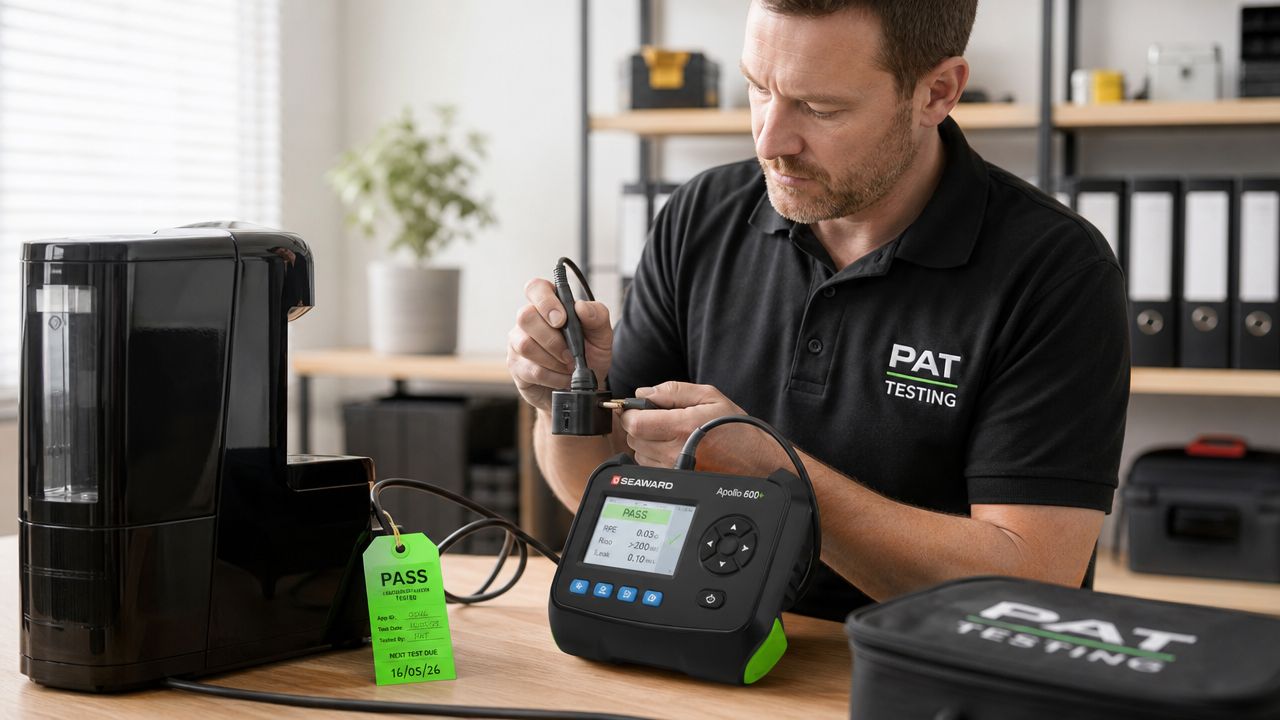
In this context, “portable” doesn't mean small enough to carry in one hand. It generally means equipment that can be moved and connected to the supply by a plug and lead.
That can include:
A fixed oven wired directly into the installation isn't the same thing as a plug-in microwave. A hardwired air conditioner isn't treated the same way as a portable fan heater.
A proper test starts before any machine is connected. The first check is visual. That's where obvious defects get picked up. Cracked plugs, bent pins, frayed cords, heat marks, loose cable entry points, and damaged casings all matter.
After that, the technician uses a Portable Appliance Tester or similar test instrument to check the item electrically. The exact tests depend on the appliance type, but the purpose is straightforward:
The tag isn't decoration. It's the visible record that the item has been inspected and tested. In practice, the tag helps owners, managers, tenants, and staff see whether the item has been checked and whether it should still be in service.
A compliant tag needs to be durable and easy to read. It typically identifies the test date and the next due date, along with details that let the item be tracked in records.
The useful part of a tag isn't the colour. It's the fact that someone can look at the item and know whether it's current, overdue, failed, or removed from service.
Different companies may use different tag colours for their own systems. Colour alone doesn't tell the full story. The information on the tag, and the record behind it, is what matters.
Queensland doesn't treat electrical testing and tagging as a one-rule-for-everything exercise. The framework comes from workplace electrical safety requirements and the technical standard used across Australia for portable appliance inspection and testing. The key point for property owners is simple. Risk drives frequency.
WorkSafe Queensland states that only a person appointed as competent by their employer can test and tag electrical equipment, and it requires a durable tag showing the test date and the next scheduled test date. WorkSafe Queensland also sets clear intervals for different environments, with the schedule drawn from the AS/NZS 3760 approach. You can review that directly in the WorkSafe Queensland guidance on testing and tagging electrical equipment.
Here's the essential information. The interval changes with the environment.
| Environment / Equipment Type | Recommended Retest Frequency |
|---|---|
| Construction work | 3 months |
| Manufacturing work when equipment is not double insulated | 6 months |
| Office work with no safety switch | 12 months |
| Office work with a fixed safety switch present | 5 years |
That spread tells you a lot. A grinder on a building site gets dragged around, dropped, exposed to dust, and plugged into temporary supplies. A printer in a protected office doesn't face the same abuse. The schedule reflects that difference.
A Brisbane rental usually doesn't operate like a workplace construction zone. But that doesn't mean you ignore portable appliance safety. It means you classify the gear properly.
For example:
If you use one site-wide schedule for every item, you'll either overspend on low-risk gear or under-manage the equipment that actually gets damaged.
That's also why appliance records matter. The durable tag is only one part of the system. The wider compliance value comes from keeping an auditable trail of what was inspected, what passed, what failed, and what needs review next.
Portable appliance checks sit alongside wider electrical responsibilities. If you're dealing with renovation work, tenancy turnover, defect rectification, or insurance paperwork, you may also need documentation for completed electrical work. This guide to an electrical certificate of compliance helps distinguish fixed electrical work records from test-and-tag records.
The practical takeaway is straightforward. Don't ask, “What's the standard interval?” Ask, “What environment is this equipment used in?” That question gives a far better answer.
When a proper test and tag service is done well, it's organised, methodical, and easy to follow. It shouldn't feel like someone walking through the property sticking labels on cords as fast as possible.
A good visit starts with identifying the equipment, the environment it's used in, and anything that needs to be isolated or removed from service before testing begins.
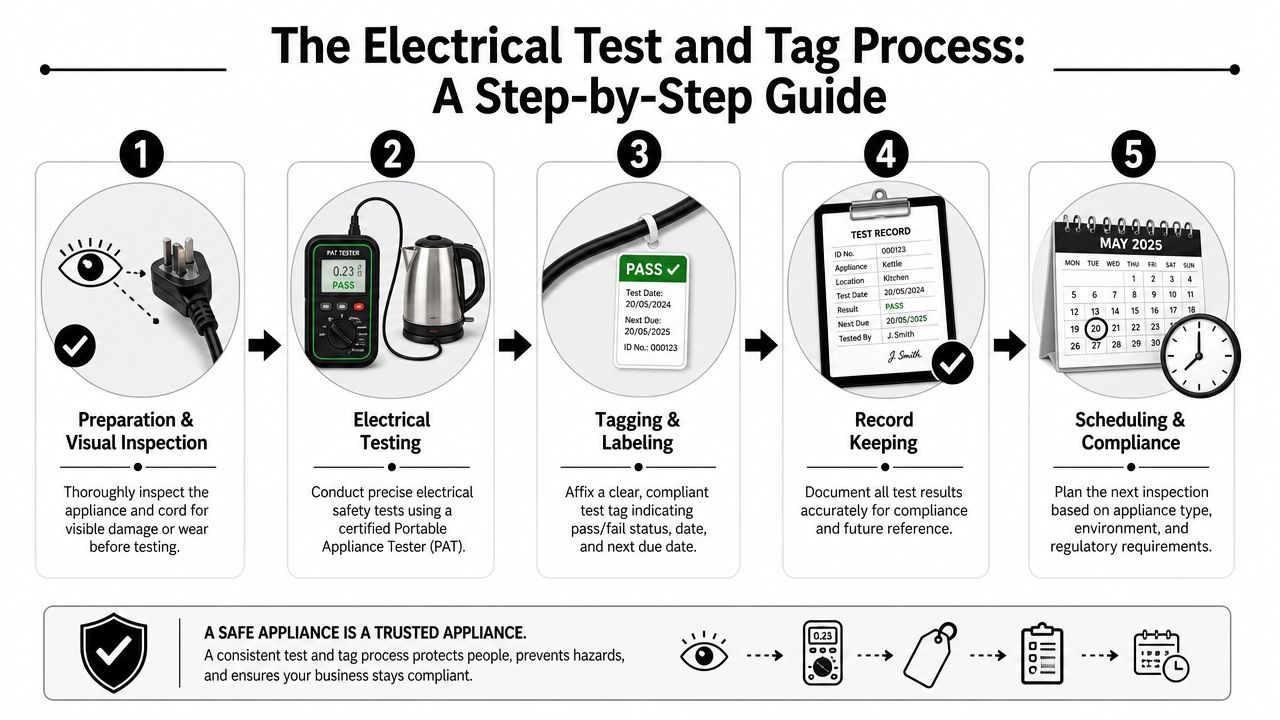
The first stage is always the visual inspection. This catches a surprising number of problems before the tester even comes out.
An electrician will usually look for:
If an item is clearly unsafe, it shouldn't stay in use just because someone wants a test reading. Unsafe gear gets pulled aside.
The next stage is the electrical test using a PAT device or equivalent instrument suited to the appliance class. That's where the technician confirms whether the item meets the required safety checks for its type.
Once the item passes, the technician applies the tag. Queensland guidance requires that durable, visible tag to show the test date and the next scheduled test date. According to Australian industry guidance, that tagging requirement matters because it creates an auditable record and turns testing from a one-off event into a recurring compliance system under AS/NZS 3760, as explained in this overview of electrical tag testing and record-keeping practice.
The on-site process makes more sense when you see it visually.
The tag on the cord is only the visible part. The more useful deliverable is the record set.
That usually includes:
The record matters as much as the test. If you can't show what was checked, when it was checked, and what failed, the tags alone won't help much during a dispute, audit, or incident review.
For small businesses, strata managers, and landlords with multiple appliances, that register is what makes the system manageable over time.
Electrical testing and tagging is worth doing when it's applied to the right equipment for the right reason. It's not magic, and it's not a substitute for proper electrical maintenance. It is a practical way to identify damaged portable equipment before someone keeps using it because “it still turns on”.
The biggest benefit is obvious. You reduce the chance that a worn lead, faulty plug, or damaged appliance stays in service longer than it should.
For property owners and small operators, the value usually sits in four areas:
There's also a practical legal angle. Good records make it easier to show that portable appliance safety was actively managed, rather than treated as an afterthought.
Owners sometimes misinterpret the situation. A fresh tag on an appliance doesn't mean the whole property is electrically safe.
Australian guidance aimed at Brisbane owners and landlords points out that full value comes from combining test-and-tag with broader maintenance, especially around fault-prone items, damaged cords, and RCD safety, as discussed in this article on what testing and tagging should and should not be relied on for.
That means if you've got nuisance tripping, old power boards, suspect outlets, or switchboard concerns, appliance tagging alone won't fix the underlying problem.
Pricing varies by provider, access, number of items, and how organised the site is. Some jobs are priced around a call-out plus item count. Others depend on whether the contractor is testing a short list of appliances at one property or managing a larger asset register across multiple tenancies.
The best way to think about cost is operationally:
If you want a rough sense of how providers structure charges, this overview of testing and tagging prices is a practical starting point.
The expensive mistake isn't usually the service fee. It's leaving damaged equipment in use because nobody checked it properly.
Most properties don't need a blanket response. They need a clean list, a quick risk sort, and a sensible schedule. That's how owners avoid both under-managing and over-servicing.
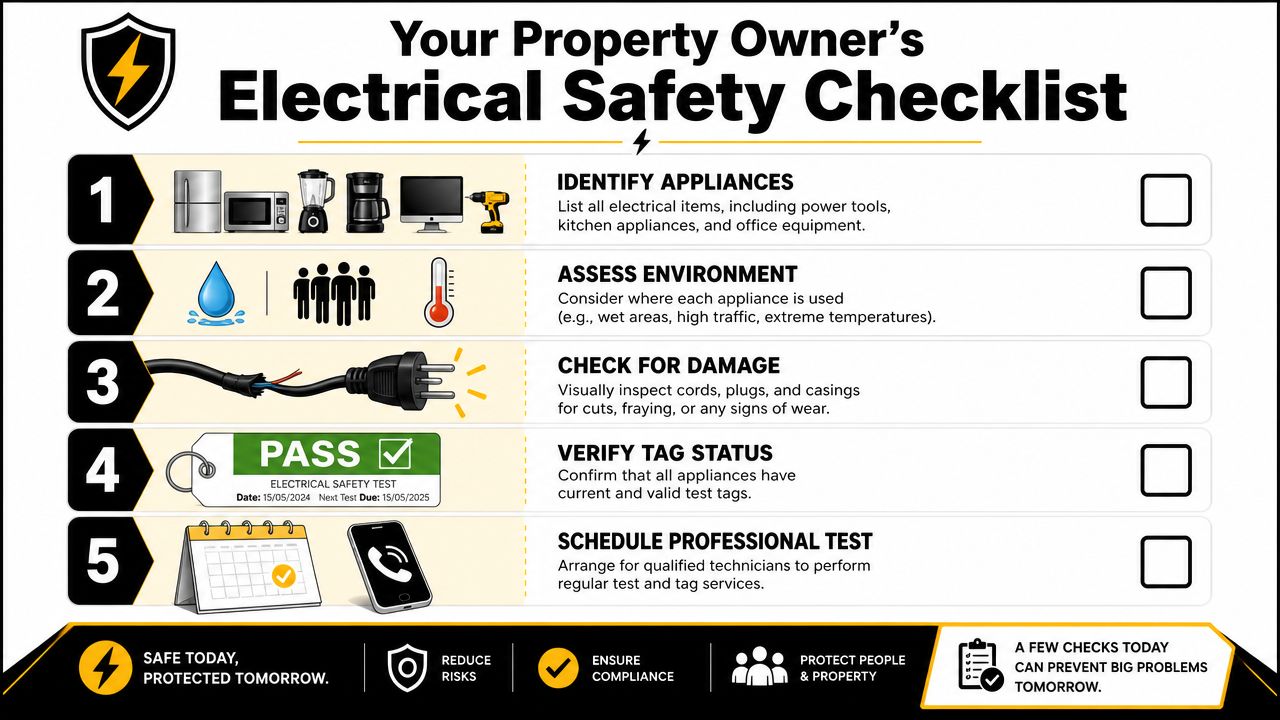
Walk the property and list every plug-in item you supply or control. Don't stop at the obvious appliances.
Include:
If it plugs in and stays with the property or the business, it belongs on the list.
The foundation for useful decisions lies in Australian guidance for property managers and commercial operators, recommending equipment classification by environment and duty cycle, because gear that is moved often or exposed to dust and impact degrades faster than stationary office appliances, as explained in this summary on risk-based electrical test and tag intervals.
A simple property-level sort works well:
| Risk band | Typical examples |
|---|---|
| Low | Study lamp, desktop monitor, modem in a dry room |
| Medium | Vacuum cleaner, portable heater, extension lead in regular use |
| Higher | Power tools, damp-area equipment, frequently moved leads and boards |
You don't need test gear to spot obvious problems. Owners and managers should look for damage between formal inspections.
Check for:
If something looks wrong, take it out of service. Don't leave it there for the next scheduled visit.
A quick visual check by the owner won't replace formal testing, but it often catches the issue that matters most. The appliance should never have stayed plugged in.
A workable checklist is better than a perfect one nobody follows.
Use this sequence:
For Brisbane owners with a few appliances across a rental, home office, or small shop, that approach keeps the focus where it belongs. On real risk.
Choosing a test and tag provider isn't about finding someone who can print labels. It's about finding someone who can identify unsafe equipment, classify it sensibly, and leave you with records you can use.
For Brisbane properties, ask straightforward questions before you book:
If you want one local option, DLG Electrical provides residential and commercial electrical services in Brisbane, which makes them relevant when appliance testing sits alongside wider maintenance, repairs, or compliance work on the same property.
A good booking process should be simple. You describe the property, the number and type of appliances, and whether the site includes higher-risk gear such as extension leads, portable tools, kitchen appliances, or maintenance equipment. The contractor should then explain the likely scope, what records you'll receive, and whether any related electrical issues need separate attention.
The main thing is not to treat electrical testing and tagging as a sticker exercise. If the person you hire can't explain risk, records, and next steps in plain language, keep looking.
If you need help sorting out which appliances on your Brisbane property should be tested, and which issues need broader electrical attention, contact DLG Electrical for a free, no-obligation quote. You'll get practical advice, clear records, and a compliance approach that fits the way your property is really used.

Master Electrician with over 30 years of experience. Founded DLG Electrical in 2005 after international project work including electrical installations at Stamford Bridge Stadium, London(Home of Chelsea FC).

Local Electricians that can fix all Electric Hot water Systems.
Motion sensor lights are a versatile addition to any home, offering nu
