83 Jean St, Grange QLD 4051
Mon-Fri 07:30 AM - 04:00 PM - Sat - 8:00 - 12 - Sunday Closed
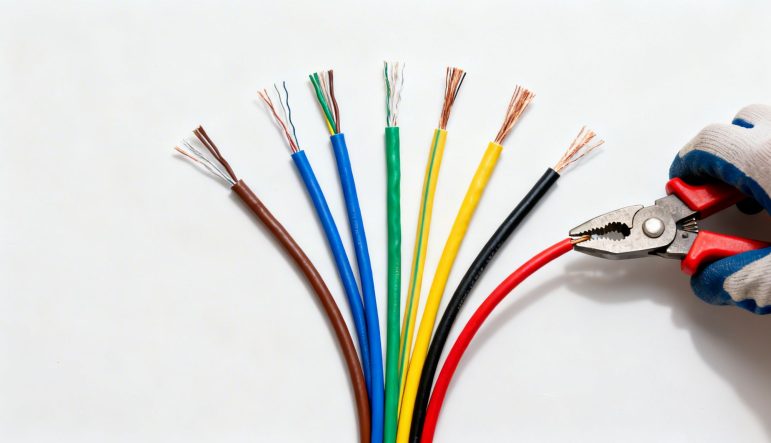
In Australia, knowing your electrical wiring colours isn’t just trivia for tradies—it’s a fundamental safety rule. The whole system is standardised to make sure everyone’s on the same page, with Brown for Active, Blue for Neutral, and Green/Yellow for Earth. This isn’t just a guideline; it’s a critical safety protocol laid out in the AS/NZS 3000 standard, often called the “Wiring Rules.”
Understanding what these colours mean is the first step in knowing what you’re looking at behind a power point or light switch, and more importantly, when to step back and call a professional.
At first glance, the wiring inside your walls might look like a complicated mess. But once you know the modern colour code, it’s actually quite logical and designed purely for safety. Years ago, Australia harmonised its standards with international codes (specifically IEC 60446), which was a huge step forward. It means an electrician trained in Brisbane uses the same “language” as one in Berlin, dramatically reducing the risk of dangerous mix-ups during installations or repairs.
This simple diagram is a great visual cheat sheet for the three main wires you’ll find in any modern, single-phase Aussie home.
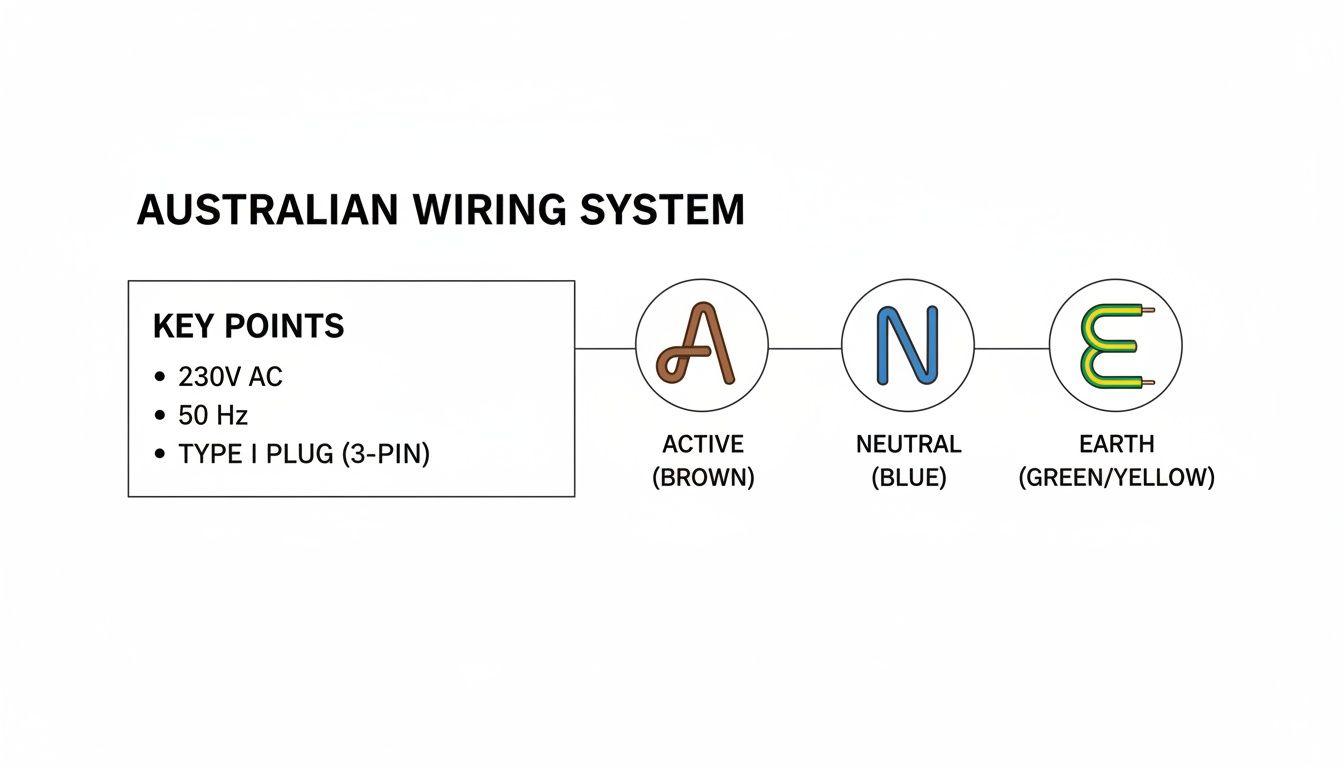
This graphic boils the current standard down to its essential parts. It’s the perfect quick reference to have handy.
For any licensed sparkie, these colours are second nature. But even if you’re a homeowner just trying to understand your property better, memorising these three core colours is non-negotiable for basic electrical safety awareness.
To make things even easier, here’s a quick-reference table breaking down the modern Australian wiring colours you’ll see in any compliant home today, as per the AS/NZS 3000 standard. Think of this as your go-to guide for identifying wires at a glance.
Current AS/NZS 3000 Wiring Colour Codes
| Wire Colour | Function | Common Name |
|---|---|---|
| Brown | Carries the electrical current from the power source. | Active or Live |
| Blue | Completes the electrical circuit, returning current to the source. | Neutral |
| Green/Yellow | A safety wire that provides a path for current to go to the ground in case of a fault. | Protective Earth |
This table covers the fundamentals for any standard single-phase circuit you’d encounter. Each colour signifies a distinct and vital role. Getting them mixed up isn’t just a simple mistake—it can lead to electric shock, fire, or catastrophic damage to your appliances.
If you’ve ever looked inside a light switch or power point in a home built before 2000, you’ve probably seen the old-school wiring colours. The classic Australian system was straightforward: red for active, black for neutral, and green for the earth wire. This was the standard for decades, but as the world became more connected, it started to pose a few safety problems.
To boost safety and get in sync with the rest of the world, Australia made a crucial switch. This wasn’t just a cosmetic change; it was about creating a universal language for electricians everywhere. With so many appliances and electrical components coming from overseas, a harmonised system was needed to prevent dangerous mix-ups and keep everyone safer.
The main driver behind updating our wiring colours was to align with the International Electrotechnical Commission (IEC) standards. This single move brought Australia’s wiring practices in line with Europe and many other parts of the world, making things much simpler for tradespeople and manufacturers. A unified colour code simply means fewer mistakes and a safer worksite, whether you’re installing a new circuit or fault-finding on an imported machine.
For homeowners, though, this changeover period created a bit of a messy situation. Properties built around the late 1990s and early 2000s can sometimes have a mix of both old and new wiring colours. This makes renovations or even simple repairs a real hazard if you don’t know exactly what you’re looking at.
In 2000, Australia officially moved to the modern colours we use today: brown for active, blue for neutral, and green/yellow for the protective earth. This transition brought us into line with the international IEC 60445 standards, a massive step forward for electrical safety.
However, the old wiring is still out there. Industry reports show that over 40% of Queensland homes built before the year 2000 still have some form of mixed or outdated wiring. This creates a 25% higher risk of misidentification errors during maintenance, a serious safety issue flagged in AS/NZS 3000 compliance audits. If you want to dig deeper, this informative wiring colours guide offers a great overview of the different standards.
This transition highlights something every property owner needs to understand.
The presence of older wiring colours like red and black is a strong indicator that your home’s electrical system may not meet current safety standards. It often signals the need for a professional inspection to assess its condition and ensure compliance.
A licensed electrician can spot these legacy systems immediately and advise on what needs to be done, whether that’s replacing old, brittle cabling or installing modern safety switches. To learn more about the rules we work to, check out our guide on the current electrical wiring standards in Australia. Getting your wiring checked ensures your home isn’t just compliant, but genuinely safe for you and your family.
If you live in an Australian home, you’re almost certainly using a single-phase electrical system. It’s the standard setup that powers everything from your kettle to your air conditioner. Getting your head around the basics is the first step to understanding why our wiring colour codes are so important for safety.
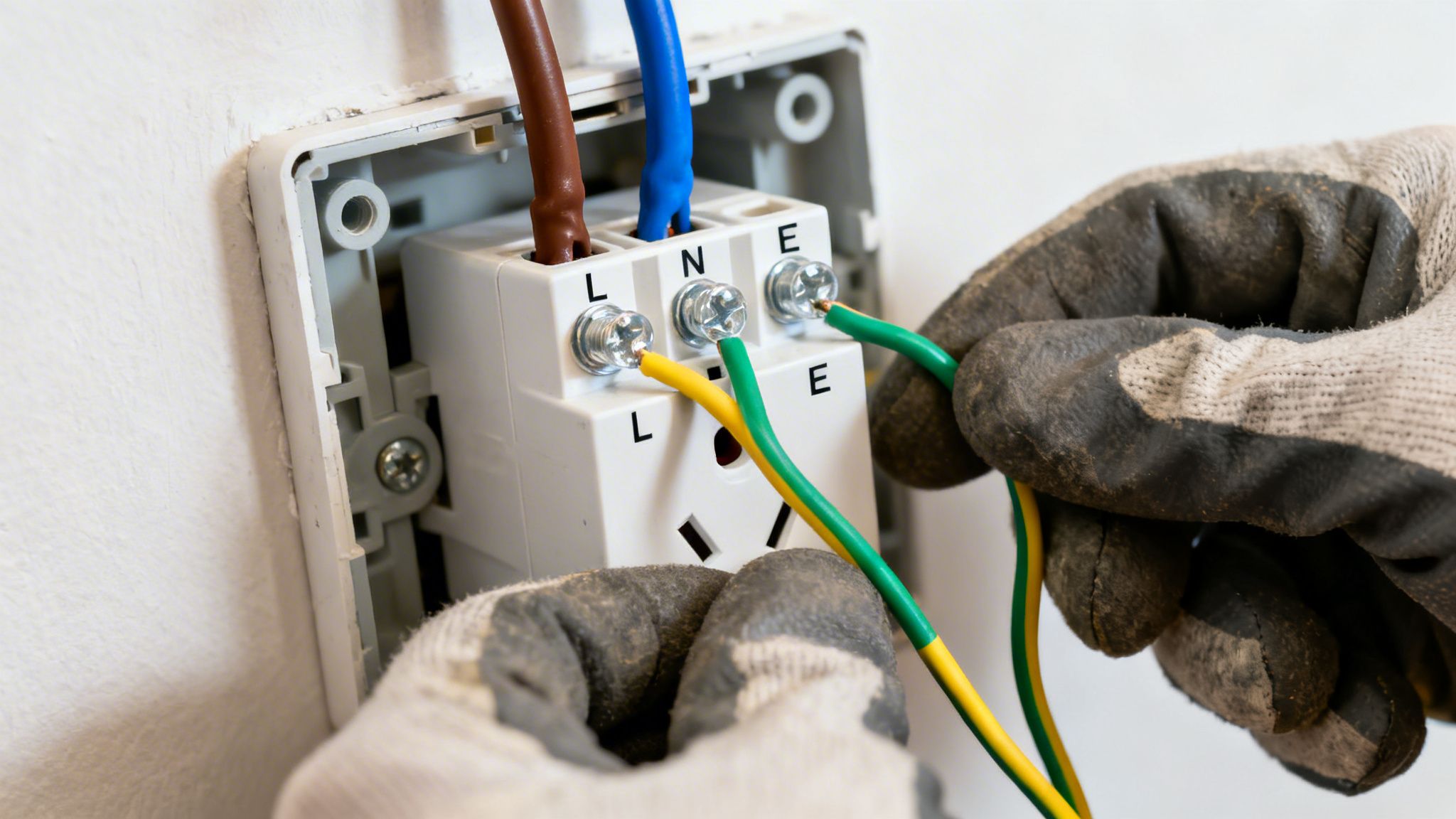
At its heart, the system is pretty straightforward. It relies on three specific wires, each with a critical job to do. One brings the power in, one takes it back out, and a third is there purely for safety. Let’s break down what each one does.
The brown wire is your Active or Live conductor. Think of it as the high-pressure pipe carrying electricity from your switchboard to whatever needs power. This is the wire that carries the dangerous voltage, which is why it demands the utmost respect.
When you flip a light switch, you’re essentially completing a circuit that lets power flow through the brown active wire to the light fitting. It’s for this exact reason that you must never touch a brown wire unless you’re a licensed sparkie who has properly isolated and tested the circuit.
Next up is the blue wire, which is the Neutral conductor. Its job is to complete the circuit. After the electricity has done its work in your appliance, the blue wire carries the current back to the switchboard, creating a continuous loop for the power to flow.
While the neutral wire generally sits at or near ground potential, it can become live if a fault occurs elsewhere in the system. Because of this, it needs to be treated with the same caution as the active wire. In a properly wired GPO (General Purpose Outlet), the blue wire is what lets your devices run as they should.
Finally, we have the green-and-yellow striped wire, known as the Protective Earth. This one is a pure lifesaver. Under normal conditions, it carries no current at all. Its sole purpose is to provide a safe path for electricity to escape to the ground if something goes wrong, like a live wire touching a metal appliance casing.
This grounding action is precisely what trips a safety switch (RCD) or circuit breaker, shutting off the power in milliseconds and preventing a potentially lethal electric shock. The earth wire is your electrical system’s most important failsafe.
Imagine the wiring inside your washing machine frays, and the active wire touches the metal drum. The green-and-yellow earth wire instantly diverts that dangerous current straight to the ground, tripping the RCD long before you can get a shock.
Understanding the distinct roles of these three wires—brown, blue, and green-and-yellow—gives you a much clearer picture of how a single-phase circuit works safely. It also shows why following the colour codes isn’t just about ticking a box for compliance; it’s about keeping people safe. Always remember, any hands-on work with these wires is a job for a licensed professional.
While most homes across Brisbane are perfectly fine running on single-phase power, many commercial sites and larger houses with power-hungry gear need something a bit more robust. That’s where three-phase power comes in. It delivers a much steadier, more reliable stream of electricity, which is exactly what you need for running big air conditioning units, commercial kitchen equipment, or heavy workshop machinery.
Getting your head around the wiring colours for these systems is absolutely critical. Unlike single-phase, you’re dealing with multiple active conductors, and a simple mix-up can lead to catastrophic equipment failure or, far worse, a serious safety hazard. Thankfully, modern Australian standards have made things much clearer and safer.
The current standard, AS/NZS 3000, lays out a distinct and logical colour system for three-phase wiring. Each active phase gets its own colour, which makes it incredibly easy for sparkies to identify them and properly balance the electrical load across the system. It’s a huge leap forward in safety compared to the old days.
Here are the standard colours you’ll see in any new installation:
Along with these three active wires, the system uses the same neutral and earth colours you’d find in a single-phase setup.
So, while you have three active wires doing the heavy lifting from the switchboard, they’re all supported by the same fundamental neutral and earth wiring. If you’re thinking about an upgrade for your property, you can get the full rundown in our guide to three-phase power installation.
Just like with standard household wiring, three-phase systems went through a major colour code overhaul. Before the current standards kicked in, electricians were working with a totally different set of colours that could easily cause confusion, especially when you’re working in a dimly lit roof space or switch room.
The old pre-2000 standard used Red, White, and Blue for the three active phases. The white active wire was a particular problem because it could easily be mistaken for a neutral wire in other contexts, creating a massive risk of electrocution. Switching to the modern Brown, Black, and Grey system has completely eliminated that dangerous ambiguity.
The move to the harmonised AS/NZS 3000 standard was a game-changer for safety and efficiency. After the post-2000 colour codes were introduced—making Phase 1 brown, Phase 2 black, Phase 3 grey, neutral blue, and earth green/yellow—compliance in new installations shot up to 92% by 2005. This clarity led to a 28% reduction in downtime related to wiring faults, according to audits by Australian Standards.
This table shows the transition perfectly.
This quick comparison highlights the critical shift from the pre-2000 wiring colours to the current, much safer AS/NZS 3000 standard used across Australia today.
| Function | Pre-2000 Colour Code | Current AS/NZS 3000 Colour Code |
|---|---|---|
| Phase 1 (L1) | Red | Brown |
| Phase 2 (L2) | White | Black |
| Phase 3 (L3) | Blue | Grey |
| Neutral | Black | Blue |
| Protective Earth | Green | Green/Yellow Stripe |
As you can see, the updated electrical wiring colour codes provide a far more intuitive and safer framework for electricians. If you own or manage a commercial property with older wiring, it’s essential to get a professional inspection done to ensure everything is safe and compliant with today’s strict standards.
If you’ve ever looked inside a switchboard or behind a power point in an older home, especially one built before 2000, you might have noticed a completely different set of wire colours. This isn’t just a quirky design choice from a bygone era; it’s a legacy wiring system that requires a healthy dose of respect.
Recognising these older systems is a critical first step in electrical safety. The colours used back then had entirely different meanings, and confusing them with modern standards can be genuinely dangerous.
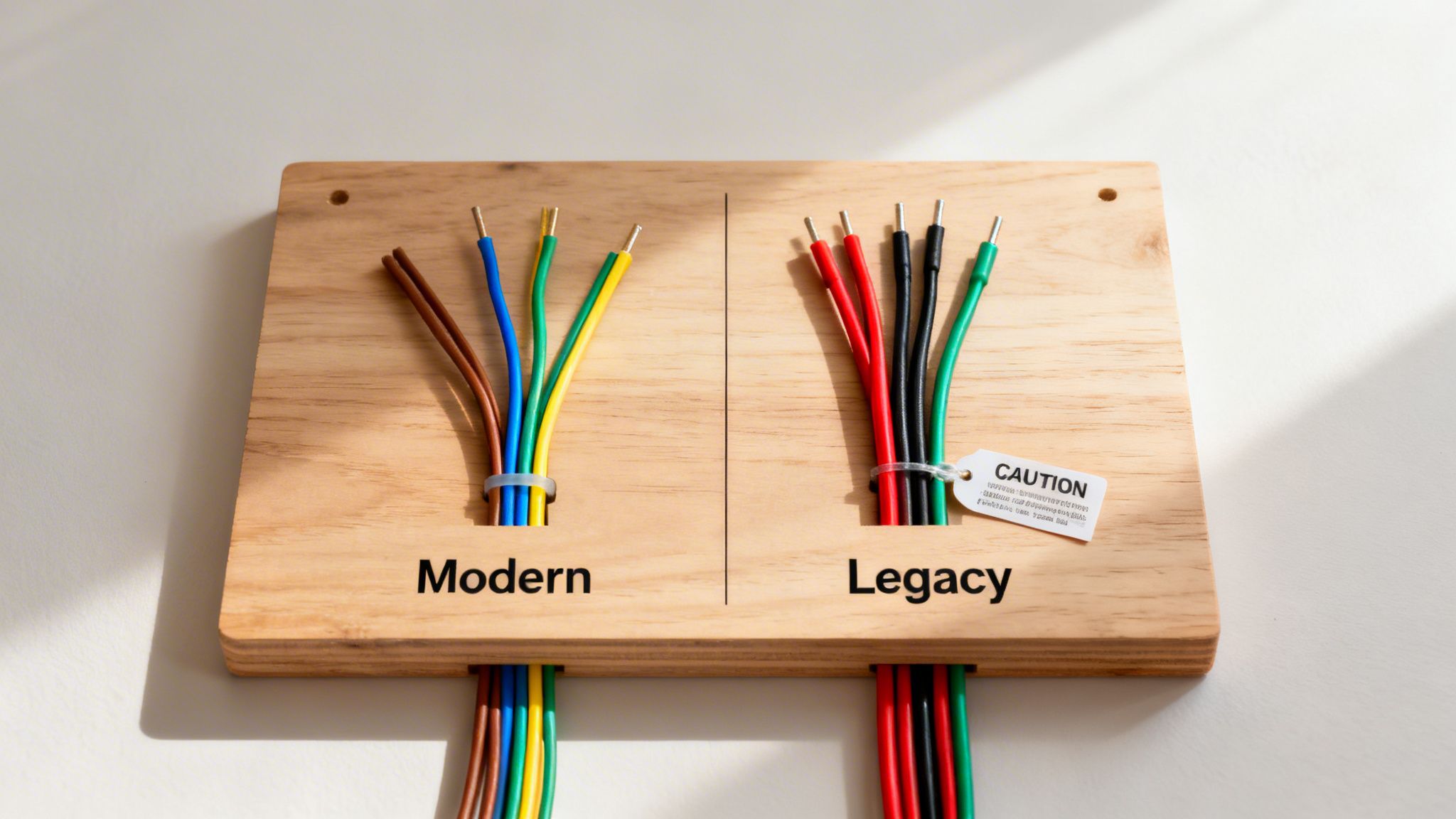
The most common legacy system you’ll come across in Australia uses a simple palette. Seeing these colours is a dead giveaway that you’re dealing with a pre-2000 installation that really should be looked over by a professional.
Before Australia moved to harmonise with international IEC standards, our wiring landscape was defined by its own distinct set of colours. The real danger today is that these old functions don’t line up with what a modern sparkie would expect to see.
Here’s the old-school lineup to look out for:
The main hazard here is pretty clear: in a modern three-phase system, black is now an active colour. An electrician who isn’t aware they’re working on an old system could easily mistake the old black neutral for a live wire. That kind of mix-up can lead to electric shock or fried appliances in a heartbeat.
Critical Safety Warning: Never, ever assume a wire’s function based on its colour in an older property. If you see red, black, and green wires, take it as a clear signal that the system might not meet today’s safety standards. It’s time to get it professionally assessed by a licensed electrician.
In very old homes, you might uncover wiring that dates back to the imperial system, which frankly, poses even bigger risks. These ancient systems sometimes used red and black for both active and neutral conductors in the same circuit, making a visual ID impossible without proper testing gear.
Worse still, the insulation on these older cables is often rubber or cloth, which becomes brittle over time and can crack or crumble away. This exposes the live copper wire underneath, creating a massive fire hazard.
Discovering any kind of legacy wiring is often a sign that it’s time to think seriously about a full rewire for the safety of your family and your property. To get a better idea of what’s involved, you can learn more about the average cost of rewiring a house in Australia. Booking a professional inspection and potentially upgrading your switchboard is always the safest way forward.
Getting your head around Australian wiring colour codes isn’t just about passing a technical exam—it’s a fundamental safety measure. Think of it as a universal language for electricians, designed to prevent catastrophic mistakes. When that language is misunderstood, a simple job can quickly become a life-or-death situation.
Picture this: a keen DIYer is renovating an older home and comes across the old red and black wiring. They assume black is neutral, like it is in many other applications. But in this legacy system, black is often an active conductor. Connecting that wire to a new appliance thinking it’s neutral can energise the entire metal casing, creating a silent, deadly trap for the next person who touches it.
This isn’t a rare occurrence. It’s a very real danger lurking in older properties across Brisbane and Queensland.
Getting the wires mixed up is a recipe for disaster. The consequences go far beyond a simple circuit trip; we’re talking about serious harm and significant property damage.
The switch to the harmonised AS/NZS 3000 wiring colours has made our homes safer, but it has also highlighted the risks in properties that haven’t been updated. In Queensland alone, there were 18,000 reported wiring faults in 2022, and a shocking 62% of them were traced back to old red/black/green systems.
The risks aren’t just confined to residential settings, either. Electrocution remains one of the primary workplace safety risks in electric utilities, which shows just how dangerous this work is even for trained professionals.
In Australia, it’s crucial to remember that performing your own electrical work is not just dangerous—it’s illegal. Only a licensed electrician has the training, tools, and expertise to work safely and certify that your home complies with current standards.
At the end of the day, these colour codes are a critical safety language. Respecting what they mean and leaving electrical work to the professionals is the only way to protect your property and the people inside it.
Even with a handy chart in front of you, things can get confusing when you’re staring at the actual wires in your wall. This is especially true in older Brisbane homes that have seen a renovation or two over the decades.
Here are some of the most common questions we get asked by homeowners. The answers highlight just how tricky real-world wiring can be and why a professional eye is so important for keeping your family safe.
Absolutely. In fact, it’s very common in homes built or renovated between the late 1990s and the mid-2000s. This was the changeover period, so it wasn’t unusual for an electrician to run a new circuit for an air conditioner using the modern brown, blue, and green/yellow, while the original lighting circuits next to it were still the old red, black, and green.
This creates what we call a mixed wiring system. While it might have been installed correctly at the time, it’s a recipe for confusion and creates a serious risk of misidentification during any future work.
Think of a mixed system as a major red flag. It’s a clear sign you need a professional electrical inspection. A licensed electrician can trace every circuit, properly label your switchboard, and guarantee all connections are safe and up to current standards. It completely removes the dangerous guesswork.
You’ve probably noticed that the flexible cord on your toaster or lamp doesn’t always seem to match the wiring in the wall. That’s because appliance cords follow a slightly different standard, though the fundamental principles of Active, Neutral, and Earth are exactly the same.
For nearly all modern appliances sold in Australia, you’ll find this combination:
As you can see, this combination directly mirrors the current AS/NZS 3000 standard for the fixed wiring in your walls. This consistency is designed for safety, all the way from the socket to the device. If you ever see an appliance cord that’s frayed with these colours showing, stop using it immediately.
No, and this is a critical safety point. While Australia’s move to the IEC standards brought us in line with Europe and many other parts of the world, there are still massive differences globally. You can never assume the colours in one country mean the same thing in another.
Just look at these examples:
This is exactly why using imported electrical gear that isn’t certified for Australian use is so risky. The internal wiring might not align with our system, creating a serious risk of malfunction, fire, or electric shock when you plug it in.
Over the years, the heat from current, general age, or even sunlight exposure can cause the coloured insulation on wires to fade badly. Sometimes they’re just covered in dust or old paint, making them impossible to identify at a glance.
If you can’t be 100% certain of a wire’s colour and function, you must treat it as live and dangerous. Never, ever guess. This is a situation that demands immediate professional help. A licensed electrician has proper testing equipment, like a multimeter, to safely trace the wire and determine its purpose, regardless of what it looks like. Guessing wrong could cause a short circuit, start a fire, or lead to a fatal electric shock. Stop all work and call a professional. This is a non-negotiable safety rule.
At DLG Electrical, our licensed and insured electricians have seen it all. We have the expertise to safely identify, repair, and upgrade any wiring system, whether it’s old, new, or a confusing mix of both. If you’re worried about mixed colours, faded wires, or the general electrical safety of your Brisbane home, don’t leave it to chance. Contact us for a free, no-obligation quote and get the peace of mind you deserve.

Master Electrician with over 30 years of experience. Founded DLG Electrical in 2005 after international project work including electrical installations at Stamford Bridge Stadium, London(Home of Chelsea FC).

Local Electricians that can fix all Electric Hot water Systems.
Motion sensor lights are a versatile addition to any home, offering nu
