83 Jean St, Grange QLD 4051
Mon-Fri 07:30 AM - 04:00 PM - Sat - 8:00 - 12 - Sunday Closed

Electrician company near me: When you need to find a good electrician, the last thing you want is to be frantically Googling “residential electrician company near me” while sparks are flying from an outlet. The smart move is to do your homework beforehand, so you have a shortlist of trusted, local professionals ready to go before an emergency strikes.

Hitting the search bar is the natural first step, but the real skill is in looking past the first paid ad. Your goal is to find electricians with a proven track record, not just the biggest marketing budget. There are some great strategies for finding local service companies that apply here, helping you cut through the noise.
Effective searching means digging into what real customers are saying. Don’t just look at the star rating; look for a consistent pattern of positive, detailed feedback across multiple sites like Google Reviews.
Sometimes the best leads come from people you already trust. Ask your neighbours, family, or work colleagues who they’ve used for electrical work. A firsthand recommendation is often worth more than a dozen online reviews. Local community groups on social media can also be a goldmine for honest, unfiltered opinions.
Once you have a few promising names, do a quick digital once-over. A professional and easy-to-navigate website is a good sign. It should clearly lay out their services, service area, and how to get in touch. If you want to get a better feel for the kind of work they do, reading up on different types of electrical services in Brisbane can help you know what to look for.
Before you waste time making calls, make this your golden rule: only consider electricians who are fully licensed and insured. This isn’t just a box to tick; it’s a critical safety net for your home, your family, and your finances.
A legitimate residential electrician will have their licence number handy and won’t hesitate to provide it. You can usually verify this with your state’s regulatory body. They should also be able to show you a current Certificate of Currency for their public liability insurance, which protects your property from any accidental damage during the job.
An unlicensed or uninsured tradie puts all the risk squarely on your shoulders. If they damage your property or someone gets hurt, you could be left with a massive bill. Always, always verify these credentials upfront.
Any hesitation or excuse when you ask for these documents is a giant red flag. Thank them for their time and move straight on to the next name on your list. It’s simply not worth the risk.
To help you stay organised, here’s a quick checklist you can use to vet potential electricians before you even pick up the phone.
Use this table as a quick reference to evaluate potential residential electricians before making contact.
| Vetting Criteria | Why It’s Critical for Your Safety | Where to Verify |
|---|---|---|
| Electrical Contractor Licence | Confirms they are qualified and legally allowed to perform electrical work. | Ask for their licence number and check it on your state’s official licensing board website. |
| Public Liability Insurance | Covers the cost of any accidental damage to your property during the job. | Request a copy of their Certificate of Currency. It should be current. |
| Professional Website | A clear, professional website suggests an established and serious business. | Check their website for clear service descriptions, contact details, and service areas. |
| Consistent Positive Reviews | Shows a history of satisfied customers and reliable service. | Look at Google Reviews, local directories, and community social media groups. |
| Local Service Area | A truly local electrician will have a faster response time, especially in an emergency. | Their website or Google Business Profile should list their main service suburbs. |
Having these fundamentals checked off ensures you’re only spending time on qualified, professional electricians who take your safety as seriously as you do.
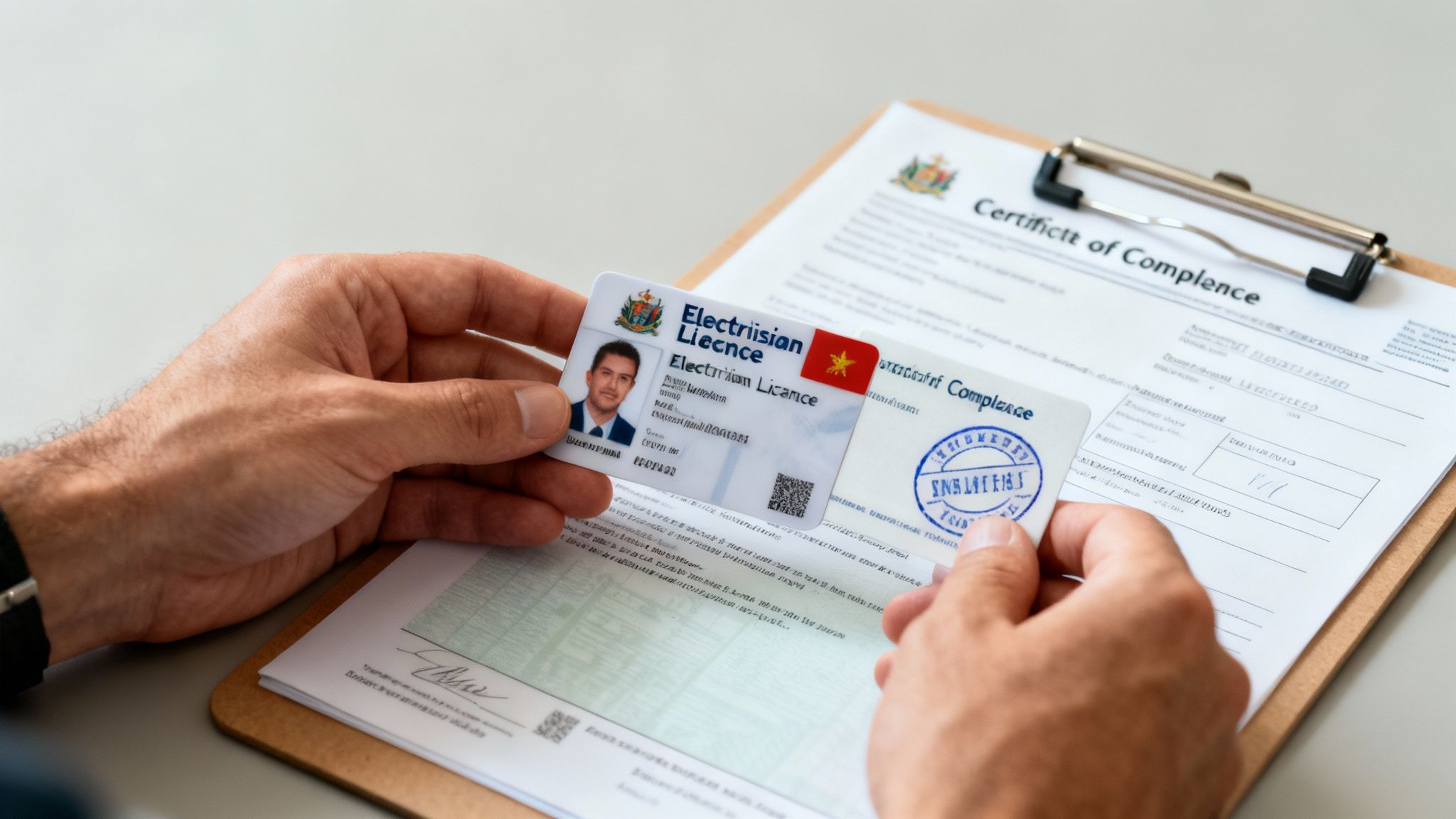
Alright, you’ve narrowed down your list of potential sparkies. Now comes the most important part: digging deeper than just the online reviews. The credentials an electrician holds aren’t just pieces of paper; they are your primary defence against shoddy, non-compliant, and downright dangerous work.
This is the step that separates the true professionals from the cowboys.
Any legitimate residential electrician company near me will be completely open about their qualifications. The first and most critical credential is their electrical contractor licence. This confirms they are legally allowed to operate and have passed the tough training and competency standards set by state authorities.
Never feel awkward about asking for their licence number. It’s your right. You can then verify it on your state’s public register to be sure.
In Australia, electrical licensing isn’t a ‘nice-to-have’—it’s the law. An unlicensed person touching your wiring is not only breaking that law but putting your home and family at extreme risk. Their work won’t be insured, it won’t be compliant, and it could have catastrophic results.
Just as critical is their public liability insurance. Picture this: a contractor is working in your ceiling and accidentally drills through a water pipe, causing a major leak that damages your ceilings and floors. If they don’t have insurance, you’re the one left footing the bill for all those repairs.
A professional electrician will always carry adequate public liability insurance, typically for $5 million or more. You should always ask to see their Certificate of Currency. This simple check ensures their policy is active and provides enough coverage to give you proper peace of mind.
This due diligence is more vital than ever. Australia is currently facing a major shortage of skilled electricians, with nearly 80% of businesses struggling to find qualified tradespeople. This high demand can unfortunately tempt unqualified individuals to try and fill the gap, making your verification process absolutely essential. You can read more about the industry pressures and the demand for electricians in Australia to understand the current landscape.
Beyond a licence and insurance, a qualified electrician must follow strict safety standards. All electrical work in Australia has to comply with AS/NZS 3000, known as the Wiring Rules. This standard sets out the minimum safety requirements for all electrical installations, making sure everything is done correctly.
When the job’s done, you should receive a formal document for any significant electrical work. This is called a Certificate of Compliance for Electrical Work (CCEW), or something similar depending on your state. This certificate is the electrician’s official declaration that their work is safe, has been tested, and meets all the relevant standards.
It serves two key purposes:
An electrician failing to provide this certificate is a massive red flag. It strongly suggests the work might not be compliant, or worse, that the person who did it wasn’t qualified. You can learn more by checking out our guide on the importance of the Certificate of Compliance. Without it, you have no formal record or guarantee of safety.

Alright, so you’ve done your homework and found a few local electricians who are properly licensed and insured. Now comes the most important part: the conversation.
This is your chance to get a feel for their professionalism, communication style, and actual hands-on experience before they even touch a wire in your house. Think of it less like an interview and more like a chat to see if they’re the right fit for you and your project.
The goal here is to get past simple “yes” or “no” answers. Instead of just asking if they have experience, you need to dig a little deeper. This is how you really find out if they can problem-solve on the fly—a critical skill when you’re searching for a reliable residential electrician company near me.
No two electrical jobs are the same. You need to know that the person you hire understands the specific challenges your project might throw at them. The way they answer these questions will tell you everything about their depth of knowledge and practical skills.
Here are a few great questions to get the ball rolling:
A solid answer will be specific and confident. If you get vague replies, or they seem to struggle to recall a similar job, that’s a red flag.
A professional’s willingness to openly discuss their past work and internal processes is a strong indicator of transparency and pride in their workmanship. If they’re reluctant to share details, it’s often a sign that you should be cautious.
Even the best-planned projects can hit a snag. How an electrician communicates about delays, unforeseen costs, or changes is just as important as their technical ability. Nailing down these expectations from the start can save you a world of frustration later on.
To get a feel for their process, try asking these:
By asking these specific questions, you turn a simple meet-and-greet into a powerful vetting tool. You’re not just hiring a pair of hands; you’re starting a professional relationship built on trust, clear communication, and proven skill. This extra diligence ensures there are no nasty surprises once the job is underway.

Okay, so you’ve shortlisted a few electricians who seem to know their stuff. Now comes the crucial part: figuring out the money and the time commitment. This is where quotes and project timelines move to the top of the pile, and knowing how to read them properly is your best defence against unexpected costs and delays.
First up, let’s clear up a common point of confusion: the difference between an ‘estimate’ and a ‘quote’. An estimate is really just a ballpark figure, often given over the phone, and it can definitely change. A formal written quote, on the other hand, is a solid offer that locks in the cost for a specific scope of work.
My advice? Always, always insist on a detailed, itemised quote in writing before you give anyone the green light.
A proper quote is far more than just a total at the bottom of the page. It’s a transparent breakdown of exactly what you’re paying for. If you get a vague, one-line quote, consider it a major red flag.
A professional quote should clearly break down the two main cost drivers: materials and labour.
Here’s what to look for in any quote you receive:
A detailed quote not only lets you compare offers on an apples-to-apples basis but also shows that the residential electrician company near me you’re dealing with is organised and upfront.
If you get a quote that seems way cheaper than the others, be sceptical. It often means the electrician is cutting corners with cheap, non-compliant materials, compromising on safety, or planning to sting you with “surprise” costs down the track.
Lots of different things can impact the final price of an electrical job. Understanding them helps you see why one quote might be higher than another for what seems like the same task. The age of your house, for instance, is a big one. Older homes can have outdated wiring that needs extra work to bring it up to current Australian Standards.
The complexity of the job is another huge factor. Popping a new power point into a room with easy ceiling access is a world away from running a new circuit for an oven through double-brick walls.
Labour costs also make up a significant chunk of any quote, reflecting the high demand for skilled tradies. In Australia, good electricians are in short supply, especially in the residential sector, which is reflected in their rates. To get a better feel for the numbers, you can dive into detailed breakdowns of how much electricians charge. Ultimately, you’re paying for a qualified professional’s time to ensure the job is done safely and correctly the first time.
Finally, any good quote should come with an estimated project timeline. For small jobs like installing a ceiling fan, it might only be a few hours. But for bigger projects like a full switchboard upgrade or a partial rewire, it could take a couple of days.
Chatting about the timeline upfront helps manage everyone’s expectations. It also lets you plan around any disruptions, especially if the power needs to be shut off for a while.
Knowing what to look for when vetting an electrician is one thing, but finding a local company that actually ticks all the boxes is another. It’s not just about technical skill. You need someone who communicates well, respects your home, and stands by their work.
This is where we at DLG Electrical aim to be more than just another tradie. We want to be your trusted electrical partner here in Brisbane.
For us, that partnership starts with being completely upfront. We’re a fully licensed and insured residential electrical company, and we’re happy to show you our credentials right from the start. It’s about giving you peace of mind, knowing your property is in safe, qualified hands before we even pick up a tool.
Our goal isn’t just to fix the problem you have today. It’s to be the one you call for any electrical need your home has in the future.
Life’s busy enough without having to track down a different specialist for every little thing. Whether you’ve got a flickering light that’s driving you mad, you’re planning a full-scale renovation, or you’ve lost all power on a Sunday afternoon, having one reliable contact makes everything simpler.
At DLG Electrical, we’ve built our services around the needs of a modern Brisbane home.
We’ve learned over the years that building trust is just as important as the technical work. It all comes down to effective client communication. We make sure you know what’s happening at every stage, from the first quote to the final walkthrough. It’s this simple approach that has helped us earn a consistent five-star rating from homeowners just like you.
At DLG Electrical, our philosophy is simple: do the job right the first time, communicate clearly, and stand behind our workmanship. It’s about building a lasting relationship, not just completing a one-off task.
The electrical industry in Australia is a big one, valued at AUD 36.2 billion. But it’s also seen a lot of change recently. After the boom from federal stimulus programs, the market cooled, and intense price competition kicked in.
Now, things are shifting again. We’re seeing a move towards higher-density housing, which requires far more complex electrical systems than a simple wiring job. For a homeowner, this means you need an electrician who not only knows the traditional trade but is also ready for what’s next.
With 19 years of hands-on experience, we at DLG Electrical have seen it all. We blend that practical knowledge with a forward-looking approach. We also know that every dollar counts, which is why we offer free, transparent quotes so there are no surprises.
When you choose us, you’re not just hiring an electrician. You’re partnering with a local, family-owned business that’s genuinely dedicated to keeping your home safe and efficient.
Even with all your research done, a few questions always seem to pop up right when you’re about to hire someone. Getting these last few details ironed out is key to feeling confident in your choice. Let’s tackle some of the most common queries we hear from Brisbane homeowners.
The world of electrical trades can be a bit of a maze, but there are a couple of key things you need to know. A common mistake is assuming all licensed electricians can do the same work—they can’t, and hiring the wrong one can cause major headaches.
This is probably the biggest point of confusion for homeowners, and for good reason. The distinction between a standard licensed electrician and a Level 2 Accredited Service Provider (ASP) all comes down to where they’re legally allowed to work.
A regular licensed electrician is your expert for everything inside your property line. Think of them for jobs like installing new power points, upgrading your switchboard, fitting new lights, and figuring out why a circuit keeps tripping.
A Level 2 ASP, on the other hand, holds advanced qualifications that allow them to work on the electrical supply network itself—the poles and wires that connect your home to the street’s power grid. You absolutely must hire a Level 2 electrician for jobs like:
Here’s a simple way to remember it: for anything from your switchboard inwards, call a regular electrician. For anything from your switchboard outwards to the street, you need a Level 2 ASP.
It can be tough to know if an issue is a minor nuisance or a genuine, drop-everything emergency. But some signs are dead giveaways that you have a serious fault on your hands that could pose a fire or shock risk. Don’t second-guess these.
If you smell a persistent burning odour, see sparks shooting from an outlet, hear buzzing from your switchboard, or if someone has received an electric shock—treat it as an emergency. Don’t wait. Call for help immediately, because it’s always better to be safe than sorry.
Another critical emergency is a power outage affecting essential medical equipment. If you’re ever in doubt, just make the call. A true professional would rather you call for a false alarm than risk a disaster.
For any job that isn’t an immediate emergency, our answer is always a resounding yes. We recommend getting at least three detailed, written quotes from different companies. This isn’t just about chasing the lowest price when you search for a “residential electrician company near me.”
Comparing quotes gives you a feel for each contractor’s professionalism and how thoroughly they’ve assessed the job. It’s the best way to spot a quote that seems way too low—often a red flag for cheap materials, rushed work, or hidden costs that will bite you later. A few good quotes will give you a clear benchmark for what a fair market price looks like for your project.
At DLG Electrical, we’re firm believers in being upfront and transparent right from the start. That’s why we offer free, no-obligation quotes, so you can make a decision you’re comfortable with, no pressure involved. If you’re in Brisbane and ready for reliable, five-star service, get in touch with our team today.

Master Electrician with over 30 years of experience. Founded DLG Electrical in 2005 after international project work including electrical installations at Stamford Bridge Stadium, London(Home of Chelsea FC).

Local Electricians that can fix all Electric Hot water Systems.
Motion sensor lights are a versatile addition to any home, offering nu
