83 Jean St, Grange QLD 4051
Mon-Fri 07:30 AM - 04:00 PM - Sat - 8:00 - 12 - Sunday Closed

So, you’re thinking about getting an EV charger installed at home in Brisbane. It’s a smart move, but one of the first questions on everyone’s mind is: “How much is this actually going to cost me?”
For a standard, professional home EV charger installation, you should budget somewhere between $1,200 and $3,000+. This ballpark figure covers both the charger itself and the crucial work done by a licensed electrician to get it running safely and correctly.
Making the switch to an electric vehicle is an exciting step. But like any major home upgrade, it pays to understand the investment involved. The total cost really breaks down into two key parts: the hardware (the charger unit) and the labour for a safe, compliant installation.
Think of it like getting a new split-system air conditioner. You’ve got the cost of the unit itself, and then you have the specialist who comes in to make sure it’s wired up perfectly, safely, and won’t cause any issues down the track. It’s the exact same principle for EV chargers.
The charger unit—usually a Level 2 charger for practical home use—can vary quite a bit. In Australia, you’ll find these units typically range from $500 to $2,500. The price difference comes down to the brand, the power output (like a 7kW versus a more powerful 22kW model), and any “smart” features like Wi-Fi apps or solar integration.
Then comes the installation. A qualified electrician in Brisbane will generally charge between $750 and $2,500 for this part of the job. This isn’t just for their time; it covers all the necessary cabling, new circuit breakers in your switchboard, and making sure every single connection meets Australia’s strict electrical safety standards. If you want to dive deeper into those rules, we’ve got a great guide on electrical wiring standards in Australia.
It’s important to remember that these figures are a solid starting point for a standard setup. The final price can definitely shift based on factors unique to your property, which we’ll get into later in this guide.
To make things a bit clearer, let’s break down the expected costs in a simple table.
Here’s a snapshot of what you can typically expect to pay for the most common types of Level 2 chargers, including both hardware and a standard installation in Brisbane.
| Charger Type | Hardware Cost (Approx.) | Installation Cost (Approx.) | Total Estimated Cost |
|---|---|---|---|
| Level 2 (7kW) | $600 – $1,500 | $750 – $1,500 | $1,350 – $3,000 |
| Level 2 (22kW) | $1,200 – $2,500 | $1,000 – $2,500+ | $2,200 – $5,000+ |
This summary gives you a solid baseline for budgeting. Just keep in mind, the two biggest things that can move these numbers are the current state of your home’s wiring and how far your switchboard is from your garage or carport. The further the distance, the more cable and labour required. You can find more helpful info and stats on local EV charger trends from sources like localelectricianssydney.com.au.
When you get a quote for your EV charger installation, it’s easy to see it as just one big number. But it helps to know what’s actually inside that final price, so you can see exactly where your money is going. Think of it like building a home theatre system—it’s more than just the screen.
You’ve got the main unit (the charger), the expert labour to get it all connected safely (the electrician), and the essential hardware like cabling and safety switches (the materials). Each piece of the puzzle plays a vital role in the final cost.
The total EV charger installation cost really boils down to three main pillars: the charger itself, the labour to install it, and any electrical upgrades or materials needed to get the job done right.
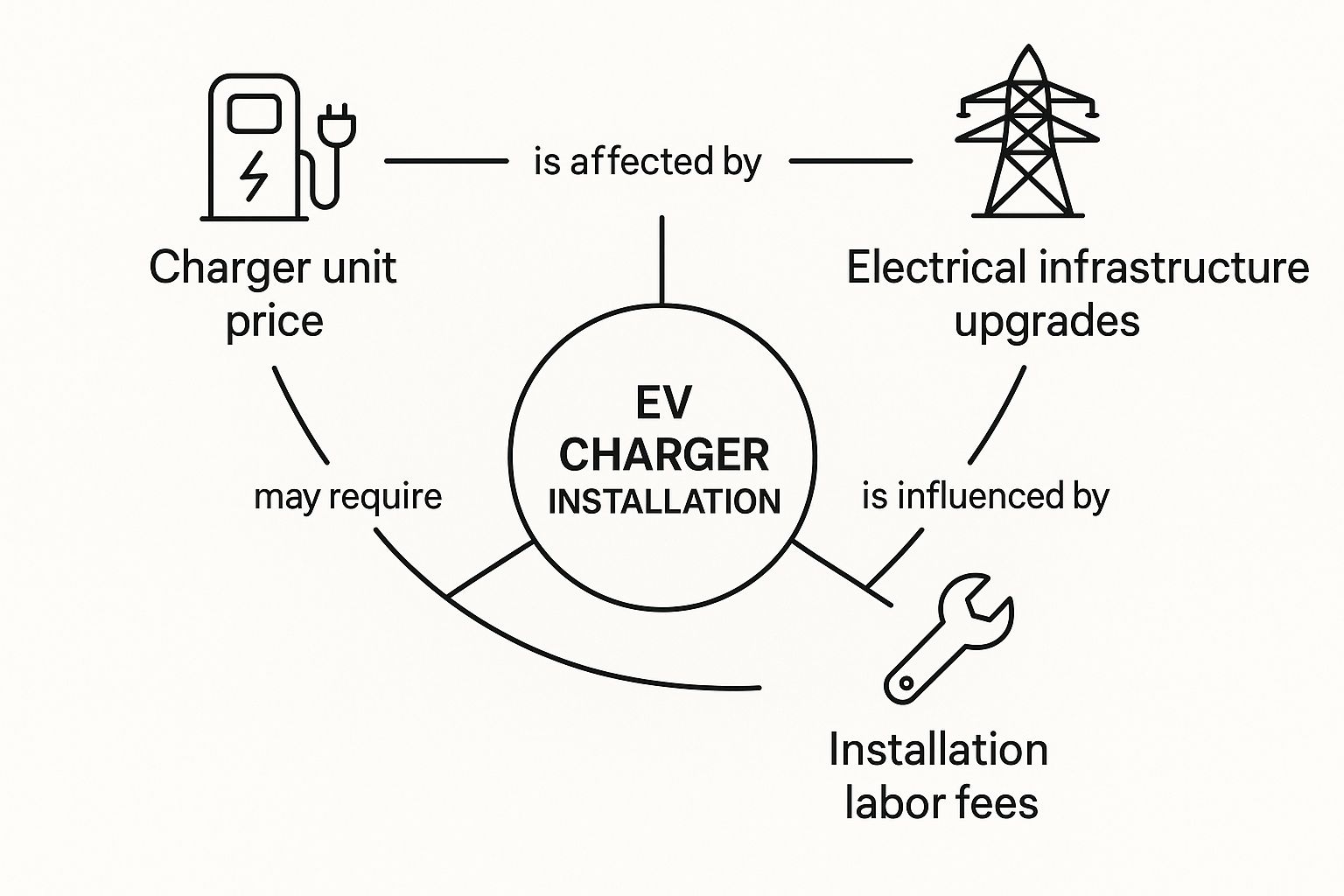
As the infographic shows, these factors are all linked. For instance, a more powerful charger often demands more complex labour and might even mean upgrading your switchboard, which naturally pushes up the total price. Let’s take a closer look at each of these components.
This is the most straightforward part of the quote. The price tag on the charger unit itself typically ranges from $600 to over $2,500. So, why the big difference? It comes down to a few key factors:
Deciding between a basic, no-frills model and a feature-packed smart charger is the first big choice that will shape your budget.
This is what you pay for a licensed electrician’s time, skill, and commitment to safety. In Brisbane, labour costs for a standard installation usually fall between $750 and $1,500. This isn’t just for connecting a couple of wires; it’s a complete, professional service.
A licensed electrician’s work ensures your installation is safe, meets Australian Standards, and won’t void your home insurance or the charger’s warranty. This is absolutely not a DIY job.
The electrician’s job involves assessing your home’s current electrical load, installing a dedicated new circuit from your switchboard, and making sure all safety gear, like RCDs (Residual Current Devices), is installed and working correctly. The more complex the job, the more labour is involved.
Finally, your quote will cover all the physical bits and pieces needed to connect your charger. This includes high-quality cabling, circuit breakers, safety switches, and the conduit used to protect the wiring. The cost of these materials is directly tied to how complex the installation is.
Specifically, it often comes down to the distance from your switchboard to your desired charger location. A longer run means more cable and more labour, which bumps up the price.
On top of that, some installations might require a Certificate of Electrical Safety or council permits, which can add a small administrative fee to the final bill. Together, these three components—the charger, the labour, and the materials—form the foundation of every installation quote.
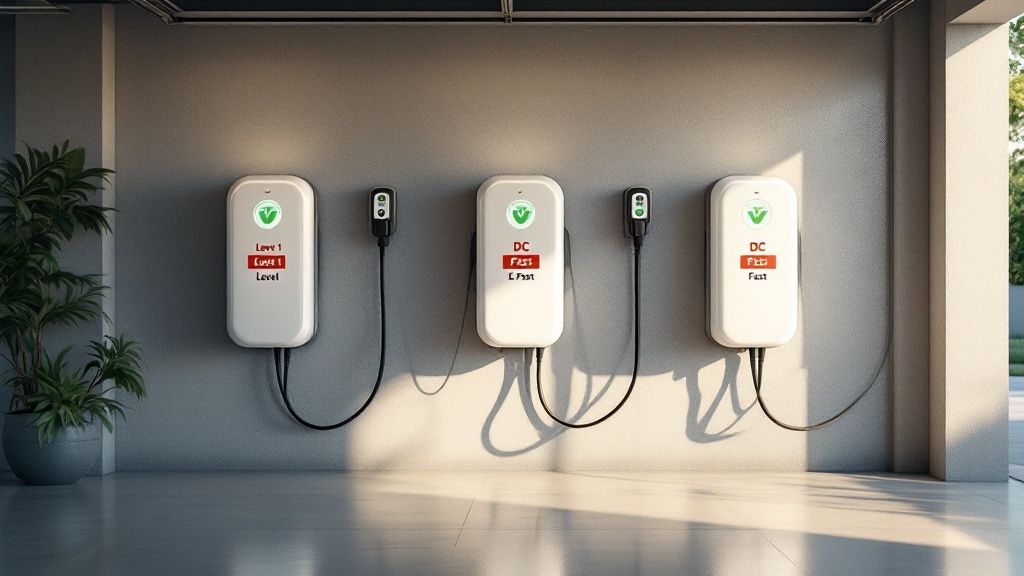
Ever wondered why one electrician’s quote for a charger installation is $1,200, while another comes in closer to $3,000? The answer usually lies in the unique conditions of your property. Much like a home renovation, the true cost often depends on what’s behind the walls and under the ground.
These site-specific variables have the biggest impact on your final bill. A brand-new home with a modern switchboard right next to the garage is about as straightforward as it gets. But an older character home in Brisbane, with its switchboard on the opposite side of the house, presents a completely different challenge—and this is where costs can escalate.
Understanding these factors helps demystify the price variations in your quotes. It’s all about the journey the electricity needs to take from your main supply to your car.
The single most significant hidden cost is the condition of your electrical switchboard. Think of it as the central hub of your home’s electrical system. An EV charger places a heavy, continuous demand on it, far more than most household appliances.
If your switchboard is old, has no spare circuits, or lacks modern safety switches, it will almost certainly need an upgrade. This isn’t just a recommendation; it’s a critical safety requirement. An overloaded or outdated panel poses a serious fire risk.
Upgrading a switchboard is a separate, more involved job that adds a significant amount to the overall EV charger installation costs. If you’re curious about what that entails, our guide explains the electrical switchboard upgrade cost in more detail.
The physical distance between your switchboard and your preferred charger location is another major cost driver. This directly dictates the amount of heavy-duty copper cabling required for the job.
Think of it this way: every extra metre of cable adds to both the material bill and the electrician’s time on site. Planning for the shortest, most direct route is one of the best ways to keep your installation price down.
Finally, how the cable gets from A to B really matters. If the charger is in a detached carport or on the far side of a concrete driveway, the electrician may need to dig a trench to run the wiring safely underground.
Trenching is labour-intensive work. It can involve digging through soil, navigating garden beds, or even cutting through concrete. This complexity will be reflected in your final quote, often adding several hundred dollars to the job compared to a simple surface-mounted installation along a garage wall.
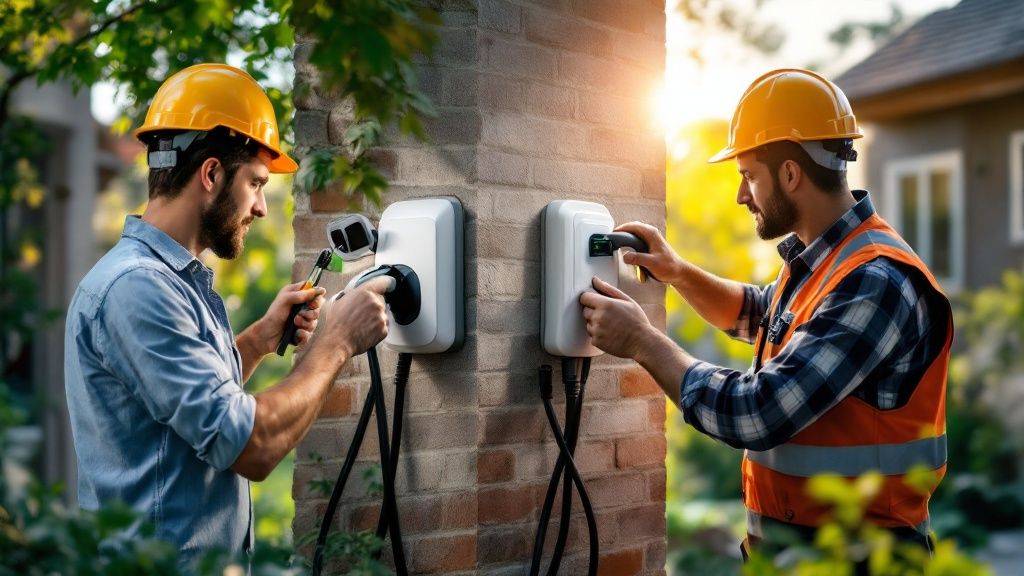
Stepping up from a simple home setup, installing commercial EV chargers is a completely different ball game. This isn’t just about providing a convenient plug for an employee or customer; it’s a significant infrastructure investment built for public use, high turnover, and long-term reliability. The sheer scale of these projects demands more robust hardware and often involves major electrical and civil works.
Think of it this way: a home charger is like a standard garden hose—perfect for one backyard. A commercial installation, especially a DC fast charger, is more like installing the town’s main water line. It requires extensive planning, heavy-duty components, and professional engineering to handle the massive power flow safely and efficiently. This complexity is exactly why the installation work itself often makes up the largest chunk of the total cost.
The biggest jump in cost and complexity for commercial projects comes from the raw electrical demand. A single DC fast charger can draw as much power as a small apartment block. That means your site’s existing power supply is almost certainly not going to cut it, and the fix goes way beyond a simple switchboard tweak.
Key electrical upgrades often include:
For businesses, the installation work—not the charger hardware—is where the bulk of the investment lies. Proper site preparation and electrical upgrades are non-negotiable for a safe, compliant, and future-proof charging station.
The hardware for commercial use is built to a much higher standard than the units you’d find in a home garage. A typical Level 2 commercial charger can cost between $1,950 and $3,000 for the unit alone. And because of all the site preparation and labour, the installation can represent up to 80% of the total project cost.
When it comes to DC fast chargers, the hardware alone can run into the tens of thousands of dollars, and the complex installation can easily double that figure.
But it doesn’t stop with the physical charger. Commercial stations also need sophisticated software to handle things like payment processing, load management, and user access. This software often comes with its own setup fees and ongoing subscription costs, adding another layer to your financial planning. For any business exploring large-scale charging, it’s crucial to understand all the options, and you can find detailed insights into the top electric vehicle charging solutions for your business to compare different systems and features.

It’s easy to get caught up in the initial number, but thinking about EV charger installation costs as a one-time expense is missing the bigger picture. Installing a charger at your Brisbane home is a genuine investment, and it starts paying you back every single time you plug in. That upfront cost quickly transforms into an asset that saves you real money.
The most obvious win is the massive drop in your running costs. Charging at home is dramatically cheaper per kilometre than filling up with petrol or even relying on public fast chargers. Waking up to a full “tank” every morning is a great feeling, but so is waving goodbye to the unpredictable prices at the bowser.
So, what does this look like in the real world? Let’s break it down.
On average, charging your EV at home in Australia costs around 30 cents per kilowatt-hour (kWh). For most cars, that works out to be roughly $16 to $25 for a full charge. Compare that to pulling into a public DC fast charger, where that same charge could set you back anywhere from $33 to $48. You can read more about these cost comparisons and see just how clear the financial advantage of home charging really is.
That price gap adds up fast. Even if you only drive an average amount, you could be saving hundreds—if not thousands—of dollars every year just by ditching public chargers or the petrol station for convenient, affordable power at home.
By framing the installation cost as an investment that pays for itself, the upfront price becomes a smart, long-term financial decision rather than just another household expense.
Want to get that return on investment even faster? It’s all about being smart with how you use your energy. Most Brisbane energy providers offer time-of-use tariffs, which give you much cheaper electricity rates during off-peak hours (usually late at night).
This approach turns your car into a smart part of your home’s energy ecosystem. Suddenly, that initial installation cost is being chipped away by ongoing savings, delivering a clear and compelling return on your investment for as long as you own the vehicle.
Okay, so you understand what goes into the cost of an EV charger installation. Now for the important bit: how to actively manage those costs and get the best bang for your buck.
With a bit of smart planning, you can bring down your final bill quite a bit without ever compromising on safety or the quality of the job. Think of this as your practical guide to becoming a savvy EV owner.
The single most powerful tool you have is comparison shopping. You should always get at least three detailed quotes from different licensed electricians in Brisbane. This does more than just give you a clear picture of the market rate; it shows you how different professionals plan to tackle the same installation.
Be wary of a quote that seems suspiciously low—it can be a red flag for cut corners. A good, itemised quote helps you understand exactly what you’re paying for, from the cable to the labour.
Beyond just getting a few quotes, there are several practical decisions you can make that will directly lower your final invoice.
Here are a few actionable tips:
The goal here is to strike a balance between upfront savings and long-term performance. Choosing the right hardware and planning the installation thoughtfully is the key to getting a professional setup at the best possible price.
Thinking ahead can also turn this from a simple purchase into a smart energy investment. For example, exploring how integrating a Tesla Level 2 Wall Connector with solar panels can lead to significant long-term savings by charging your car with free energy from the sun.
When you’re looking at getting an EV charger installed, a few questions always pop up. Getting your head around the answers now will make the whole process smoother and help you budget properly. Here are some of the most common queries we get from homeowners across Brisbane.
Not always, but it happens a lot more often than people think. An EV charger is a serious piece of kit that puts a heavy, continuous load on your home’s electrical system—far more than a kettle or a toaster. A licensed electrician will need to do a proper load calculation to see if your current switchboard can handle the extra demand safely.
If your switchboard is old, already packed with circuits, or doesn’t have modern safety switches (RCDs), an upgrade isn’t just a good idea—it’s non-negotiable for safety and to meet Australian Standards. This is probably the single biggest factor that can push up the final EV charger installation costs.
Absolutely not. Here in Australia, it’s illegal and incredibly dangerous to install an EV charger yourself. This isn’t like wiring a new light fitting; it’s a high-voltage job that involves running a dedicated circuit straight from your home’s main electrical system.
Trying to DIY an EV charger installation will instantly void your home insurance and the charger’s warranty. More importantly, it puts you, your family, and your property at a huge risk of electrical fire. This work must be done by a Licensed Electrical Contractor, no exceptions.
For a straightforward job—let’s say the charger is going right next to a modern switchboard that has plenty of spare capacity—we’re usually in and out in about 2 to 4 hours.
But if things get more complicated, it can easily turn into a full-day job or even longer. If we need to do a full switchboard upgrade, run long stretches of cable through walls or underground, or dig a trench to get power to your garage, the timeline will naturally stretch out. Your electrician will give you a clear time estimate after they’ve had a proper look at your property.
Ready to get a clear, upfront quote for your EV charger installation? The team at DLG Electrical provides professional, safe, and compliant installations across Brisbane. Contact us for your free quote.

Master Electrician with over 30 years of experience. Founded DLG Electrical in 2005 after international project work including electrical installations at Stamford Bridge Stadium, London(Home of Chelsea FC).

Local Electricians that can fix all Electric Hot water Systems.
Motion sensor lights are a versatile addition to any home, offering nu
