83 Jean St, Grange QLD 4051
Mon-Fri 07:30 AM - 04:00 PM - Sat - 8:00 - 12 - Sunday Closed

You pull into the garage after dark, hit the switch, and get the same result many Brisbane homeowners put up with for years. One bright patch under the fitting, shadows along the walls, and poor visibility exactly where you need it most, around shelves, bins, tools, and the car doors.
I see this often in older Brisbane homes. The garage was originally set up for storage and parking, not battery chargers, freezers, gym gear, a workbench, or weekend repairs. Once the space starts doing more than one job, the lighting needs to do more as well.
Good garage lighting starts with layout, not the fitting catalogue. In a standard residential garage, the goal is even coverage across the whole floor area so you can walk safely, find what you need, and work without eye strain. A single centre light rarely does that well. In practice, multiple light points usually give a better result than one high-output fitting because they reduce shadows at the perimeter and over bench areas.
Brightness still matters, but it has to be matched to how the garage is used. A garage used only for parking can cope with a lower output than one used for storage, maintenance, or detailed hand work. For Brisbane homes, I usually advise planning around the room size first, then checking fitting output, beam spread, mounting height, and ceiling obstructions before anything is installed. Homeowners comparing fixture types can also review the practical benefits of LED lighting for energy use, lifespan, and maintenance.
Colour temperature is the next decision that affects day-to-day usability. Cooler white light often suits garages because it improves contrast around shelving, vehicle panels, and tools. But there is a trade-off. Go too harsh, and the space can feel clinical. Go too warm, and fine detail is harder to pick up. The right choice depends on whether the garage is mainly a parking bay, a workshop, or a mixed-use room.
The options below cover the main fixture styles worth considering for Brisbane garages, with the practical pros, limitations, and installation points that matter before you spend money or book the work.
You pull into the garage after dark, hit the wall switch, and the whole room needs to light up properly in one go. For that job, LED panel lights and flush mounts are usually the safest starting point for Brisbane homes. They sit close to the ceiling, throw light out evenly, and stay out of the way of roller doors, storage racks, and roof-mounted cargo boxes.
They suit standard ceiling heights and work best as the main layer of light across the full garage, not just the centre. If a homeowner wants one fitting type that handles parking, storage, and occasional bench work reasonably well, this is often it.
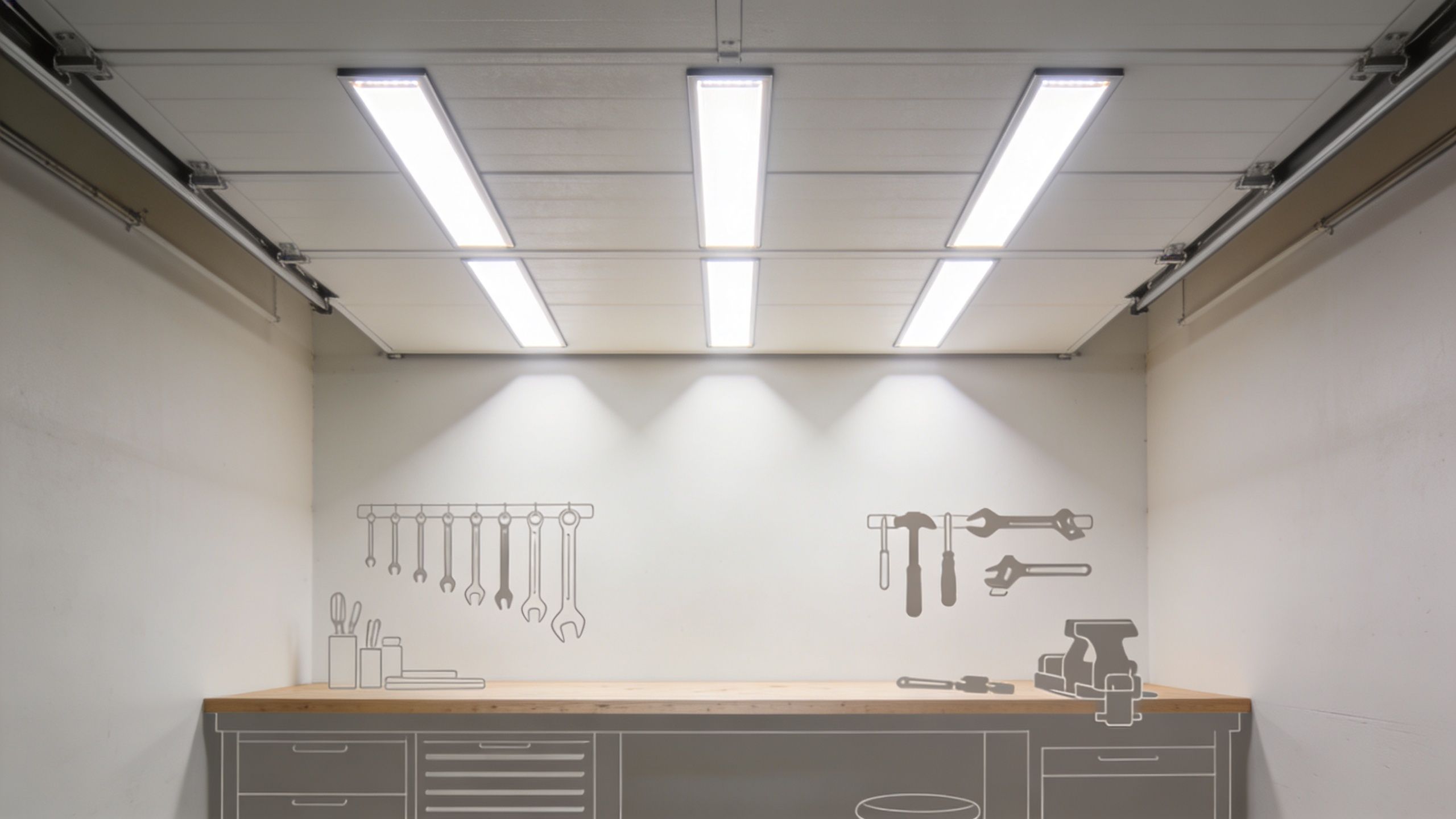
A lot of Brisbane garages still have old fluorescent battens, uneven retrofits, or a single oyster light in the middle of the room. Panel lights and flush mounts fix that with wider, cleaner coverage and lower maintenance. In coastal and humid conditions, fewer lamps, starters, and ageing diffusers also means fewer nuisance failures over time.
The layout matters as much as the fitting. In a single garage, two well-placed fittings often outperform one brighter unit because they reduce shadowing along shelving and around the sides of the car. In a double garage, I usually look at how the room is used before choosing the number of fittings. Parking only, storage, laundry overflow, and workshop use all need slightly different spacing and output.
These fittings also pair well with control upgrades. If you are planning hands-free operation later, it helps to choose gear that can work with garage motion sensor light setups from the start rather than trying to make incompatible fittings behave properly after installation.
A practical setup usually comes down to four decisions:
If you are replacing fluorescent tubes or outdated battens, DLG’s guide to the benefits of LED lighting explains the day-to-day gains in efficiency, lamp life, and maintenance.
For homeowners who want a clean ceiling line and dependable all-purpose light, LED panels and flush mounts are usually the first option I price. They are not always the best choice for detailed workshop tasks on their own, but as the base layer of garage lighting, they are hard to beat.
You pull into the garage after dark with groceries in both hands, the roller door is still moving, and the floor ahead is already lit. That is the benefit of sensor lighting. It improves access and reduces the chances of walking into a dim garage full of bikes, tools, and stored gear.
The convenience is obvious, but I usually recommend sensor lights for control and safety first. In Brisbane homes, garages often serve as the main entry point, a storage room, and a workspace. A well-placed sensor helps the light come on where you move, then switch off after the area is clear instead of burning for hours because someone forgot the wall switch.
Motion-activated LED sensor lights earn their place in a few specific spots:
Sensor performance depends heavily on placement. PIR sensors detect movement across their field better than movement straight toward them, so side-on positioning often works better than mounting a fitting directly above the door. Heat from motors, poor aiming, and low-grade sensors are common causes of nuisance switching. That is usually an installation problem, not a flaw in the idea.
In a small single garage, one quality sensor fitting can cover the room well enough for day-to-day use. In a double garage or any space with shelving, fridges, freezers, or a workbench, I prefer a layered setup. Keep a standard switched light for full output, then use sensor lighting for access paths and quick trips in and out.
This is also where settings matter. Adjustable detection range, hold time, and lux level make a big difference. If the lux setting is wrong, the light can trigger during the day. If the hold time is too short, it can switch off while someone is still at the freezer or bench. Cheap all-in-one units often give you very little control, which is why they get replaced early.
For Brisbane garages, I also check whether the fitting suits the environment. Open-front garages and spaces exposed to humidity, dust, and wind-blown rain need better-sealed products than a fully enclosed internal garage. The fitting itself matters, but so does the wiring connection, sensor angle, and mounting height.
If you are comparing layouts and fitting types, DLG’s guide to garage motion sensor light options covers the practical differences in more detail.
Done properly, sensor lighting is not a gimmick. It is a useful layer that makes the garage safer to enter, cheaper to run, and easier to use every day.
Pull into a garage with a high roof and a single domestic batten in the middle, and the problem is obvious. The floor looks bright enough until you open the bonnet, step to the workbench, or try to see into shelving along the walls.
High-bay and low-bay fittings solve that coverage problem in larger garages, detached sheds, and workshop-style spaces. They are built to throw usable light over a wider area and to cope with longer operating hours than many decorative residential fittings.
These fixtures need to suit the room. In a standard suburban garage with a low ceiling, an oversized industrial fitting often creates glare on bonnets, windscreens, and sealed floors. In a taller space, the same fitting can produce cleaner, more even light with fewer dark edges.
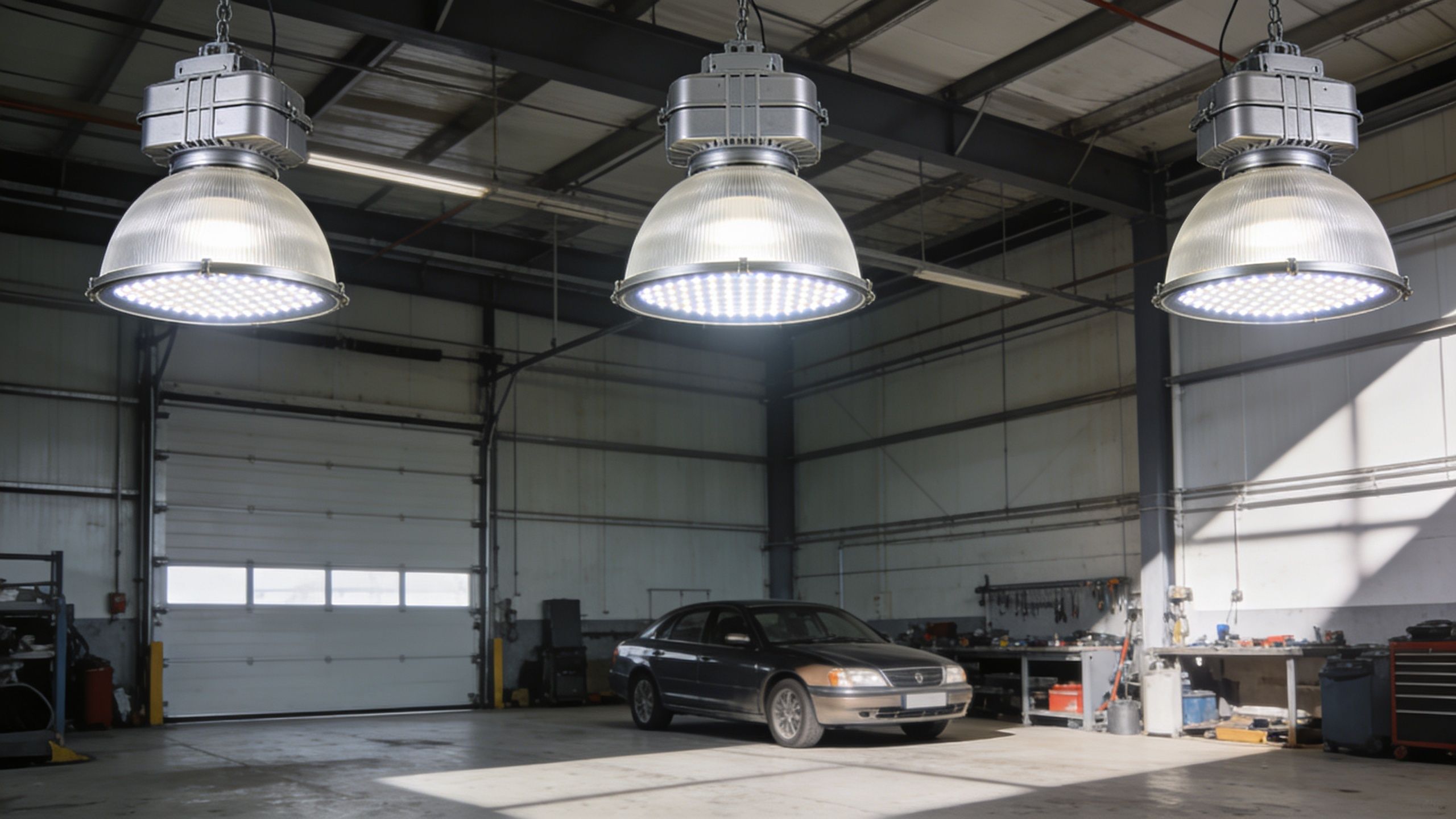
I usually specify low-bay fittings for residential garages with higher-than-average ceilings, especially where the space doubles as a workshop, home gym, or storage area with full-height shelving. They give stronger output than typical household fittings without demanding the mounting height that true warehouse-style high-bays need.
High-bays make more sense in converted sheds, large detached garages, and spaces with cathedral or raked ceilings. The main question is not whether the fitting looks industrial. It is whether the mounting height, beam angle, and lumen package match the job.
Brisbane conditions matter here too. Open-front garages, semi-enclosed sheds, and spaces exposed to humidity or dust need fittings with an appropriate IP rating and solid driver quality. A cheap high-output unit may look good on paper and still fail early if the housing, diffuser, or terminations are not suited to the environment.
Industrial fixtures can work extremely well, but they are less forgiving than basic flush lights.
For many double garages, the best result comes from two or more well-placed low-bay fittings rather than one oversized unit. That layout spreads light more evenly, reduces shadowing at the car doors, and makes the space easier to use for maintenance, storage, and weekend projects.
If you want industrial performance at home, choose the fitting by ceiling height and task, not by maximum wattage. That is the difference between a garage that feels sharp and usable, and one that just feels aggressively bright.
You pull into the garage during a Brisbane storm, one hand on the wheel, the other juggling the remote, and the light comes on before you step out. That is where smart lighting makes sense. In a garage, good control is often just as useful as raw light output because the space usually has to cover parking, storage, access to the house, and bench work.
Smart systems suit homeowners who use the garage at different times and for different tasks. A bright full-output setting works for unloading tools or cleaning up. A softer scene is better for late-night access when you do not want glare bouncing off the car, roller door, or sealed floor.
The practical value comes from control, not novelty.
Useful features include scheduled on and off times, motion-triggered activation linked to occupancy sensors, app control for checking whether lights were left on, and dimming that lets you adjust the space for task work or basic access. If the garage is part of a wider home upgrade, smart lighting can also be tied into security devices or smoke alarm work, provided the products are compatible and the circuit design is done properly.
For Brisbane homes, I usually tell clients to keep the lighting plan simple first, then add smart control on top. Start with enough lumens, even spacing, and the right colour temperature. After that, choose controls that make daily use easier.
Smart fittings still need to perform well as fittings. A poor-quality light with Wi-Fi is still a poor-quality light.
The biggest problems I see are compatibility and reliability. Some products dim poorly with the wrong driver. Some lose settings after a power interruption. Some only work properly if everyone leaves the wall switch on all the time, which rarely happens in a family home.
Wi-Fi strength also matters. Garages at the front of the house, detached sheds, and rooms with block walls or foil insulation can all have patchy coverage. In those cases, a smart switch, hardwired sensor, or a system with better local control is usually a better choice than relying on a single app-based fitting.
Connected lighting works best when the controls match the way the garage is used.
A well-planned smart system should feel predictable. If the light turns on when it should, dims properly, and still works normally from the switch, the technology is doing its job.
If you want smart garage lighting installed properly, DLG Electrical can help you choose fittings, controls, and circuit layouts that suit the way your Brisbane garage is used.
Track lighting suits garages that change over time. If the workbench moves, the shelving gets reconfigured, or one side of the garage becomes a hobby zone, adjustable spotlights let you redirect light without rewiring the whole room.
That flexibility is the main selling point. You’re not locked into one beam angle forever, which is useful in multi-purpose garages where storage, parking, and practical work all compete for space.
Track systems perform well when the garage has a clear task zone. Think workbench, tool wall, detailing area, or storage bay where labels and hardware need to be seen properly.
They are not usually the best sole light source for a whole garage. Spotlights create contrast. That’s useful over a bench, but if you rely on them alone you’ll often end up with bright islands and darker walkways.
A better approach is to combine them with broader ceiling lighting. The overhead layer handles the room, while the track heads sharpen up the places where your hands work.
A few decisions make a big difference with track systems:
Track lighting is one of the more underused garage lighting ideas for homeowners who use their garage as a workshop. It won’t replace good general lighting, but it does add precision where broad fittings fall short.
At 10 am in a Brisbane garage, daylight can make the space far easier to use. Labels read clearly, bench work feels less fatiguing, and the room stops feeling shut in. The catch is heat, glare, and inconsistency. Good daylighting improves the garage only when it is planned around roof orientation, summer sun, and the electric lighting that still carries the load after dark.
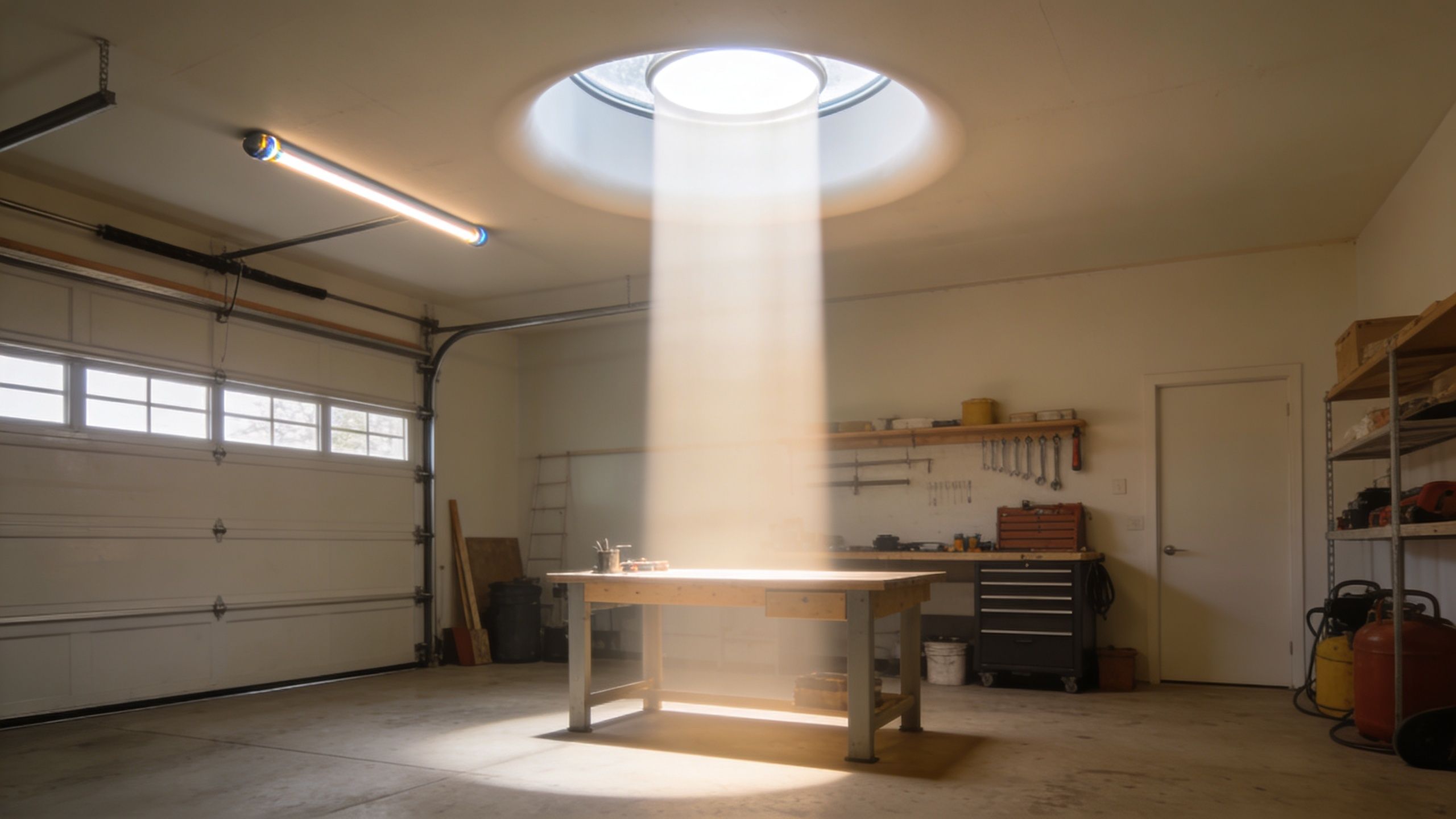
Skylights suit larger garages or renovated spaces where the ceiling and roof structure allow a clean opening. Tubular daylighting devices are often the better fit in standard suburban garages because they need less roof area and can route light into the centre of the room without a large shaft. In practice, I’d look at tubular units first for single garages and tighter roof cavities, then consider full skylights where the garage is being upgraded into a workshop, gym, or regularly used utility space.
The light itself is pleasant, but it changes through the day. North and west-facing roofs can bring in strong summer glare in Brisbane, especially on pale floors, bonnets, and glossy storage cabinets. Diffusers, opal finishes, and careful placement help control that. So does avoiding a layout where the brightest daylight falls straight into your line of sight at the bench or vehicle bay.
If you are already planning exterior changes, garage door glazing matters as well. Side windows, upper door panels, and roof daylighting all affect how balanced the room feels. This guide to commercial facility garage door window options is useful for comparing how different window placements change light spread and privacy.
Daylighting also has trade-offs that homeowners often miss. Every roof penetration has to be flashed properly, sealed properly, and chosen for local conditions. In Brisbane, heat load and moisture matter. A cheap skylight that looks fine on install day can become a source of condensation, leaks, or stained plaster if the product and installation quality are poor.
The best results come from treating natural light as one layer in the lighting plan, not the whole plan. Use it to reduce daytime reliance on electric fittings, then back it up with properly placed LEDs for early mornings, storms, overcast afternoons, and night use. For garages that double as work areas, I usually recommend keeping general lighting in the neutral white range so the room stays visually consistent when daylight fades.
Here’s a useful visual example of daylight entering a garage workspace:
Wall lights and pendants aren’t usually the first fittings people think of for a garage, but they can be surprisingly effective when used with restraint. They add side light, which helps soften shadows that overhead fittings often create on shelving, vertical storage, and bench faces.
This category works best in garages that are more finished in appearance. If the space has cabinetry, painted walls, a dedicated work area, or a side entry used daily, wall-mounted fittings can make the room feel more deliberate and easier to use.
Wall sconces are practical near internal doors, side access points, and bench walls. Pendants can work over a fixed bench or central island-style workspace in a larger garage, provided there’s enough clearance and they won’t interfere with opening doors or moving equipment.
They’re not the right answer in every garage. Low-hanging pendants in a cramped parking bay quickly become a hazard. Decorative sconces with weak output often look good on paper and disappoint in use.
Treat wall and pendant fittings as support lighting, not your main source.
A lot of garage lighting ideas focus only on the ceiling. That misses how useful side-mounted light can be, especially in garages that serve as workshop and storage spaces rather than just car bays.
You pull into the garage at night, hit the switch, and the room looks sharp, but the bench is still in shadow and the sides of the car disappear into dull patches. That is the trade-off with recessed lighting. It looks clean, but it only works well when the layout is properly planned.
Downlights suit Brisbane homes where the garage is part of a finished renovation, especially with plasterboard ceilings and a design brief that needs to match the rest of the house. They keep the ceiling uncluttered and give the space a more polished feel than surface battens or industrial fittings.
Appearance is only half the job.
In a garage, recessed fittings need enough output, correct spacing, and the right beam spread to avoid dark zones around shelving, roller doors, and parked vehicles. I see plenty of double garages with a small row of downlights through the middle. They look tidy and perform poorly. If the garage is used for storage, charging gear, or weekend workshop jobs, that layout usually leaves too much shadow where you need to see.
For more detail on fitting types, beam angles, and installation basics, DLG’s guide to LED down lights is a useful starting point.
The other point homeowners miss is installation complexity. Recessed lights need ceiling access, clearance from insulation, suitable switching, and careful circuit planning. In some garages, especially older Brisbane homes, the ceiling cavity and existing wiring make downlights a less practical option than they first appear. In those cases, a good electrician will say so.
Compliance also matters more than many owners expect. Rental properties, garage conversions, and garages used as part workshop, part storage room need more than a cosmetic lighting upgrade. Lighting changes can overlap with smoke alarm placement, switchboard condition, and the broader electrical safety standard of the property. As noted earlier, landlords and renovators should treat garage lighting as part of the overall compliance picture, not as an isolated fitting swap.
Recessed lights can deliver a clean result, but the best installations are planned around how the garage is actually used, not just how the ceiling will look once the plaster is patched.
| Lighting Option | 🔄 Implementation Complexity | ⚡ Resource Requirements (cost / energy) | ⭐ Expected Outcomes / Quality | 📊 Ideal Use Cases / Impact | 💡 Key Tips |
|---|---|---|---|---|---|
| LED Panel Lights and Flush Mounts | 🔄🔄 Medium, fixture replacement, compatible dimmers, electrician recommended | ⚡ Very efficient (70–80%+ vs incandescent); higher upfront, low operating cost | ⭐⭐⭐⭐ High, uniform, long-lived (25k–50k+ hrs), low heat | Home garages, task-focused workbenches, modern renovations | 💡 Choose 5000–6500K for tasks; space evenly; verify dimmer compatibility |
| Motion-Activated LED Sensor Lights | 🔄🔄 Low, bolt-on or replace fixtures; simple sensor setup | ⚡ Extremely efficient in practice (up to ~90% savings); low power; options battery/mains | ⭐⭐⭐ Good, convenient hands-free lighting; reduces wasted runtime | Entryways, infrequent-use garages, security-focused installs | 💡 Position away from vents, use adjustable sensitivity, test after install |
| High-Bay and Low-Bay Industrial Fixtures | 🔄🔄🔄 High, mounting at height, structural/electrical work required | ⚡ Efficient per lumen but high power and higher upfront cost; professional install | ⭐⭐⭐⭐⭐ Very High, exceptional lumen output and wide area coverage | Large workshops, professional mechanic bays, industrial garages | 💡 Calculate lumens per sq ft, angle to avoid glare, consider heat management |
| Smart and Connected Lighting Systems | 🔄🔄🔄 Medium–High, electrical plus network integration and configuration | ⚡ Efficiency varies; can reduce energy via automation; higher initial investment | ⭐⭐⭐⭐ High, flexible control, scenes, energy monitoring, integration | Tech-forward homes, property managers, integrated security systems | 💡 Ensure strong Wi‑Fi, choose compatible platform, implement cybersecurity best practices |
| Track and Spotlight Systems | 🔄🔄 Medium, planning for layout; mounts and wiring needed | ⚡ Moderate efficiency; targeted lighting reduces waste; moderate cost | ⭐⭐⭐ Good, highly flexible directional task lighting | Workbenches, display areas, multi-use garages needing reconfigurable light | 💡 Plan spotlight positions, combine with ambient ceiling lighting, use multiple small heads |
| Natural Light Integration (Skylights / Tubular Daylighting) | 🔄🔄🔄 High, roof penetrations, structural and weatherproofing work | ⚡ Zero electrical use by day; high installation and potential maintenance costs; variable output | ⭐⭐⭐ Good, excellent daylight quality and ambiance; weather-dependent | Daylit garages, eco-conscious homeowners, reduce daytime electricity use | 💡 Use diffusers for intense sun, combine with LED backups, ensure proper sealing/insulation |
| Wall-Mounted Sconce and Pendant Lighting | 🔄🔄 Medium, wall wiring and multiple fixtures for coverage | ⚡ Moderate efficiency (LED options); generally affordable fixtures and install | ⭐⭐⭐ Good, improves aesthetics and task lighting near walls/doors | Accent/task zones, entry areas, style-conscious garage conversions | 💡 Mount 5–6 ft above workbench, space fixtures 4–6 ft apart, pair with overhead lights |
| Recessed Ceiling Lights and Downlights | 🔄🔄🔄 Medium–High, requires ceiling access, spacing and wiring work | ⚡ Efficient LED options; higher installation labor cost; minimal dust accumulation | ⭐⭐⭐⭐ High, clean, unobtrusive ambient lighting; versatile with trims and beams | Contemporary garages, homeowners wanting minimalist, even ambient light | 💡 Space 4–6 ft apart, calculate total lumens by area, combine with accent/task fixtures |
You pull into the garage after dark, hit the switch, and half the room still disappears into shadow. That is the point where fixture choice stops being a style decision and starts becoming a usability and safety issue.
The best garage lighting plan is built around how the space works day to day. A parking-and-storage garage usually needs even overhead light, reliable sensor control, and enough brightness at the roller door, internal entry, and shelves. A workshop, gym, or hobby setup needs layered lighting. That means a solid base level of general light, stronger task lighting over benches or equipment, and separate switching so you are not lighting the whole room every time you need one area.
Layout matters as much as the fitting itself. A single bright light in the middle often leaves shadows at the walls and directly over a workbench, which is where people need clear visibility. In Brisbane garages with low ceilings, panel lights or flush mounts often give better spread than a deeper fitting. In larger or taller garages, the right answer may be more fittings on separate circuits rather than one higher-output unit trying to do everything.
Controls are often overlooked. In practice, they make a big difference. A standard wall switch is still fine in many homes, but garages usually work better with zoning, occupancy sensors, or smart control where it suits the household. One circuit for vehicle bays, one for the bench, and one for the side access or storage wall is a sensible setup in many garages. It cuts wasted power and makes the room easier to use.
Compliance also needs to be part of the plan from the start. In Queensland, garage lighting work must comply with AS/NZS 3000, and licensed installation helps avoid overloaded circuits, poor terminations, incorrect IP selection, and other faults that can create safety issues later. For rental properties, lighting upgrades can also overlap with smoke alarm compliance and broader electrical obligations, so it pays to have the work scoped properly before installation starts.
There is a cost benefit as well. Modern LED garage lighting generally runs cooler, lasts longer, and uses less power than older fluorescent or halogen fittings. The savings are real, but only if the design is right. I see plenty of garages with efficient fittings installed in the wrong locations, or with colour temperatures that are too harsh for regular use. For most Brisbane homes, a neutral to cool white light works well in a garage, but the best choice depends on whether the space is used mainly for storage, detailed bench work, or as an extension of the home.
If the garage is part of a renovation or new build, lighting should be planned alongside storage, access points, smoke alarms, and switchboard capacity. That is just as true in an older garage in Grange as it is in a newer home in Windsor. Broader project planning often benefits from early coordination with your builder, especially if you are already using expert tips for Brisbane homeowners building to map out the rest of the job.
DLG Electrical has worked with Brisbane homeowners for over 19 years, and that local experience matters. Garage construction varies widely across the city. Some homes have older wiring and limited ceiling access. Others have lined garages, higher ceilings, or multi-use layouts that need a more careful lighting design. The best result usually comes from matching fitting type, beam spread, switching, and circuit design to the way the garage is used.
If your garage still relies on one dim fitting in the centre of the ceiling, there is usually a much better option.
If you want garage lighting that is practical, compliant, and properly designed for the way you use the space, contact DLG Electrical for a free quote. Their Brisbane team handles residential lighting upgrades, switchboard work, smoke alarm integration, and customised electrical solutions that get the garage right the first time.

Master Electrician with over 30 years of experience. Founded DLG Electrical in 2005 after international project work including electrical installations at Stamford Bridge Stadium, London(Home of Chelsea FC).

Local Electricians that can fix all Electric Hot water Systems.
Motion sensor lights are a versatile addition to any home, offering nu
