83 Jean St, Grange QLD 4051
Mon-Fri 07:30 AM - 04:00 PM - Sat - 8:00 - 12 - Sunday Closed

Halogen vs LED Lights: When it comes to lighting your property, the choice you make has a huge impact on your power bills, safety, and overall atmosphere. For a long time, halogen bulbs were the standard for anyone wanting bright, crisp light. But that technology is now seriously outdated, especially when you look at how much they cost to run.
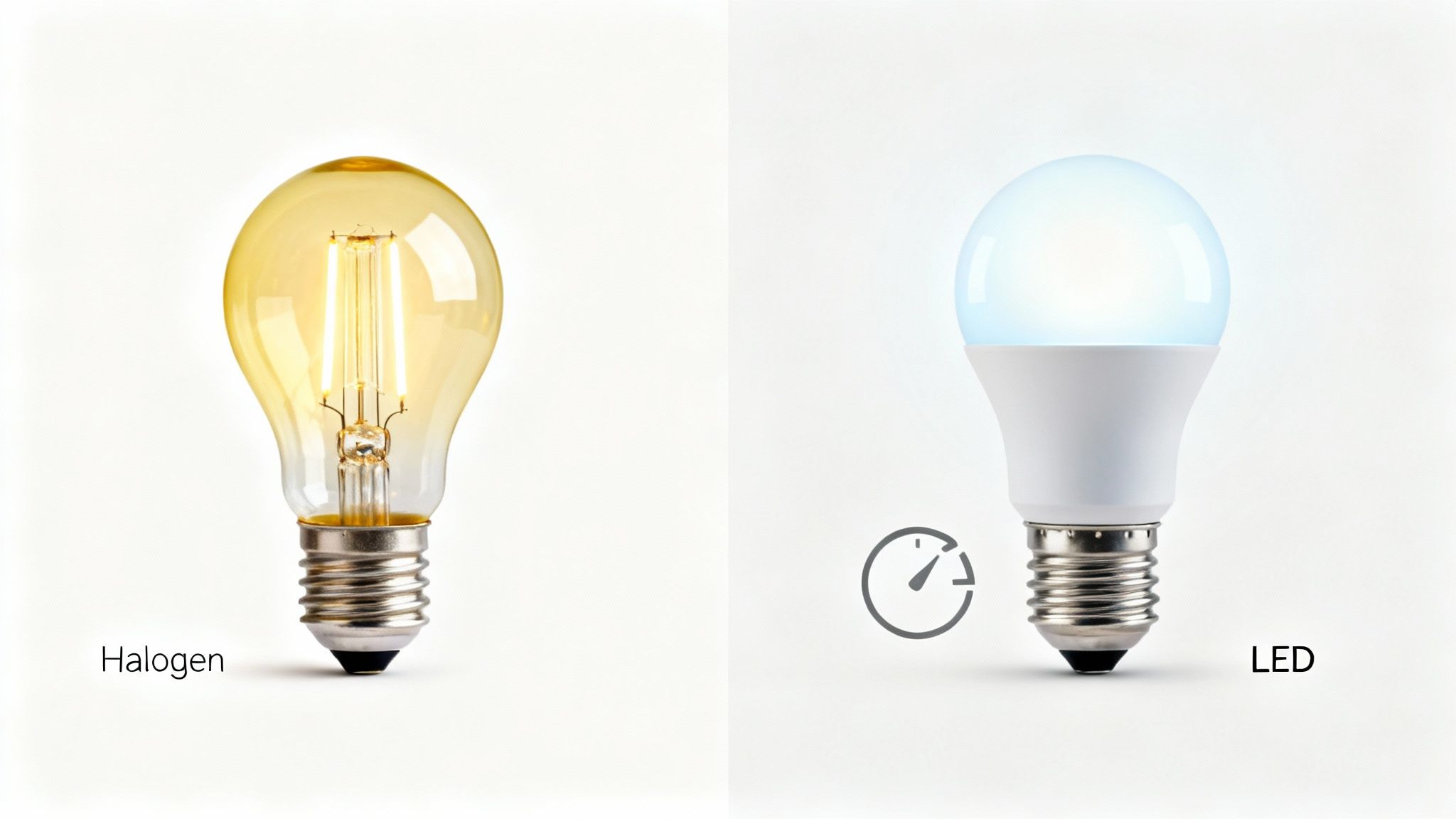
This is where LEDs (Light-Emitting Diodes) have completely changed the game. They deliver brilliant light but use a tiny fraction of the energy, last for years on end, and run cool to the touch, making them a much safer option.
The bottom line? In the halogen vs LED debate, there’s a clear winner for any modern home or business. LEDs simply outperform halogens in every area that matters: efficiency, lifespan, and long-term value.
The switch to LED technology isn’t just a passing trend; it’s a complete transformation of the lighting industry. In fact, Australia’s lighting market is set to climb to AUD 30.55 billion by 2035, a boom driven almost entirely by the shift to LEDs.
As of 2024, LEDs already hold a massive 61.45% revenue share, proving that old, inefficient technologies like halogen are being left behind for good. It’s easy to see why when LEDs use up to 80% less electricity and can last 25 times longer. They are now the undisputed standard for all new builds and retrofits.
This massive shift shows a clear understanding of the real-world benefits LEDs offer, from lowering your carbon footprint to delivering serious savings on your electricity bills. You can read more about the Australian lighting market shift to see the data for yourself.
To really grasp why LEDs are the smarter choice, it helps to see a direct comparison. This table breaks down the most important differences that affect your budget, safety, and day-to-day convenience.
| Feature | Halogen Lights | LED Lights |
|---|---|---|
| Average Lifespan | 1,000 – 2,000 hours | 25,000 – 50,000+ hours |
| Energy Efficiency | Very Low (wastes ~90% as heat) | Very High (converts ~95% to light) |
| Heat Output | Extremely Hot (fire risk) | Cool to the touch (safe) |
| Running Cost | High | Very Low |
| Durability | Fragile (thin filament) | Very Durable (solid-state) |
| Colour Options | Limited (typically warm white) | Wide Range (warm to cool) |
As you can see, the numbers speak for themselves. While halogens get the job done, their short lifespan and high running costs make them an expensive habit. LEDs, on the other hand, are a true invest-and-forget solution that pays for itself over time.
When we talk about lighting, it’s easy to think it’s just about flicking a switch. But the actual quality of the light filling your room makes all the difference to the atmosphere, how you see colour, and even how functional the space is. This is where the technical gap between halogen and LED really widens, showing why one is a relic and the other is the future.
First, we need to unlearn a bad habit. For years, we’ve been conditioned to think watts equal brightness. That’s not quite right. Wattage is simply how much power a bulb consumes. The real measure of brightness is lumens—the amount of light it actually produces. Getting this right is the first step in understanding the difference.
Halogen bulbs are notoriously power-hungry. They’re incredibly inefficient, wasting a huge chunk of the energy they draw as heat instead of converting it into light. A typical 50-watt halogen downlight might give you about 800 lumens. Do the math, and that’s a dismal 16 lumens for every watt.
Now, look at LEDs. They are engineered from the ground up to maximise light and minimise waste. A modern 10-watt LED downlight can comfortably produce the same 800 lumens as its 50-watt halogen counterpart. That’s an efficiency of 80 lumens per watt—a staggering 500% improvement. It’s the same brightness, for a fraction of the running cost.
The core takeaway is simple: Wattage measures your energy bill, while lumens measure the light you actually get. In the halogen vs LED comparison, LEDs deliver far more lumens for every watt, making them the undisputed efficiency champion.
Brightness is only half the story. The quality of light also depends on its ability to show colours accurately. We measure this with the Colour Rendering Index (CRI), a scale from 0 to 100 that tells you how true-to-life colours will look under a light source compared to natural daylight.
To be fair, this was halogen’s one big strength. Halogen lights have a continuous light spectrum that mimics the sun, giving them a CRI of nearly 100. This made them a favourite for places where colour accuracy was critical, like retail stores or art galleries.
Early LEDs really struggled here, often casting a sterile light that made colours look flat or washed out. But that’s ancient history now. Modern, high-quality LEDs have completely closed the gap, consistently hitting a CRI of 90 or higher. This means you get all the energy savings without sacrificing vibrant, accurate colour, busting one of the oldest myths about LED lighting for good.
Perhaps the biggest win for LEDs is the incredible control you get over colour temperature, which is measured in Kelvins (K). This isn’t about heat; it’s about the visual warmth or coolness of the light, from a golden glow to a crisp white. This flexibility lets you craft the perfect atmosphere for any space.
Halogen bulbs? You get one option: a warm, yellowish light. That’s it. LEDs, on the other hand, give you a full spectrum of choices.
Warm White (2700K – 3000K): This is the classic, cosy glow we associate with old-school halogen or incandescent bulbs. It’s perfect for living rooms, bedrooms, and dining areas where you want to create a relaxing, inviting vibe.
Cool White (4000K): This offers a much cleaner, neutral white light. It’s brilliant for task-oriented spaces like kitchens, laundries, and bathrooms where you need clear visibility without the harshness of a clinical light.
Daylight (5000K – 6000K): Just as it sounds, this light simulates bright, natural daylight. It’s the ideal choice for home offices, workshops, and garages where you need to stay focused and see fine details clearly.
With LEDs, you can literally dial in the exact mood for every single room. For a closer look at picking the right light for your space, our guide on the different types of downlights offers some great advice. This level of customisation is something halogen technology could never deliver, cementing LEDs as the only real choice for modern, adaptable lighting design.
The price tag on the shelf is just the opening chapter in the story of lighting costs. To really understand the financial difference between halogen and LED, you have to look at the total cost of ownership. This isn’t just about the purchase price; it’s a full calculation that includes ongoing energy bills and how often you’ll be dragging out the ladder for replacements.
A halogen globe might look like a bargain at the checkout, but it quickly becomes the more expensive choice the moment it’s switched on. Its shocking inefficiency means you’re paying mostly for wasted heat, not light, which pads out your electricity bill every quarter. This is a crucial concept where reducing total cost of ownership over the long haul is the only way to make a smart investment.
At a glance, the comparison seems straightforward. A single halogen downlight globe can be picked up for just a few dollars, whereas an equivalent LED might be three or four times that price. For one room, that’s not a big deal. But when you’re fitting out an entire Brisbane home or a commercial office, the initial outlay for LEDs can feel pretty steep.
But thinking of this as just a capital expense is a financial misstep. The higher ticket price of an LED isn’t just for a light globe; it’s an upfront investment in dramatically lower future bills. It’s like pre-paying for years of energy savings and zero maintenance, which completely flips the financial equation on its head.
The real comparison isn’t the price of one halogen versus one LED. It’s the cost of one LED versus the 25 halogens you’d need to buy to match its lifespan, plus the inflated energy costs for every single hour those halogens are running.
This is where the financial argument for LEDs becomes impossible to ignore. Let’s run the numbers with a real-world example using typical Queensland electricity rates. A standard 50W halogen downlight, running for just four hours a day, will chew through about 73 kilowatt-hours (kWh) of electricity each year.
Now, compare that to a 10W LED equivalent that delivers the same amount of light. Over the same period, it uses only 14.6 kWh. That’s a massive 80% reduction in energy use from just one light. Imagine multiplying that saving across every light fitting in your home or business.
Recent data shows that swapping out just 18 old halogen bulbs for modern LEDs can save the average Australian household around $102 per year. For a business owner or landlord, that’s not just a nice little bonus—it’s a significant cut to your operational overheads.
This chart visually breaks down the key performance metrics that drive these long-term cost differences.
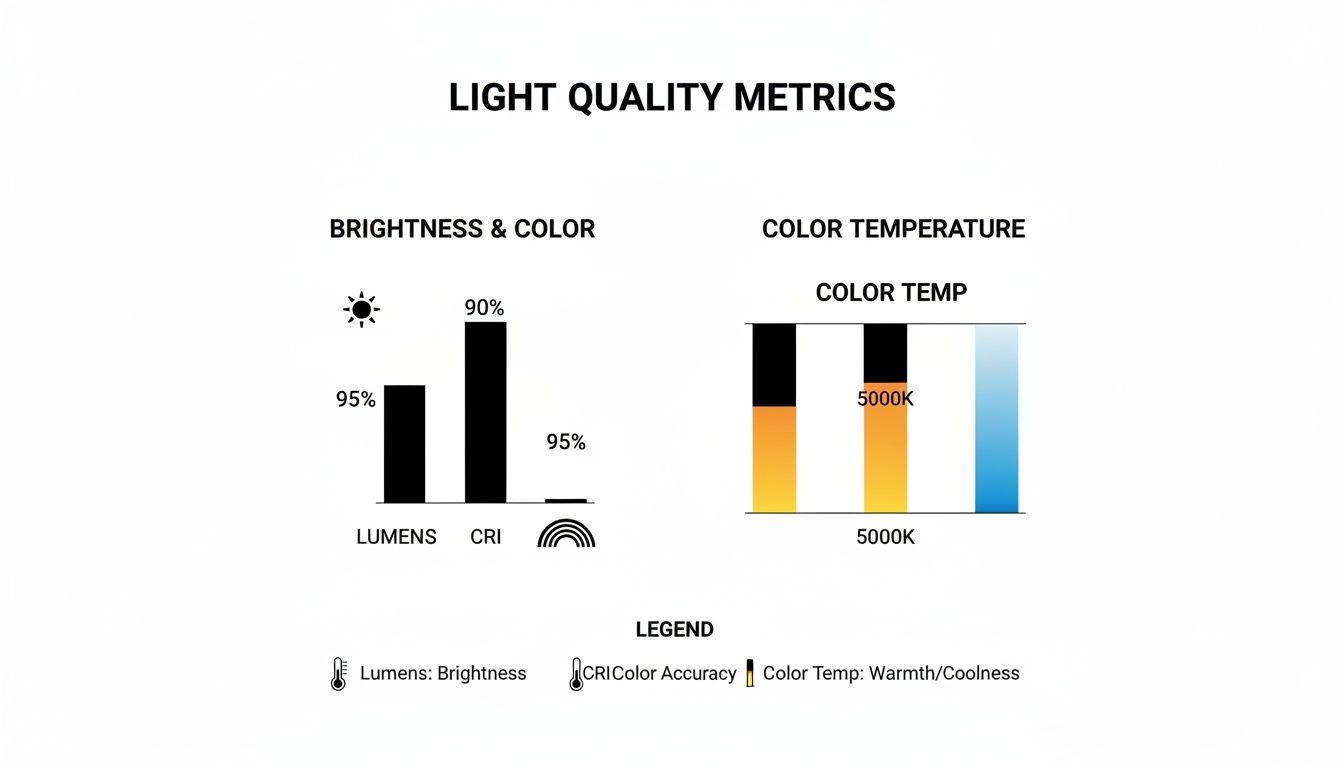
As you can see, LEDs deliver far superior lumens and a better range of colour temperatures for a tiny fraction of the energy, cementing their long-term financial value.
The final piece of the total cost puzzle is lifespan. A halogen bulb is a disposable item, built to last for about 2,000 hours if you’re lucky. An LED, on the other hand, is engineered for endurance, with a typical lifespan of 25,000 to 50,000 hours.
This translates into a huge difference in real-world upkeep.
This isn’t just about saving a few bucks on new bulbs. It’s about eliminating the hassle, time, and safety risks of constantly changing lights, especially in rooms with high ceilings or in hard-to-reach commercial spaces.
When you combine the huge energy savings with the near-elimination of replacement costs, the return on investment for an LED upgrade is usually seen within just one to two years. After that, it’s pure savings in your pocket. For more practical tips on trimming your power bills, take a look at our guide on how to reduce electricity consumption.
Beyond the immediate savings on your power bill, the long-term reliability of your lighting is a massive factor in the halogen vs. LED debate. The difference in lifespan isn’t just a minor detail; it’s a fundamental shift in how we handle maintenance and plan for the future of our properties.
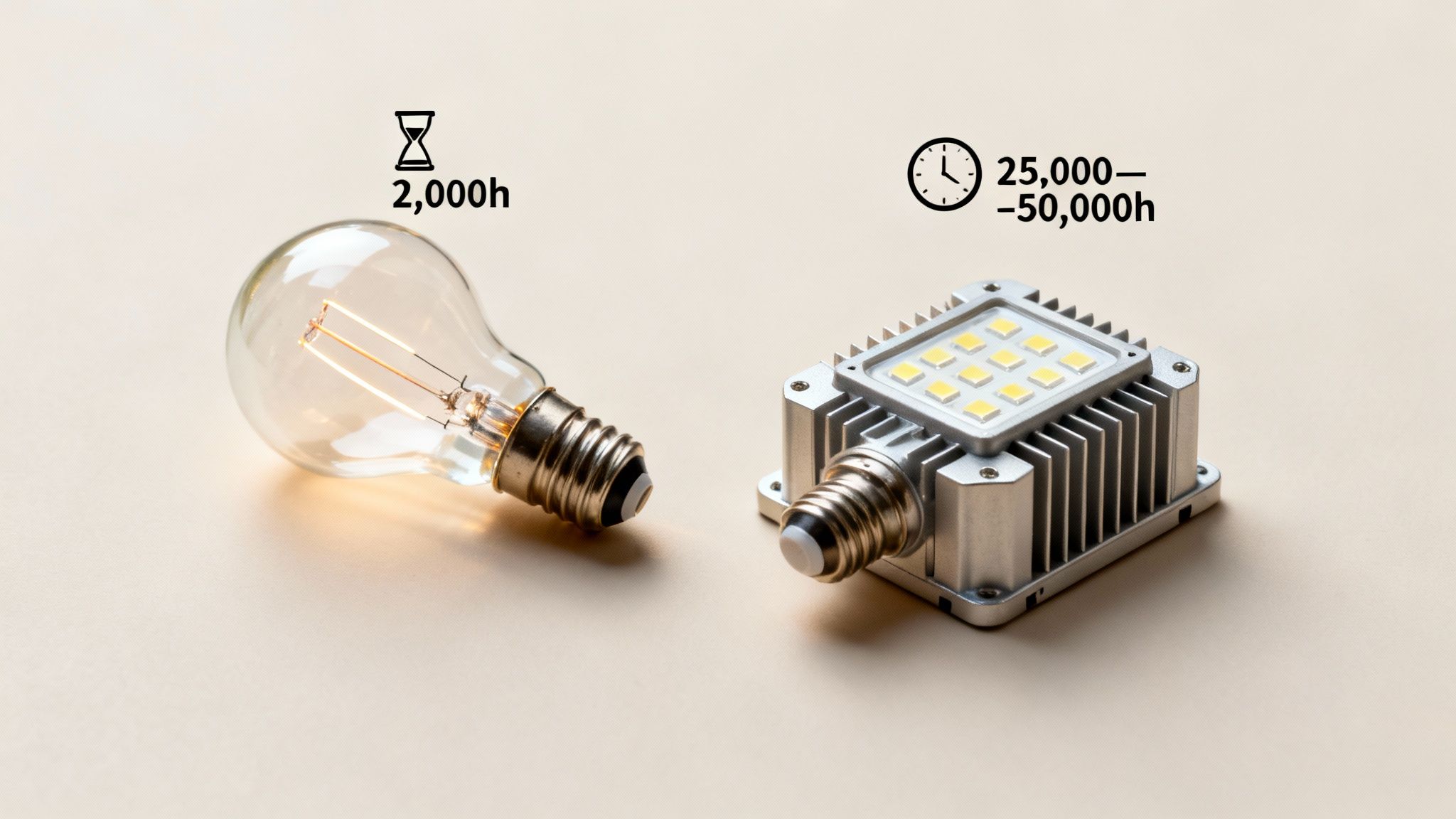
Halogen globes are built around a delicate, fine tungsten filament sealed inside a glass envelope. This design makes them inherently temporary, with a typical operational life of around 2,000 hours.
In stark contrast, LEDs are solid-state devices. They have no fragile filaments or breakable glass components. This robust construction gives them a staggering lifespan, usually ranging from 25,000 to 50,000 hours. This kind of longevity completely redefines what you can expect from a light source.
Numbers on a box can feel a bit abstract, so let’s put them into a real-world context. Picture a light fixture in a busy commercial hallway or a home kitchen that’s on for eight hours every single day.
This isn’t just about convenience. For a business, it means a huge reduction in maintenance labour and material costs. For homeowners, it means years of not having to think about climbing a ladder to change a globe in a high-ceiling living room or an awkward stairwell.
To get a deeper look at this, our article exploring how long LED lights last breaks down the factors behind their impressive lifespan.
The core difference is simple: Halogen lights are a consumable product requiring frequent replacement, while LED lights are a durable, long-term asset for your property.
Durability is more than just how long a light lasts; it’s also about how well it stands up to physical stress. The delicate filament inside a halogen bulb is its greatest weakness. Even minor vibrations from foot traffic on the floor above or the rumble of machinery can cause this filament to snap, leading to premature failure.
This makes halogens a poor choice for any environment that isn’t perfectly still. Just think about their use in places like:
LEDs, being solid-state technology, have no moving parts or fragile filaments to break. They are incredibly resilient to shock, vibrations, and impact. This inherent toughness makes them the only logical choice for demanding applications where reliability is non-negotiable.
An LED fixture can handle the bumps and rattles of a busy workshop or an exposed outdoor eave with ease, performing reliably for years where a halogen would have failed countless times over. This resilience ensures consistent performance and, ultimately, better safety.
When you’re weighing up halogen vs LED lighting, performance and cost are big factors. But safety? That’s non-negotiable. Any electrical work in your home or business has to prioritise the wellbeing of everyone inside and the protection of your property. This is one area where the two technologies are worlds apart.
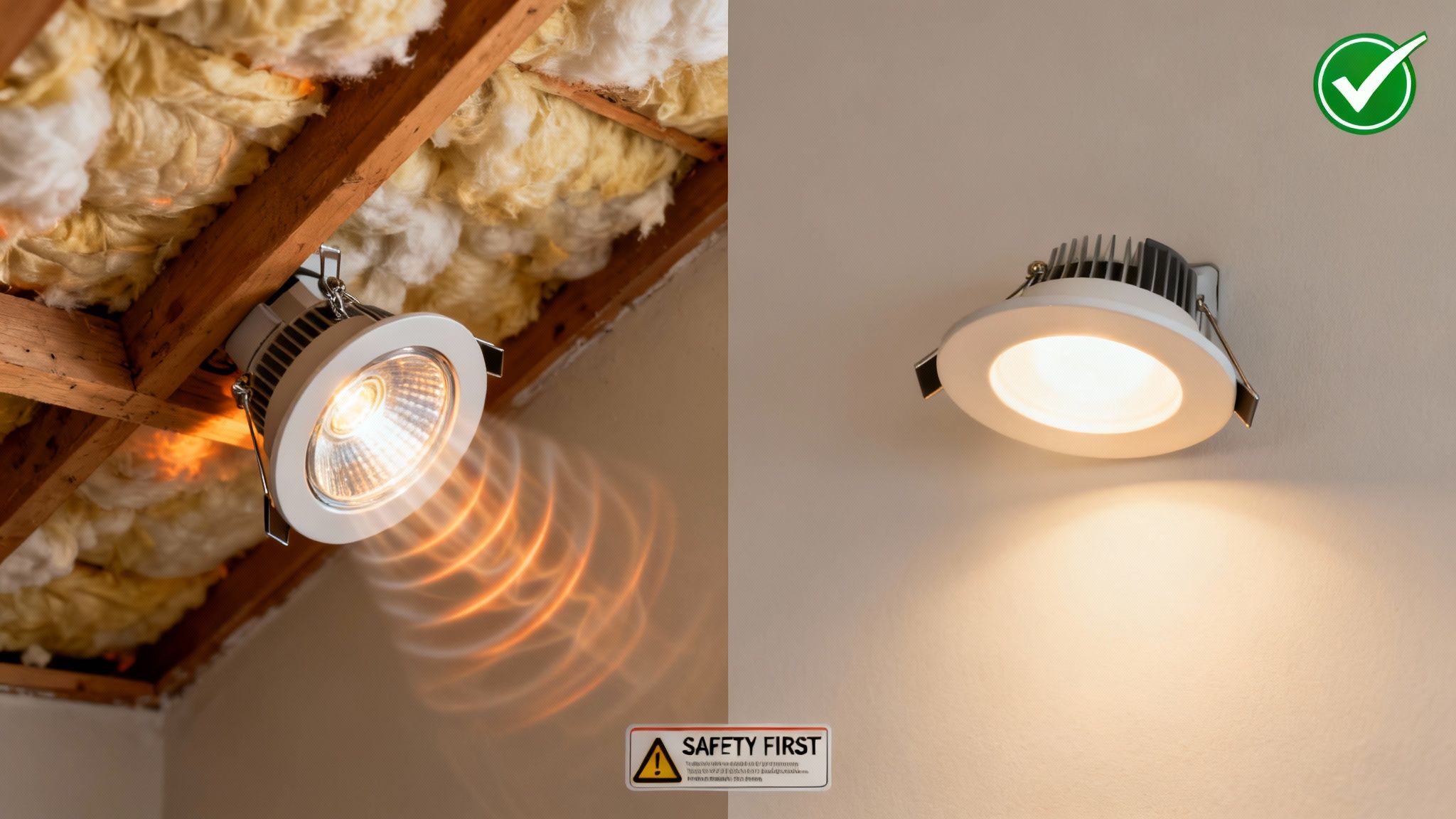
The biggest red flag with halogen bulbs is the incredible amount of heat they generate. A shocking 90% of the energy they pull from the wall is wasted as heat, not light. This means a standard halogen bulb can easily hit temperatures over 200°C—a serious fire hazard just waiting to happen.
This intense heat is a massive risk, especially in ceiling cavities where downlights sit right next to timber beams, insulation, and other flammable materials. That constant, high heat can degrade wiring over time and dramatically increase the chances of a fire. Frankly, it makes halogens a liability in any modern building.
LEDs, on the other hand, are a completely different story. They are a fundamentally safer technology because they run so much cooler. They’re incredibly efficient at turning electricity into light, which means very little energy is wasted as heat. An LED light is typically just warm to the touch, even after being on for hours.
This low operating temperature all but eliminates the fire risk that comes with old-school lighting. You can safely install LED downlights right up against insulation without a second thought, giving both homeowners and business managers genuine peace of mind.
The crucial difference in the halogen vs LED safety debate comes down to one thing: heat. Halogens create a dangerous fire risk through extreme heat output, while LEDs run cool, making them the only responsible choice for ceilings and enclosed spaces.
The safety and efficiency gains from LEDs aren’t just best practice; they’re baked into Australian law. Government regulations have been progressively phasing out inefficient and dangerous lighting like halogens, pushing the country toward safer, more sustainable solutions.
This government-led shift means choosing LEDs isn’t just a smart upgrade—it’s about staying compliant. Sticking with outdated halogen technology could mean your property no longer meets current energy efficiency or safety standards, which can cause headaches with insurance and even affect property value.
This trend is even more pronounced in commercial and emergency lighting. Government policies have effectively banned halogens in critical applications, giving LEDs a dominant 79.26% market share in areas like security systems where reliability is everything. For Brisbane households, the switch is just as impactful. Data shows a family can save around $229 annually just by swapping 10 old halogens for LEDs. This is a key reason why LEDs are now essential for any modern electrical work. For more details on how this technology is shaping our market, you can explore research on the national work light industry.
Deciding between halogen and LED lighting is usually straightforward—the evidence for LEDs is pretty overwhelming. But figuring out how to make the switch is where the real planning begins.
With clear benefits in efficiency, safety, and lifespan, upgrading to LED is one of the smartest investments you can make for your home or business. Now, let’s map out how to get it done properly.
You’ve got two main paths to choose from, and the right one depends on your budget, property, and long-term goals. Understanding the difference between a simple retrofit and a full fixture replacement is the key to a successful upgrade.
A retrofit is the quick and easy route. It involves swapping your old halogen globes for new LED ones that use a compatible base, like a GU10 fitting. It’s a fast fix that delivers immediate energy savings.
The catch? This approach can sometimes cause flickering or early failure. Old halogen transformers were designed for a much higher electrical load, and the low-wattage LEDs don’t always play nicely with them, leading to compatibility headaches.
A full fixture replacement, on the other hand, is the comprehensive solution. We remove the entire halogen fitting—globe, housing, and transformer—and install a brand-new, integrated LED unit. This guarantees perfect compatibility and unlocks the maximum performance and lifespan you expect from LED technology.
So, which option is right for you?
A full replacement is what we always recommend for homeowners and businesses wanting a true “set and forget” lighting system. Every component is designed to work together flawlessly, giving you decades of efficient, maintenance-free light.
While changing a globe seems simple enough, a proper lighting upgrade is a job for a licensed electrician. An experienced professional does more than just install lights; they ensure your investment is safe, compliant, and built to last.
When you bring in DLG Electrical, you get an expert assessment of your existing wiring and fixtures. We can spot potential compatibility issues with a retrofit before they become a problem, recommend the best quality LED products for your space, and ensure the entire installation meets all Australian standards.
A professional installation is your guarantee that the job is done right the first time, protecting your property and maximising your return on investment.
When you’re thinking about a lighting upgrade, it’s natural to have questions, especially when moving from old-school halogens to modern LEDs. Here are some of the most common queries we get from Brisbane property owners about making the switch.
In many cases, yes, you can. It’s possible to buy LED globes with the same base as your halogen ones (like a GU10), which is known as a simple retrofit.
But this is where things can get tricky. Halogen transformers were designed to handle a certain electrical load, and a single, ultra-efficient LED often doesn’t draw enough power to meet that minimum. This mismatch is what causes that annoying flickering, buzzing, or can even lead to the new globe failing prematurely. To guarantee performance and safety, it’s always best to have a licensed electrician check your setup and install proper LED-specific drivers if needed.
If you’re just looking at the price on the shelf, then yes, a single LED globe costs more upfront than a halogen. But that’s a tiny piece of the financial puzzle. The real story is in the total cost of ownership, and that’s where LEDs are dramatically cheaper.
An LED light can last over 25 times longer than a typical halogen and uses up to 80% less energy to run. Those numbers add up to massive savings on your power bills and almost completely do away with the cost of buying replacement globes. Most people find the higher initial investment pays for itself within a year or two, and from then on, it’s just pure savings.
The real comparison isn’t the price of one globe. It’s the cost of one LED versus the 25 halogens you’d have to buy—and pay to power—just to match its incredible lifespan.
Absolutely. This is a common myth that’s a hangover from the early days of LED technology when your only choice was a harsh, cool light. Things have changed completely.
Modern LEDs come in a huge range of colour temperatures, measured in Kelvins (K). You can easily find an LED that produces a ‘Warm White’ light (around 2700K-3000K), which perfectly mimics that cosy, yellowish glow of a classic halogen. It’s ideal for living areas and bedrooms. Of course, you can also get ‘Cool White’ or ‘Daylight’ options that are brilliant for task-focused areas like kitchens, laundries, and offices.
While popping in a new globe is a simple DIY job, a full lighting upgrade is a different ball game. Getting a professional involved is essential for a few critical reasons:
For a safe, efficient, and professional lighting system that truly maximises your investment, trusting a licensed electrician is the only way to ensure the job is done right.
Ready to make the switch and start saving on your power bills? The team at DLG Electrical is here to help with professional advice and expert installation. Contact us today for a free quote on your lighting upgrade.

Master Electrician with over 30 years of experience. Founded DLG Electrical in 2005 after international project work including electrical installations at Stamford Bridge Stadium, London(Home of Chelsea FC).

Local Electricians that can fix all Electric Hot water Systems.
Motion sensor lights are a versatile addition to any home, offering nu
