83 Jean St, Grange QLD 4051
Mon-Fri 07:30 AM - 04:00 PM - Sat - 8:00 - 12 - Sunday Closed

Think of a solar battery as your own personal energy reservoir. It’s designed to do one simple, brilliant thing: store the extra electricity your solar panels generate during the day so you can use that clean, free power at night or during an outage. This stops you from having to buy expensive power from the grid the moment the sun goes down.
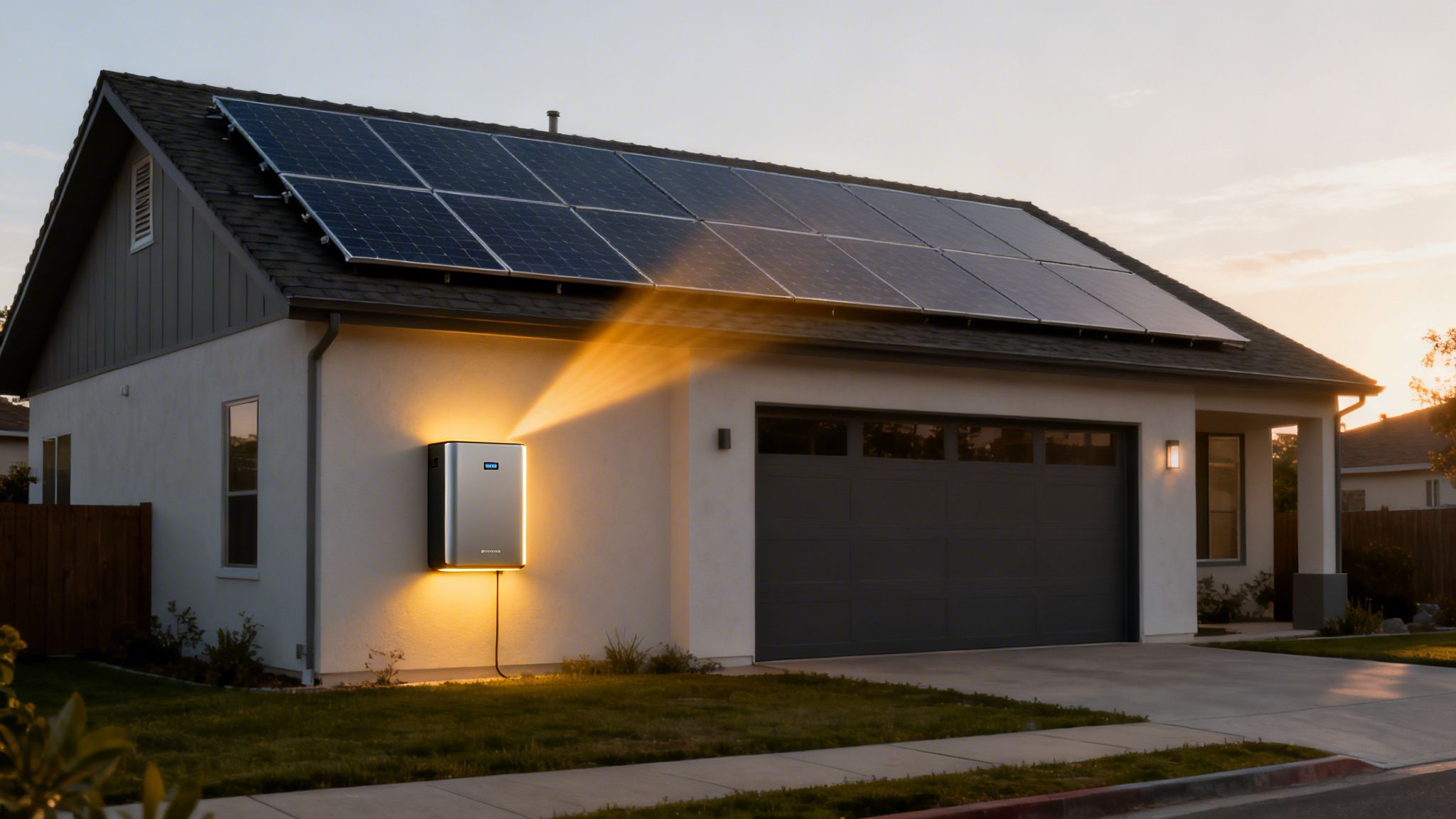
Your solar power system is a fantastic generator. On a bright, sunny Brisbane day, it will often produce far more energy than your home can use in that moment. Without a battery, all that valuable surplus power is just fed back into the grid, often for a tiny credit on your electricity bill.
This is where understanding how a solar battery works becomes a real game-changer. A solar battery simply captures and holds onto that excess energy, creating a reserve of power that’s exclusively yours.
The entire process is automatic and completely seamless. Your system’s smarts will first send solar power to whatever needs it right now—the air con, the lights, the TV, and other appliances. Only once those needs are met does any leftover energy get “deposited” to charge up the battery.
Then, as the sun sets and your panels stop producing, your home automatically starts “withdrawing” power from your battery. Instead of pulling from the grid and paying peak evening rates, you’re running on the free solar energy you stored just hours earlier. It’s a simple cycle that can dramatically reduce what you owe your electricity retailer each quarter.
To give you a clearer picture, here’s a quick breakdown of a typical day with a solar battery.
| Time of Day | What Your Solar Panels Are Doing | What Your Solar Battery Is Doing |
|---|---|---|
| Morning | Starting to generate power as the sun rises. | Powers your morning routine (kettle, toaster) if it has leftover charge from the day before. |
| Midday | Generating maximum power in full sunlight. | Charging up with all the excess solar power your home isn’t using. |
| Evening | Production stops as the sun sets. | Discharging to power your home through the evening peak (cooking, lights, TV). |
| Night | Inactive. | Continues to supply stored power for overnight appliances like your fridge. |
This cycle repeats daily, making your home a self-sufficient energy hub.
Beyond the obvious bill savings, a solar battery provides something invaluable: backup power. We all know Brisbane’s storm season can be brutal, and a blackout can leave you completely in the dark. A correctly installed solar battery, however, can instantly kick in, isolating your home from the grid and keeping the essentials running—from the fridge and lights to medical devices or the internet. For many local families, this peace of mind is one of the biggest benefits.
If you’re new to this, our guide on how a solar power system works is a great place to start for the basics.
Ultimately, solar batteries are a massive step towards a more sustainable and resilient home, fitting perfectly alongside other energy-efficient home upgrades that lower your environmental footprint. By using every last drop of your own clean energy, you’re not just saving money—you’re contributing to a greener grid. In this guide, we’ll walk you through everything you need to know, from the tech inside to sizing it for your home.
A solar battery might just look like a sleek, simple box on your wall, but inside, it’s a finely-tuned system. Three core components work together to safely store your excess solar energy and deliver it on demand, giving you power long after the sun has set.
Getting to know these parts is the key to understanding how your battery really works. Think of it as a team: the battery cells are the energy warehouse, the Battery Management System (BMS) is the on-site safety manager, and the inverter is the translator that gets the power ready for your home to use.
The battery cells are where the energy is actually stored. The vast majority of modern home batteries you’ll find in Brisbane use lithium-ion chemistry. This isn’t some new, untested tech; it’s the same reliable technology that powers everything from electric vehicles to your smartphone. It’s popular for good reason—it packs a lot of energy into a small space and is built to last.
Inside these cells, lithium ions shuttle back and forth between two electrodes. When your solar panels are making more power than you need, that extra energy is used to push the ions in one direction, effectively charging the battery. Later that night, when you switch on a light, the process reverses, releasing that stored energy to power your home.
This is where the real smarts of a modern solar battery come in. The Battery Management System (BMS) is a dedicated computer that acts as the protector and performance manager for the entire system. It’s the unsung hero that ensures your battery operates safely and efficiently for a decade or more.
The BMS is constantly monitoring critical data to keep everything running smoothly:
A great BMS is what separates a reliable, long-lasting battery from a potential headache. It’s the built-in safeguard that gives homeowners in Brisbane peace of mind, protecting their investment and making sure the system never operates outside its safe limits.
The final piece of this puzzle is the inverter. Both your solar panels and your battery deal in Direct Current (DC) power. The problem is, every appliance in your home—from the fridge and air con to your TV—runs on Alternating Current (AC). The inverter’s job is to be the essential translator between the two.
When your battery discharges to power your home, it sends DC power to the inverter, which instantly converts it into the stable 240V AC power your appliances need. This happens so seamlessly you’ll never even notice the switch. Modern inverters are incredibly good at their job, with typical efficiency ranging from 94% to 98%. This means very little of your valuable solar energy gets lost during the conversion. You can read more about how the US government measures solar performance and efficiency to get a better handle on these metrics.
Together, these three components form a smart, automated system. They work in concert to capture, store, and deliver clean solar power exactly when you need it, making your home more resilient and self-sufficient.
A solar battery’s day-to-day operation is a beautifully simple rhythm of charging, using, and interacting with the grid. This whole process is automated, designed to make sure you use every drop of your own clean energy first, which drastically cuts down how much power you need to buy. It’s the very core of how a solar battery delivers both serious savings and true energy independence.
The cycle kicks off the moment your solar panels are generating more power than your home is actually using. Instead of exporting that valuable surplus to the grid for a pittance, your system is smart enough to redirect it straight into your battery, building up a bank of free energy for later.
As the Brisbane sun gets higher, your solar production really starts to crank. Your home’s appliances—the air con, the pool pump, the washing machine—get first dibs on the power. Any electricity left over is automatically sent to charge your battery.
This continues through the sunniest parts of the day. Your battery basically acts like a big energy sponge, soaking up all that excess solar power until it’s full. The whole time, the brains of the operation—the inverter and the Battery Management System (BMS)—are managing the flow to make sure the battery charges safely and efficiently, without ever overcharging.
This flowchart shows how these key components work in harmony to manage the energy flow.
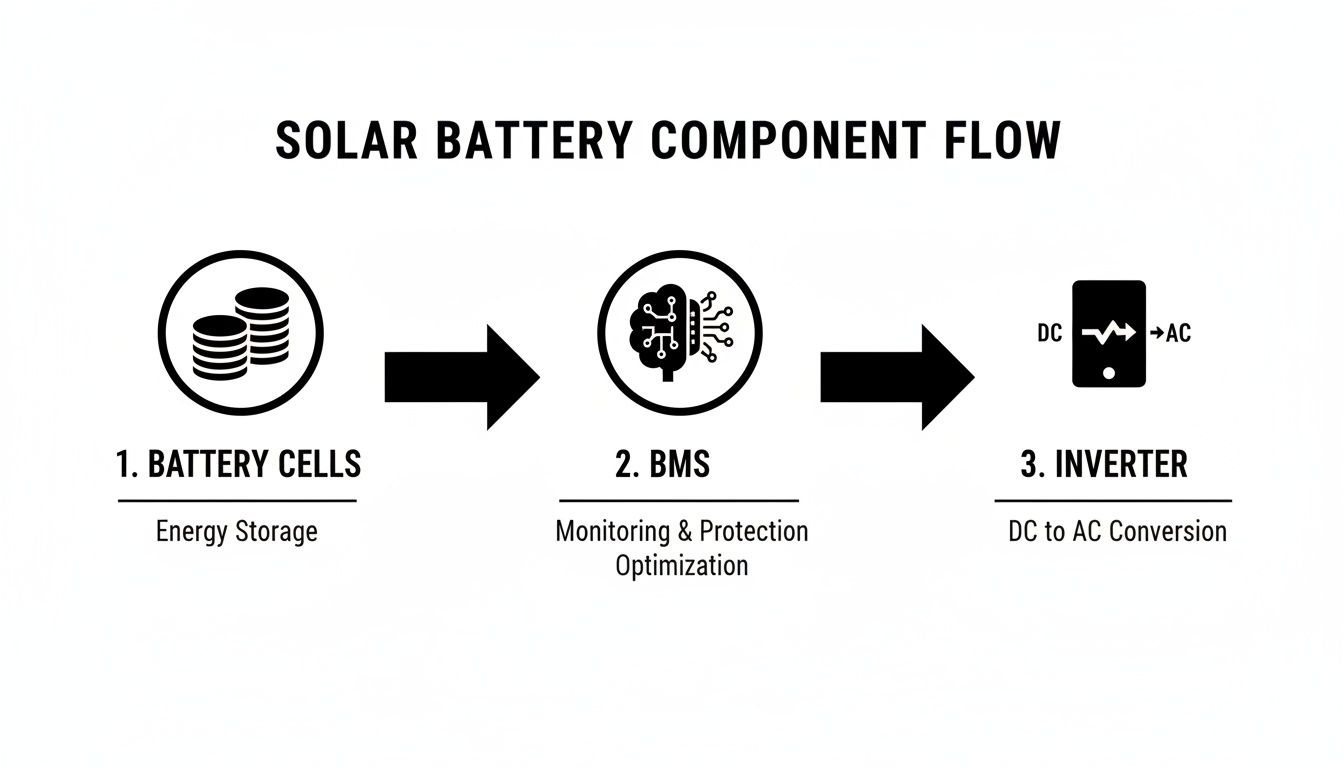
As you can see, the energy’s journey is seamless—from the individual battery cells, through the protective BMS, and finally to the inverter where it’s converted into power your home can use.
Once the sun goes down and your panels stop producing, the next phase begins. As you switch on the lights, cook dinner, or settle in to watch TV, your home will automatically start pulling power from your full battery instead of the grid.
The switchover is completely seamless. The stored DC power flows out of the battery to the inverter, which flips it into the AC power your appliances run on. You won’t notice a thing—no flicker, no interruption—just the quiet satisfaction that you’re running your home on stored sunshine and dodging those expensive evening electricity rates.
Modern solar batteries are more than just a simple power bank; they come with intelligent modes that give you incredible control. These settings let you customise exactly how your battery works with the grid, so you can tailor its behaviour to meet your specific goals.
There are three main modes that define this relationship:
Prioritising the use of your own stored solar energy is the key to getting the most out of your investment. By running in self-consumption mode, you ensure you always use the free power you’ve generated before you ever think about buying it from the grid.
This self-consumption approach is incredibly effective. Data shows that by setting up a battery to prioritise stored solar, homeowners can slash their grid reliance and see their electricity bills shrink by up to 90%. You can dig into more of the numbers on how self-consumption drives savings over at SolarQuotes.com.au. This strategy is also a game-changer for those with other high-demand systems at home; you can read more about this in our guide on EV charger installation. This daily rhythm of charging and discharging is what makes a solar battery such a powerful tool for any modern home.
Once you start digging into solar batteries, you’ll find yourself staring at a spec sheet full of numbers and acronyms. It can feel like reading a different language, but getting your head around these key metrics is the difference between buying the right system and making a costly mistake.
These numbers aren’t just technical jargon; they directly translate into how your battery will perform day-to-day. They tell you how much energy it can hold, how many appliances you can run at once, and how much of your precious solar power actually makes it back into your home. Let’s break down the four most important metrics so you can compare models like a pro.
The first number everyone looks at is capacity, measured in kilowatt-hours (kWh). This is straightforward: it’s the total amount of energy your battery can store when fully charged. Think of it as the size of your energy “fuel tank.”
A bigger number means more stored energy. For example, a 10kWh battery can power your home for roughly twice as long as a 5kWh one. This is what determines whether you can get through a short evening blackout or ride out a multi-day grid failure.
But capacity is only half the story. You also need to know the power rating, measured in kilowatts (kW). While capacity tells you how much energy is in the tank, the power rating tells you how fast you can use it. It’s the maximum muscle your battery has to power things at any single moment.
This is critical for running multiple appliances. A battery with a low 3kW power rating might handle your lights, TV, and fridge, but it will trip if you try to run the air con and the oven at the same time. A higher 5kW power rating gives you the grunt to run more demanding appliances simultaneously, which is essential for proper blackout protection.
Depth of Discharge (DoD) is the percentage of the battery’s total capacity you can actually use without causing damage. You might assume a 10kWh battery gives you 10kWh of power, but it’s not always that simple. The DoD tells you the usable capacity.
Thankfully, this is less of a worry with today’s technology. Most modern lithium-ion batteries have a very high DoD, often 90% or even 100%. So, if you buy a 10kWh battery with a 90% DoD, you get a solid 9kWh of usable energy.
Finally, there’s round-trip efficiency. No battery is 100% perfect; a little bit of energy is always lost as heat when charging and discharging. This metric, shown as a percentage, tells you how much energy you get back out for every unit you put in.
A higher number is always better. For instance, a battery with 95% round-trip efficiency gives you back 9.5kWh of usable power for every 10kWh of solar energy you store. A lower efficiency means more of your solar generation is wasted, so this is a key number for calculating your long-term return on investment.
When you’re looking at different battery models, their spec sheets can be overwhelming. This table breaks down what these key numbers really mean for you and shows the typical ranges you’ll see in the market for 2026.
| Metric | What It Means For You | Typical Range In 2026 Models |
|---|---|---|
| Capacity (kWh) | The total amount of energy stored (your “fuel tank” size). Determines how long you can run your home on stored power. | 5kWh – 15kWh per module |
| Power Rating (kW) | How much power you can draw at once. Determines how many appliances you can run simultaneously. | 3kW – 7kW continuous output |
| Depth of Discharge (DoD) | The percentage of usable capacity. Higher DoD means you can use more of the energy you’ve stored. | 90% – 100% |
| Round-Trip Efficiency | How much energy you get back vs. what you put in. Higher efficiency means less wasted energy and better value. | 88% – 96% |
Understanding these four metrics is the foundation for making a smart choice. It allows you to move beyond just the brand name or upfront cost and select a battery that truly fits your home’s energy profile and your goals for energy independence.
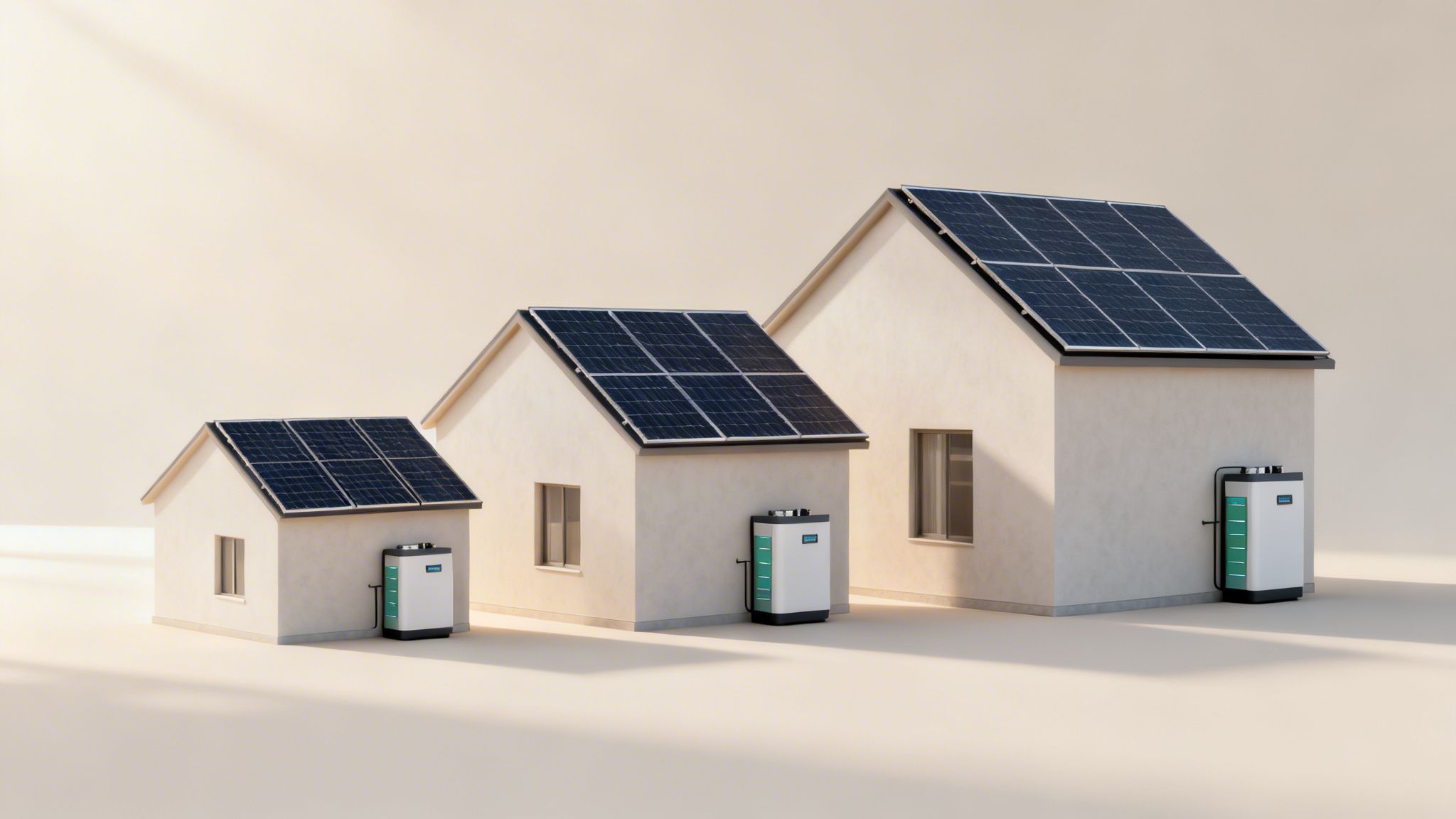
When it comes to solar batteries, a one-size-fits-all approach simply doesn’t cut it. Go too small, and you’ll be left frustrated, still pulling power from the grid when you don’t want to. But go too big, and you’ll have a huge battery you can’t fill, meaning you’ve paid for expensive capacity that just sits there, giving you a poor return on your investment.
Getting it right is all about matching the battery’s capacity to your home’s unique energy habits and your personal goals. Are you just trying to avoid expensive evening power bills, or are you after full blackout protection for the entire house? The answers are hiding in plain sight on your electricity bill and in your daily routine.
Your quarterly electricity bill is the best place to start. Buried in there you’ll find an “average daily usage” figure, usually shown in kilowatt-hours (kWh). This number is your baseline, telling you how much power your household chews through in a 24-hour period.
To put it in perspective, a typical Australian home uses around 18-20 kWh of electricity per day. A 10 kWh solar battery could comfortably cover about 50-60% of that usage, making a serious dent in your reliance on the grid, especially during those costly evening peak hours. You can get a better feel for average household energy use by checking out the information available on Energy.gov.au.
But total daily use is only half the story. The real key is understanding when you use that power. Is your house empty all day, with usage spiking after dark? Or do you work from home, with appliances running consistently all afternoon? This pattern is what determines the perfect battery size.
Let’s walk through a couple of real-world scenarios for a Brisbane home to see how this works in practice.
Choosing the right size isn’t just about the kWh number. It’s about making sure your investment is perfectly aligned with your goals. A professional assessment will analyse your actual usage patterns to find that sweet spot, so you aren’t paying for capacity you simply don’t need.
Doing your own sums is a great start, but nothing beats a professional load assessment for accuracy. An experienced electrician will get your interval data from your energy provider, which breaks down your consumption into 30-minute blocks. This incredibly detailed view shows us exactly when your peak usage occurs and how much surplus solar you’re exporting—the precise amount of energy available to charge a battery.
This data-driven approach takes all the guesswork out of the equation. It also lets us check for other critical factors, like whether your existing switchboard can handle the load. In some cases, installing a large battery might mean you also need a switchboard upgrade to manage the new circuits safely. If you’d like to know more, have a look at our guide on switchboard upgrades in Brisbane.
Ultimately, a professional sizing consultation ensures your new battery system is a perfect match for your home, your lifestyle, and your budget from day one.
When you start looking into a solar battery, the conversation always comes down to two big questions: how much will it set me back, and how long is it going to last? Getting a handle on the full financial picture is key to making a smart investment in your home’s energy independence.
The upfront cost isn’t just the sticker price on the battery. It’s a complete package that covers the battery unit itself, a compatible inverter to manage the energy flow, and the critical professional installation by a certified expert.
While the initial investment can seem high, it’s crucial to think about the long-term value. A solar battery is a major home appliance built for the long haul, not a gadget you’ll replace in a few years. The real payoff comes year after year as you slash the amount of power you need to buy from the grid, especially during those expensive peak-rate hours.
One of the most important numbers in this whole equation is the battery’s lifespan. Thankfully, modern lithium-ion solar batteries have become incredibly reliable. Most top-tier manufacturers back their products with a warranty of around 10 years. This warranty is also often measured in “cycles”—one full charge and discharge of the battery.
For a good comparison, you can look at the similar technology covered in discussions about how long EV batteries typically last. A quality solar battery today is typically warrantied for 10 years or between 6,000 to 10,000 cycles. This level of durability makes them a solid, long-term asset for any Brisbane home.
Think of it this way: with one cycle per day, a battery rated for 10,000 cycles has the potential to last well over two decades, though performance will naturally degrade slowly over time. The 10-year warranty is your guarantee of solid performance for at least that period.
When you’re budgeting for a solar battery in 2026, you absolutely must look at the total installed price. This isn’t just the battery unit; the full cost includes:
One of the best things about today’s solar batteries is just how little maintenance they need. Unlike your car, there are no regular oil changes or tune-ups. These systems are designed to be almost completely self-sufficient, with the internal Battery Management System (BMS) doing all the hard work to keep the cells healthy.
For a homeowner, this makes ongoing upkeep wonderfully simple. It’s generally a good idea to have a professional give it a check-up every year or two, usually as part of your routine solar system inspection. This quick review just makes sure all the connections are secure and the system is performing as it should, giving you total peace of mind that your investment is protected and working hard for its entire lifespan.
As you start looking into how solar batteries work, it’s only natural for practical questions to pop up. For many Brisbane homeowners, getting clear answers to these questions is the final step before deciding to invest. Here are the straightforward answers to the questions we get asked most often.
The technology inside a modern home battery is probably more familiar than you think. Most new solar battery systems use lithium-ion chemistry, the same tech that powers electric vehicles and smartphones.
This is the go-to choice for a reason. It’s favoured for its high energy density (meaning more power in a smaller box), long cycle life, and falling costs. It’s a big part of why today’s batteries are so compact and reliable. You can read more about these energy storage systems from energy.gov.
Yes, in almost all cases, you can. The process is known as “AC coupling”. An installer will add a battery and a compatible hybrid inverter that works in tandem with your current solar setup.
Your existing solar system doesn’t change; it keeps generating power just like it always has. The new battery system simply steps in to intelligently monitor for any excess solar power that would normally be sent to the grid, and diverts it to charge your battery instead.
This is where a solar battery really proves its worth, especially during Brisbane’s unpredictable storm season. When the grid goes down, a properly installed battery system with backup capability automatically disconnects your home from the grid. This is called “islanding”.
In that moment, your battery and inverter work together to create a private mini-grid for your house, using the stored solar power to run your essential circuits. The switchover is so fast—often just milliseconds—that you probably won’t even see the lights flicker.
Key Takeaway: During an outage, your battery doesn’t try to power the whole street. It safely isolates your home, keeping your essential appliances like the fridge, lights, and internet running on stored energy until the grid comes back online.
Very little. Modern solar batteries are designed to be a “set and forget” solution. The internal Battery Management System (BMS) is the brains of the operation, constantly monitoring and balancing the battery cells to ensure they stay healthy and last as long as possible.
There are no fluids to top up or moving parts to service. We do recommend a quick professional check-up every year or two—often done at the same time as a solar panel clean—just to make sure all the connections are tight and everything is performing exactly as it should.
Ready to take control of your home’s energy? The expert team at DLG Electrical can design and install the perfect solar battery solution for your Brisbane home. Get your free, no-obligation quote today!

Master Electrician with over 30 years of experience. Founded DLG Electrical in 2005 after international project work including electrical installations at Stamford Bridge Stadium, London(Home of Chelsea FC).

Local Electricians that can fix all Electric Hot water Systems.
Motion sensor lights are a versatile addition to any home, offering nu
