83 Jean St, Grange QLD 4051
Mon-Fri 07:30 AM - 04:00 PM - Sat - 8:00 - 12 - Sunday Closed

How does an Aircon Work: blast of cold air on a scorching day feels almost magical, but the science behind how your aircon works is surprisingly straightforward. At its heart, an air conditioner is just a very clever heat mover. It uses a simple process to grab all the unwanted heat from inside your home and dump it outside, leaving you with that cool, comfortable air.
Think of your air conditioner like a ‘heat sponge’. It soaks up warmth from your living room, then gets carried outside to be wrung out in your backyard. This simple idea of moving heat is the key to understanding the whole cooling cycle. It’s not about creating cold; it’s about removing heat.
This process runs in a continuous loop, relying on a special substance called a refrigerant that travels between the indoor and outdoor units of your system. The real magic happens as this refrigerant flips between being a liquid and a gas, over and over again.
Your aircon operates on a fundamental law of physics: heat naturally moves from a warmer place to a cooler one. The system cleverly exploits this by creating an intensely cold surface inside your home (called the evaporator coil). As your warm indoor air is blown across it, the heat gets absorbed into the refrigerant—much like how a cold drink soaks up the warmth from the air on a hot day.
This now heat-filled refrigerant travels to the outdoor unit. Here, the system reverses the trick, making the refrigerant hotter than the outside air and releasing all that captured indoor heat into the atmosphere.
The core function of an air conditioner is not to generate cold air but to efficiently relocate heat from inside your home to the outside environment, using a continuous refrigeration cycle.
To really get your head around this, it can help to look at similar technologies. For anyone interested in the nitty-gritty, digging into the mechanics of heat pumps offers great insight, as they share an almost identical operating cycle with air conditioners.
The entire system is engineered to make this heat exchange happen as efficiently as possible. Every single component, from the compressor to the fans, plays a crucial role in keeping this loop going. In the next sections, we’ll meet the key players that make it all happen.

To really get how an aircon works, you need to meet the hardworking components doing all the heavy lifting. Every air conditioner, from a small window unit to a massive ducted system, relies on four main parts working in perfect harmony. Think of them as a specialist team, each with a critical job in the heat-moving process.
When these parts function together, they create the continuous refrigeration cycle that pulls warmth from your home and dumps it outside. Let’s break down each player and their specific role in delivering that refreshing, cool air.
First up is the compressor, which you’ll find humming away in the outdoor unit. It’s basically the engine or heart of the entire system. Its main job is to take the low-pressure refrigerant gas that has soaked up heat from inside your home and pressurise it.
Think about pumping up a bike tyre—as you apply pressure, the air inside gets hot. The compressor does something very similar, transforming the cool, low-pressure gas into a hot, high-pressure gas. This step is vital because it gets the refrigerant ready to release its stored heat once it moves on to the next stage. It’s no surprise the compressor is often the biggest energy user in an air conditioning system.
After leaving the compressor, this hot, high-pressure gas flows into the condenser coil, which is also part of the outdoor unit. This component works a lot like the radiator in your car. It’s made up of a long series of pipes with fins attached, a design that maximises its contact with the outside air.
As the hot refrigerant gas travels through these coils, a large fan blows ambient air across them. This simple action transfers the heat from the refrigerant into the surrounding atmosphere. The refrigerant then cools down and condenses back into a high-pressure liquid. This is the “heat dumping” part of the cycle, where all that unwanted warmth from your house gets kicked to the curb.
By converting the refrigerant from a hot gas back into a liquid, the condenser coil effectively “wrings out” the heat that was absorbed from your indoor air, making the entire cooling process possible.
Now in liquid form but still under intense pressure, the refrigerant travels back towards the indoor unit. Before it gets there, though, it has to pass through the expansion valve. This component might be small, but it plays a massive role in how an aircon actually works.
Its job is to act as a gatekeeper, causing a drastic drop in the pressure of the liquid refrigerant. As the liquid is forced through a tiny opening, its pressure plummets, causing it to flash into an intensely cold, low-pressure mist. This sudden drop in temperature is what makes the final stage of cooling possible.
Finally, this super-chilled, low-pressure refrigerant enters the evaporator coil, located in your indoor unit. This is the component that actually cools your home’s air. A fan inside this unit blows your warm indoor air across the cold fins of the evaporator coil.
As the air passes over, the cold refrigerant inside the coil acts like a sponge, absorbing heat and humidity from the air. This process not only cools the air but also dehumidifies it—that’s why air-conditioned air feels so crisp and dry. Having soaked up the heat, the refrigerant turns back into a low-pressure gas, ready to head back to the compressor and start the whole journey over again.
While the air conditioner’s components are the stage, the refrigerant is definitely the star of the show. This special chemical is the secret ingredient making the magic happen, acting as a relentless heat-transfer agent as it cycles through the system. Its unique ability to easily flip between a liquid and a gas is the entire foundation of how your aircon works.
Think of the refrigerant as a tiny, super-efficient courier. Its only job is to pick up a package of heat from inside your home, carry it outside, drop it off, and then race back in to grab another one. This happens in a continuous, high-speed loop. To really get it, let’s follow the refrigerant through its four key transformations.
Our journey kicks off at the compressor, located in the outdoor unit. The refrigerant arrives here as a cool, low-pressure gas, having just soaked up heat from your indoor air. The compressor’s job is to squeeze this gas with incredible force, which dramatically increases both its pressure and its temperature.
It’s a bit like pumping up a bicycle tyre—the act of compression makes the air inside hot. By pressurising the refrigerant, the compressor turns it into a superheated, high-pressure gas. This primes it to easily offload its captured heat to the outside world.
This infographic breaks down the fundamental three-step process of how refrigerant moves heat.
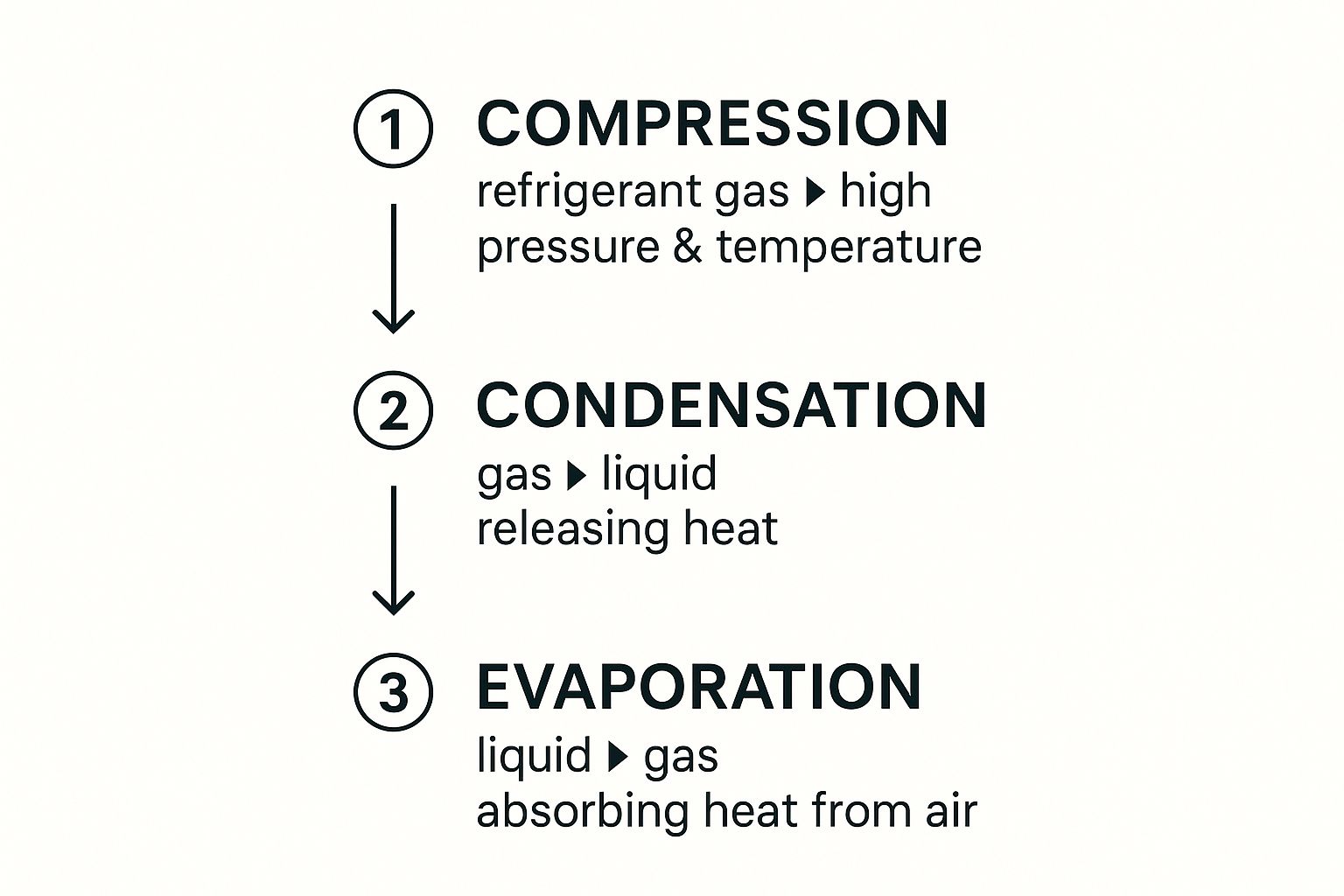
As you can see, cooling isn’t about creating cold air out of thin air. It’s a continuous cycle of compressing, condensing, and evaporating a substance to physically move thermal energy from one place to another.
Now a hot, high-pressure gas, the refrigerant flows into the condenser coils—also part of the outdoor unit. A large fan blows the surrounding ambient air across these coils. Since the outside air is much cooler than the superheated refrigerant, heat naturally moves from the refrigerant to the air.
As it rapidly loses heat, the refrigerant undergoes a phase change, condensing from a gas back into a high-pressure liquid. This is the exact moment all that unwanted warmth from your home is officially dumped outside.
The core principle here is simple but powerful: by changing from a gas to a liquid, the refrigerant sheds the heat it absorbed indoors. It effectively “wrings out” the thermal energy before continuing its journey.
Still a liquid and under high pressure, the refrigerant travels back towards the indoor unit. But before it enters the evaporator coil, it’s forced through a tiny component called an expansion valve. This valve causes a sudden, massive drop in pressure.
This rapid depressurisation forces the liquid refrigerant to quickly expand and flash-evaporate into an intensely cold, low-pressure mist. It’s this change that makes the refrigerant cold enough to absorb the heat from your room’s air.
This reliance on air conditioning has seen a huge rise. Since 1994, air conditioning use in Australian households has nearly doubled. In Victoria alone, by 2008, around 67% of households owned at least one air conditioner. Some regions like Goulburn-Ovens-Murray even reached 91% penetration, showing just how essential this cooling cycle has become. You can discover more insights about these Australian household trends and their impact on energy use.
Finally, this super-chilled mist enters the evaporator coil, located inside your home. The fan in the indoor unit blows your warm room air across the coil’s freezing-cold surface. Because the refrigerant is so much colder than the air, it readily absorbs both heat and humidity.
This absorption of heat gives the refrigerant the energy it needs to evaporate, changing it back into a cool, low-pressure gas. Now carrying a fresh load of heat, it travels back to the compressor to begin the entire cycle all over again, repeating the process endlessly to keep you cool.
If you take a stroll through your neighbourhood, you’ll see most modern air conditioners are what we call ‘split systems’. This isn’t just a fancy industry term; it simply means the system is split into two distinct parts: an indoor unit and an outdoor unit, connected by a set of pipes.
This design isn’t arbitrary—it’s the secret sauce behind how your aircon moves heat so effectively.
Think back to our ‘heat sponge’ analogy. To properly cool your home, you need a spot to soak up all the unwanted heat and another place—well away from your living room—to wring it all out. The split system design nails this perfectly by separating the two main jobs of the cooling cycle.
This clever division of labour is what makes modern air conditioning both quiet and incredibly efficient.
That sleek, quiet box mounted high on your wall? That’s the indoor unit, and its whole purpose is to pull heat and humidity out of the air in your room. Tucked away inside are two critical components that get this done:
In short, the indoor unit is the ‘cool side’ of the operation. It’s where the magic of heat absorption happens, making your room comfortable.
The split system design is brilliant because it keeps the noisiest part of the system—the compressor—outside. This leaves the indoor unit to do its job of quietly absorbing heat and circulating cool air.
That bigger, boxier unit humming away in your backyard or on the side of your house is the outdoor unit. This is the ‘hot side’ of the system and the real powerhouse of the whole operation. Its job is to take all that heat collected from inside and dump it into the outside air.
It contains the other essential parts of the puzzle:
This separation is what makes the system so comfortable to live with. It isolates the compressor, the loudest component, keeping your indoor space peaceful.
Understanding how these two units work together also helps when planning an installation. For example, the placement and complexity of a ducted system can vary greatly. You can learn more about what influences the price to install ducted air conditioning in our detailed guide, which breaks down how unit placement and system type affect the final cost. Remember, keeping both units clean and clear of leaves or debris is one of the best things you can do to keep your system running efficiently for years.

Staying cool during a brutal Aussie summer isn’t a luxury; it’s a necessity. But that comfort definitely comes at a cost. Your air conditioner is often one of the biggest power guzzlers in your home, and getting a handle on what drives that energy use is the first step to managing your electricity bill.
The process of shifting heat from inside your home to the outside isn’t free. It takes a serious amount of electrical power, mostly to run the compressor—the real workhorse of your aircon system. Every single degree you ask your unit to cool your home forces this component to work harder and longer, which directly cranks up your power consumption.
There are a few key things that determine just how much energy your air conditioner chews through. Understanding these factors can help you make smarter choices without having to sweat it out. It’s not just about flipping the switch on and off; it’s about how you use it.
The main drivers of your aircon’s running costs really boil down to this:
The core takeaway is simple: your aircon’s energy use is a direct reflection of how hard it has to work. The bigger the temperature difference between inside and outside, the more power it needs to maintain the climate you’ve set.
With electricity prices and summer temperatures both climbing, the financial sting of running an air conditioner is getting more and more noticeable. Australian households are feeling this pinch, with spending on cooling increasing year after year.
Here’s a quick look at the Australian air conditioner market, highlighting just how significant this industry has become.
| Metric | Value/Figure | Timeframe |
|---|---|---|
| Market Size (Revenue) | AUD 3.1 billion | 2024 |
| Year-over-Year Growth | $190 million increase | 2023 to 2024 |
| Electricity Price Increase | 37% hike | Since 2022 |
| Average Household Spend | $305 | Summer 2024 |
These figures show a clear trend: as our summers get hotter and energy gets more expensive, the cost of cooling our homes is becoming a major household expense.
Even with millions of households trying to cut back, the average family still spent around $305 on cooling for the summer. It’s easy to see how simple habits can make a huge difference in managing these expenses. Things like closing blinds during the day, sealing up drafts, and doing basic maintenance like cleaning filters all reduce the workload on your system.
For a deeper dive into the specific numbers, check out our guide on the true cost of running your aircon for more detailed breakdowns. By understanding how your aircon works and what drives its consumption, you can keep your home comfortable and your energy bills under control.
Alright, so now you know the magic behind how your aircon turns a steamy Brisbane day into a cool, comfortable afternoon. That’s a great start. But knowing how it works is only half the battle—knowing how to look after it is what will keep it running efficiently for years to come.
Think of it like your car. You wouldn’t drive it for years without an oil change or a basic check-up, right? Your air conditioner is no different. A little bit of simple, regular maintenance is the single best thing you can do to protect your investment, prevent expensive breakdowns, and keep it humming along nicely.
The good news? Most of these tasks are dead simple. We’re talking about a few minutes of your time each month. By linking these simple actions back to the components we’ve just unpacked, you’ll see exactly why they’re so critical for keeping your system in top shape.
Getting into a regular maintenance rhythm is easy, and focusing on a few key areas will make a massive difference to your unit’s performance and the quality of air you’re breathing. If you let these things slide, you’re looking at weaker cooling, higher power bills, and a system that could fail years before it should.
Here are the most important jobs to add to your home care routine:
That filter in your indoor unit? It’s the bodyguard for your entire system. Its whole purpose is to trap dust, pet hair, and other airborne gunk before it can get sucked in and plaster itself all over the delicate fins of the evaporator coil.
When the filter gets dirty, airflow drops dramatically. This means less warm air can pass over the evaporator coil, so your room takes way longer to cool down. The system has to run harder and for longer to hit the temperature you’ve set on the remote, which you’ll see reflected in your next electricity bill.
For more ways to cut down your power consumption, check out our guide on energy efficiency tips from a Northside electrician.
A clean filter is directly linked to the health of your evaporator coil. By keeping the filter clean, you ensure the coil can absorb heat at its maximum capacity, allowing the entire refrigeration cycle to function as designed.
Just as the indoor unit needs to breathe freely, so does its outdoor partner. The big box outside contains the compressor and condenser coil—it’s where all that heat pulled from inside your house gets expelled into the atmosphere. A massive fan inside pulls air through the unit to help get rid of this heat.
If that unit is blocked by overgrown bushes, buried under lawn clippings, or covered in leaves, it’s like asking it to breathe through a wet towel. It will struggle to release heat, forcing the compressor to work harder and risk overheating. A good habit is to keep a clearance of at least 60 centimetres around the entire outdoor unit. Give it some space to work!
This reliance on air conditioning isn’t slowing down. The Australian air conditioner market was valued at around USD 3.1 billion in 2024 and is projected to hit USD 5.3 billion by 2033, largely driven by our rising temperatures and the push for more energy-efficient models.
While these DIY checks are fantastic, they don’t replace the need for professional AC services and maintenance. Getting a pro in every year or so is essential for the tricky stuff, like checking refrigerant levels and testing electrical connections. It’s the best way to catch small issues before they snowball into major, expensive problems.
For professional air conditioner installation, servicing, and repairs that you can trust, the team at DLG Electrical is here to help. Contact us today for a free quote!

Master Electrician with over 30 years of experience. Founded DLG Electrical in 2005 after international project work including electrical installations at Stamford Bridge Stadium, London(Home of Chelsea FC).

Local Electricians that can fix all Electric Hot water Systems.
Motion sensor lights are a versatile addition to any home, offering nu
