83 Jean St, Grange QLD 4051
Mon-Fri 07:30 AM - 04:00 PM - Sat - 8:00 - 12 - Sunday Closed

When one interconnected smoke alarm senses trouble, they all sound the alarm. It’s that simple. This single feature transforms a series of individual detectors into a unified, home-wide safety network. The result? You and your family get precious extra seconds to escape a fire, no matter where it starts.
Picture this: a fire starts in the garage while everyone is asleep upstairs. A standard, standalone smoke detector down there might be screaming its head off, but with closed doors and the distance, you might not hear it. By the time the danger is close enough to wake you, your escape time has been drastically cut. It’s a critical safety gap that many people don’t think about until it’s too late.
Now, let’s replay that scenario with an interconnectable wireless smoke alarm system. The second that garage alarm detects smoke, it doesn’t just make a noise on its own. It blasts a wireless signal to every other alarm in the house—in the hallways, the bedrooms, and on every floor. Instantly, your entire home is filled with a loud, impossible-to-ignore alert.
A traditional smoke alarm is like a lone watchman in a castle. If they’re too far away to be heard, the warning is useless. An interconnected system, on the other hand, is like a modern communications network where everyone gets the emergency alert at the exact same moment.
This simultaneous alarm is what makes these systems a genuine game changer. It closes that dangerous time gap between the first sign of smoke and the moment everyone in the house knows there’s a problem. This is absolutely vital in homes that are:
A synchronised, house-wide alert can be the difference between a close call and a tragedy. It ensures that no matter where a fire starts, everyone gets the warning immediately, giving you the maximum time to get out safely.
In a house fire, every single second counts. Toxic smoke can overwhelm a room in just a couple of minutes, making a fast escape the number one factor for survival. By giving everyone an earlier, louder, and more widespread warning, an interconnected system buys your family the most valuable thing in an emergency: time.
Those crucial extra moments are what allow everyone to react, get low to the ground, and follow your fire escape plan without panic. This isn’t just about ticking a box for compliance; it’s about installing a smarter, faster safety net that actively protects every corner of your home and the people inside it.
Ever wondered how an alarm in the kitchen can instantly trigger the one in a bedroom at the other end of the house? It’s not magic. It’s a clever and incredibly reliable communication system working behind the scenes. Think of an interconnectable wireless smoke alarm system as its own private, miniature radio station, dedicated solely to your family’s safety.
At the heart of each alarm sits a small but powerful radio frequency (RF) module. This little piece of tech is both a transmitter and a receiver. When you first set up the system, you go through a simple “pairing” process. This is like tuning all your alarms to the same secure radio channel, making sure they only listen to and talk with each other.
Once paired, the alarms are always listening. If one unit senses smoke, its RF module immediately broadcasts a distress signal on that dedicated channel. Every other alarm in the network picks up this signal in a fraction of a second and sounds its own siren. This is what creates that simultaneous, house-wide alert that makes these systems so effective.
To really appreciate how seamlessly this all works, it helps to understand the three key parts working together inside each unit. Each one plays a distinct and vital role in creating a dependable safety net for your home.
This infographic below does a great job of showing the difference in alert coverage between a single, lonely alarm and a fully interconnected system.
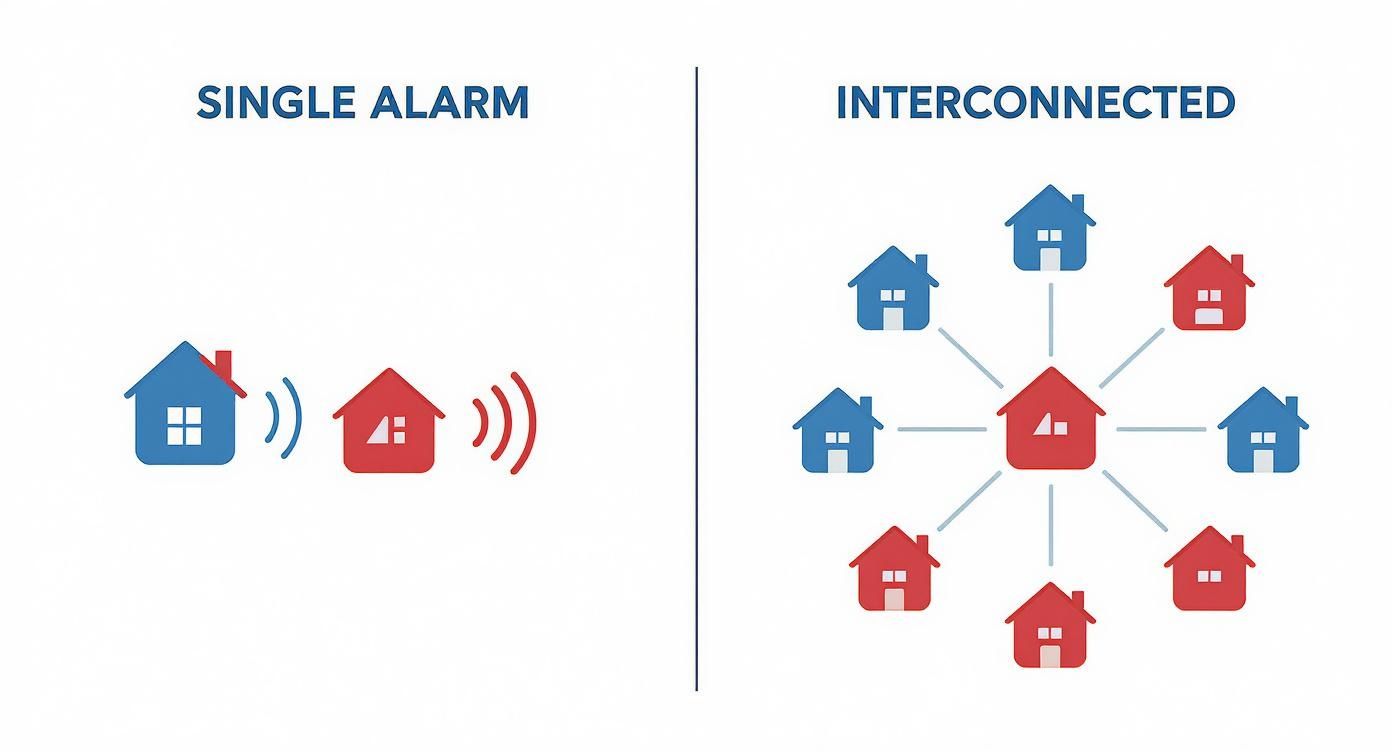
You can see how an interconnected network closes those critical safety gaps, making sure an alert is heard everywhere, instantly.
Many of the latest interconnectable wireless smoke alarms use even more robust communication methods to guarantee reliability. Instead of just a simple broadcast, they often create what’s known as a mesh network.
In a mesh network, each alarm also acts as a repeater. It strengthens and extends the signal. So, if one alarm can’t “hear” the original signal directly, another alarm in the middle can relay the message, ensuring total coverage even in large or complex homes.
This self-healing network design is incredibly resilient. The advantages of mesh networks are well-documented, showing why this technology is so reliable for home safety. For a closer look at how leading brands apply this, you can learn about the advantages of Brooks mesh technology, which is used in some of the best alarm systems on the market.
The move towards this kind of dependable tech is growing fast. The Australian market is supported by strong regulations that encourage the installation of interconnected smoke detectors in both homes and businesses. This regional shift is highlighted by the projected growth of the Asia-Pacific wireless fire detection market at a CAGR of 9.5% from 2025 to 2032. This regulatory push ensures homeowners have access to proven technologies that offer far superior protection.
So, beyond the basic idea that all the alarms go off at once, what are the real, practical advantages that make an interconnectable wireless smoke alarm system such a smart move for your home? The benefits go way beyond just making a louder noise—they touch on life-saving speed, simple installation, and genuine flexibility for the future.
These systems are designed to close the dangerous safety gaps found in so many homes. The benefits really boil down to three key things: you get a much earlier warning, the installation is dead simple, and the system can grow with your needs down the track.
Let’s paint a picture. You’re working from your home office at one end of the house, headphones on, deep in concentration. At the complete opposite end of the house, a small electrical fault in the kitchen starts a smouldering fire. A single, isolated alarm in the kitchen might be sounding, but you’d never hear it over your music.
This is exactly where a networked system proves its worth. The second that kitchen alarm detects smoke, it doesn’t just chirp by itself. It blasts a wireless signal to every other alarm in the house, including the one right outside your office door. Suddenly, a house-wide alert you simply can’t ignore cuts through your focus, giving you a clear, immediate warning of the danger, no matter where you are.
A networked system removes the element of chance. It ensures an alarm in an empty part of the house delivers an alert directly to you, giving you those critical extra seconds to react and get out safely.
This instant, widespread alert is the single most important benefit. It turns your smoke alarms from lonely sentinels into a smart, coordinated team that protects every corner of your home at the same time.
Another massive real-world benefit is just how easy they are to install compared to old-school hardwired systems. To network hardwired alarms, you need a licensed electrician to run new cables through your walls and ceilings. This job can get expensive and messy, often involving cutting into plasterboard, which then needs patching and repainting.
An interconnectable wireless smoke alarm system gets rid of all that hassle.
This simple, non-invasive setup means upgrading your home’s safety can be a clean and affordable weekend project instead of a major renovation.
Your home and family’s needs change. You might build an extension, convert the garage into a granny flat, or decide to add an alarm to a new nursery. With a wireless interconnected system, expanding your safety net is incredibly easy.
Instead of calling an electrician back to run more wires, you can just buy a new compatible alarm and pair it to your existing network in a few minutes. This scalability ensures your home stays fully protected as it evolves. You can start with a basic setup covering the essentials like bedrooms and hallways, and then effortlessly add more units later on, guaranteeing total coverage without having to rip everything out and start again.
This forward-thinking design is a big reason why demand for these systems is climbing. In fact, the Australia smoke detector market is projected to grow at a compound annual growth rate (CAGR) of 6.4% from 2025 to 2033, driven by greater safety awareness and updated regulations. You can explore more insights about these market trends and what’s behind them. This growth shows a clear shift towards smarter, more adaptable safety solutions that just make sense for modern homeowners.
Picking the right interconnectable wireless smoke alarm system can feel like a big decision, but it really boils down to getting a few key things right. If you focus on the sensor type, power source, and make sure it meets Australian Standards, you’ll be well on your way to choosing a system that gives you real peace of mind.
Think of it like choosing the right tyres for your car. You wouldn’t put racing slicks on a 4WD you take camping, would you? You need something suited to the conditions. It’s the same with smoke alarms—you need a system optimised for the kinds of fire risks you actually find in a home.
When you start looking at different alarms, the first and most important thing to check is the sensor technology. For homes here in Australia, fire authorities are unanimous in their advice: install photoelectric smoke alarms.
Photoelectric sensors are designed to “see” smoke. Inside the alarm, there’s a chamber with a beam of light. When smoke particles drift in, they scatter the light and hit a sensor, which triggers the alarm. This technology is incredibly good at detecting slow, smouldering fires—the most common type of blaze you’ll find in a home. These are the fires that often start from things like faulty wiring, a couch catching fire from a cigarette, or an electrical short, and they produce a lot of smoke long before you see any flames.
On the other hand, you have the older ionisation alarms. They’re better at picking up fast-flaming fires with tiny smoke particles, but they’re notorious for false alarms. If you’ve ever had an alarm scream at you just from cooking toast or having a steamy shower, it was probably an ionisation model. This is exactly why photoelectric technology is now the mandated choice in many Australian states.
Choosing a photoelectric alarm isn’t just a good idea; it’s the gold standard for home safety. It ensures your system is tuned to detect the most likely type of fire, giving your family the earliest possible warning.
Once you’ve decided on photoelectric sensors, the next choice is how your alarms get their power. With an interconnectable wireless smoke alarm, you’ve got two main options, and each has its own practical pros and cons.
For most homeowners, the sheer convenience and long-term reliability of a 10-year sealed battery make it the clear winner. It’s a decade of uninterrupted protection without a second thought.
This part is completely non-negotiable. Any smoke alarm you buy in Australia must be certified to meet Australian Standard AS 3786:2014. This certification is your guarantee that the device has been put through its paces with rigorous testing for performance, reliability, and durability.
Look for the AS 3786:2014 mark printed clearly on the box and on the alarm itself. This standard confirms the alarm meets strict criteria for:
Buying a certified product means you’re installing a device that’s not only legally compliant but has been proven to work properly in an emergency. Choosing a non-compliant alarm is a massive risk to your family and your home.
To help you put it all together, here’s a simple table comparing the key features you should be looking for.
This table breaks down the most important features to help you select the right interconnectable wireless smoke alarm for your home, focusing on what really matters for safety and convenience.
| Feature | Photoelectric Sensor | Ionisation Sensor | 10-Year Sealed Battery | Smart Home Integration |
|---|---|---|---|---|
| Best For | Detecting smouldering fires, the most common type in homes | Detecting fast-flaming fires, less common in homes | “Set and forget” convenience and reliability | Tech-savvy homeowners wanting remote alerts and control |
| False Alarms | Low risk; less likely to be triggered by cooking fumes | High risk; often triggered by cooking and steam | None from low batteries for 10 years | Can help distinguish real alarms from tests via app notifications |
| Compliance | The recommended standard for Australian homes | Generally not recommended for residential use | Meets modern safety standards for long-life alarms | Varies by model; check for AS 3786:2014 compliance first |
| Maintenance | Regular cleaning and testing | Regular cleaning and testing | No battery changes needed; replace unit after 10 years | Requires a stable Wi-Fi network and app updates |
Ultimately, by using these three checkpoints—insisting on a photoelectric sensor, choosing a suitable power source, and checking for mandatory compliance—you can cut through all the marketing noise. You’ll be able to confidently pick the perfect interconnectable wireless smoke alarm system to keep your home safe.
Interconnectable alarms have come a long way from just being loud noisemakers. Today’s smart models do so much more—they transform a simple safety device into an intelligent, proactive hub that gives you genuine control and awareness, no matter where you are.
These advanced systems connect directly to your home’s Wi-Fi, creating a seamless link between your smoke alarms and your smartphone. This connection unlocks a whole world of powerful features that were once the stuff of science fiction.
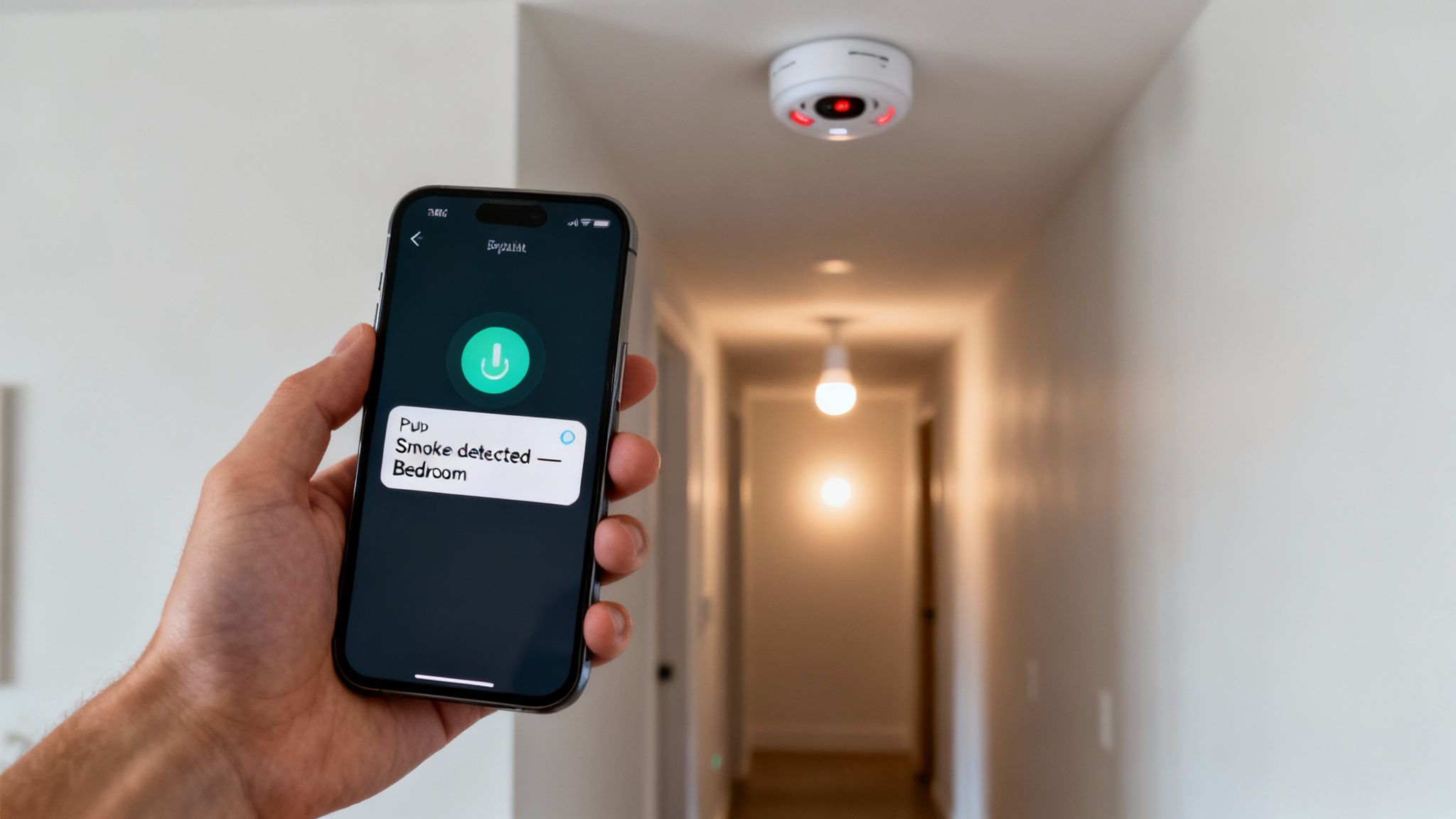
The single biggest advantage of a smart system is getting real-time alerts sent straight to your phone. Think about it: you could be at work, doing the weekly shop, or even on holiday on the other side of the world. If a fire starts back at home, you won’t be left in the dark.
Instead of a siren blaring to an empty house, you’ll receive an instant push notification that tells you exactly which alarm has been triggered. This lets you take immediate action—like calling 000 or asking a neighbour to check on your property—potentially saving your home and belongings from catastrophic damage.
A smart interconnectable wireless smoke alarm acts as your eyes and ears when you’re not there. It turns a local alert into a global one, making sure you’re always the first to know about a potential fire.
Smart features aren’t just for emergencies; they also bring a new level of convenience to everyday life. We’ve all been there: a piece of burnt toast sets off a deafening alarm, and you’re left waving a tea towel at the ceiling, trying to silence it.
With a smart alarm, you can just open an app on your phone and hush the false alarm with a single tap. This is a game-changer for anyone fed up with nuisance alarms, especially if you have high or vaulted ceilings that are hard to reach.
The real power, though, is how these alarms can work with your other smart home devices.
This combination of enhanced safety and everyday convenience is why smart interconnectable wireless smoke alarms are quickly becoming the new standard in Australian homes. The demand for smart home solutions that offer greater control is growing, and manufacturers are responding with models that integrate perfectly into existing platforms.
Beyond just detecting fires, these alarms are often part of a much larger smart home ecosystem. For those looking to build a comprehensive safety net, it’s worth exploring the broader range of advanced electronic security solutions that use similar connected technology. By integrating these smart features, your alarm system is no longer just a passive warning device—it becomes an active participant in keeping your home and family safe.
An interconnected wireless smoke alarm system is a brilliant safety net, but it’s only as good as its setup and upkeep. Getting the installation right is about more than just screwing a device to the ceiling—it’s about strategic placement. Think of it like setting up a security perimeter around your home; you need guards in all the right places to catch trouble early.
For your system to work as intended, placement has to align with Australian safety regulations. This creates a reliable web of protection across your entire property, ensuring an alarm is always close enough to detect a fire in its first critical moments.
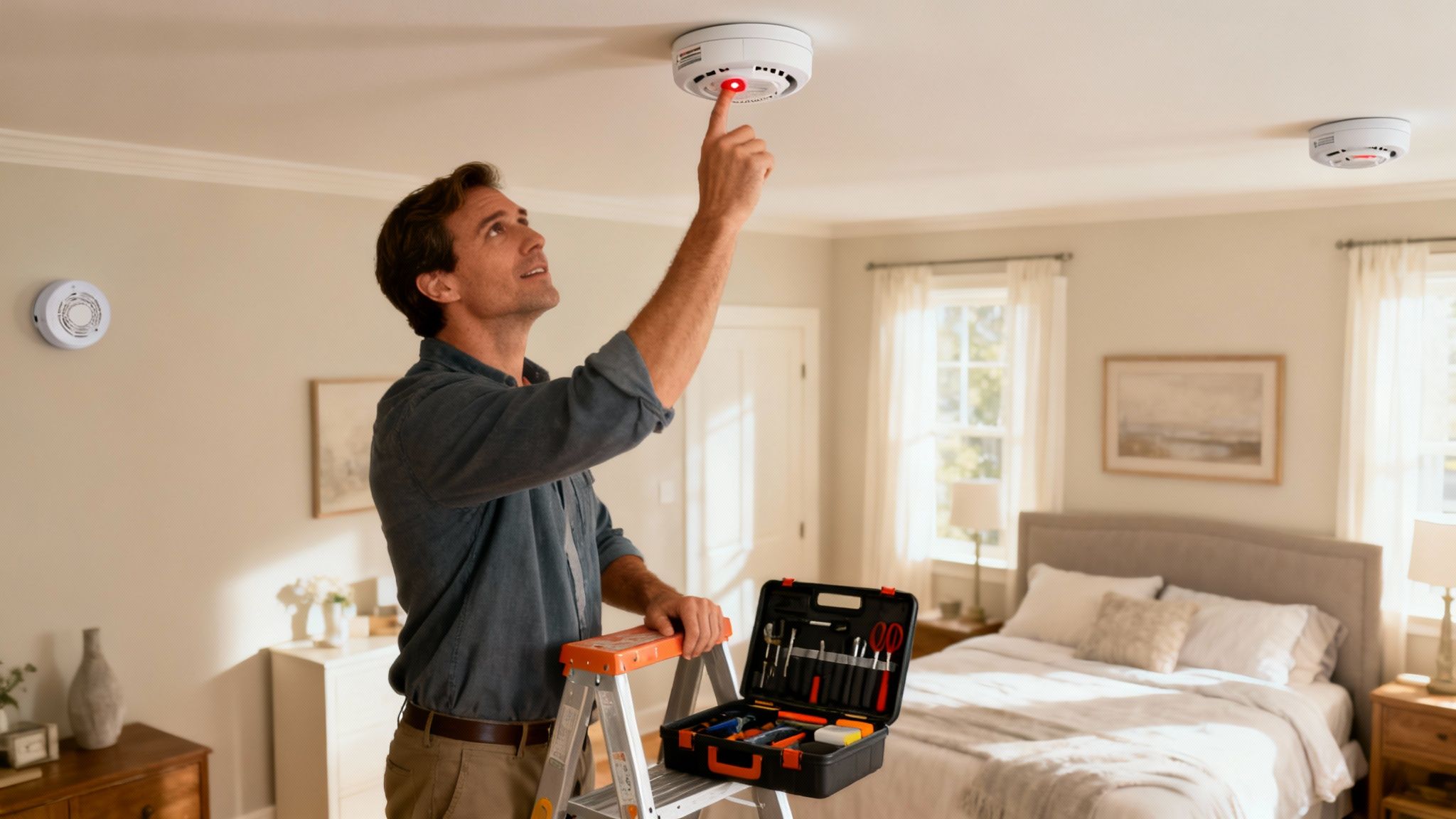
To get the earliest possible warning, your alarms need to be positioned where they can best “smell” the smoke. Sticking to the Australian guidelines is the simplest way to get this right.
The non-negotiable spots for installation are:
Just as important is knowing where not to put them. A common mistake is installing an interconnectable wireless smoke alarm too close to kitchens or bathrooms. Steam from a hot shower or smoke from burnt toast can easily trigger a false alarm. Not only is this annoying, but it can lead to people ignoring or, even worse, disabling the whole system.
Once your alarms are up, a simple, regular maintenance routine is all it takes to keep them in perfect working order. This isn’t a massive chore; it’s a tiny investment of time that ensures your system remains a dependable lifesaver.
A smoke alarm you don’t maintain is just a piece of plastic on the ceiling. Regular checks confirm that your safety network is actually online and ready to protect you when it matters most.
Here’s a straightforward checklist to follow:
When you’re looking into something as important as home safety, it’s natural to have a few questions. Getting straight answers about interconnectable wireless smoke alarms is the key to making a confident choice that protects your family and your property. Let’s break down some of the most common queries we hear from homeowners.
This is one of the most critical questions, and the answer isn’t just a suggestion—it’s a legal safety standard. For your home to be properly protected, you need an alarm installed in every bedroom, in the hallways that connect them, and on every single level of your home.
Think of it as creating a safety net. This strategic placement ensures that no matter where a fire might start, it gets detected fast. For a really detailed look at the local rules, our guide to smoke alarm compliance in QLD lays out all the specifics you need to know.
It can be tempting to grab whatever is on sale, but mixing brands is a huge mistake. For an interconnectable wireless system to function as a team, every alarm needs to speak the same “language.” Different manufacturers use their own proprietary radio frequencies and communication protocols.
Mixing brands is a recipe for disaster. It can cause the wireless connections to fail, which means an alarm going off in one part of the house might not trigger the others. Always stick to a single, compatible brand to ensure you have a reliable safety network.
The biggest difference comes down to power and installation. Hardwired alarms are physically connected to your home’s main electrical circuit, and they almost always have a battery for backup power. To install them, an electrician has to run new wiring through your walls and ceilings, which can be a messy, disruptive, and expensive job in an existing home.
Wireless alarms, on the other hand, are powered by long-life batteries and talk to each other using radio signals. This makes installation a breeze. There’s no new wiring to run, no holes to patch in the plaster, and no need for a sparkie to hook them all up, giving you a much more flexible and less invasive solution.
For professional advice on the best interconnectable wireless smoke alarm system for your Brisbane home, trust the experts at DLG Electrical. Our licensed electricians ensure your installation meets all safety standards for complete peace of mind. Contact us today for a free quote at https://dlgelectrical.com.au.

Master Electrician with over 30 years of experience. Founded DLG Electrical in 2005 after international project work including electrical installations at Stamford Bridge Stadium, London(Home of Chelsea FC).

Local Electricians that can fix all Electric Hot water Systems.
Motion sensor lights are a versatile addition to any home, offering nu
