83 Jean St, Grange QLD 4051
Mon-Fri 07:30 AM - 04:00 PM - Sat - 8:00 - 12 - Sunday Closed

When you’re weighing up LED lights vs halogen, the verdict is pretty clear-cut: for almost every situation in Australian homes and businesses, LEDs are the hands-down winner. Their impressive energy efficiency, incredibly long lifespan, and major safety improvements make them the new standard, leaving older halogen technology in the dust for most applications.
The move from halogen to LED lighting isn’t just a passing trend; it’s a smart, practical upgrade that delivers real, tangible benefits. Halogen bulbs, which are a type of incandescent technology, work by heating a tiny tungsten filament until it glows. It’s an old-school method that wastes up to 90% of its energy as raw heat.
In stark contrast, LEDs (Light Emitting Diodes) are solid-state devices. They turn electricity directly into light far more efficiently, which means they produce very little heat in the process.
This fundamental difference in technology is the root of every major advantage LEDs have over their halogen counterparts. When you line them up on the key metrics that every property owner cares about, the choice becomes pretty straightforward.
This image breaks down the critical differences in energy use, lifespan, and cost at a glance.

As you can see, while halogens might seem cheaper to buy off the shelf, LEDs completely dominate in energy savings and longevity. It all adds up to far greater value over the long run.
To make the decision even simpler, let’s put the core differences side-by-side. This table gives you a clear, high-level overview of what you’re really choosing between.
| Feature | LED Lights | Halogen Lights |
|---|---|---|
| Energy Efficiency | Extremely high (use up to 75% less energy) | Very low (wastes most energy as heat) |
| Average Lifespan | 25,000 – 50,000+ hours | 1,000 – 2,000 hours |
| Heat Output | Very low (cool to the touch) | Extremely high (significant fire hazard) |
| Durability | High (solid-state, shock-resistant) | Low (fragile glass and filament) |
| Lifetime Cost | Low (due to energy savings and long life) | High (due to replacements and energy use) |
Looking at the numbers, it’s easy to see why the Australian LED lighting market is booming. This growth is fuelled by the huge demand for energy-efficient solutions from both homeowners and commercial operators. The widespread switch to LEDs is all down to their compact size, minimal maintenance costs, and superior light output—factors that are pushing more and more people to finally make the upgrade. If you’re interested, you can explore more data on Australia’s LED market growth.
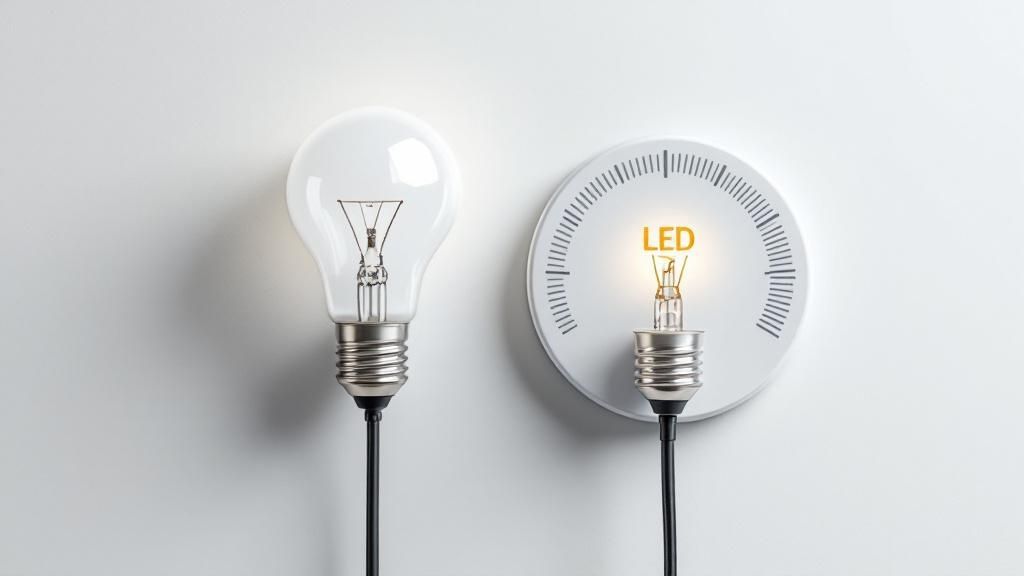
If you’ve noticed halogen bulbs becoming harder to find on store shelves across Australia, you’re not imagining it. This isn’t a random market shift; it’s a deliberate, nationwide move towards better, more sustainable technology. The change is being driven by a combination of government action and a clear shift in what Aussie homeowners and businesses expect from their lighting.
At the core of this transition are Australia’s Minimum Energy Performance Standards (MEPS). These regulations were designed to systematically get rid of inefficient appliances, and old-school lighting was a prime candidate. By setting an energy efficiency benchmark that halogens just couldn’t meet, MEPS essentially wrote the final chapter for them in the Australian market.
This regulatory push had a domino effect. Long before the official bans kicked in around 2020, government announcements and industry chatter signalled the end was near. In response, smart suppliers and retailers started clearing out old stock and stopped importing halogen bulbs, speeding up the market’s evolution.
This government-led change couldn’t have come at a better time, as it perfectly matched a growing cultural trend. Australians are more conscious than ever about their environmental impact and long-term household budgets. The undeniable benefits of LEDs—slashed power bills and far less time spent on a ladder changing bulbs—made them an obvious upgrade for anyone ready to ditch outdated tech.
The result has been a complete overhaul of Australia’s lighting landscape. Halogen and incandescent lamps, once the go-to choice, saw their import share collapse from over 40% in the mid-2010s to under 10% by 2022. This steep decline shows a market responding to both smart policy and what consumers actually want. You can dig into the data behind this shift on the official Energy Rating website.
The chart below shows just how quickly halogen imports dried up as LEDs took their place.
This graph tells a clear story: as the market for inefficient halogens shrank, it was quickly replaced by superior, energy-saving alternatives like LEDs.
The phase-out isn’t just about switching a bulb; it’s a nationwide commitment to reducing energy consumption, lowering carbon emissions, and embracing smarter, more sustainable technology for the future.
Ultimately, the disappearance of halogens from our shelves is a good thing. It frames the LED lights vs halogen debate not just as a technical comparison but as a story of national progress. Understanding this background helps explain why, in the detailed breakdowns that follow, LED technology consistently comes out on top for modern Australian homes and businesses.
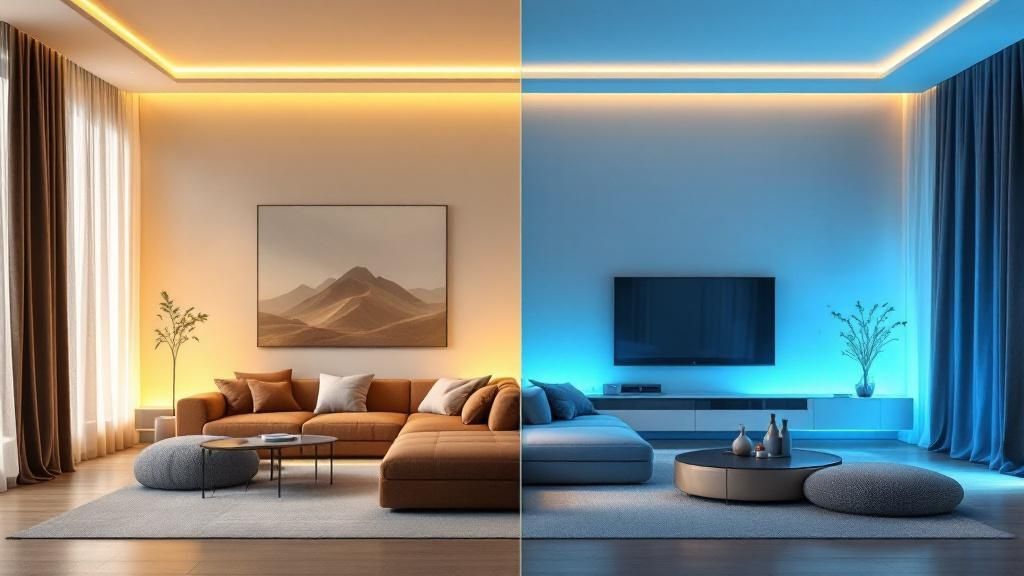
Alright, let’s move past the regulations and get to the heart of the matter. The real story in the LED vs halogen debate is how they actually perform day-to-day. How they make light, how long they last, and the quality of that light are what directly impact your home or business. These differences aren’t just minor tweaks; they’re fundamental.
Halogen bulbs are basically supercharged versions of old-school incandescent lights. They work by running electricity through a tiny tungsten filament inside a quartz capsule filled with halogen gas. This forces the filament to burn hotter and brighter, but it’s incredibly inefficient—most of the energy is wasted as intense heat.
LEDs, on the other hand, play a completely different game. A Light Emitting Diode is a semiconductor that creates photons (light) when a current passes through it. This solid-state process is far more controlled and efficient, turning significantly more energy directly into light instead of heat.
This core technological difference—burning a filament versus exciting a semiconductor—is the source of nearly every advantage LEDs have. It explains why halogens get dangerously hot and burn out quickly, while LEDs remain cool and last for years.
The most dramatic performance gap is in energy efficiency, which we measure in lumens per watt (lm/W). This metric tells you exactly how much light a bulb produces for every watt of power it eats up. In this department, LEDs are in a league of their own.
This efficiency gap hits your power bill directly. Swapping just one 50W halogen downlight used for four hours a day with a 7W LED equivalent can save you over $20 per year on that single bulb. Multiply that across your entire home, and the savings really start to add up.
Another clear win for LEDs is their remarkable lifespan. They don’t have fragile filaments that burn out, so they simply last for an incredibly long time.
This durability makes LEDs perfect for those hard-to-reach places like vaulted ceilings or outdoor fixtures, completely removing the hassle of frequent changeovers.
While halogens were once loved for their warm, cosy glow and excellent Colour Rendering Index (CRI), modern LEDs have not only caught up but have blown past them in versatility. CRI measures how accurately a light source shows the true colours of objects, with natural sunlight being a perfect 100.
Halogens have a fantastic CRI, usually around 99-100. But today’s high-quality LEDs consistently hit a CRI of 90+, which is more than enough for beautiful, true-to-life colour in homes and most commercial settings. The real advantage for LEDs, though, is choice. When you’re deciding on lighting, it’s vital to understand the impact of color temperature (warm white vs. cool white) and how it shapes the entire feel of a room.
The Australian lighting market, now valued at around AUD 12.45 billion, certainly reflects this shift. LEDs are dominating thanks to their solid performance and energy savings of up to 80%. This trend is strong right across the country, with places like the ACT and Western Australia making up big chunks of the market. While you can still find halogens, their market share is shrinking fast due to their high energy use and short lifespans, which aligns with Australia’s national push for sustainability.
That low sticker price on a halogen bulb at the hardware store can be incredibly tempting, but it tells a seriously misleading story about the real cost. Once you look past that initial purchase and consider the total cost of ownership over several years, the financial picture flips on its head. The LED lights vs halogen debate really comes alive when you start factoring in your electricity bills and how often you’re up a ladder changing bulbs.
Halogens might be cheap to buy, but they are expensive to run and maintain. Their massive energy consumption translates directly into bigger power bills, and their frustratingly short lifespan means you’ll be buying replacements far more often than you’d like. On the other hand, an LED’s higher upfront cost is an investment that pays for itself multiple times over, thanks to huge energy savings and by practically eliminating the need for replacements.
The true cost of a light bulb isn’t just its price on the shelf; it’s the sum of the purchase price, the electricity it consumes, and the cost of replacing it over its entire operational life.
To put this into perspective, let’s break down a common scenario: lighting a standard Australian living room. We’ll imagine it has ten downlights, running for an average of four hours per day. We’ll compare the total cost of using LEDs versus halogens over a decade, using an average electricity rate of $0.30 per kilowatt-hour (kWh).
The numbers here really paint a clear picture of the long-term financial impact.
| Cost Factor | LED Lighting Scenario | Halogen Lighting Scenario |
|---|---|---|
| Initial Bulb Cost | 10 bulbs @ $8 each = $80.00 | 10 bulbs @ $3 each = $30.00 |
| Bulbs Needed Over 10 Years | 10 (one set lasts ~15 years) | ~140 (one set lasts ~1 year) |
| Total Replacement Cost | $0.00 | 13 sets @ $30 each = $390.00 |
| Annual Energy Cost | ~$30.66 | ~$219.00 |
| 10-Year Energy Cost | ~$306.60 | ~$2,190.00 |
| Total 10-Year Cost | $386.60 | $2,610.00 |
As the table shows, the long-term cost of sticking with halogens is staggering. That initial $50 you save on bulbs is quickly wiped out by more than $2,200 in extra costs for replacements and electricity over the decade. This is where a simple lighting upgrade becomes a serious cost-saving strategy. If you’re looking for more ways to make your home more cost-effective, you can find excellent energy efficiency tips from a Northside electrician that go hand-in-hand with a lighting overhaul.
This financial reality is precisely what’s driving the massive shift to LEDs. To really understand the benefits, exploring the various energy-efficient LED lighting options can give you a better idea of the potential savings. The numbers don’t lie; investing in LEDs provides substantial financial relief for homeowners and businesses alike.
Choosing between LED lights vs halogen isn’t just about the tech specs on a box; it’s about context. The right light for your cosy living room is rarely the best choice for a functional kitchen workspace. When you get this right, room by room, you completely transform your home’s atmosphere and usability. And today, LEDs offer a superior solution for nearly every single scenario.
Halogens were once prized for their crisp, bright light, but let’s be honest, modern LEDs have completely surpassed them in performance and versatility. The argument for sticking with halogens has become incredibly narrow, while LEDs now excel across a massive range of applications.
The key is to match the light’s characteristics to the room’s purpose. LEDs provide the flexibility to do this effectively, offering a wide spectrum of colour temperatures and beam angles that halogens simply can’t compete with.
For the main lighting in your living rooms, bedrooms, and hallways, the goal is always broad, even coverage. This is where LED downlights or oyster lights are the clear winners. They deliver excellent light distribution without the intense, focused heat that halogens are known for, making your spaces feel comfortable and properly lit.
Better still, with dimmable LEDs, you can effortlessly adjust the brightness to suit any mood—from bright and functional for cleaning day to a soft, warm glow for relaxing in the evening. This level of control was always a bit clunky with halogens but is now seamless with modern LED technology.
In areas where you’re performing specific tasks, like kitchens and home offices, focused light is absolutely essential. Under-cabinet lighting is a perfect example of where LEDs completely dominate.
Honestly, the low heat and directional nature of LEDs make them functionally superior for any task-oriented lighting you can think of.
When you want to highlight artwork, architectural features, or elements in your garden, you need precision and quality. Once again, LEDs have the edge. Their incredibly long lifespan and durability make them the ideal choice for hard-to-reach spotlights or outdoor settings exposed to the Aussie weather.
For those with specific outdoor lighting needs, professional services can design stunning landscapes using weather-resistant LEDs. This also applies to automated security. For more on this, our guide on the benefits of motion sensor lights can help you secure your property effectively. In every one of these use cases, from the kitchen to the garden, LEDs deliver a safer, more efficient, and far more customisable lighting solution than their halogen predecessors.
https://www.youtube.com/embed/8XvLc6VlpI8
Upgrading your old halogen lights to modern LEDs is one of the smartest and safest decisions you can make for your home. But it’s not always as simple as a straight bulb swap. To get it right and avoid any headaches, there are a few technical details you need to be aware of from the start.
The first thing to do is check for fixture compatibility. Many halogen downlights use a standard GU10 base, which is a mains-voltage fitting you just twist and lock into place. If this is what you have, you can often directly replace the old halogen with a new GU10 LED equivalent. Easy.
However, if your halogens are the low-voltage MR16 type (the ones with two thin pins), the switch becomes a bit more involved. These low-voltage systems rely on a transformer to step down your home’s main electricity, and this is where people run into trouble.
Old halogen transformers are almost always incompatible with the incredibly low power draw of LEDs. This mismatch is the number one cause of flickering, buzzing, or your brand-new LEDs failing prematurely. For a reliable, long-term solution, it’s best to have a licensed electrician replace the old transformer with a dedicated LED driver.
Another common pitfall is dimming. If your halogens are on a dimmer switch, you can’t just assume it will play nicely with LEDs. Old-school dimmers were designed for the high-power, hungry nature of halogens and will almost certainly cause annoying flickering or strobing with efficient LEDs.
The fix is straightforward: you’ll need to upgrade the switch itself to a dedicated LED-compatible dimmer. This will give you the smooth, flicker-free control you expect.
Beyond the technical side, the biggest reason to make the switch is safety. The difference in heat output between LED lights vs halogen is massive, and it’s a genuine safety risk that many people overlook.
Halogen bulbs operate at dangerously high temperatures, often getting hotter than 200°C. This intense heat is a significant fire hazard, especially when lights are recessed into ceilings near insulation or in homes with older wiring. LEDs, on the other hand, run cool to the touch, making them an infinitely safer choice for any home, particularly those with kids.
By tackling compatibility, transformers, and dimmers, you can confidently manage the upgrade yourself or know exactly what to ask your electrician for. The result isn’t just a more energy-efficient home, but a much, much safer one.
Even with all the clear benefits, I find that many homeowners still have a few practical questions when they’re thinking about making the switch from old-school halogens. It’s completely understandable. Let’s run through some of the most common ones to make sure your upgrade goes off without a hitch.
This is probably the number one question I get. People love the cosy, inviting light from their halogens and worry that LEDs will feel cold or clinical. The great news is, the answer is a definite yes. Modern LEDs have come a long way. You can now get them in a massive range of colour temperatures, from a crisp, cool daylight right through to that classic warm white that perfectly mimics the ambience of a halogen bulb.
Another big one is compatibility. While some LED bulbs are designed as direct “plug-and-play” replacements for halogens, it’s not always that simple. If you’ve just put in a new LED and it’s flickering or buzzing, the culprit is almost always an old halogen transformer or a dimmer switch that can’t handle the LED’s super-low power draw. It’s a common issue, but an easy fix for a qualified electrician who can install a proper LED driver to sort it out.
Beyond just the power savings, are LEDs really more environmentally friendly? Absolutely. Think about it—their incredibly long lifespan means far fewer bulbs are manufactured, transported, and eventually thrown out. That means less waste in our landfills. Plus, unlike those old CFL (compact fluorescent) globes, LEDs contain no nasty materials like mercury.
This commitment to efficiency is a smart move for any household, just like keeping other systems running at their best. It’s the same principle we discuss in our guide on winter maintenance for electric hot water systems, where a little upkeep goes a long way.

Master Electrician with over 30 years of experience. Founded DLG Electrical in 2005 after international project work including electrical installations at Stamford Bridge Stadium, London(Home of Chelsea FC).

Local Electricians that can fix all Electric Hot water Systems.
Motion sensor lights are a versatile addition to any home, offering nu
