83 Jean St, Grange QLD 4051
Mon-Fri 07:30 AM - 04:00 PM - Sat - 8:00 - 12 - Sunday Closed
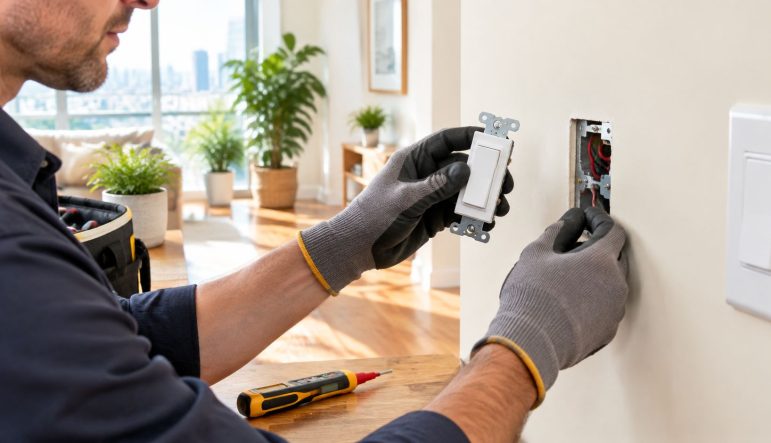
You've found a cracked or loose light switch in your Brisbane home, and the replacement looks like a quick Saturday job. The cover plate comes off, the new mechanism appears to fit, and a hardware-shop purchase seems cheaper than calling an electrician.
That assumption becomes dangerous as soon as the switch is removed. Behind the plate may be heat-damaged insulation, loose terminations, incorrect conductor identification, or no usable earth connection. In Queensland, light switch replacement is licensed electrical work, not a cosmetic repair, and the condition of the wider circuit can determine whether a simple replacement remains simple.
A light switch only controls a lighting load, but the switch box still contains live electrical infrastructure. Turning the wall switch off doesn't prove that every conductor behind it is safe to touch. A wiring fault, an incorrectly identified circuit, or an unexpected connection from another part of the installation can expose someone to electric shock.
Older Brisbane homes deserve particular caution. Renovations may have added new cables around original wiring, wall boxes can be cramped or damaged, and previous work may not have followed current installation practice. A switch that feels warm, crackles, sparks, smells of burnt plastic, or operates intermittently isn't asking for a new faceplate. It's signalling that the circuit needs diagnosis.
Practical rule: If removing the plate reveals damaged insulation, loose wires, discolouration, moisture, or an unfamiliar arrangement, stop work and leave the switch untouched.
The regulatory reason matters as much as the physical risk. AS/NZS 3000:2018 was published on 26 June 2018 and took effect in most Australian states and territories on 1 January 2019, making it the relevant wiring-rules milestone for compliant switch replacement in the AU region. The standard covers the design, construction, and verification of electrical installations, so a switch change must be considered within the installation, not as an isolated decoration update. Standards Australia's AS/NZS 3000:2018 information provides the formal reference.
The switch may be the visible failure point, while the defect sits in the cable, terminal, wall box, lighting circuit, or switchboard. A loose connection can generate heat over time, and a missing or ineffective earth can leave exposed metalwork without the intended fault path.
Residential lighting layouts also vary considerably. Australia's 2016 Residential Lighting Report recorded an average house with 23.7 switches controlling about 38.2 lamps, or roughly 1.6 lamps per switch. The same report recorded switch counts ranging from 4.6 to 23.7 and lamps replaced per house ranging from 5.0 to 24.8 across its dwelling groups, showing why a switch replacement often forms part of a broader lighting job rather than a one-device repair. The 2016 Residential Lighting Report is the source for those figures.
Queensland homeowners can generally handle decorative maintenance, but the boundary changes the moment the task involves electrical connections. The Electrical Safety Office specifically lists installing or replacing a light switch among jobs that should always be completed by a licensed electrician. It also warns against DIY electrical work because mistakes during isolation, testing, and re-energisation can create shock and fire risks. Queensland Electrical Safety Office resources set out the relevant safety guidance.
Replacing a loose decorative cover may be a different task from replacing the switch mechanism. Even then, the cover must be suitable, secure, and installed without disturbing the wiring. Removing the mechanism, disconnecting conductors, changing terminals, adding a dimmer, or relocating the switch crosses into licensed work.
Use this simple distinction:
A licensed contractor should also be able to demonstrate the required registration and provide appropriate documentation for the work. Property owners arranging broader renovation inspections may find kitchen renovation inspection tips useful because electrical changes often sit alongside building, wet-area, and cabinetry work. For contractor registration context, see DLG Electrical's contractor registration guide.
The safe professional sequence is deliberate rather than dramatic. The electrician identifies the correct circuit, isolates it at the switchboard, prevents accidental re-energisation, proves the conductors are de-energised with suitable test equipment, replaces the device, and tests the completed installation. A wall switch being off isn't an isolation procedure, and a non-contact pen tester alone isn't a substitute for proving dead with the right instrument.
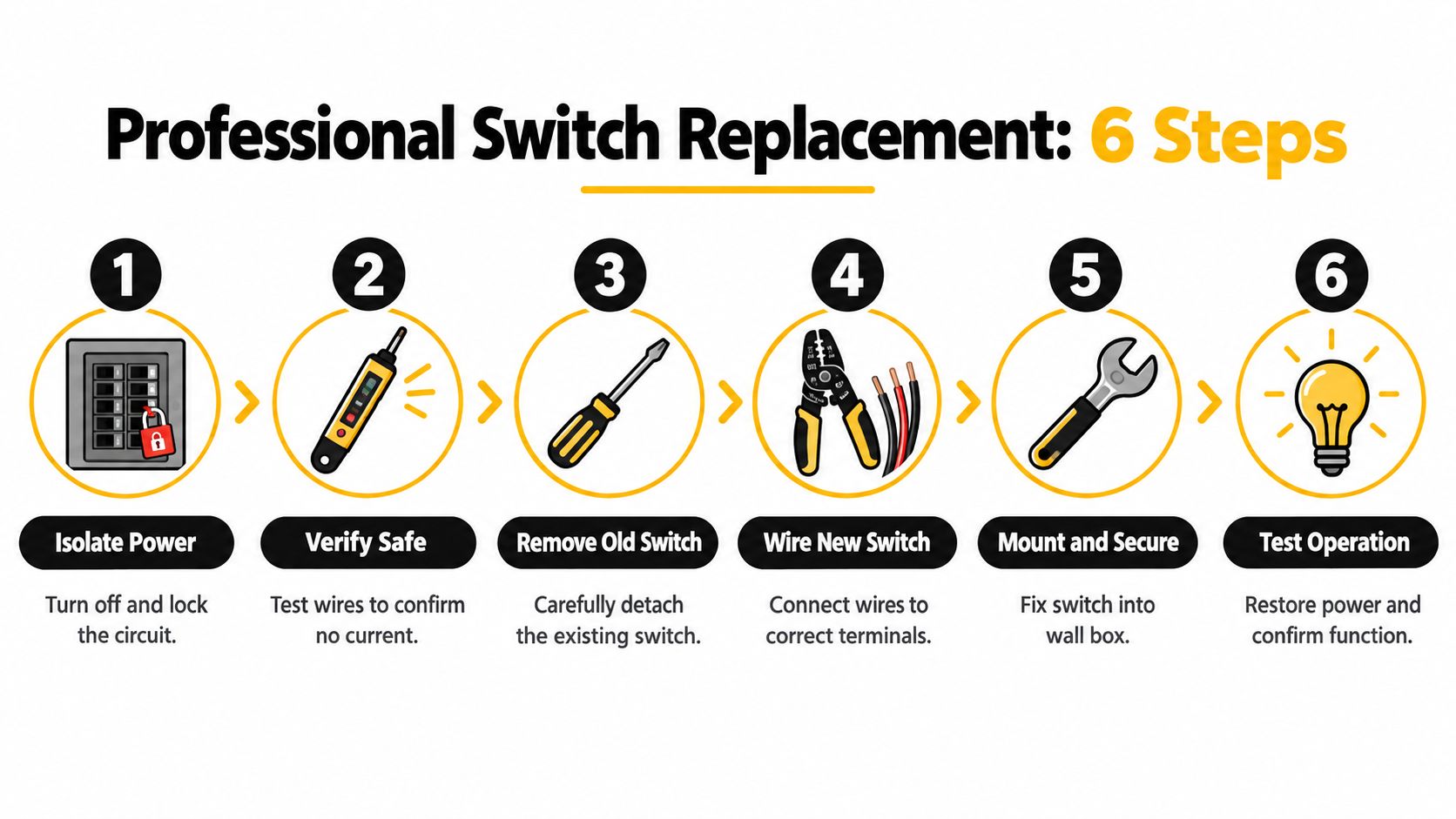
A competent electrician treats the switch as one part of a controlled electrical task. The work starts before the old plate comes off, with questions about the symptom, the circuit, the property's age, and whether other lighting or renovation work has recently occurred.
The first step is identifying the lighting circuit at the switchboard and isolating it. The electrician then applies lock-out/tag-out controls so another person can't restore power while work is underway. At the switch location, a two-pole tester is used to prove de-energisation before any conductor or terminal is handled.
The tester itself must be checked as part of a reliable proving process. The point isn't to see whether the light has gone out. The electrician must establish that the relevant conductors are dead and that the test instrument is functioning correctly.
Once safe access is established, the electrician checks the existing switch, conductors, insulation, earth arrangements, wall box, terminals, and signs of overheating. Correct conductor identification matters because Australian wiring can't be treated as a colour-matching exercise when older work or alterations are present.
A like-for-like replacement in the same location may remain a limited task. A dimmer, smart mechanism, extra switching arrangement, or relocated control can require a different assessment. The electrician also considers whether the work is a replacement or an alteration to the final sub-circuit, because that distinction affects protection requirements.
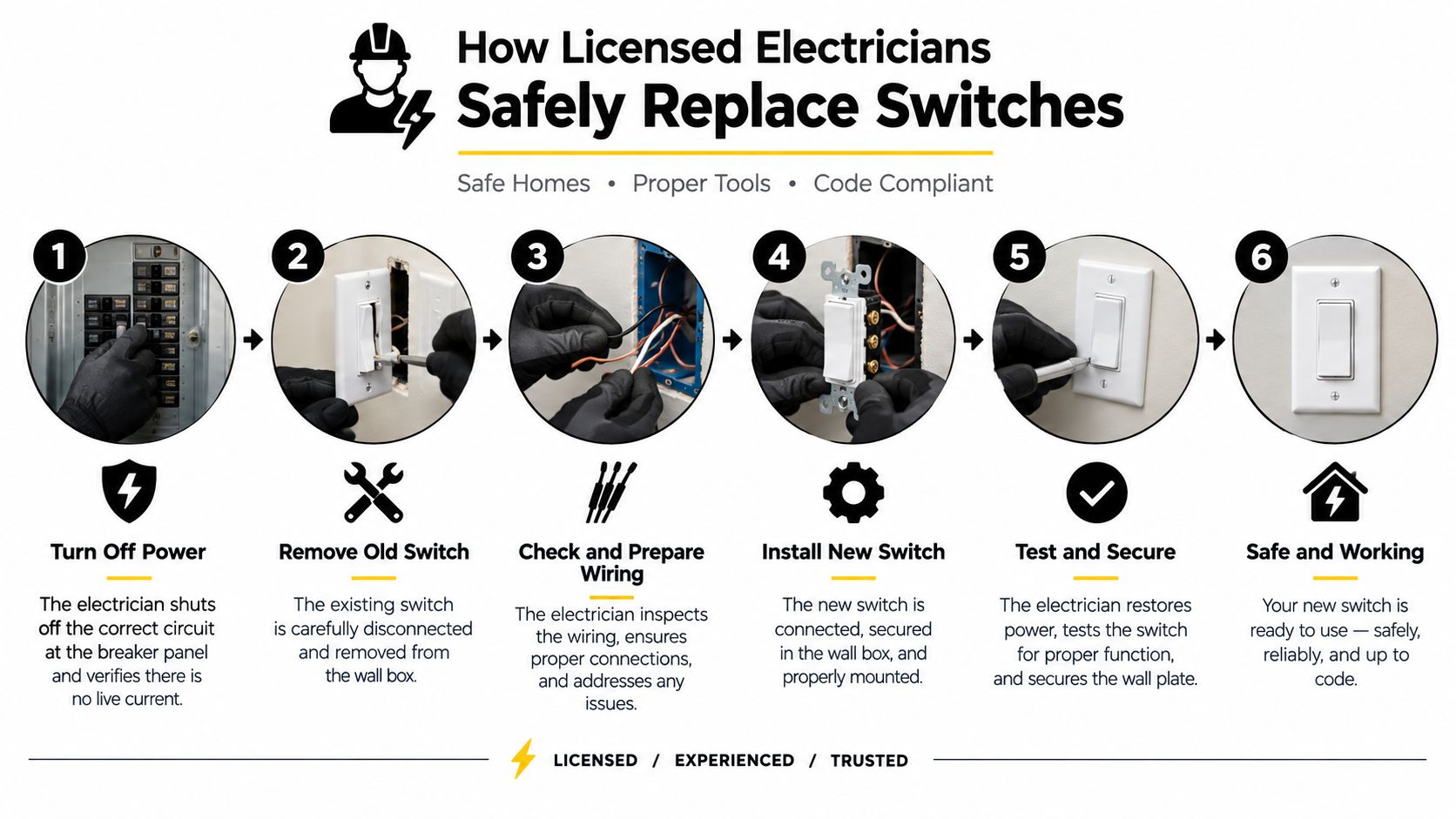
The new mechanism must suit the circuit and be connected to the correct terminals. The electrician secures the device in the wall box, ensures conductors aren't pinched or strained, fits the plate neatly, and checks that the switch operates mechanically as intended.
Before handing the room back, the electrician verifies the circuit and protective devices, restores supply under controlled conditions, and tests operation. Depending on the scope, testing can include polarity, continuity, insulation, earth arrangements, and RCD operation.
For homeowners who want a clearer picture of the trade's wider responsibilities, what an electrician does gives useful context beyond the visible switch replacement.
A replacement can expose a switchboard that was already behind current expectations. That doesn't mean every old board must be replaced whenever a mechanism fails, but it does mean the electrician has to classify the work correctly and assess the protection already provided.
The important distinction is between an equivalent single-item replacement in the same location and an alteration to an existing final sub-circuit. Australian guidance summarised in Hager's Queensland material states that an equivalent replacement may be exempt from adding new RCD protection, while an alteration to an existing final sub-circuit triggers the 30 mA RCD requirement. The practical consequence is easy to miss. Adding a dimmer, changing the switch position, combining the job with rewiring, or extending the circuit can turn a basic swap into alteration work.
Queensland requires landlords to have safety switches installed, and the supplied Queensland compliance information states that missing protection can attract a fine of up to A$1,500. Queensland Electrical Safety Office frequently asked questions should be checked for the current regulatory position.
Victoria takes a similarly direct approach for rental properties. Its minimum standards require modern switchboards with circuit breakers and electrical safety switches, while also recognising that some existing circuit-breaker-type boards may need added protection for power outlets and lighting circuits rather than a complete system rewrite. Consumer Affairs Victoria's rental property minimum standards explains that framework.
In Queensland, safety switches have been compulsory on all power point and lighting circuits in new homes built since 2000, and extensions adding lighting or power circuits must also provide safety-switch protection for both circuit types. An older Brisbane property with ceramic fuses, limited RCD coverage, or an unclear switchboard schedule may need more than a new mechanism.
For a deeper look at the rules affecting that decision, see switchboard upgrade regulations. The right outcome may be a like-for-like replacement, an RCD or RCBO addition, or a broader switchboard upgrade. The electrician should explain which condition applies and why.
The correct switch depends on the lighting load, control arrangement, room, and intended use. A standard toggle is often the straightforward choice for a single light, but it isn't automatically suitable for a dimmable LED, a multi-way switching arrangement, or a connected smart-home system.
| Switch Type | Best Use Case | Compatibility Notes |
|---|---|---|
| Standard toggle | General room lighting and simple on/off control | Confirm the mechanism suits the existing switching arrangement and load |
| Push-button mechanism | A tactile, contemporary control style | Check the wiring configuration and manufacturer requirements |
| Dimmer | Living rooms, dining areas, bedrooms, and mood lighting | The dimmer must be compatible with the lamp or LED driver |
| Smart switch | App, automation, or voice-assisted control | Check neutral requirements, network features, load compatibility, and installation instructions |
A dimmer can improve control in a living area, but installing one isn't just a matter of choosing a nicer plate. Some LED lamps flicker or fail to dim properly with an incompatible mechanism. Smart switches may require a neutral connection or a compatible load, and older switch boxes may not provide the space or wiring arrangement the product needs.
For a bedroom, consider bedside access, two-way control, and whether the switch layout works with furniture placement. A useful design reference on electrical points in bedroom design can help homeowners coordinate switch positions with lighting, charging, and joinery decisions.
Outdoor security lighting deserves particular care because repeated operation, weather exposure, and the connected fitting can affect the choice of control. The electrician should confirm the mechanism's suitability rather than relying on appearance or a generic “heavy-duty” label.
Smart controls also introduce a maintenance question. A conventional mechanism keeps working without an account, app, or wireless connection, while a smart product can offer automation at the cost of additional compatibility checks. Tell the electrician what you want the room to do, not just which brand or finish you like.
The visible price of a switch is only one part of the job. In Brisbane, basic light switch replacement and similar repairs are commonly priced around A$250–A$400, reflecting a short call-out, professional testing, and certification rather than a parts-only purchase. That market benchmark comes from the supplied Brisbane-focused pricing information.
DIY can appear cheaper until a loose connection damages the mechanism, a concealed fault remains energised, or an alteration requires later compliance work. Insurance, tenancy obligations, and the cost of tracing an undocumented repair can outweigh the original saving. A professional also identifies whether the switchboard needs attention before the next fault exposes the gap.
DLG Electrical is a family-owned Brisbane contractor serving residential and commercial customers, including homeowners and landlords in North Brisbane, Grange, and Windsor. Its services include light switch replacement, switchboard work, lighting, smoke detector compliance, and related electrical repairs. For a broader pre-sale maintenance perspective, prep your home to sell in Boston is a useful reminder that small visible defects can prompt buyers to investigate the condition of the wider property.
If your Brisbane switch is loose, damaged, flickering, or due for a renovation upgrade, arrange a licensed inspection before touching the wiring. Visit DLG Electrical to discuss light switch replacement, RCD protection, switchboard upgrades, and a practical quote for your home.

Master Electrician with over 30 years of experience. Founded DLG Electrical in 2005 after international project work including electrical installations at Stamford Bridge Stadium, London(Home of Chelsea FC).

Local Electricians that can fix all Electric Hot water Systems.
Motion sensor lights are a versatile addition to any home, offering nu
