83 Jean St, Grange QLD 4051
Mon-Fri 07:30 AM - 04:00 PM - Sat - 8:00 - 12 - Sunday Closed

You're probably in the middle of the same decision most Brisbane renovators hit sooner or later. The cabinetry looks sorted. Benchtops are getting picked. Appliance finishes are under control. Then you look up and realise the kitchen still has one centre light doing all the work.
That's where many renovations lose momentum. A kitchen can have excellent joinery and still feel dull, shadowy, and awkward to use if the lighting plan is weak. Good modern kitchen lighting fixes more than the look of the room. It changes how safely you prep food, how the space feels at night, and how well the kitchen works as part of an open-plan home.
A lot of older Brisbane kitchens have the same problem. One harsh ceiling light throws glare onto glossy surfaces, leaves shadows across the bench, and makes the room feel tired even after a cosmetic update. You notice it most when you're chopping near your own shadow, trying to read labels under overhead cabinets, or switching on every nearby light just to make the room usable.
That frustration is one reason kitchen lighting gets attention early in a proper renovation now, not at the end. The market is moving that way too. The Australian kitchen lighting market is projected to grow at a CAGR of 8.8% from 2021 to 2028, and Queensland renovation activity increased 12.5% in 2022-2023, with kitchen remodels accounting for 42% of projects in Brisbane suburbs such as Grange and Windsor, according to kitchen lighting market analysis covering Australia and Queensland renovation activity.
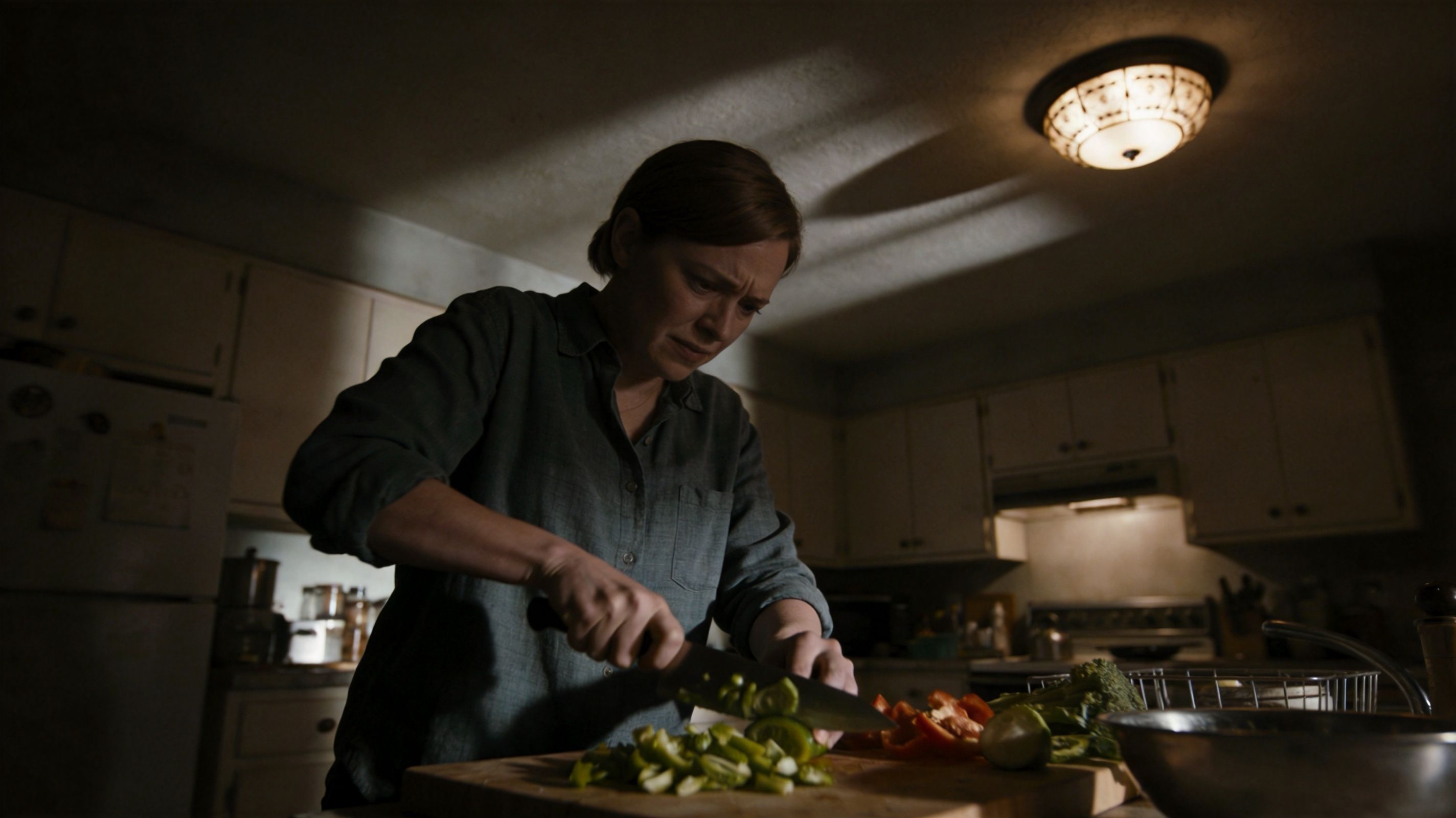
Often, the initial request involves pendants over the island or something “clean and modern”. That's fair, but the actual brief is usually broader:
A modern kitchen lighting plan solves all four at once.
Practical rule: If your kitchen lighting only looks good in a showroom photo, it's not enough. It has to work at 6 am, during dinner prep, and when someone wants a softer setting later that night.
When lighting is planned properly, the room feels bigger, cleaner, and easier to move through. Matte finishes look richer. Stone and tile textures show properly. Food looks like food, not grey shapes under a blue-white lamp.
That's why lighting shouldn't be the leftover item after cabinets and splashbacks. In a modern kitchen, it's one of the foundations.
The easiest way to understand modern kitchen lighting is to think about clothing. You wouldn't wear one heavy item and expect it to suit every temperature and occasion. Kitchens work the same way. One fitting can't handle prep, cooking, cleaning, dining, and late-night ambient use well.
A layered lighting plan uses different fittings for different jobs. That's how you get a kitchen that feels balanced instead of overlit in one spot and gloomy in another.
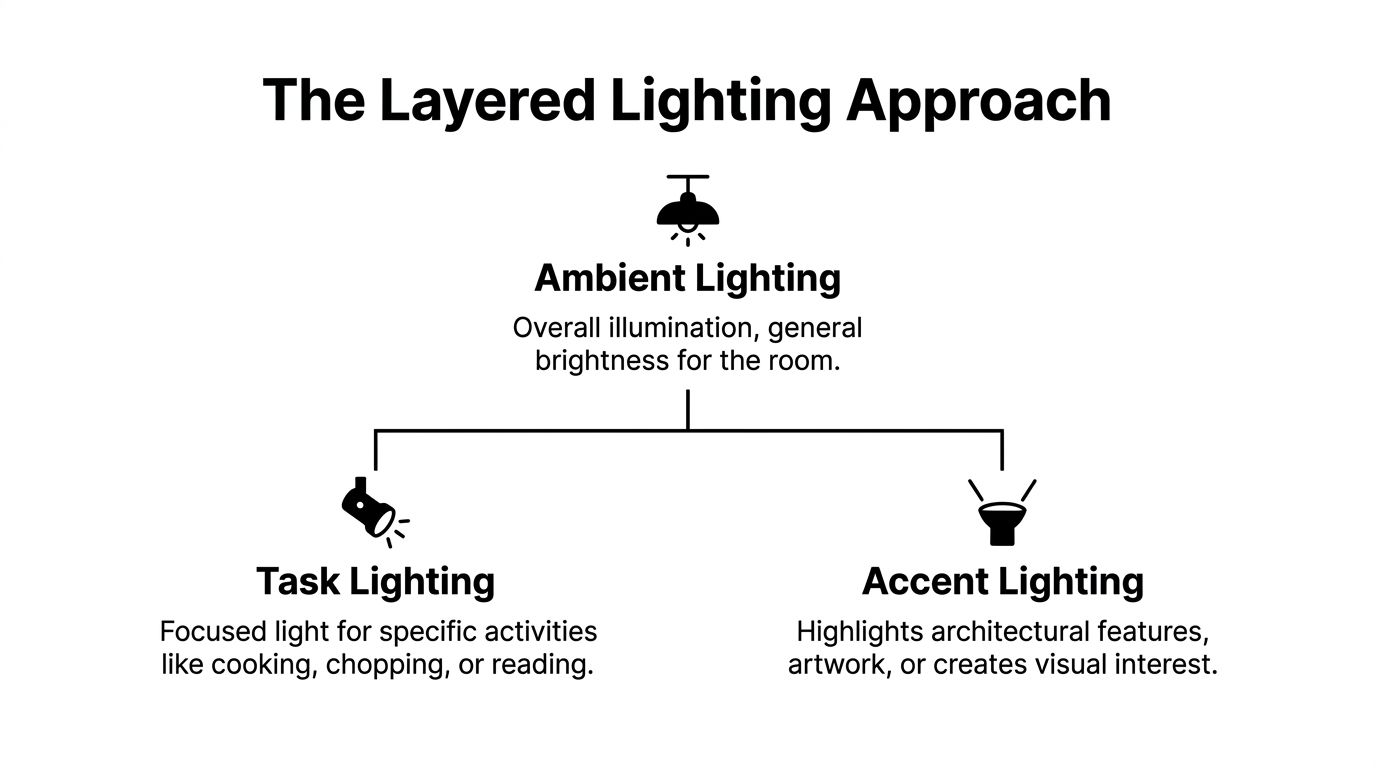
Ambient lighting is the base layer. It gives the room overall illumination so you can move through the space comfortably and the kitchen doesn't feel patchy. In most Brisbane homes, this comes from recessed LED downlights, surface-mounted ceiling fittings, or a neat track system in the right layout.
This layer shouldn't do all the heavy lifting. It sets the room's general brightness. It doesn't replace focused bench lighting.
A common mistake is spacing downlights around the room perimeter and assuming that covers everything. It often doesn't. You end up with bright floors and dark benchtops because the light lands behind the person using the bench.
Task lighting is the layer that makes a kitchen practical. It targets the places where people work: benchtops, cooktops, sinks, and islands.
Australian standards such as AS/NZS 1680.2.2 recommend 500 lux on countertops and cooking surfaces, and targeted task lighting at that level can reduce food preparation errors by up to 25% while also making surfaces easier to inspect, according to this guide to kitchen lighting standards and task area illuminance.
That's why under-cabinet LED strip lighting is so useful. It puts light where your hands are working instead of behind your head. Over an island, well-positioned pendants or directional fittings can do the same job if the beam spread and mounting height are right.
Good task lighting should land on the work surface, not in your eyes.
Accent lighting adds depth and interest. It's the layer people often think is “optional”, but it's what stops a modern kitchen from feeling flat. This can include strip lighting in a nib wall, inside a display shelf, above overhead cabinetry, or beneath an island overhang.
Accent lighting isn't there to make the kitchen brighter. It's there to shape the room and create contrast.
A strong kitchen plan usually looks something like this:
If one layer is missing, the room usually tells on itself quickly. Too much ambient light feels harsh. Too much accent light looks fashionable but impractical. Too little task light becomes annoying within days.
People often get tripped up by lighting terminology. The two terms that matter most are lumens and colour temperature.
Lumens tell you how much light you're getting. They don't tell you power use. That's a common mix-up. If you want a brighter bench or a softer dining feel, lumens matter more than old habits around wattage.
Colour temperature, usually shown as K, tells you whether the light feels warm or cool. Lower numbers feel softer and more relaxed. Higher numbers feel crisper and more clinical.
A warm lamp can feel close to candlelight. A cooler lamp feels closer to daylight. Neither is automatically right or wrong. The right choice depends on where the fitting sits and what that part of the kitchen needs to do.
As a practical guide:
The biggest mistake is mixing unrelated lamp tones in one sightline. If your pendants glow warm amber but your task lights are stark and icy, the kitchen can feel disjointed.
CRI, or Colour Rendering Index, matters more in a kitchen than many people realise. A CRI of 90 or higher is recommended for accurate colour rendering, and low CRI light can distort the appearance of meat, vegetables, and other fresh food, as explained in this guide on kitchen lighting layout and colour rendering.
That affects more than appearance. It changes how confidently you can judge freshness, cleanliness, and texture.
If food looks dull or odd under your lights, the fittings may be the problem, not the ingredients.
| Lighting Layer | Recommended Lumens | Recommended Colour Temp (CCT) |
|---|---|---|
| Ambient | Moderate to high overall output for even room coverage | Warm white to neutral white |
| Task | Higher output focused on benchtops, sink, and cooktop | Neutral white to slightly cool white |
| Accent | Lower output for mood and visual depth | Warm white |
For most modern kitchen lighting jobs, the safest path is consistency. Choose a main colour temperature family, then make small adjustments by zone rather than treating each fitting like a separate design statement.
That gives you a kitchen that feels organised. It also makes dimming and scene control far more effective later.
Fixtures matter because each one solves a different problem. The cleanest-looking kitchen isn't always the most usable one, and the most powerful fitting isn't always the right visual fit. Selection comes down to function first, then placement, then style.
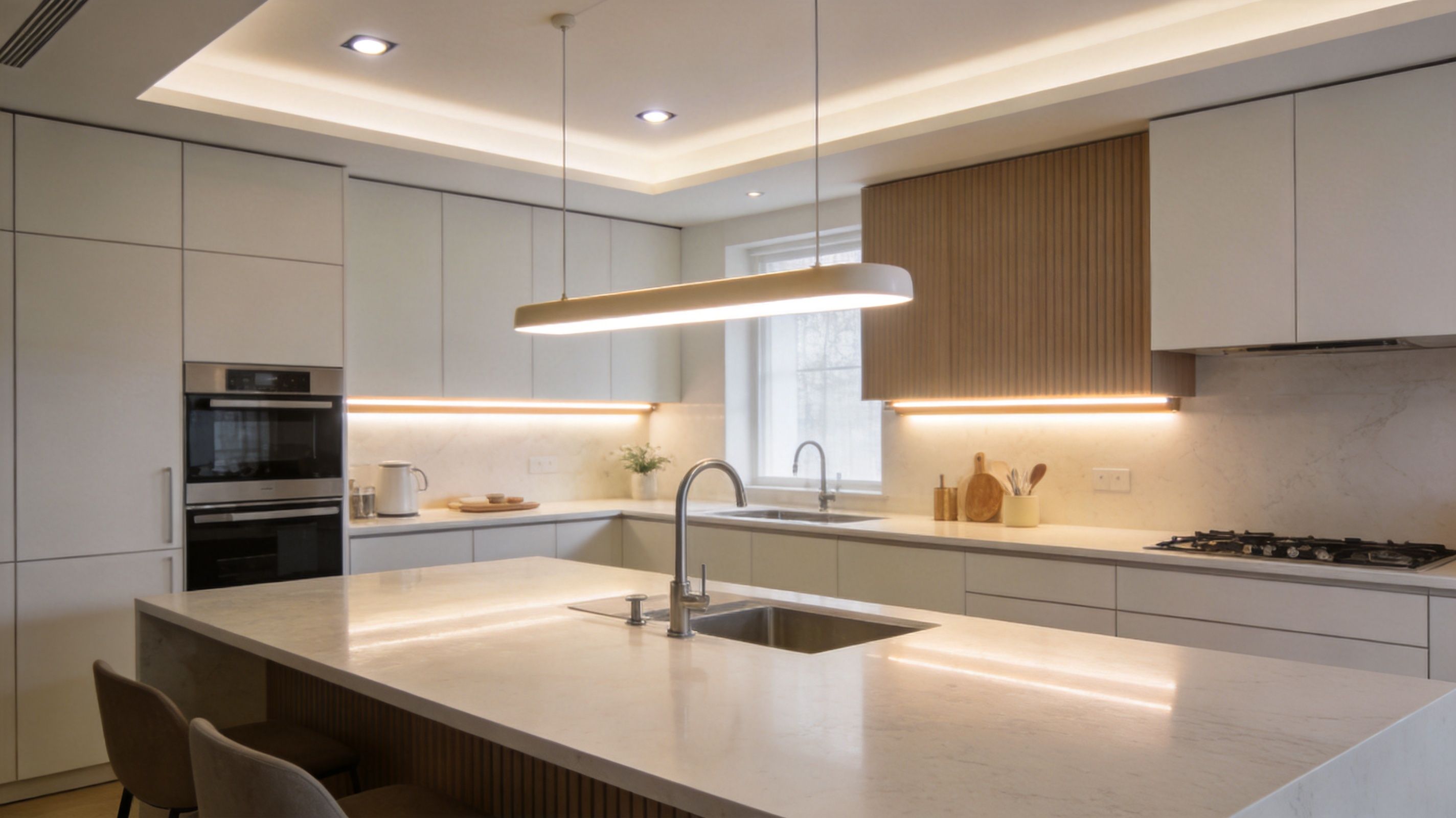
Downlights are still the workhorse in many Brisbane kitchens. They're discreet, easy to integrate into modern ceilings, and excellent for ambient coverage when laid out properly.
Their main strength is visual simplicity. Their weakness is that people often use them as the only light source.
If you rely on downlights alone, bench shadows are common. The fix usually isn't “more downlights”. It's better placement plus a proper task layer.
Pendants bring focus and personality. Over an island or breakfast bar, they help define the kitchen zone and can provide both task and decorative value.
They do have limits. A pendant that's too large can dominate the room. One that hangs too low can interrupt sightlines across an open-plan space. One with poor diffusion can create glare on polished stone.
Linear pendants suit long islands well. Cluster pendants can work in compact feature zones if the ceiling height allows it.
If I had to pick the most consistently useful fitting in a working kitchen, it would be under-cabinet LED strip lighting. It solves the exact shadow problem caused by overhead lighting and makes bench spaces feel finished.
For homeowners comparing strip options, this guide on modern kitchen bench lighting is useful because it focuses on placement and practical bench illumination rather than just appearance.
Track lighting has become a stronger option in modern kitchen lighting because it gives flexibility without the clutter of multiple decorative fittings. Adjustable heads let you redirect light onto prep areas, artwork, shelving, or a sink zone.
This works particularly well in renovations where the ceiling layout or structure makes fixed placement less forgiving. The trade-off is visual presence. Track lighting is more noticeable than recessed fittings, so it needs to suit the room.
A quick visual example helps here:
Most successful kitchens use more than one of these. That's usually the difference between a lighting plan that photographs well and one that works well in practice.
The fittings are only half the story. The controls decide how useful the system feels day to day. A beautiful kitchen with one on-off switch is still a blunt instrument.
Smart controls give the room range. You can run bright task lighting when cooking, lower the room for dinner, and leave a soft path of light for early mornings or late nights without changing fittings.
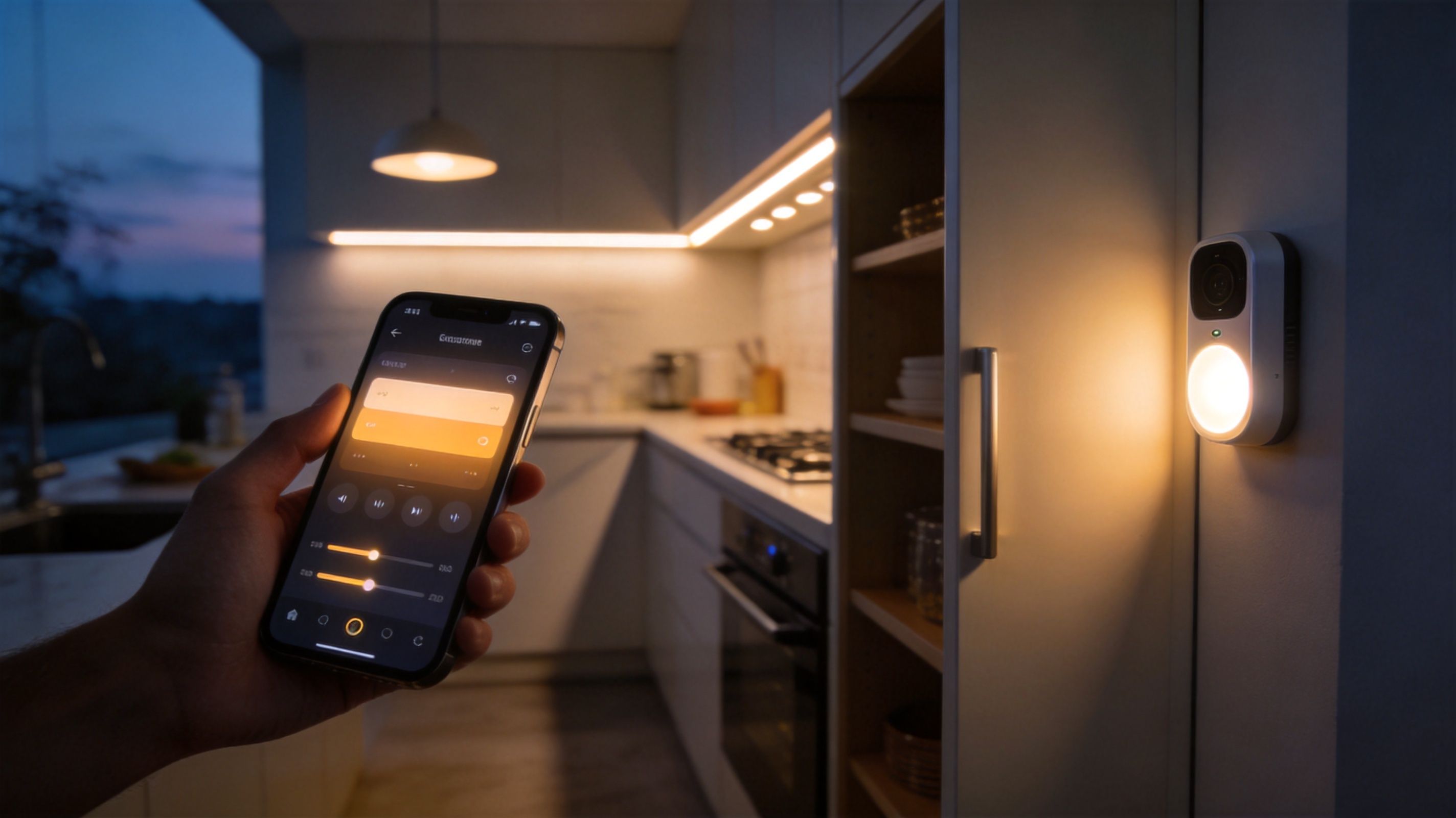
The most useful upgrades are usually simple:
By 2024, 28% of Brisbane homes had incorporated smart lighting, and homeowners upgrading to smart systems have been doing so for 50-60% energy reductions compared to older, non-dimmable lighting, according to this report on smart lighting adoption and kitchen lighting demand in Brisbane.
Most homeowners don't need a complex automation setup. They need a few reliable scenes that match real use:
That's where planning matters. If all your kitchen lights are grouped on one circuit, smart gear won't save the design. The room still behaves like one big switch.
For homeowners collecting ideas before they lock in a renovation brief, this article on smart kitchen ideas for your remodel is a helpful companion because it broadens the conversation beyond lighting alone.
One upgrade with outsized impact: Put the kitchen lighting on separate zones before the plaster is closed up. It gives you far better control later.
Smart controls save more when the base design is sound. Efficient LED fittings, sensible zoning, and dimmer compatibility all need to be sorted early. If you're weighing whether dimmers are worth adding, this practical guide to how to install a dimmer switch explains the setup considerations clearly.
Modern kitchen lighting should feel easier to use, not harder. If the app is clunky, the dimmer buzzes, or the fittings flicker at low output, the system hasn't been specified well.
Kitchen electrical work isn't a DIY category. It combines moisture, metal surfaces, appliance loads, switching, and often altered circuits during a renovation. A neat-looking finish means very little if the wiring, protection, or compliance work behind it is wrong.
In Queensland homes, that matters for both owner-occupiers and landlords. Work needs to align with the applicable wiring and building requirements, including safe circuit protection and correct installation methods under AS/NZS 3000 and the relevant Queensland compliance framework.
A safe lighting installation usually involves more than swapping fittings. It can include circuit checks, load review, switchboard capacity, RCD protection, and placement decisions around cabinetry, splashbacks, and appliance zones.
The practical issues I'd want sorted before sign-off include:
For landlords, lighting decisions can overlap with smoke alarm obligations. In Queensland, all rental properties must comply with AS 3786:2020 for interconnected smoke alarms by 2027, and integrating smart lighting systems with these alarms is an emerging trend that can reduce false alarms and improve safety, according to this article on kitchen lighting ideas and Queensland smoke alarm compliance.
That matters in older homes around areas like Windsor and Grange, where renovations often combine layout updates with overdue compliance work.
A homeowner doesn't need a lecture in standards. You need to know the person doing the work is properly qualified and thinking ahead.
Check for:
If you're comparing providers, this guide on finding electrician companies near you gives a practical shortlist of what to check before booking anyone.
For homeowners also updating adjacent spaces, it can help to think about finishes and lighting quality as a whole. Something as simple as choosing an LED mirror in Australia can sharpen your eye for colour quality, glare control, and integration across the home.
Safety compliance is invisible when it's done properly. That's the point.
The strongest modern kitchen lighting plans are usually the simplest on paper. They don't chase every trend. They solve the room properly.
A practical checklist looks like this:
Map how you use the kitchen
Mark the prep zones, island, sink, cooktop, pantry entry, and dining edge. Lighting should follow activity, not just ceiling symmetry.
Build the layers
Start with ambient coverage, add dedicated task lighting where hands are working, then use accent lighting to shape mood and highlight details.
Choose brightness and colour carefully
Keep the kitchen bright enough to work in, but don't let it feel clinical. Prioritise good colour rendering and a consistent tone across visible fittings.
Select fixtures by job, not trend
Pendants, downlights, strips, and track lights all have a place. The right answer depends on the room, not what looked good in someone else's renovation.
Plan controls early
Dimmers and zoning are far easier to do properly before the fit-off stage than after you've moved in.
Treat compliance as part of the design
The kitchen should look sharp, but it also needs to be safe, maintainable, and correctly installed.
If you're still refining the overall look of your renovation, it can help to step back and compare how lighting supports contemporary interiors more broadly. This article on mastering modern apartment design is useful for seeing how restraint, clean lines, and layered light work together across a full living space.
Good lighting makes a kitchen easier to cook in, easier to clean, and nicer to spend time in. That's the result worth aiming for.
If you're planning a renovation and want a lighting layout that balances style, usability, and compliance, DLG Electrical can help you assess the space, choose suitable fittings, and map out a practical kitchen lighting plan for your Brisbane home.
Your Trusted Electrician Brisbane Northside for Home and BusinessSwitchboard Upgrades: Why switchboard upgrades Matter for Safety
Master Electrician with over 30 years of experience. Founded DLG Electrical in 2005 after international project work including electrical installations at Stamford Bridge Stadium, London(Home of Chelsea FC).

Local Electricians that can fix all Electric Hot water Systems.
Motion sensor lights are a versatile addition to any home, offering nu
