83 Jean St, Grange QLD 4051
Mon-Fri 07:30 AM - 04:00 PM - Sat - 8:00 - 12 - Sunday Closed

A lot of Brisbane hallways have the same problem. They're narrow, a bit dark at night, and lit by a single tired fitting that flattens the whole space. In older Queenslanders, the ceiling height can make that weakness even more obvious. In newer homes, the corridor often feels clean but forgettable.
Pendant lights in hallway spaces can fix that, but only when they're chosen for the actual shape of the home and installed with clearance, wiring, and compliance in mind. A pendant that looks perfect in a showroom can become a glare point, a head-strike risk, or the wrong fitting for the corridor once it's in place.
That's the part generic style guides usually miss. In Brisbane homes, especially renovations, pendant lighting needs to work with ceiling height, circulation space, mounting support, and Queensland electrical rules. Good hallway lighting isn't just about making the entry look better. It's about safe movement, even light, and a finish that suits the house.
Walk into a Brisbane hallway at night with one ageing oyster light overhead and the problem is obvious. The space feels flat, shadows collect along the walls, and the fitting does nothing for the character of the home. A well-chosen pendant can change that, but in local houses it has to do more than look good on a mood board.
I see the biggest improvement in older Queenslanders and in long corridors in newer builds. In a Queenslander, a pendant can suit the ceiling height and bring some visual weight back into a hallway that has lost its original detail over time. In a newer home, it can break up a plain run of ceiling and give the passage a clearer sense of entry and direction.
The practical benefit is just as important as the visual one. A pendant helps define the space, soften the feel of a long corridor, and distribute light more deliberately than a basic central fitting in the right setting. It is not the right answer for every hall, though. Low ceilings, tight walkways, weak mounting points, and existing wiring limitations can all make a suspended fitting the wrong choice. In those cases, a downlight for ceiling applications may be the safer and cleaner option.
In Brisbane, that decision also needs to account for compliance. The National Construction Code and relevant AS/NZS wiring rules affect how fittings are selected and installed, especially in renovations where ceiling cavities, old cabling, or timber framing can complicate the job. A pendant in a hallway has to clear the walking path, suit the structure it is fixed to, and be installed by a licensed electrician so the finished work is safe and legal.
Surface condition matters too. If the ceiling is dated or heavily textured, a new light fitting can draw more attention to the defects instead of improving the room. This guide on how to remove popcorn ceiling is a useful starting point if painting and lighting upgrades are being planned together.
A hallway pendant should improve the way the space looks and the way people move through it safely.
Hallway pendants fail for predictable reasons. The fitting is too large for the corridor, the drop is too low for safe passage, or the spacing leaves dark gaps between pools of light. In Brisbane homes, especially older Queenslanders with higher ceilings and uneven existing wiring positions, all three need to be checked before the fitting is ordered.
Proportion comes first. A pendant should suit the width and length of the corridor, but it also needs to respect how people use the space. A narrow hallway with bedroom doors opening into it cannot carry the same visual weight as a wide entry hall, even if the ceiling height suggests a larger fitting.
The common sizing formula based on room dimensions can still be a useful starting point, but only as a guide. I treat it as a rough check, not a rule. In practice, hallway width, sightlines from adjoining rooms, and the amount of visual clutter at ceiling level usually matter more than a formula taken in isolation.
Older Brisbane homes add another layer. Decorative plaster ceilings, VJ linings, and timber framing can all affect where a pendant looks balanced and where it can be fixed securely. If the corridor is tight or the ceiling is low, a suspended fitting may be the wrong choice altogether. In those cases, a downlight for low-clearance ceiling applications often gives a cleaner and safer result.
Clearance is the first hard limit.
In a walkway, the lowest point of the pendant needs enough floor-to-fitting clearance so people can move through without obstruction. A practical benchmark often used for hallways is at least 220 cm from finished floor level to the bottom of the fitting. That measurement applies to the lowest part of the pendant, including any finial, lamp, or decorative detail hanging below the shade.
Product photos often mislead homeowners. The shade may look compact, but the total drop includes the suspension, lamp holder, and any adjustment hardware. In renovation work, I also check finished floor levels carefully because new flooring can reduce clearance more than people expect.
One pendant can work well in a short hall. Longer corridors usually need multiple fittings, but the spacing has to match the beam spread and ceiling height. Set them too far apart and the floor ends up with bright islands and dull sections between them. That never looks settled, and it makes the hallway less comfortable to walk through at night.
Even spacing usually gives the best result, but exact placement should respond to the house. Door swings, archways, linen cupboards, smoke alarms, access panels, and existing joists all compete for the same ceiling space. In Queenslanders, I often find the ideal visual centreline is not the safest or most practical fixing point, so there is a trade-off between symmetry and a compliant installation.
| Guideline | Recommendation | Why It Matters |
|---|---|---|
| Size | Use room proportions as a starting point, then check hallway width, door positions, and visual weight before choosing a diameter. | It keeps the fitting in scale with the corridor and avoids a pendant that feels crowded or insignificant. |
| Height | Maintain at least 220 cm clearance from the floor to the lowest point of the fitting in a walking area. | It reduces the risk of obstruction and helps the installation suit everyday use. |
| Spacing | Use a single pendant for a short hall, or evenly spaced multiples in longer corridors with enough overlap between light patterns. | It avoids patchy illumination and gives the walkway a more consistent feel. |
Practical rule: Measure the full drop before purchase and check it against the actual floor level on site, not just the ceiling height listed on the plan.
The fitting is only half the job. The other half is the light it produces. I've seen expensive pendants made to look cheap by the wrong lamp choice, and simple fittings look excellent once the light quality is sorted.
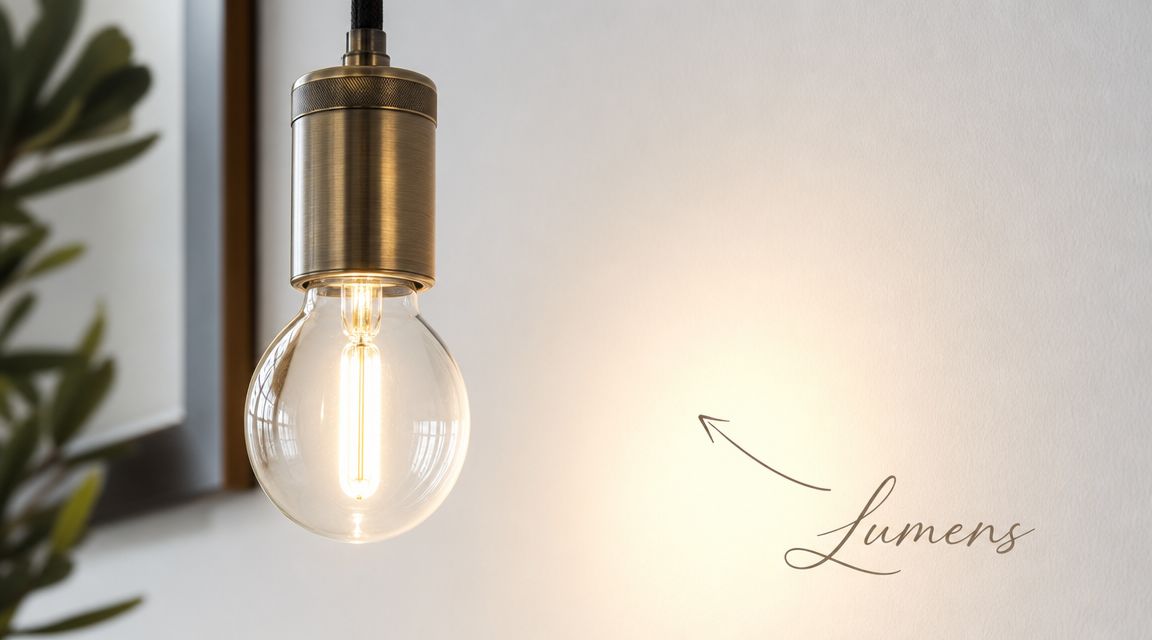
For a typical residential corridor, lighting designers recommend maintaining around 100 to 200 lux on the walkway, with a wide beam spread helping deliver more even illumination. The same technical guidance notes that dimmable LED pendants are preferable because the fitting can work as both wayfinding light and low-glare accent lighting depending on the time of day (hallway lighting design guidance).
That's why I usually steer homeowners toward LED-compatible pendants with proper dimming support. Hallways don't need the same feel all day. You might want a brighter setting when people are moving through the house in the evening, and a softer level later at night.
If you're weighing up efficiency, longevity, and general household lighting upgrades at the same time, this overview of the benefits of LED lighting is a useful companion read.
Homeowners often hear lumens, Kelvin, and CRI and switch off. The terms are simpler than they sound.
A simple way to think about colour temperature is time of day. Warm light feels closer to sunset. Cooler light feels closer to midday. In a hallway, a welcoming effect is preferred, not a clinical one, so the lamp choice should support the mood of the house rather than fight it.
Some pendant shades throw light straight down and leave the side walls dull. Others diffuse too much and lose presence. For hallways, the most reliable result usually comes from:
That last point becomes noticeable in Queenslanders. Timber, VJ walls, and heritage-style paint colours all respond better when the light source renders colour cleanly.
Style is optional. Safety and compliance aren't.
In Brisbane, pendant lights in hallway spaces need to be assessed as part of a circulation path. Under the Australian National Construction Code, circulation spaces must remain safe and unobstructed. In practice, a pendant's lowest point should be above 2.1 m from the finished floor level, and installation must be completed by a licensed electrician to comply with Queensland electrical requirements (hallway fixture installation compliance guidance).
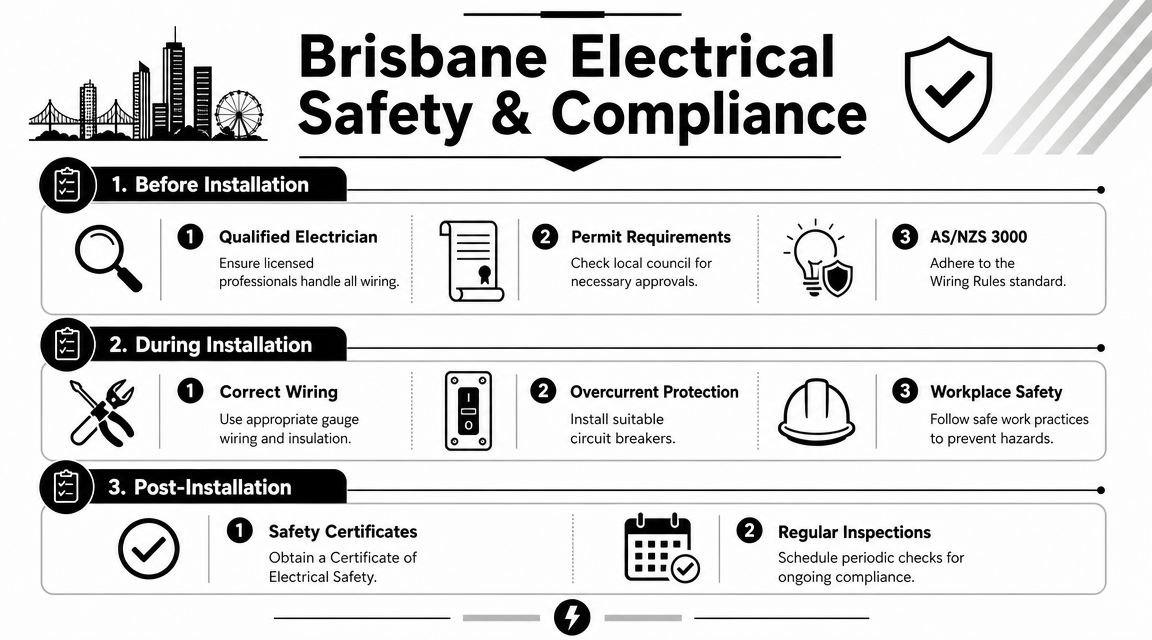
The question isn't just “Will the pendant fit?” The better question is “Is a pendant even suitable here?”
That matters in older Brisbane homes where hallways can be narrow, the ceiling height can vary between rooms, and previous renovations may have changed the original layout. A fitting that hangs safely in a wide entry void might be completely wrong for a tight internal corridor.
Australian compliance practice puts weight on three things:
The most common issue isn't a dramatic one. It's a series of small mistakes. The fitting is chosen online. The drop is guessed. The existing mounting point is assumed to be fine. Then the pendant ends up too low, too central in a tight passage, or unsupported for the fixture weight.
In a hallway, a pendant should sit outside the occupant envelope while still delivering useful light. If it can't do both, it's the wrong fitting for that location.
This is also why flush-mount or semi-flush fittings are often the safer option in lower hallways or retrofitted entries. Pendant lighting is excellent in the right space, but compliance has to lead the decision.
A pendant light is fixed electrical work. It isn't just hanging a decorative object. The job can involve cable condition checks, secure mounting, connection testing, and confirming the finished installation is safe for the space.
For Brisbane homeowners, that's the line between a stylish upgrade and a defect that causes trouble later.
DIY has obvious appeal. A pendant looks simple from the outside, and plenty of homeowners assume it's a straightforward swap. In a hallway, it rarely is.
The attraction is usually speed and cost. If there's already a light point in the ceiling, it can look like a remove-and-replace job. That's especially tempting when the fitting comes with glossy instructions and the old light has been there for years without issue.
For basic understanding, articles like how to wire a ceiling light can help homeowners understand the parts involved. But understanding the components isn't the same as being authorised to complete fixed electrical work in Queensland.
A compliant installation deals with more than the visible fitting. It covers the mounting point, support suitability, cable condition, termination, testing, and whether the chosen pendant is appropriate for the hallway at all.
Here's the practical comparison:
DIY approach
You may save time upfront, but you carry the risk of incorrect mounting, unsafe terminations, poor alignment, and a finished height that doesn't suit the circulation space.
Licensed electrician
The work is assessed against the hallway layout, the fitting is installed properly, and the result is safer, neater, and less likely to create problems later.
Long-term outcome
Poor pendant installs don't always fail immediately. Some just annoy you every day. They glare, hang awkwardly, feel too low, or highlight the walls unevenly.
For most hallway pendant jobs, the smartest decision is professional installation. Not because homeowners can't change a light bulb, but because a hallway fitting has to satisfy appearance, clearance, and fixed-wiring requirements at the same time.
A good hallway upgrade is easy to notice because the whole space changes character. The corridor feels less like a passage and more like part of the home.
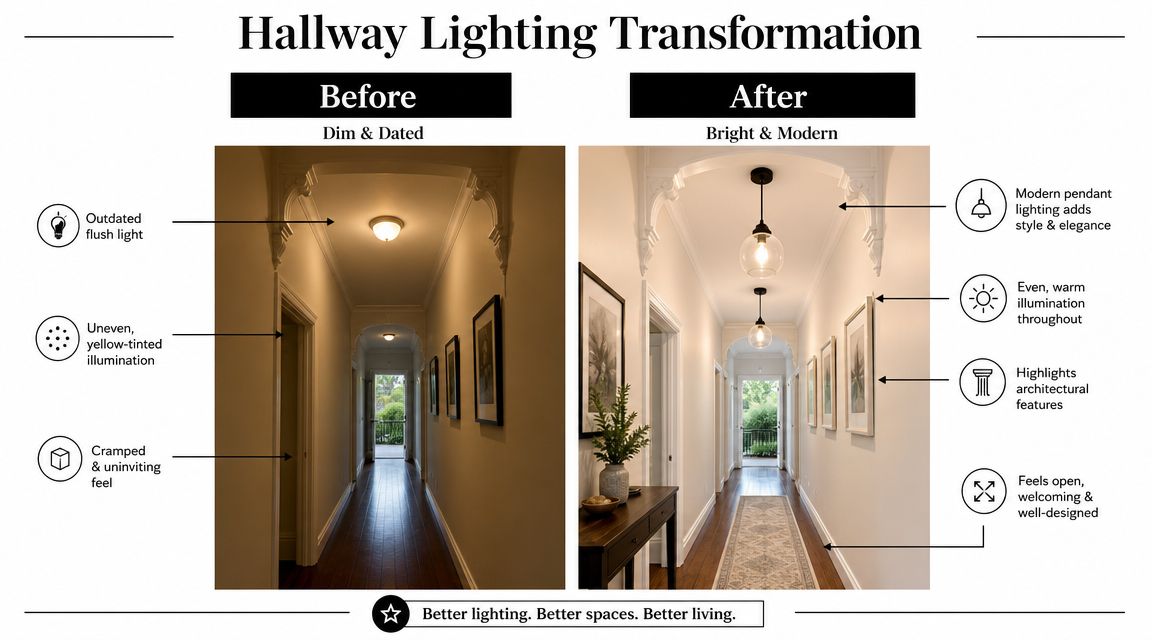
Before the change, the space had the usual symptoms. One central fitting. Uneven light. Dark edges near the skirting and corners. The hallway technically worked, but it didn't feel comfortable at night and it made the home feel more closed in than it really was.
After the update, a pair of carefully selected pendants brought rhythm to the corridor. The light spread more evenly and the ceiling line suddenly had purpose. Instead of a blank tunnel, the hallway felt organised and calm.
If you're collecting ideas before choosing fittings, it's worth taking time to explore Vivid Skylights' lighting ideas. Looking at daylight, skylight, and fixture combinations often helps homeowners decide whether they need a feature light, more ambient light, or both.
A short visual example helps here:
The second type of change is very different. A Queenslander entry with higher ceilings doesn't usually need multiple fittings to make an impact. It needs one pendant that suits the proportions of the house and respects the architecture around it.
Before, the hallway can feel underdressed. The ceiling is high, the walls have character, and the old fitting sits there doing the bare minimum. After the right pendant goes in, the entry gains presence. Timber trims read better. The ceiling height feels intentional rather than empty. The fitting becomes a focal point without cluttering the floor area.
The best hallway pendant doesn't just fill space. It makes the proportions of the house make sense.
That's the difference between decoration and proper lighting design. One adds an object. The other improves how the home feels to move through.
Pendant lights in hallway spaces work well when the design and the installation are treated as one job. The fitting has to suit the dimensions of the corridor, the light output has to be comfortable, and the final position has to respect the way people move through the space.
That matters even more in Brisbane homes with mixed ceiling heights, narrow passageways, and renovation-era surprises hidden above the plaster. A hallway pendant can look simple on paper and still be the wrong choice once clearance, support, and compliance are checked properly.
DLG Electrical has been delivering residential and commercial electrical work in Brisbane for over 19 years, with fully licensed and insured electricians, free quotes, and a strong focus on getting installations right the first time. For homeowners planning lighting upgrades, DLG Electrical can assess the hallway layout, advise whether a pendant is suitable, and complete the fixed wiring and installation work in line with Queensland requirements.
If you're unsure whether your hallway can safely take a pendant, that's the right time to ask. It's much easier to choose the correct fitting at the start than to replace the wrong one after installation.
Sometimes, yes. The deciding factors are ceiling height, hallway width, and whether the fitting can sit clear of the movement path without becoming intrusive. In many narrow Brisbane corridors, a slim pendant or a compact diffuser style can work. In others, a flush or semi-flush fitting is the safer call.
They often are, especially where the home has higher ceilings and the hallway has enough vertical space to carry a suspended fitting properly. Pendants can suit the proportions of a Queenslander very well, but the style should match the architecture and the installation still needs to be checked for clearance and support.
A low-glare diffuser usually performs better than a narrow, harsh directional shade. Hallways benefit from even light and comfortable visibility along the full corridor, not just a bright circle on the floor under the fitting.
That depends on the length and layout of the hallway. A short entry might only need one well-proportioned pendant. A longer corridor often benefits from multiple fittings so the lighting feels balanced instead of concentrated in one section.
In most homes, yes, it's a very practical addition. Hallways serve different purposes across the day and evening, and dimming gives you more control over how the space feels. It also helps soften glare at night.
Possibly, but don't assume the existing point automatically makes it suitable. The final choice depends on the corridor proportions, the total drop of the fitting, the mounting method, and whether the new light is appropriate for a circulation path.
A licensed electrician. Hallway pendants are fixed electrical fittings, and the installation needs to be safe, secure, and compliant with Queensland requirements.
If you're planning pendant lights in hallway areas and want advice that balances style with safe, legal installation, contact DLG Electrical. The team can help you assess the space, choose a suitable fitting, and arrange a free, no-obligation quote for your Brisbane home.

Master Electrician with over 30 years of experience. Founded DLG Electrical in 2005 after international project work including electrical installations at Stamford Bridge Stadium, London(Home of Chelsea FC).

Local Electricians that can fix all Electric Hot water Systems.
Motion sensor lights are a versatile addition to any home, offering nu
