83 Jean St, Grange QLD 4051
Mon-Fri 07:30 AM - 04:00 PM - Sat - 8:00 - 12 - Sunday Closed

At its core, an RCD power board is a portable power board with a safety switch built right in. Its entire job is to protect you from a life-threatening electric shock. It does this by constantly monitoring the electricity flowing through it and instantly shutting off the power if it senses a dangerous leak—the kind that happens when electricity finds a shortcut through a person. This makes it an absolute must-have for workshops, outdoor areas, and anywhere you’re using power tools or appliances.
Think of an RCD power board as a personal bodyguard for your electrical safety. It’s far more than just an extension cord with a few extra sockets; it’s a smart device doing a critical, life-saving job every single second it’s plugged in. Its main purpose isn’t to protect your gear from power surges—that’s a different task for a different device—but to protect you from electrocution.
This protection comes from a clever but simple principle. The RCD, or Residual Current Device, is like a hyper-sensitive set of scales, constantly balancing the electricity flowing out to an appliance with the electricity flowing back. In a healthy, safe circuit, these two currents are perfectly matched.
The moment a fault happens—maybe from a frayed cord, a bit of moisture getting in, or internal damage—a tiny amount of electricity can escape the circuit. If that stray current finds a path to the ground through a person, it creates a dangerous imbalance. This is where the RCD power board springs into action.
It detects this tiny difference in current, as small as 30 milliamperes, and trips the circuit in as little as 30 milliseconds. That’s faster than a critical heartbeat, cutting the power long before a fatal shock has a chance to occur.
The widespread adoption of RCDs, both in portable boards and in fixed switchboard installations, has dramatically improved electrical safety across Australia. In fact, an analysis of 4,880 recorded electrical accidents over a six-year period showed just how vital these devices are in preventing serious injuries and deaths. If you want to dive deeper into the tech, you can check out our detailed guide on what a residual current device is.
This lightning-fast response makes an RCD power board an indispensable tool in any high-risk environment. It’s particularly crucial in a few key situations:
Ultimately, this device gives you a focused bubble of safety right where you need it most. It’s like a personal safety net that travels with your tools, ready to catch you if something goes wrong.
It’s a common mistake to think all the safety gadgets in your switchboard do the same thing. While they all work together to keep things safe, they’re actually protecting you from very different dangers. Getting your head around the difference is the key to making sure your family and home are properly protected.
At the most basic level, the difference is this: circuit breakers protect equipment, while RCDs protect people.
Think of a standard circuit breaker as a security guard for your home’s wiring and appliances. Its one job is to watch for overloads (like running the heater, kettle, and toaster all at once on one circuit) and short circuits. When it spots one of these big problems, it trips, cutting the power to stop wires from overheating and starting a fire.
An RCD power board, on the other hand, is more like a personal bodyguard. It’s not looking for those big, clumsy surges of power. Instead, it’s watching for tiny, almost invisible leaks of electricity—the kind that can pass through a person. These are the small, dangerous leaks a normal circuit breaker would completely ignore.
A standard circuit breaker is perfectly happy to let electricity flow, as long as the total amount of current stays within its limits. It has no idea where that current is going. If some of that electricity decides to take a dangerous detour through a person on its way to the ground, the circuit breaker is none the wiser. It won’t trip.
This is where an RCD shines. It’s specifically designed to spot that dangerous detour. By constantly balancing the electricity flowing out with the electricity coming back, it can detect a leak as small as 30 milliamperes and shut the power off in a fraction of a second.
This is why you need both. A circuit breaker might save your house from burning down due to a faulty wire, but an RCD is what will save you from a fatal shock when you’re using a power tool in the garden.
The infographic below really simplifies the critical role an RCD plays in standing between you and a nasty shock.
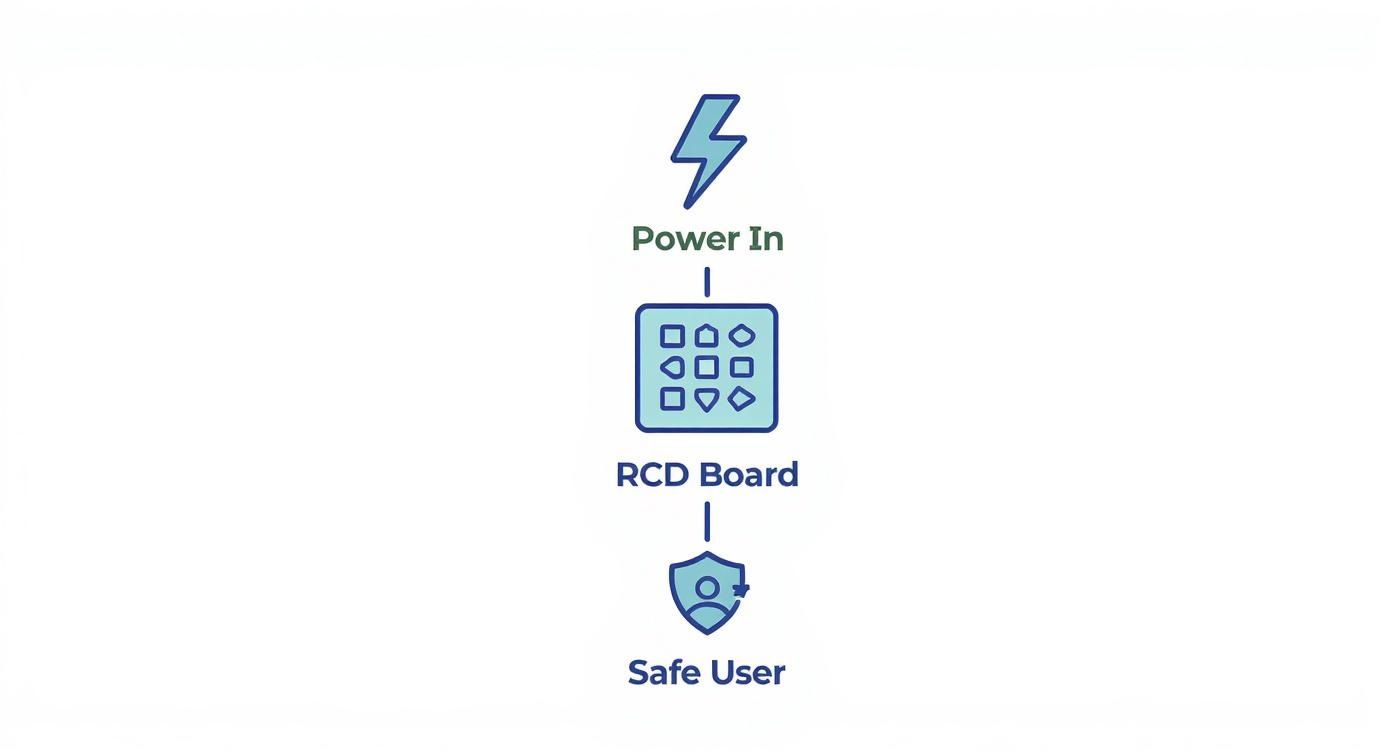
As you can see, the RCD power board acts like an intelligent safety gate, slamming shut the moment it detects a fault before it can ever reach you.
To help clear things up, here’s a quick breakdown of how these different devices stack up against each other.
| Device Type | Primary Function | Protects Against | Best Use Case |
|---|---|---|---|
| RCD Power Board | Personal Safety | Electric shock from small current leaks to earth. | High-risk tools or outdoor work where extra protection is needed. |
| Switchboard RCD | Circuit-Wide Personal Safety | Electric shock on all outlets connected to that circuit. | General household protection for entire rooms or areas. |
| Circuit Breaker | Equipment & Wiring Safety | Overloads and short circuits (large current surges). | Preventing electrical fires and appliance damage. |
This table shows that while they all live in the world of electrical safety, they each have a very specific and non-overlapping job. You wouldn’t rely on a circuit breaker to save you from electrocution, just as you wouldn’t rely on an RCD to stop a massive short circuit from melting your wiring.
To add one more piece to the puzzle, you’ll find RCDs in two main forms: the fixed ones installed in your switchboard and the portable RCD power boards we’re talking about here. A switchboard-mounted RCD (what most of us call a safety switch) gives you blanket protection over entire circuits in your home—for example, it might cover all the power points in the bedrooms.
A portable RCD power board gives you focused, localised protection exactly where and when you need it most. This makes it perfect for those high-risk situations where you want an extra layer of confidence, such as:
Its portability is its biggest advantage, letting you create a movable safety zone wherever you’re working.
It’s also worth noting that if you have a device that keeps tripping, the cause can be very different. If you’re wondering why a circuit breaker keeps tripping, it usually points to a different set of problems than a tripping RCD would.
Navigating local electrical laws in Queensland isn’t just about ticking boxes to avoid a fine; it’s about making sure our homes and workplaces are genuinely safe. The Electrical Safety Act 2002 is the key piece of legislation here, and it sets out clear, non-negotiable standards for Brisbane and the rest of the state. Its main goal? Using things like Residual Current Devices (RCDs) to prevent tragic, and entirely avoidable, accidents.
These rules aren’t just friendly suggestions—they’re legal requirements with real consequences. Whether you’re a homeowner, a landlord, or looking to sell your property, getting your head around these obligations is crucial for both safety and staying on the right side of the law.
The law is very specific about when and where RCDs must be installed. This isn’t just for new builds; it applies to plenty of existing properties, especially when they’re being sold or rented out.
Here are the key times when RCDs are a legal must-have:
Failing to comply can lead to hefty fines, but the real cost is far greater. It leaves people inside the property exposed to the risk of a severe electric shock—a danger that a correctly installed RCD practically eliminates.
Just like our phones and TVs get updated, so do our electrical safety standards. One of the most important recent changes is the type of RCD that’s now required. For years, Type AC RCDs were the standard, and they did a decent job of detecting faults from simple appliances.
But think about what’s in our homes today: computers, smart TVs, inverter air conditioners, and modern washing machines. These electronics can create a different kind of electrical fault called a ‘pulsating DC current’. The problem is, older Type AC RCDs might not even see this type of fault, leaving you unprotected.
This blind spot led to a nationwide change in regulations. As of 30 April 2023, Type AC RCDs are no longer allowed to be sold or installed in Australia. All new installations must now use Type A RCDs, which are specifically designed to detect both the old-style AC faults and the newer pulsating DC faults. This gives you far better protection in a modern home.
To get a complete picture of the rules, it’s always a good idea to check out resources like this practical guide to compliance with government regulations. For anyone in Brisbane, making sure your home is fitted with the right type of RCD isn’t just about best practice—it’s a legal and safety must-do. An expert team like DLG Electrical can carry out a compliance check to confirm your property is up to code and handle any necessary upgrades.
An RCD power board is a fantastic safety net, but it’s only useful if you know it’s in good working order. An untested RCD is a bit like having a fire extinguisher you’ve never checked—it gives you a false sense of security. Thankfully, testing your board is a quick and simple routine that turns this piece of equipment into a reliable, life-saving tool.
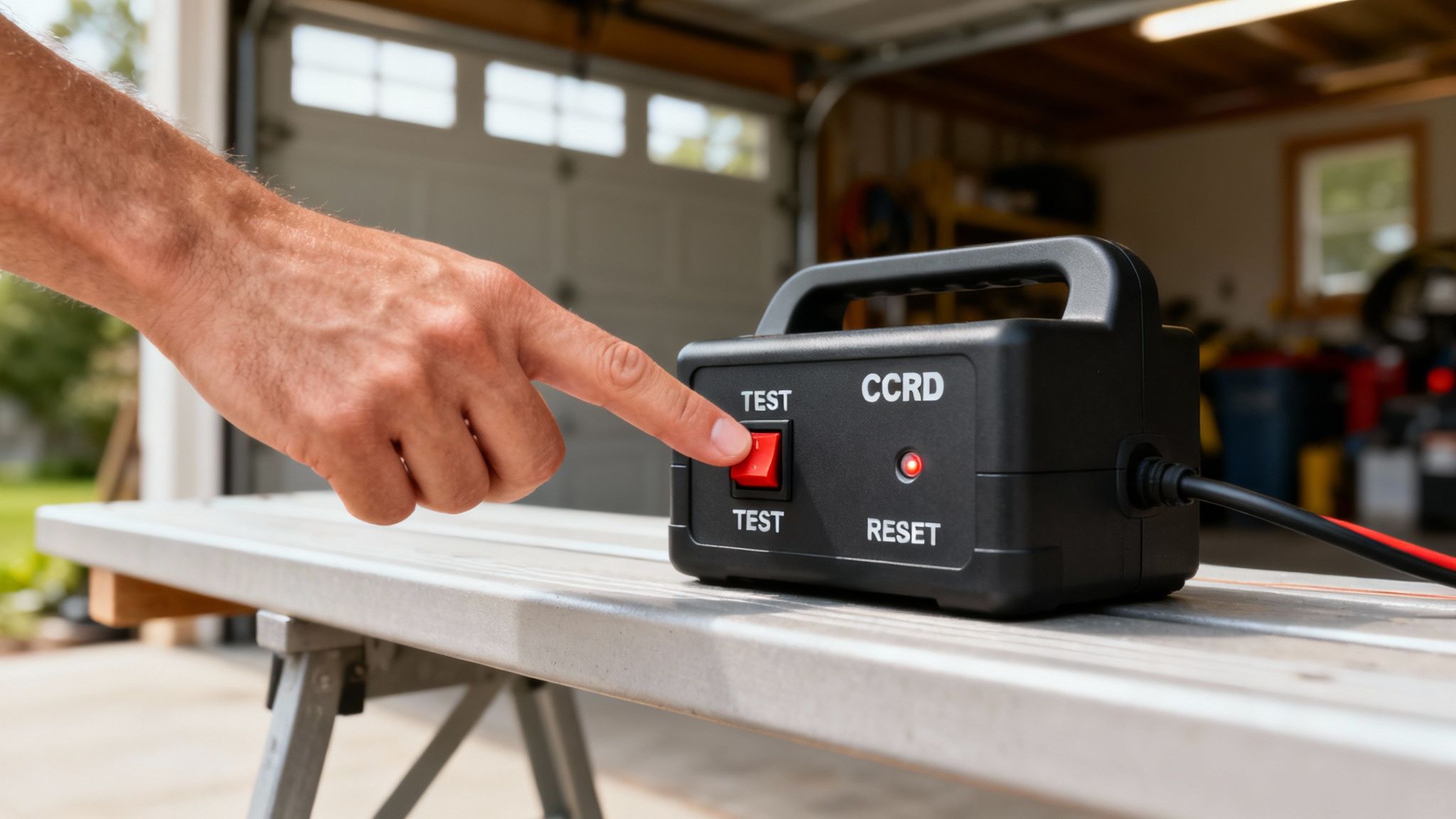
This check takes less than a minute, but it’s one of the most important safety habits you can build. Think of it as part of your pre-work checklist, just like making sure your power saw has a sharp blade or your ladder is on solid ground.
Every RCD power board is fitted with two crucial buttons, usually labelled ‘TEST’ and ‘RESET’. The testing process is dead simple, something anyone can and should do regularly.
Here’s the step-by-step:
This simple sequence confirms that the RCD’s internal safety switch can do its job—detect a fault and cut the power before it can cause harm.
A successful test is your proof that the RCD is ready to protect you. If the RCD does not trip when you press ‘TEST’, or if it fails to reset afterwards, stop using it immediately. It’s no longer safe and must be replaced.
Knowing how to test your RCD is only half the job; doing it consistently is what really counts. How often you test should depend on how and where you’re using the board.
Beyond the push-button test, a little physical maintenance will go a long way in extending the life of your board and keeping it safe. Keep it clean and dry, and before plugging it in, always give it a quick visual once-over. Look for any signs of damage like cracks in the casing, burn marks, or a frayed cord.
A working RCD power board is a silent guardian, always on the lookout for electrical faults. But a faulty one? That’s just a regular power board giving you a dangerous, false sense of security.
Knowing the subtle clues that your device is on its last legs is just as important as testing it. These red flags mean its protective shields are down, leaving you completely exposed to serious electrical risks.
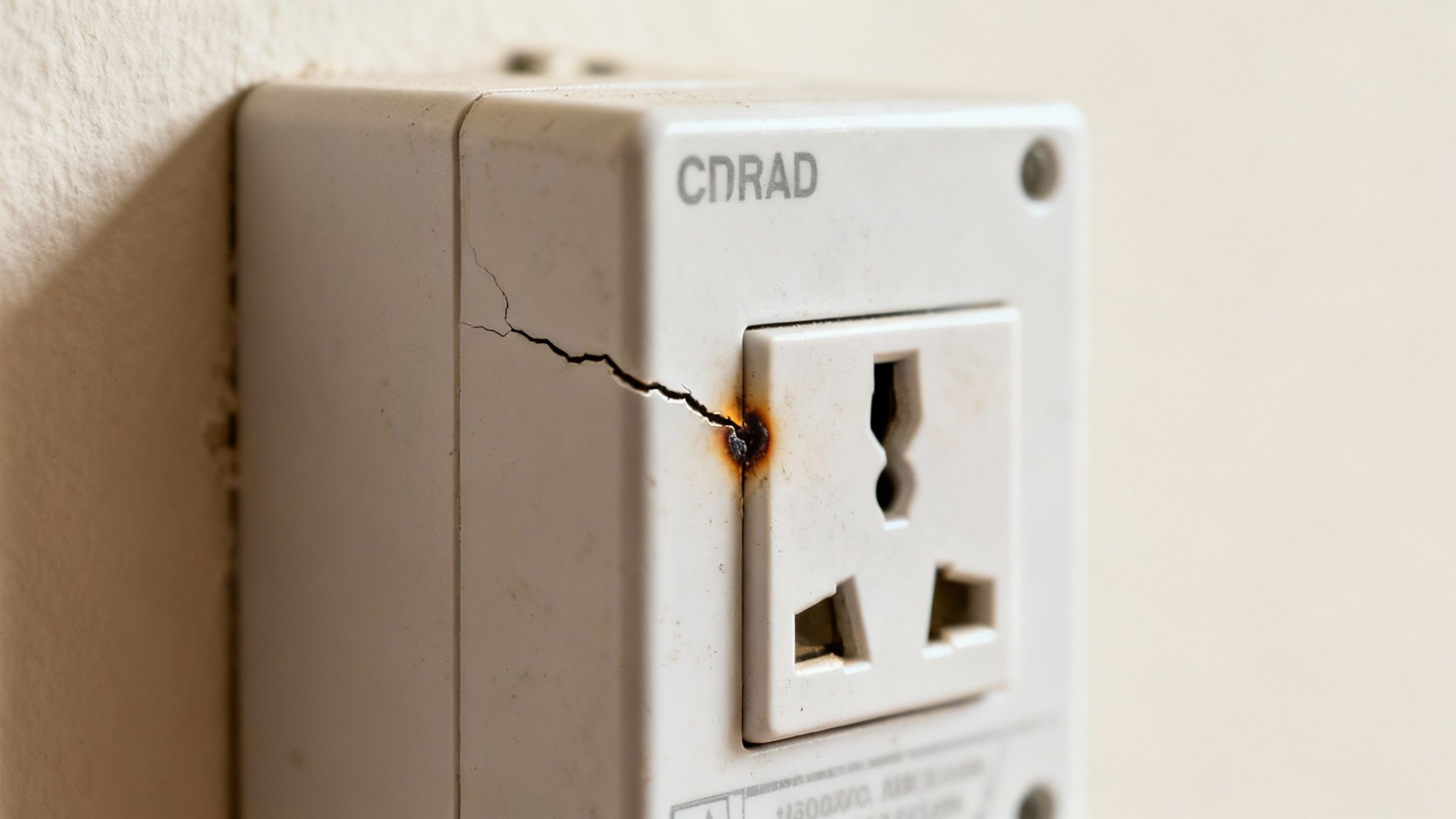
Ignoring these symptoms is a gamble you can’t afford to take. The second you think your RCD power board might be failing, stop using it immediately and get it replaced.
One of the biggest giveaways is frequent, unexplained tripping. Sure, an RCD that trips occasionally might just be doing its job protecting you from a faulty appliance. But if it’s constantly tripping for no obvious reason, it could point to an internal fault within the RCD itself. The device might have become overly sensitive, making it unreliable.
An even more critical warning sign is when it fails a manual test. When you push the ‘TEST’ button, the power should cut out instantly. If nothing happens, or if it won’t reset properly afterwards, the internal trip mechanism is broken.
An RCD that doesn’t pass this simple test is effectively just a standard power board with no life-saving features. Continuing to use it is like driving a car knowing the airbags won’t deploy in a crash. It provides zero protection against electric shock.
You should also give the device a quick visual inspection every now and then for signs of wear and tear. Physical damage is a clear sign that the board is no longer safe to use.
Keep an eye out for:
If you spot any of these warning signs, the next step is simple and non-negotiable: unplug the device immediately and do not use it again. A faulty RCD is a liability, not a safety tool. Get in touch with a professional electrician like DLG Electrical for advice on a safe, suitable replacement.
While a portable RCD power board is a fantastic safety gadget, it’s really important to see it as just one piece of a much bigger electrical safety puzzle. Thinking that a single plug-in device has you completely covered can create a false sense of security, potentially masking deeper, more serious issues lurking in your home’s wiring. For genuine peace of mind, a holistic approach guided by a professional sparky is non-negotiable.
An RCD power board is a valuable addition, but it’s no substitute for whole-home protection. The most effective safety systems always start at the source: your switchboard. Properly installed, switchboard-mounted RCDs protect entire circuits, not just the appliances plugged into one power board. A qualified electrician is the only person who can properly assess your current setup and make sure every circuit is safeguarded.
Getting a licensed electrician to run a full safety inspection on your Brisbane property gives you benefits that a single portable device simply can’t match.
Professional electrical advice is crucial for ensuring the safe implementation of any power solutions, including reliable safe emergency power supplies, and confirming they incorporate appropriate safety devices like RCDs.
The focus on electrical safety has seen the market for RCDs in Australia grow significantly. Tellingly, the hybrid RCD segment—which covers more advanced devices—held a huge revenue share of 55.84% in 2024. This reflects the growing need for sophisticated protection in modern homes, especially those with solar panels and battery storage.
At the end of the day, a qualified electrician is your essential safety partner. For a proper, thorough evaluation of your home’s electrical health, your best bet is always to chat with a trusted electrician in Brisbane who can deliver a complete and reliable solution.
As electricians, we field a lot of questions about how to use RCD power boards safely and correctly. Here are some of the most common queries we get from our clients right here in Brisbane.
Yes, you can, but the order you plug them in is critical for your safety. Always plug the RCD power board directly into the wall socket first. From there, you can safely plug an extension cord into one of the board’s protected outlets.
This setup makes sure that any tool or appliance running off that extension cord is covered by the RCD’s life-saving trip mechanism. If you do it the other way around, you’re plugging a protected board into an unprotected cord, which completely bypasses the safety feature.
No, it doesn’t, and this is a massive misconception. An RCD’s one and only job is to protect people from electric shocks caused by earth faults. It’s not designed to shield your expensive electronics from voltage spikes, power surges, or lightning strikes.
For protecting your gear, you need a dedicated surge protector. You can find some heavy-duty power boards that offer both RCD and surge protection in a single unit, which is a fantastic all-in-one solution for workshops or home offices.
If your RCD trips constantly, it’s usually pointing to one of three culprits: a faulty appliance, moisture getting into a connection somewhere, or the RCD unit itself is on its way out.
A good first step is to unplug everything from the board and then plug your appliances back in one by one. This little process of elimination will often help you pinpoint the faulty device. If the RCD trips even when nothing is plugged into it, stop using it immediately. That’s a clear sign it’s failed and needs to be replaced.
When it comes to electrical safety, there’s no room for guesswork. If you’re unsure about your setup or need a professional compliance check for your home or business, don’t leave it to chance. The fully licensed and insured team at DLG Electrical is here to help.
Contact us for a free quote and get expert advice on keeping your Brisbane property safe.

Master Electrician with over 30 years of experience. Founded DLG Electrical in 2005 after international project work including electrical installations at Stamford Bridge Stadium, London(Home of Chelsea FC).

Local Electricians that can fix all Electric Hot water Systems.
Motion sensor lights are a versatile addition to any home, offering nu
