83 Jean St, Grange QLD 4051
Mon-Fri 07:30 AM - 04:00 PM - Sat - 8:00 - 12 - Sunday Closed

When a safety switch trips, it can be a bit startling. One minute the lights are on, the next, you’re plunged into darkness. While it feels like an inconvenience, it’s actually your home’s electrical bodyguard doing its job perfectly. It has instantly cut the power, preventing what could have been a nasty electric shock from a faulty appliance or dodgy wiring. Annoying? Yes. A critical safety feature in action? Absolutely.
That sudden power outage in one part of your house isn’t just a random glitch. It’s a clear signal that your electrical system has spotted a potentially life-threatening fault and has stepped in to protect you.
A safety switch, technically known as a Residual Current Device (RCD), has one primary mission: to protect people from electric shock. It’s constantly monitoring the electrical current flowing through a circuit. If it senses even a tiny amount of electricity leaking to the earth—a sign that it could be passing through a person’s body—it shuts off the power in a fraction of a second.
This isn’t just a “nice-to-have” feature; it’s a lifesaver. Tragically, around 15 Australians are killed and 300 are hospitalised each year due to electrical accidents at home. These are incidents that a safety switch is specifically designed to prevent. You can read more about these figures in an official report from Treasury Australia.
A safety switch is your frontline defence against electrocution. It’s engineered to trip in just 0.03 seconds—faster than the critical phase of a heartbeat—which is quick enough to prevent serious injury or death.
It’s common for people to mix up safety switches and circuit breakers, but they do very different jobs. Knowing the difference is key to understanding what’s just happened in your home.
A circuit breaker is there to protect your home’s wiring and appliances. It trips when there’s an overload (too many appliances running at once) or a short circuit, preventing a potential fire. A safety switch, on the other hand, is there to protect you.
So, how can you tell them apart on your switchboard? It’s pretty simple:
This distinction is crucial. When your safety switch tripped, it signals a potential danger to a person, not just an issue with your electrical hardware. It’s a warning you need to take seriously.
When the power suddenly goes out, your first instinct is probably to head straight for the switchboard and flip the tripped switch back on. But hold on a moment. That switch tripped for a good reason, and just resetting it without finding out why could mean you’re right back in the dark in a few minutes—or worse, ignoring a serious electrical hazard.
The real goal isn’t just getting the lights back on; it’s about doing it safely. The best way to do this is with a simple diagnostic process I always recommend to clients, often called an “isolation test.” It’s a straightforward way to pinpoint the problem yourself, no special tools needed.
First, head over to your switchboard. Look for the switch that’s flicked off. Before you do anything else, push it firmly into the full ‘off’ position. Sometimes when a switch trips, it gets stuck in a middle position, so giving it a solid push down makes sure it’s properly set to be reset.
Now for the most important part of the whole process. We need to figure out what caused the trip, and to do that, you’ll need to unplug everything. And I mean everything. Go through your entire house and physically unplug every single appliance from the wall sockets. Just turning them off at the power point isn’t enough.
From my experience, the usual suspects are often hiding in plain sight:
With every appliance unplugged, walk back to the switchboard and try flipping the safety switch to the ‘on’ position. If it stays on, fantastic! That’s a strong sign the fault is with one of your appliances, not the wiring in your walls.
This image below breaks down the three most common electrical issues that will make a safety switch do its job.
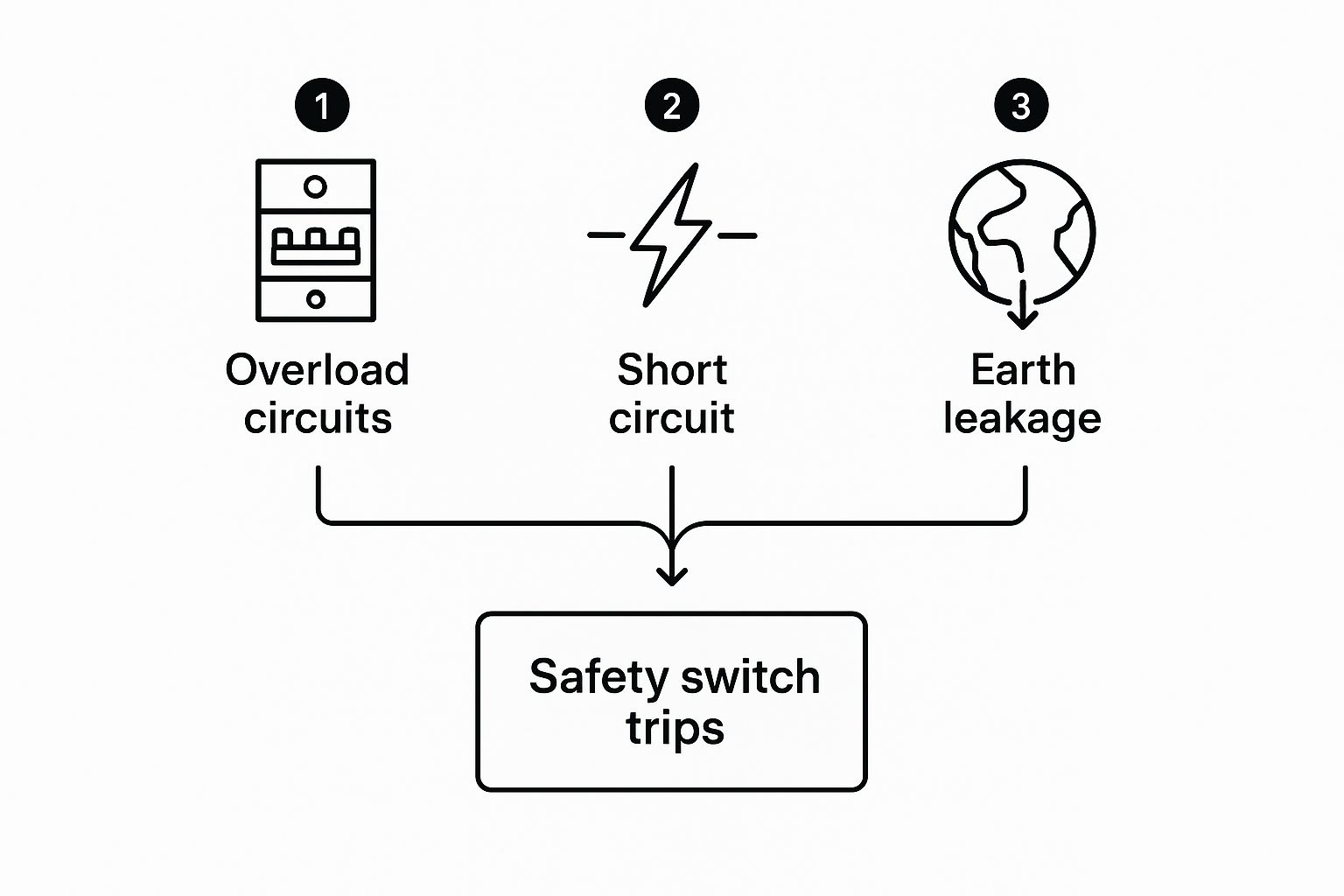
As you can see, things like overloading a circuit or a short circuit are different problems, but they all result in the same outcome: a tripped switch keeping you and your property safe.
Now that the power is back on (for now), it’s time to play detective. The key here is to be methodical. Take one appliance, plug it back in, and switch it on. If the power stays on, that appliance is likely fine. Unplug it, and move on to the next one.
Repeat this process for every single device, one by one. The moment the safety switch tripped again, you’ve found your culprit. It’s the last thing you plugged in.
Unplug that faulty item straight away and put it aside. It’s crucial that you don’t use it again until you can get it professionally repaired or you’ve replaced it. Once it’s unplugged, you should be able to reset the safety switch for good and start plugging your other, non-faulty appliances back in.
Critical Safety Warning: If the safety switch trips instantly—even when you’ve unplugged every single appliance—stop what you’re doing. Never, ever try to force or hold the switch in the ‘on’ position. This is a clear signal of a serious fault in your home’s fixed wiring or the switchboard itself. This is the point where you absolutely must call a licensed electrician immediately.
Okay, so you’ve done the isolation test and narrowed down the problem circuit. Now for the million-dollar question: what’s actually causing the fault? When a safety switch tripped, it’s almost always a sign that something, somewhere, isn’t right.
Most often, the culprit is a single faulty appliance. It’s easy to forget that over time, the wiring and internal parts of our trusty devices can wear out. This degradation can lead to a tiny amount of electricity leaking to earth—a hazard your safety switch is designed to detect instantly.
It’s often the appliances we rely on day in, day out that are the source of the drama. The ones that work the hardest, especially those dealing with heat and water, are prime candidates.
Here’s where I’d start looking:
And don’t just think about things you plug in. Faults in hardwired appliances like hot water systems, ovens, and air conditioners can also trip a switch, leaving you scratching your head because nothing is visibly plugged in.
Sometimes, the issue isn’t with your appliances at all. You need to look outside. The Australian weather, especially a good old-fashioned downpour, can create a whole new set of electrical headaches.
Think about it: a big storm rolls through, and water seeps into an outdoor power point, your garden lights, or the pool pump. If the seals aren’t perfect, that moisture creates a bridge for electricity to escape to the earth, and click—the safety switch does its job. The good news is these faults often fix themselves once everything dries out.
A Tip From Experience: If your switch trips during or right after heavy rain, moisture is almost certainly the culprit. Before you do anything else, give your outdoor electrics a chance to dry out completely. If it keeps happening, you’ve likely got a compromised seal that needs an electrician to sort out.
Ever had a safety switch tripped for no apparent reason? You’ve checked every appliance, but everything seems fine. You might be dealing with what we in the trade call ‘nuisance tripping’.
This phenomenon occurs when multiple appliances are running at once. None of them are faulty on their own, but each has a minuscule, perfectly safe earth leakage. The problem is, when their tiny leakages are combined, they can add up and cross the 30-milliamp threshold that trips the switch.
It’s one of the most frustrating scenarios because there isn’t one single “broken” thing to fix.
While a faulty kettle or toaster is a common culprit for a tripped safety switch, there are times when the trip is pointing to something far more dangerous hidden inside your home’s wiring. This isn’t just an annoyance; it’s a critical alert from your electrical system that you absolutely cannot ignore.
If a switch keeps tripping, especially if it won’t reset or you can’t find an obvious reason, you need to treat it with extreme seriousness. It’s often the first and only warning sign you’ll get about a hidden wiring fault that could pose a major fire risk.
So, you’ve gone through the isolation test. You’ve methodically unplugged every single appliance from every power point on that circuit. You go back to the switchboard, try to reset the switch, and it trips again instantly.
If this happens, the problem isn’t with your appliances; it’s somewhere in the fixed wiring of your house.
This is a red flag. It’s the point where you stop all troubleshooting and immediately call a licensed electrician. Whatever you do, don’t try to force or hold the switch in the ‘on’ position.
What could be causing it? From what we see out in the field, it’s usually one of a few things:
A safety switch that trips with nothing plugged in is doing its job perfectly—it has detected an electrical leak that could be life-threatening. Forcing it to stay on is like taking the batteries out of a smoke alarm during a fire. You’ve removed the warning, but you’ve just multiplied the danger.
It’s a sobering thought, but electrical faults are a leading cause of house fires. In New South Wales, for instance, official figures show that roughly 40% of house fires each year—that’s up to 1,800 fires—are sparked by electrical faults or appliances. It’s a stark reminder of what’s at stake. You can read more on these home electrical safety statistics from the NSW government.
A safety switch that trips persistently is your electrical system’s way of flagging a condition that could easily lead to one of those fires if it isn’t fixed.
If your switchboard is old or you find yourself dealing with tripping issues regularly, it’s a strong sign you need professional help. Learning about the benefits of modern switchboard repairs and upgrades can give you peace of mind and drastically improve your home’s safety. A qualified electrician can find those hidden wiring faults and bring your system up to code, protecting your family and your home from these invisible threats.
Dealing with a tripped safety switch is always a pain, but the best defence is a good offence. It’s far better to prevent a trip from happening in the first place. By shifting your mindset from reactive panic to proactive care, you can save yourself a lot of future headaches and keep your home’s electrical system safe and reliable.
Just a few simple habits can dramatically slash the risk of a safety switch tripping. When you work these checks into your regular home maintenance routine, you start catching potential problems long before they knock out your power.
Think of this as a quick health check for your home’s wiring and appliances. These are simple visual inspections and tests you can do yourself to keep on top of things and spot issues before they escalate.
A safety switch is a mechanical device. Just like any machine, it benefits from being operated every now and then. Regularly pressing the test button doesn’t just confirm it’s working; it also helps prevent the internal mechanism from getting stiff or seizing up over time.
While these DIY checks are incredibly useful, they don’t replace the trained eye of a professional electrician. If you live in an older home, a professional electrical inspection isn’t just a good idea—it’s a critical investment in your family’s safety. Wiring deteriorates over time, and what was considered safe 20 or 30 years ago might not meet today’s stringent standards.
Likewise, if you’re buying a new property, always get a thorough pre-purchase electrical inspection. It can uncover hidden issues that could cause endless safety switch tripped headaches later on.
If your home still has an old-school ceramic fuse box or only has a single safety switch protecting the whole house, it’s definitely time to chat with a licensed sparkie about a modern switchboard upgrade in Brisbane. A modern board isolates faults to individual circuits, making troubleshooting a breeze and making your home infinitely safer. It’s a proactive investment that can prevent countless frustrating power outages and emergency call-outs.
Even after you’ve managed to reset your safety switch, it’s completely normal to have a few nagging questions about what just happened and why. When your home’s electrical system throws up a red flag, you need clear, straightforward answers. We’ve pulled together some of the most common questions we get from homeowners, offering practical advice for those tricky situations.
You’ve followed the steps, unplugged everything, but the switch clicks off the second you try to reset it. This is a big one. It signals a serious, persistent fault in your system.
Whatever you do, do not force or hold the switch in the ‘on’ position. It’s tripping for a reason – it has detected a dangerous electrical leak and is doing its job to protect you.
This is your signal to stop. It’s time to call a licensed electrician. We have specialised diagnostic gear, like insulation resistance testers, that can safely find hidden faults within your home’s fixed wiring or in hardwired appliances like your oven, air conditioner, or hot water system.
Absolutely. In fact, it’s one of the most common culprits we see when a safety switch has tripped. Heavy rain and strong winds are notorious for causing electrical gremlins.
If a trip happens during a storm, it’s wise to wait until the weather passes and things have had a chance to dry out before you try a reset. If it keeps tripping, you might have water damage that needs a professional eye.
The key thing to remember is that a safety switch’s whole purpose is to stop electrical leaks. Since water is a fantastic conductor of electricity, a switch tripping during a storm is proof that it’s working perfectly to prevent a dangerous situation.
This is a simple bit of home maintenance that’s incredibly important. Australian electrical safety standards recommend testing every safety switch in your home every six months.
A great way to remember is to tie it in with changing your clocks for daylight saving. Just walk up to your switchboard and press the ‘Test’ button, which is usually marked with a ‘T’. The switch should flick off instantly.
If it doesn’t move, it’s faulty and isn’t protecting your family. You need to get an electrician to replace it as soon as possible. Think of this simple check as being just as vital as checking your smoke alarms, which you can learn about in our guide on how to test a fire alarm.
In older homes, a single safety switch covering the entire house was pretty standard. Nowadays, it’s far from best practice. Modern standards strongly recommend having multiple safety switches, ideally one for each circuit (lights, power points, stove, etc.).
This approach, known as circuit separation, offers far better protection and makes fault-finding a thousand times easier. A faulty kettle won’t plunge your entire house into darkness. If you look at your switchboard and only see one safety switch, you should seriously consider getting an upgrade for both safety and convenience.
When you’re dealing with a stubborn electrical fault or realise it’s time to upgrade your switchboard for better protection, you need a team you can rely on. DLG Electrical provides fully licensed and insured electrical services across Brisbane, making sure your home is safe and up to code. For a free quote and genuine peace of mind, contact our expert team today.

Master Electrician with over 30 years of experience. Founded DLG Electrical in 2005 after international project work including electrical installations at Stamford Bridge Stadium, London(Home of Chelsea FC).

Local Electricians that can fix all Electric Hot water Systems.
Motion sensor lights are a versatile addition to any home, offering nu
