83 Jean St, Grange QLD 4051
Mon-Fri 07:30 AM - 04:00 PM - Sat - 8:00 - 12 - Sunday Closed

When your power suddenly cuts out, the first thing most people suspect is a safety switch tripping. It’s more than just an annoying inconvenience; it’s a critical safety feature doing exactly what it’s supposed to do—protecting you from a potentially lethal electric shock by flagging a dangerous fault somewhere in your home.
That sudden, frustrating silence means your safety switch is performing its most important job. Think of it less as a problem and more as your home’s electrical guardian angel. It’s a common point of confusion, but a safety switch is not the same as a circuit breaker. A circuit breaker protects your wiring and appliances from overloads (like running the heater, kettle, and microwave all at once), whereas a safety switch is designed purely for your personal protection.
Its technical name is a Residual Current Device (RCD), and its job is to constantly monitor the electrical current flowing through a circuit. The moment it detects that even a tiny amount of electricity is “leaking” out and not returning—often because it’s found a path to the ground through a faulty appliance or, in a worst-case scenario, a person—it instantly cuts the power.
This isn’t a slow-acting fuse we’re talking about. Modern safety switches in Australian homes are incredibly sensitive. They’re engineered to shut off the power in as little as 0.03 seconds the moment they sense a current leakage of 30 milliamps or more.
This lightning-fast reaction is quicker than the time it takes for a fatal electrical current to pass through the human body, drastically reducing the risk of serious injury or electrocution. While the technology has been around for decades, its widespread installation over the last 30 years has played a massive role in reducing electrical fatalities, a trend highlighted in this electrical safety report.
A safety switch trip is a clear warning. It’s not about an overload from too many appliances; it’s about a fault that could pose a serious electrocution risk if you ignore it.
So, what actually causes this current leakage? The fault can almost always be traced back to a specific source in your home, not a problem with the grid. From our experience, the usual suspects are:
Knowing these common triggers is the first step to figuring out what’s gone wrong. If you find your safety switch keeps tripping, our detailed guide can help you diagnose the issue. It’s a sign your system is working, but it’s also a clear call to action to find and fix the underlying problem.
When your safety switch trips, it’s a pain. But before you call an electrician, there’s a simple diagnostic process you can run yourself. It’s called an ‘isolation test’, and it’s basically a process of elimination to find the culprit. You don’t need any special tools, just a bit of patience.
The idea is to first figure out which circuit is causing the problem, and then which appliance plugged into that circuit is the one with the fault. Sometimes it’s as simple as a faulty kettle, and you can solve it by just unplugging it. Even if you can’t fix it yourself, you’ll have some solid info to give your sparkie, which can speed things up and save you money.
This image shows some of the usual suspects that cause a safety switch to trip.
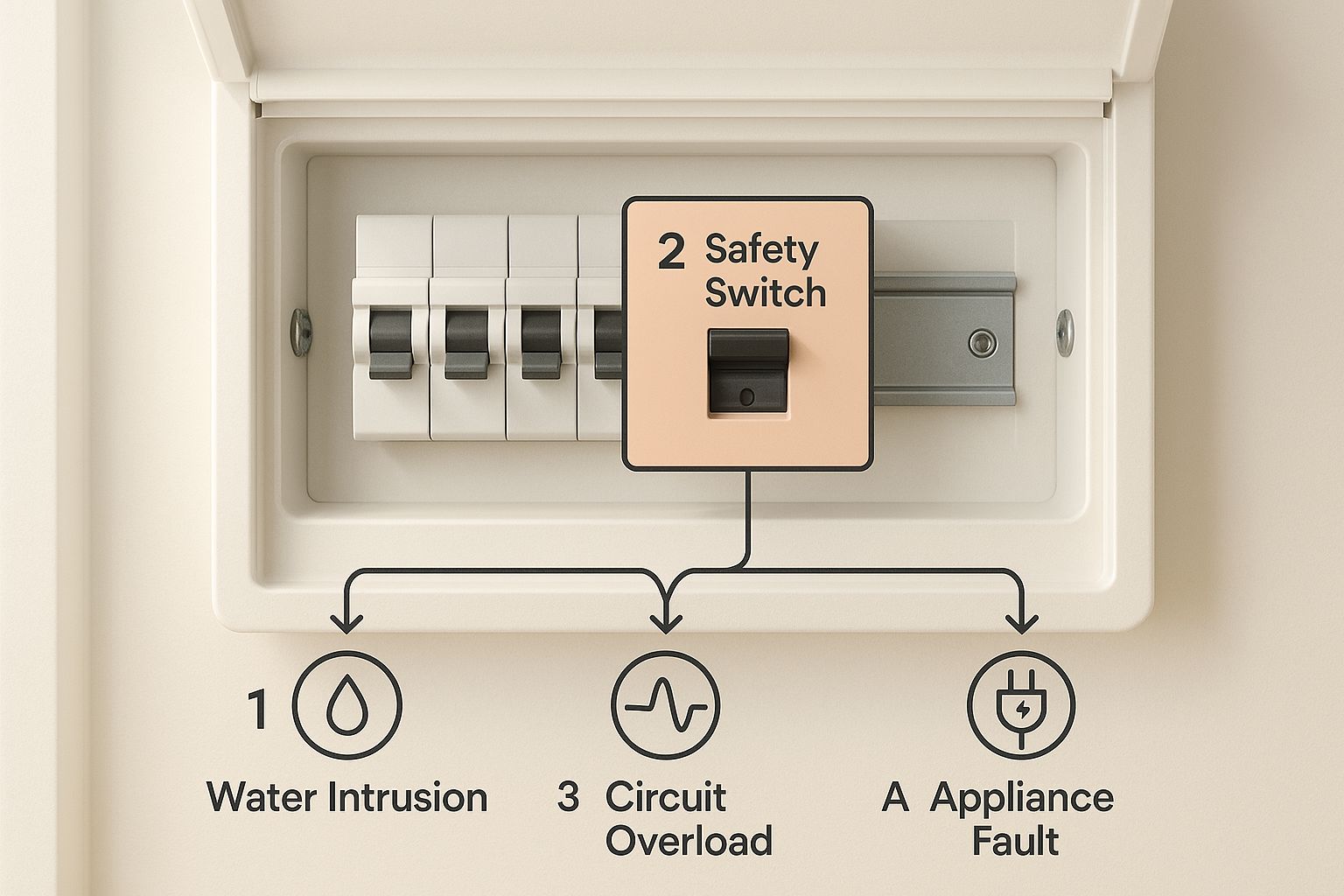
As you can see, faulty appliances are a big one, but moisture or an overloaded circuit can also be to blame. This isolation test will help you figure out what’s going on.
First things first, head to your switchboard (or fuse box). You’ll see a bunch of switches. The smaller ones are circuit breakers, often labelled for different parts of the house like ‘Kitchen Power’ or ‘Lights’. The one you’re looking for is the safety switch—it will usually have a small ‘T’ or ‘Test’ button on it.
Ready? Here’s what you do:
Once you’ve found it, switch that troublesome circuit breaker back off. Then you can reset the safety switch and turn all the other circuit breakers back on. This gets the power back on to most of your house while you play detective in the problem area.
You’ve narrowed it down to a single circuit. Now it’s time to hunt for the specific device that’s causing the grief. This means unplugging everything from the wall on that circuit.
Go around and physically pull the plug out for every appliance. Think fridge, microwave, TV, computer, chargers, and power boards. Don’t forget the ones that are easy to miss, like the dishwasher, rangehood, or that old lamp in the corner.
Important: Don’t just turn the appliance off at the wall. You need to physically unplug it from the socket. A faulty device can still cause a trip even when its own power switch is off.
With everything on that circuit unplugged, head back to the switchboard. Flick that problematic circuit breaker back to the ‘ON’ position.
If the safety switch stays on, congratulations! You’ve just confirmed the fault is with one of the appliances you unplugged.
The last step is the final process of elimination. Go back to the room and start plugging your appliances in, one by one, turning them on as you go. The moment the safety switch trips, you’ve found your culprit. It’s the last thing you plugged in.
Unplug that device straight away and don’t use it again until it’s been checked by a professional or replaced.
To help you narrow down your search, many common household items are known offenders. The table below lists some frequent culprits and what usually goes wrong with them.
| Appliance | Common Cause of Trip | What to Look For |
|---|---|---|
| Kettle | Faulty heating element, water leakage into the base. | Moisture around the base, visible corrosion, or a burning smell. |
| Toaster | A piece of food or debris touching the heating elements. | Look inside for crumbs or foreign objects. Burnt smell. |
| Refrigerator/Freezer | Failing compressor, defrost element fault, or moisture in the wiring. | Water pooling underneath, unusual noises, not cooling properly. |
| Dishwasher | Leaking pump or seals, faulty heating element. | Puddles of water on the floor, error codes on the display. |
| Washing Machine | Worn-out motor, faulty heating element, or water leaks. | Water around the machine, strange noises during a cycle. |
| Outdoor Lighting/Pumps | Water ingress into the fittings or damaged wiring from weather/pests. | Visible water inside light fittings, frayed or chewed cables. |
Remember, this is just a guide to the most common issues we see. If an appliance trips the power, it’s a clear sign that something is wrong and it’s unsafe to keep using it.
You’ve done the rounds. You’ve unplugged the toaster, the kettle, the microwave—everything on that circuit. You head back to the switchboard, flick the breaker back on, and… click. It trips again, instantly.
It’s a frustrating scenario, and it almost always points to a problem that’s deeper than a dodgy appliance you can simply unplug.
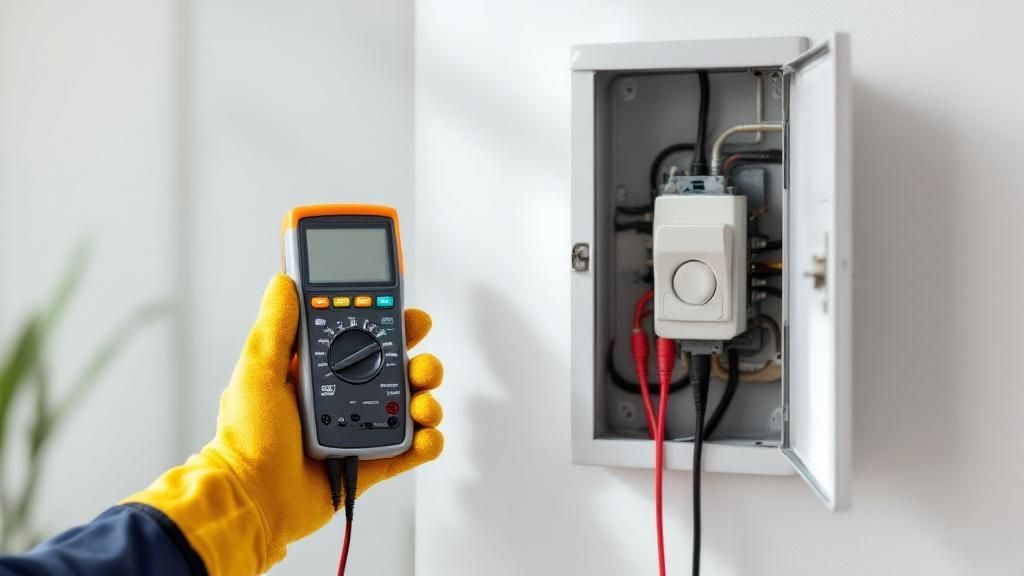
When a safety switch trips with nothing plugged in, you can be pretty sure the fault lies within your home’s permanent wiring or a hardwired appliance. These are the bits of your electrical system that are always connected, lurking behind the scenes.
Hardwired appliances are the usual suspects for these phantom trips. We see it all the time. Over the years, their internal wiring or components can degrade, creating small earth faults that you can’t see from the outside.
Here are the most common culprits we investigate:
A safety switch tripping when no portable appliances are being used is one of the most common call-outs we get in Australian homes. While portable items are often the first to blame, these hardwired systems are the next logical place to look. If you want to dive deeper, you can find more insights on these common issues from electrical safety experts.
Sometimes, there isn’t one single “bad” appliance. Instead, the issue is something we call cumulative leakage. This happens when several appliances on the same circuit each have a tiny, perfectly normal amount of current leakage. It’s a natural part of how they operate.
Individually, none of these tiny leaks are big enough to trip the 30-milliamp threshold of a standard safety switch. But when they’re all running at the same time, their little leakages can add up. The combined total pushes the circuit just over the edge, and click, the safety switch does its job.
Pro Tip: Does your safety switch only ever trip when the kitchen is in full chaos mode—oven on, dishwasher running, and the rangehood going flat out? Cumulative leakage is a very strong possibility. It’s not one device causing the problem, it’s the whole team.
The problem might not even be inside your house at all. Your home’s external wiring, lights, and power points are out there battling the elements 24/7, which creates plenty of opportunities for faults.
After a big downpour, it’s incredibly common for moisture to find its way into outdoor fittings. Water creates a perfect path for electricity to leak to the earth, which is exactly what a safety switch is designed to detect.
Be sure to check these common outdoor weak spots:
If your safety switch tripping seems to happen every time there’s wet weather, the fault is almost certainly outside. This is a job for a licensed electrician. We have the gear to trace the source of the moisture and carry out the repairs needed to make it safe and weatherproof again.
So, you’ve unplugged every single appliance and ruled out your wiring, but you’re still left scratching your head. If that safety switch keeps tripping for no obvious reason, it’s time to consider that the protector itself might be the culprit.
Safety switches are hardworking mechanical devices. Like any piece of equipment, they can wear out, get a bit too sensitive with age, or just fail over time.
A faulty switch can lead to something we call “nuisance tripping”—where it cuts the power without a genuine electrical fault. This can be caused by old age, wear and tear on its internal parts, or even damage from a past power surge. The result is a maddening cycle of power outages that no amount of unplugging seems to fix.
Figuring out whether you’re dealing with a real electrical hazard or just a dud switch is the most important step. A defective unit often shows some tell-tale signs that are different from a standard fault.
You might be dealing with a faulty switch if:
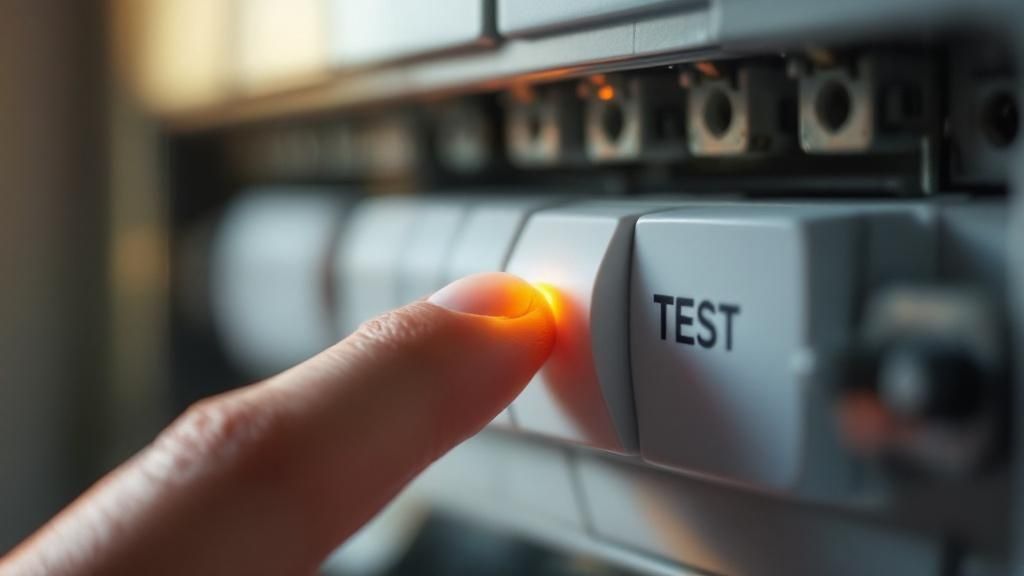
The most crucial diagnostic tool you have is the small ‘Test’ button right there on the switch itself. Regular testing doesn’t just confirm it’s working—it’s also the best way to find out when it’s not.
Every safety switch, also known as a Residual Current Device, has that test button for a very good reason. Electrical safety regulators recommend testing your switches every six months to make sure the internal mechanics are still in good working order.
If you want to dive deeper into how these devices work, our guide on what is a Residual Current Device offers a detailed breakdown.
Performing the test couldn’t be simpler:
Now, here’s the critical part. If you press the test button and nothing happens—the switch doesn’t trip—then it is definitely faulty. It’s offering you zero protection from electric shock. In this case, you need to get it replaced by a licenced electrician as a matter of urgency.
Knowing these signs helps you have a much more productive chat with your electrician, saving time and making sure the right problem gets fixed.
Of course. Here is the rewritten section, crafted to sound like an experienced human expert while following all your specific instructions.
While the isolation test is a fantastic way to pinpoint a faulty appliance, your safety is always the number one priority. Knowing your limits when dealing with electricity isn’t just a smart idea—it’s absolutely essential for protecting yourself, your family, and your property from serious harm.
There are some very clear red flags that signal it’s time to put down the tools, step away from the switchboard, and get a professional on the phone. Attempting to diagnose or fix anything beyond a simple appliance fault is not only dangerous but, in many parts of Australia, it’s also illegal. All fixed wiring work must be done by a licensed professional to meet strict safety standards.
If you come across any of the following scenarios, stop what you’re doing immediately. Don’t attempt any more troubleshooting. These are clear signs of a potentially hazardous fault inside your home’s fixed wiring or the switchboard itself.
A safety switch is a life-saving device, but it can only do its job if the rest of your electrical system is in good shape. Ignoring these warning signs puts you at a significant risk of fire or electric shock.
In Australia, safety switches have been instrumental in reducing electrical fatalities. The scary part is that recent studies show only 60–65% of homes have them installed on all circuits. This leaves a huge safety gap, contributing to around 15 preventable deaths from electrical accidents in Aussie homes each year. You can read more about these electrical safety findings and statistics if you’re interested.
Making the call to a professional isn’t admitting defeat; it’s the most responsible choice you can make. If you’ve run through the basic checks and you’re still stuck, our guide on how to find licensed electricians near you can help you connect with a qualified expert who can get the issue sorted safely.
Even after you’ve nailed the troubleshooting, it’s completely normal to have a few questions about why your safety switch is behaving a certain way. We get these queries all the time from homeowners. Here are some quick, practical answers to clear things up.
This is almost always a moisture problem. When rain gets into your outdoor electrical system, water creates a perfect, low-resistance path for electricity to leak to the earth. That’s precisely the fault a safety switch is designed to detect and shut down instantly.
Common culprits are usually external power points, garden lighting, or equipment for your pool and spa. If your safety switch tripping lines up perfectly with wet weather, it’s a massive clue that a weatherproof seal has failed. An electrician can hunt down the source of the water ingress, make the necessary repairs, and get everything sealed up safely again.
It’s extremely unlikely. A safety switch (also known as an RCD) and a circuit breaker do two very different jobs. Your safety switch is on patrol for tiny earth leakage currents, while a circuit breaker deals with overcurrent from short circuits or overloads.
A power surge is a sudden spike in voltage, which is what dedicated surge protectors are for, not your safety switch. Now, a massive surge could damage an appliance, which then develops an earth fault later on, but the surge itself isn’t the trigger. The trip is almost always caused by that resulting earth fault, not the surge.
In Australia, electrical safety authorities recommend you test your safety switches every six months. It’s a simple job that takes seconds but is absolutely vital for your family’s protection.
Just press the ‘T’ or ‘Test’ button on the switch itself. If it’s working correctly, it will immediately click into the ‘OFF’ position, cutting power to the circuits it protects. If it doesn’t trip, it’s faulty and needs to be replaced by a licensed electrician as soon as you can.
Regular testing is non-negotiable. It ensures the mechanical parts inside the switch are moving freely and are ready to do their job in a real electrical fault.
It definitely shouldn’t be normal, but it’s not unheard of. Unfortunately, a brand-new appliance can be faulty straight out of the box due to a manufacturing defect.
If you plug in that new kettle or toaster and the power trips straight away, run through the isolation test to confirm the new appliance is the problem. If unplugging it fixes the issue, then the device is faulty and unsafe. Stop using it immediately and take it back to the retailer for a replacement or refund under warranty. Never keep using an appliance that causes your safety switch tripping.
At DLG Electrical, we know that persistent electrical issues are more than just an inconvenience—they’re stressful. If you’ve worked through these troubleshooting steps and you’re still stuck, our team of licensed and experienced electricians is ready to help. We specialise in diagnosing and fixing complex electrical faults to ensure your Brisbane home is safe. For a reliable solution and a free quote, visit us at https://dlgelectrical.com.au.

Master Electrician with over 30 years of experience. Founded DLG Electrical in 2005 after international project work including electrical installations at Stamford Bridge Stadium, London(Home of Chelsea FC).

Local Electricians that can fix all Electric Hot water Systems.
Motion sensor lights are a versatile addition to any home, offering nu
