83 Jean St, Grange QLD 4051
Mon-Fri 07:30 AM - 04:00 PM - Sat - 8:00 - 12 - Sunday Closed

You're probably in one of two situations right now. Either you've looked at a few camera kits online and you're wondering whether they're enough, or you've already got bits and pieces installed and you've realised they don't work together the way you expected.
That's common in Brisbane homes. A camera at the front door feels like a good start, but security problems rarely happen in a neat, single angle. Real protection comes from how the whole system is designed, how it stays online during an outage, and who responds when an alert hits your phone while you're asleep, at work, or away for the weekend.
From an electrician's point of view, smart home security systems work best when they're treated like any other important part of the house. The same way a modern switchboard needs proper planning, a security setup needs correct device placement, reliable power, safe wiring, strong communications, and sensible user settings. Fancy features matter less than consistency. If the system drops out when the internet fails, floods you with nuisance alerts, or leaves blind spots around entry points, it won't give you much value.
We've been working across Brisbane for over 19 years, and the pattern is clear. Homeowners don't just want a louder alarm. They want a system that's easier to live with, easier to trust, and built to keep working when conditions aren't ideal.
A lot of homeowners still think of security as a siren box, a keypad near the entry, and maybe a couple of cameras. That older model can still play a role, but it doesn't match how people live now. You're in and out of the house at different hours, deliveries arrive when no one's home, kids and trades need controlled access, and there's a need to check the property from a phone without guessing what's happening.
That's why smart home security systems have moved into the mainstream. The global smart home security market was valued at about USD 28.4 billion in 2023 and is forecast to reach USD 107.1 billion by 2033, a projected 14.2% compound annual growth rate, according to smart home security market data. For Brisbane homeowners, the practical takeaway is simple. This is no longer niche tech for hobbyists. It's a normal part of the modern connected home.
A proper system isn't one device. It's an ecosystem. It usually combines cameras, motion detection, door and window protection, alarms, app control, and a central point that ties everything together.
That changes the job of home security in a useful way:
A smart security system should reduce uncertainty, not create more of it.
In practice, we see the biggest difference when homeowners stop buying security one gadget at a time. A single standalone camera might record a useful clip. An integrated system can help identify entry attempts, confirm whether an alarm is real, and support a faster, more organised response.
That matters in Brisbane because home layouts vary widely. Queenslanders, low-set brick homes, townhouses, renovated workers' cottages, and newer builds all have different weak points. Side access, sliding doors, garages, patios, and pool areas need a different design approach. A generic box off the shelf won't account for that.
Smart security is the new standard because it matches how homes function now. Done properly, it adds safety, visibility, and long-term practicality instead of just adding more devices.
The easiest way to understand smart home security systems is to think of them like a body's nervous system. Each part has a different job, but their true value comes from how they work together.
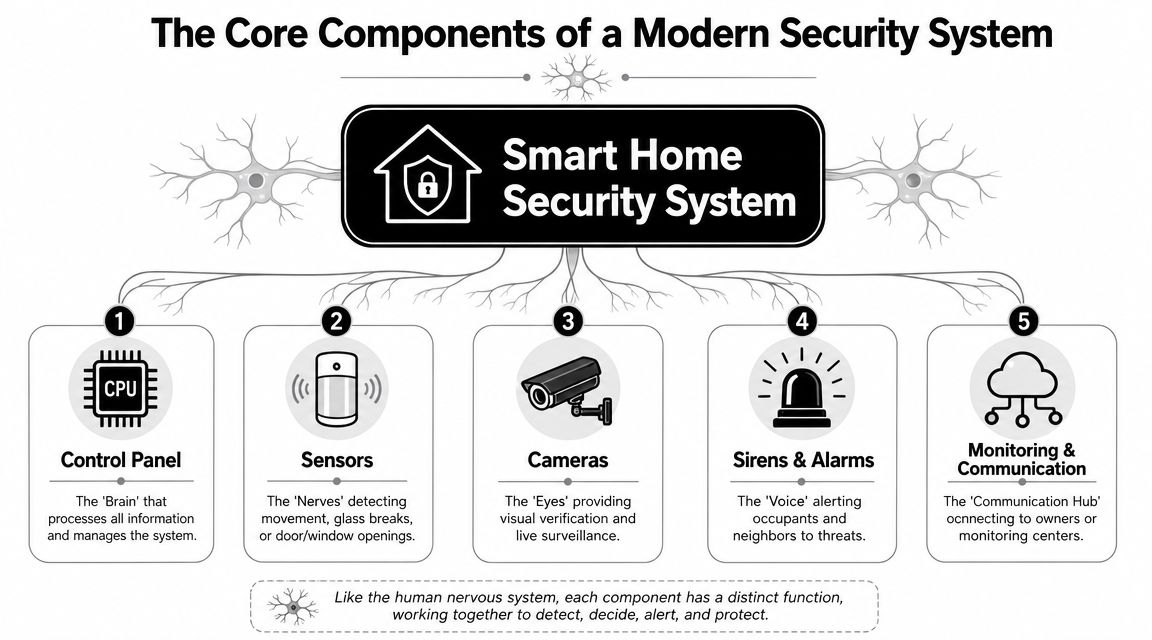
The control panel or hub is the brain. It receives signals, applies rules, stores settings, and decides what happens next. If a front door reed switch opens while the system is armed, the panel interprets that event and triggers the programmed response. In some homes that's a local siren. In others it's a push alert, camera recording, or monitored escalation.
The cameras and video doorbells are the eyes. They don't just capture footage. In a well-designed setup, they provide visual verification. That's a major difference between useful video and a camera that captures hours of uninformative footage. Placement matters more than headline resolution. A badly positioned camera with glare, poor night coverage, or a blocked field of view won't do much for you.
The door contacts, window contacts, PIRs, glass-break sensors, and perimeter devices are the nerves. They feel the disturbance first. These devices are often the earliest indication that something is wrong, and they're usually more dependable for triggering an alarm workflow than waiting for a camera to interpret movement on its own.
A siren or internal sounder is the voice. It tells occupants and nearby neighbours that something needs attention. On its own, a siren can scare someone off. Paired with sensors, cameras, and communication pathways, it becomes part of a stronger chain of evidence and response.
The communication layer connects the whole system to the homeowner or a monitoring centre. Many DIY kits often fall short in this aspect. They might send phone alerts, but they don't always handle event sequencing, backup signalling, or clean escalation when something goes wrong.
If you want a broader look at how Integrated security systems are discussed across access control, alarms, and entry points, that resource is worth reading because it highlights the practical benefit of connected devices over isolated hardware.
Practical rule: If one device has to do everything, the system is underdesigned.
When we assess a house, we usually think in zones rather than gadgets:
| Area | Main security job | Typical device mix |
|---|---|---|
| Front entry | Identify visitors and control access | Doorbell camera, smart lock, door contact |
| Side access | Detect approach before entry | Motion sensor, exterior camera, lighting integration |
| Rear doors and patio | Protect common break-in routes | Reed switches, PIRs, camera coverage |
| Garage | Secure tools, vehicles, internal access | Tilt or contact sensor, camera, internal door protection |
| Internal hallway | Confirm movement inside the home | PIR or dual-tech sensor, siren coverage |
If you want to see how that thinking applies specifically to vision devices, our guide to security camera installation for home goes deeper into placement and practical coverage.
A phone alert at 2:13 am sounds useful until you are asleep, overseas, or out of reception on the Sunshine Coast. The system may have detected the event correctly, but detection and response are not the same job. From an electrician's point of view, this choice affects the whole design brief because it determines who is expected to act, how quickly they can act, and what happens if the first notification is missed.
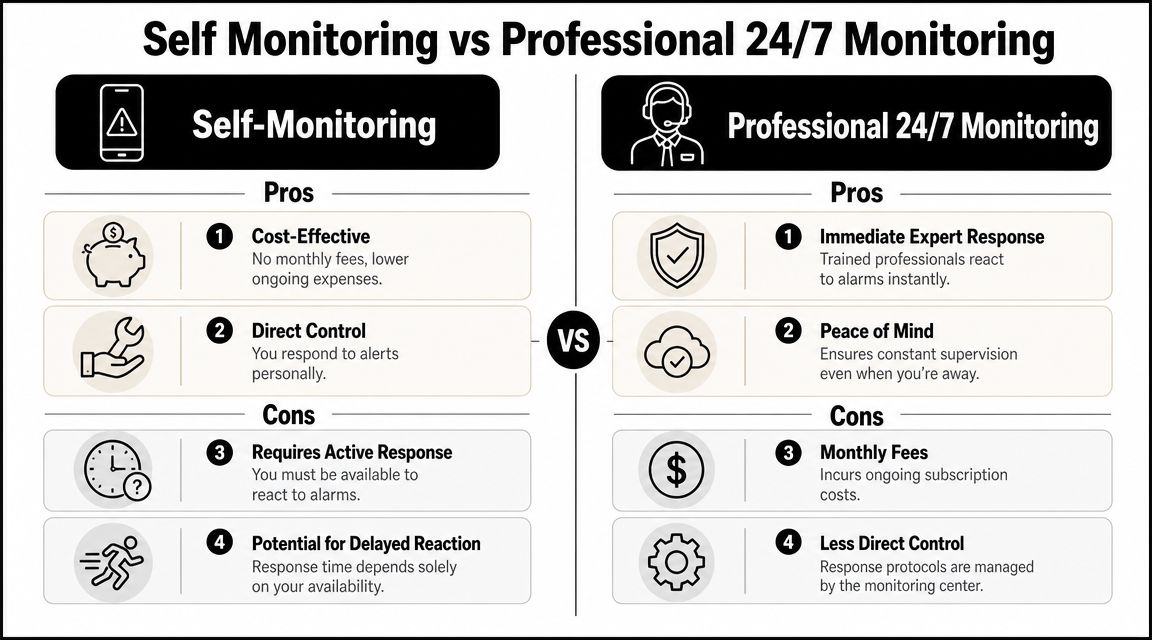
Self-monitoring gives the homeowner direct control. An alert hits your phone, you check the app, review the camera view, and decide whether it is a delivery, a family member arriving home, or something that needs attention.
That model suits some homes quite well, especially where the owner wants visibility more than managed response.
It usually makes sense when:
The main weakness is consistency. People miss calls. Phones go on silent. School pickups, flights, work meetings, patchy mobile service, and dead batteries all interrupt the response chain. We see this in Brisbane homes where owners assumed camera notifications alone would cover every situation, then found out the system was only strong while they were actively watching it.
Professional monitoring puts a response process behind the hardware. Instead of relying on one person to see and assess every alert, a monitoring centre follows set procedures for alarm events, verification, and escalation.
That matters in real-world conditions. A single motion clip from a camera often lacks context. A monitored system can use multiple triggers, such as a door contact followed by internal movement, to treat an event more seriously than an isolated push notification. That reduces false alarms and gives the event more credibility if further action is needed.
For many households, the value is simple. The system is still working when you are not.
At DLG Electrical, we usually frame this as a risk and responsibility decision, not a tech preference. If a home is occupied most nights, has straightforward access points, and the owner is engaged with the app, self-monitoring can be reasonable. If the property is left empty during travel, has several entry paths, or needs a documented escalation path, professional monitoring is often the better fit.
| Option | Best suited to | Trade-off to accept |
|---|---|---|
| Self-monitoring | Owners who want direct control and can reliably check alerts | Response depends on your availability, phone settings, and internet access |
| Professional monitoring | Homes that need round-the-clock oversight and structured escalation | Ongoing fees and less direct day-to-day handling by the homeowner |
There is also a middle ground. Some Brisbane homeowners self-monitor cameras and video doorbells, then use professional monitoring for the alarm side of the system. That approach can work well in larger homes where the owner wants day-to-day visibility but also wants a proper response path if a verified intrusion occurs.
The key point is to be honest about what each model delivers. Self-monitoring gives visibility and convenience. Professional monitoring gives coverage when life gets in the way. We design systems around that difference because a compliant, reliable setup is not just about what detects an event. It is about what happens next.
Most problems with smart home security systems aren't caused by the app. They start with power, signal path, battery dependence, poor placement, or rushed installation.
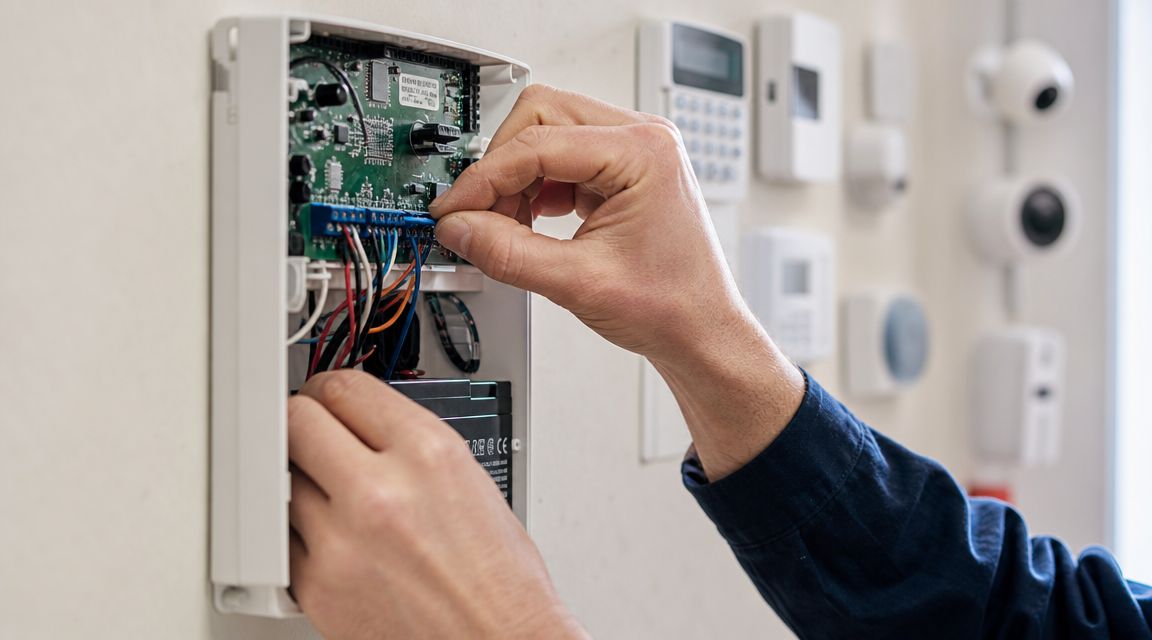
Wireless gear has a clear place. It's often the practical choice for finished homes where wall access is limited and the owner wants minimal disruption. Good wireless devices can perform well when they're chosen properly, signal-tested, and maintained.
Wired systems still hold an advantage in many larger or more permanent installations. They avoid battery replacement across multiple fixed sensors, provide stable communication paths, and suit renovations, extensions, and new builds where cable routes can be planned early.
The trade-off looks like this:
For Australian homes, connectivity resilience is the benchmark that matters most in day-to-day reliability. Systems that only use Wi-Fi can fail during power or internet outages, and professional installers reduce that risk with battery-backed control panels and cellular backup paths, as outlined in this Australian smart home security reliability guide.
That's why we pay close attention to failover. A smart system that looks impressive during normal conditions but goes blind when the router drops out isn't good enough.
A resilient setup usually includes:
Here's a useful visual overview of the physical side of the work and why cable planning matters.
Good installation also means looking beyond intrusion detection. In Queensland homes, smoke alarm compliance has its own legal and practical importance, and many homeowners prefer a coordinated approach where fire safety and security planning aren't handled as separate jobs.
A house is safer when the protection systems are organised together, tested together, and maintained together.
Cable routes, panel location, power supply protection, exterior mounting points, and app setup all affect the final result. A professional installation proves its worth in these areas. The hardware might be visible, but the hidden decisions behind it are what make the system dependable.
Most homeowners ask the cost question early, and that makes sense. The mistake is trying to compare systems by hardware price alone.
A smart security setup usually has three cost layers. First is the equipment itself, which may include cameras, sensors, a control hub, sirens, locks, and network-related gear. Second is installation, which covers cabling, mounting, programming, testing, and making sure the system operates safely and properly. Third is any ongoing service, such as monitoring, support, or cloud storage.
Hardware is the easiest part to see, so it often gets too much attention. Two quotes can look similar on the device list and still deliver very different outcomes once you factor in panel location, backup power, camera positioning, app setup, and whether the installer has allowed for reliable communications.
Installation labour isn't just time on site. It also covers design choices that reduce future headaches. Proper sensor selection, clean cable routing, practical user programming, and realistic zoning make the system easier to live with. If you want a more detailed breakdown of how those layers affect a quote, our guide to home security system cost is a useful starting point.
The better way to assess value is to ask what the system prevents and what it simplifies over time.
A cheap system can become expensive if it creates false alarms, battery churn, unreliable footage, or constant dropouts. A more carefully designed system tends to hold its value because it's easier to maintain, easier to expand, and less likely to be ripped out when your needs change.
A Brisbane system usually gets tested on an ordinary night, not on installation day. A storm rolls through, the internet drops out for a period, a camera lens picks up grime, and nobody notices a flat sensor battery until an alert fails to come through. That is why long-term reliability matters as much as the initial fit-off.
Well-installed security still needs regular attention. Outdoor cameras collect dust and spider webs. Battery devices age. User permissions change after tenants move, kids get older, or a cleaner no longer needs access. Firmware updates also matter, because a connected system that never gets reviewed can become less reliable and less secure over time.
A simple maintenance routine prevents a lot of avoidable faults:
These jobs are simple. They are also easy to forget when the system appears normal from day to day.
Smart security adds convenience, but it also adds cyber risk if the setup is sloppy. Common weak points include poor passwords, outdated firmware, and weak encryption, and connected devices can widen the home network's exposure, as discussed in this academic review of smart home security risks.
From an electrician's perspective, this is one of the biggest gaps between a basic DIY kit and a properly commissioned system. Good post-install support includes changing default credentials, setting up strong authentication, checking remote access settings, and making sure the handover does not leave loose ends behind. If cameras, alarms, and apps are tied into the home network, cybersecurity becomes part of the installation standard, not an optional extra.
More devices do not automatically mean better protection. A poorly maintained device can become the weak point.
Good support is practical. It means faults get checked before they become outages. It means the owner knows how to arm, disarm, review events, and spot warning signs such as offline devices or storage errors. It also means the system can be serviced without guesswork because the wiring, programming, and device layout were documented properly from the start.
At DLG Electrical, our security and electrical work covers installation, maintenance, repairs, smoke detector compliance, and monitored system support. That matters for Brisbane homeowners who want one contractor handling both electrical safety and security infrastructure, with attention to compliance, resilience, and the condition of the whole system rather than just the app.
For Brisbane homes, the standard is straightforward. If the system is connected, maintain it. If it stores footage or user data, secure it properly. If it protects people and property, do not leave it running unattended year after year.
A Brisbane homeowner can buy decent cameras and sensors online in an afternoon. The harder part is getting a system that still works properly after a storm, a router change, a flat backup battery, or a renovation. The installer determines that outcome.
A good installation is more than mounting devices neatly. It covers cable paths, power supply, communications backup, device placement, compliance, and a handover that leaves the owner clear on how the system operates. Poor work usually shows up later as blind spots, nuisance alarms, unreliable app access, or equipment that is difficult to service.
Ask questions that show how the installer thinks, not just which brands they sell.
Those answers tell you more than a product brochure ever will.
An installer with Brisbane experience should design for the house in front of them. High-set homes, side access, detached garages, shaded entries, exposed patios, older switchboards, and renovation limits all affect where devices should go and how they should be powered and connected.
That local judgement matters because security is tied to the wider electrical setup. A camera may need a better cable route than the obvious one. An alarm panel may need protection from heat, moisture, or accidental access. A monitored system may need communications backup that a basic DIY kit does not include. We see these trade-offs regularly, and they are usually what separates a system that looks good on day one from one that remains reliable over time.
It also helps to ask who is responsible for the full job. If multiple contractors handle power, data, alarms, and app setup separately, small gaps can get missed. One contractor blames the network, another blames the hardware, and the homeowner is left sorting it out.
The right installer leaves you with a system that makes sense, wiring that can be serviced, and clear documentation of what was installed and how it was configured. You should know what each device does, what to do if something faults, and who to call if the system needs adjustment.
For Brisbane homes, the safer choice is usually an installer who treats smart home security as part of the property's electrical and safety infrastructure. That approach gives more attention to compliance, resilience, professional monitoring options, and secure setup from the start.
If you are comparing providers, choose the one who can explain the trade-offs plainly and design the system around how your home functions. At DLG Electrical, that is how we approach security work in Brisbane.

Master Electrician with over 30 years of experience. Founded DLG Electrical in 2005 after international project work including electrical installations at Stamford Bridge Stadium, London(Home of Chelsea FC).

Local Electricians that can fix all Electric Hot water Systems.
Motion sensor lights are a versatile addition to any home, offering nu
