83 Jean St, Grange QLD 4051
Mon-Fri 07:30 AM - 04:00 PM - Sat - 8:00 - 12 - Sunday Closed
Smoke Alarm Laws QLD Your Complete Compliance Guide: In Queensland, the law is clear: every home must have interconnected photoelectric smoke alarms in all bedrooms, hallways that connect them, and on each level of the property. This overhaul of smoke alarm safety was rolled out in stages, with the final, non-negotiable deadline for all homes landing on 1 January 2027.
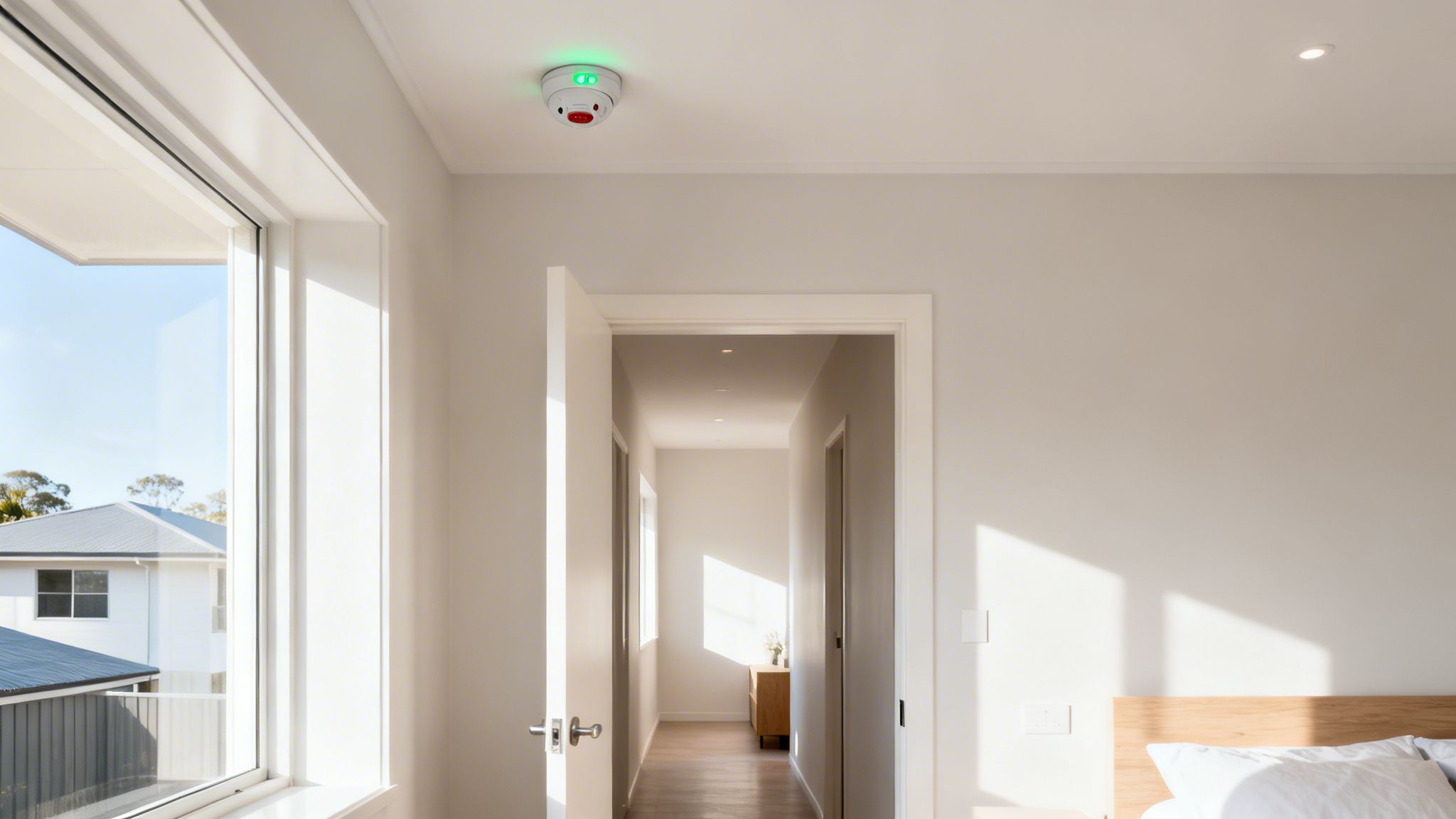
The smoke alarm laws in QLD aren’t just bureaucratic red tape; they are a direct, life-saving response to preventable fire tragedies. The legislation was specifically designed to give you and your family the earliest possible warning, buying you precious extra seconds to escape. Think of it as a digital nervous system for your home—when one alarm detects smoke, they all scream a warning.
These new rules were introduced progressively, which created different deadlines for different types of properties. While this tiered approach was meant to manage the rollout across millions of homes, it has understandably created some confusion. The core goal, however, is the same for everyone: to ensure a robust, interconnected network of modern alarms protects every single Queensland resident.
The government set a clear timeline for compliance. Figuring out which category your property falls into is the first critical step toward meeting your legal obligations.
This structured rollout isn’t just theory—it has already proven its worth. Early data after the first changes in 2007 showed a significant jump in the number of working alarms and a real drop in fire-related deaths. Compliance shot up from 87% to 96% in just one year, and fire fatalities fell from 14 to nine over the same period. If you want to see the numbers for yourself, you can read the full government statement on smoke alarm impact.
To cut through the noise, this table summarises the key dates and rules that apply to your property. It’s a quick way to see exactly where you stand.
| Property Type | Compliance Deadline | Core Requirement |
|---|---|---|
| New Builds & Substantial Renovations | From 1 Jan 2017 | Must be fully compliant upon completion. |
| Properties Being Sold or Leased | From 1 Jan 2022 | Must be made compliant before the sale or new lease. |
| All Other Dwellings (Owner-Occupied) | By 1 Jan 2027 | Must be fully compliant by this final deadline. |
The main takeaway here is simple: the final deadline is getting closer. If you’re a homeowner living in your own property, you have until the start of 2027 to get your alarms upgraded. Waiting until the last minute is a risky move—it could lead to long waits for an electrician and higher prices as demand skyrockets. Acting now isn’t just the smart choice; it’s the safest one.
The current smoke alarm laws in QLD can feel strict, but they weren’t created in a vacuum. To truly understand why they are so demanding, we need to look back at a tragedy that shook Queensland to its core and became the undeniable catalyst for change. It’s a story about the profound human cost of inadequate fire safety.
The legislation we all follow today is written in the shadow of the 2011 Slacks Creek house fire, a devastating event that remains a dark chapter in Australian history. This single incident was the critical turning point that forced a complete re-evaluation of fire safety standards in our homes.
Before this tragedy, the rules for smoke alarms were far less stringent. The heartbreaking events of that night proved, in the worst way possible, that the existing standards were simply not enough to protect Queensland families when every second counts.
The fire spread with terrifying speed, leaving little chance for escape in a home without an effective, modern warning system.
The coroner’s investigation into the fire delivered a blunt and powerful conclusion. The findings revealed a direct link between the catastrophic loss of life and the absence of functioning smoke alarms, highlighting a failure that could no longer be ignored.
This was not just an unfortunate accident; it was a preventable disaster. The detailed report from the coroner’s court became the blueprint for the new legislation, with recommendations aimed directly at preventing such a loss from ever happening again.
In 2011, a devastating house fire in Slacks Creek claimed the lives of 11 people, including eight children under 18. This marked the greatest loss of life in a domestic house fire in Australian history. The coroner’s report explicitly stated that no working smoke alarms were present when the fire started. The report concluded that had they been operational, there was a reasonable prospect that some or all of the victims could have escaped. You can read more about the pivotal Slacks Creek fire and its impact on legislation.
This event shifted the conversation from one of simple compliance to one of absolute necessity. The current smoke alarm laws QLD enforces are a direct legacy of those 11 lives lost. The requirements for interconnected, photoelectric alarms in every bedroom and on every level are not arbitrary rules; they are specific measures designed to overcome the exact failures that occurred at Slacks Creek. An interconnected system ensures that a fire in one part of the house triggers every single alarm, waking everyone at once.
To fully grasp the critical importance of these regulations, consider the devastating aftermath of a residential fire and what happens in the immediate aftermath, including details outlined in a comprehensive what to do after a house fire checklist.
Understanding this history transforms compliance from a legal chore into a meaningful act of protection. It reinforces that these laws are fundamentally about honouring the past by safeguarding the future. Every compliant alarm system installed is a small but powerful tribute to the victims, helping to ensure their story leads to safer homes for all Queenslanders.

Getting your head around the technical side of Queensland’s smoke alarm laws can feel like learning a new language. But once you break it down, the rules are all about one thing: giving you the maximum possible time to get out of a house fire.
Let’s decode the three core technical requirements you absolutely need to know. It all comes down to the alarm type, how they are connected, and where they draw power from. Nail these three, and your home won’t just be compliant—it will be genuinely safer.
The legislation is crystal clear on this point: you must install photoelectric smoke alarms. You might have seen another type, called ionisation alarms, in older homes, but these are being phased out for residential use in favour of the far superior photoelectric technology.
Here’s a simple way to think about it:
Because smouldering fires are such a common and deadly risk in homes, especially when people are asleep, Queensland law now mandates photoelectric alarms. They are proven to give you an earlier warning in these situations, and those extra seconds are vital for waking your family and getting everyone out safely. Any new alarm must also comply with Australian Standard 3786:2014.
The second major requirement—and arguably the biggest safety upgrade in the new laws—is that all your smoke alarms must be interconnected.
Interconnection means when one alarm detects smoke, every single alarm in the house goes off at the same time. It turns a collection of individual alarms into one unified warning system. A fire that starts in the garage will instantly trigger the alarm in the upstairs bedroom, rather than waiting for the smoke to travel all the way there.
This transforms your alarms from isolated sentries into a single, cohesive network. An interconnected system ensures a fire detected in any part of the home alerts everyone, everywhere, at the same time. This is especially vital in multi-level homes or properties with long hallways.
You can achieve this in two ways:
Whichever method you use, the result is the same: when one goes off, they all go off. This is a non-negotiable part of the smoke alarm laws QLD has put in place.
Finally, your alarms need to meet specific power source requirements. Forget about the old 9V batteries you have to change every year; those are no longer compliant.
You have two options, and your choice will often depend on the age and construction of your home. Your alarms must either be hardwired to your home’s 240V mains power (with a battery backup) or be powered by a non-removable 10-year lithium battery.
Hardwired Alarms
These are connected directly to your home’s electrical circuit by an electrician. They also have a backup battery (either replaceable or a 10-year lithium one) so they keep working even during a power outage. A key rule in Queensland is that if you already have a hardwired alarm, you must replace it with another hardwired alarm.
10-Year Lithium Battery Alarms
These alarms are powered by a sealed battery that is designed to last the entire 10-year lifespan of the unit itself. They are an excellent solution for existing homes where running new cables would be difficult or costly. While a handy homeowner might install these themselves, any system involving hardwiring always requires a licensed professional like DLG Electrical.
Understanding Queensland’s smoke alarm laws is the first step, but knowing exactly who is responsible for what is where the rubber really hits the road. The legislation spells out a clear chain of responsibility, giving homeowners, landlords, and tenants specific jobs to do. It’s all about making sure everyone plays their part in fire safety.
Think of it as a team effort. Each person has a distinct set of tasks, and if one link in the chain breaks, the whole safety system can be put at risk. Let’s break down exactly what you need to do.
To make things simple, here’s a quick breakdown of who is responsible for what when it comes to smoke alarm compliance in Queensland.
| Role | Key Responsibilities | Important Notes |
|---|---|---|
| Homeowner (Owner-Occupier) | – Ensure full compliance by 1 January 2027. – Install interconnected, photoelectric alarms in all bedrooms, hallways, and on every level. – Replace alarms that are over 10 years old or faulty. |
This is your property and your responsibility. Engaging a licensed electrician for hardwired alarms is mandatory. Don’t leave it to the last minute! |
| Landlord / Property Manager | – Property must have been compliant since 1 January 2022 for all new and renewed leases. – Test and clean all alarms within 30 days before a new tenancy starts. – Replace all batteries (including backups) before a new tenancy. – Replace any alarm older than 10 years or that fails a test. |
Your duty of care is legally binding. Failure can lead to massive fines and voided insurance. You cannot pass these tasks on to your tenant. |
| Tenant | – Test each alarm at least once every 12 months. – Replace batteries in alarms that start chirping (if they are user-replaceable 9V types). – Report any non-working alarm to the landlord immediately. – Keep alarms clean and free from dust. |
Your role is about ongoing checks. Never remove or tamper with an alarm. It’s illegal and puts lives at risk. |
This table gives a great overview, but let’s dive into the specifics for each role so you’re crystal clear on your obligations.
If you own the home you live in, the clock is ticking. Your final deadline is 1 January 2027. By this date, your home must be fully kitted out with interconnected photoelectric smoke alarms in every bedroom, in the hallways that connect them, and on each storey of your house.
This responsibility falls squarely on your shoulders. You’re the one who needs to:
Putting this off until the end of 2026 is a recipe for disaster. We saw it happen with the 2022 deadline for rentals—a massive rush led to electrician shortages, product backorders, and frantic last-minute price hikes. The 2027 deadline affects far more properties, so getting in early is the smart move.
For landlords and property managers, the smoke alarm laws in QLD are not just a suggestion—they’re a serious legal obligation. The law places a direct duty of care on you to provide a safe home for your tenants, and smoke alarms are a huge part of that.
As of 1 January 2022, any property starting a new lease or renewing an old one had to be fully compliant with the new interconnected photoelectric standards. The same goes if you’re selling a rental property—it must be brought up to code before the sale goes through.
For landlords, smoke alarm compliance is not just a recommendation—it is a non-negotiable legal requirement. Failure to meet these standards can result in hefty fines, voided insurance claims, and potential legal action in the event of a fire.
Your ongoing duties are just as critical:
Keeping up with your smoke alarm duties is just as important as getting an electrical safety certificate for landlords, which you can learn about in our detailed guide. It’s all part of your legal responsibility.
While the landlord handles the heavy lifting of installation and major maintenance, tenants have a crucial part to play in keeping the system working day-to-day. Your duties are straightforward but vital.
During your tenancy, you need to:
Navigating the Queensland smoke alarm laws can feel a bit overwhelming, but it doesn’t have to be. Let’s break it down into a simple, actionable checklist. Think of this as a safety audit for your home—a clear plan to get you compliant and keep your family safe.
Following these steps will help you figure out exactly what you need, when to call in a pro, and how to get everything sorted well before the 2027 deadline creeps up on you.
First things first, you need to know what you’re working with. Before you can upgrade, you need a clear picture of your current setup. This audit is the most important step and will be the foundation of your entire plan.
Count Your Bedrooms and Levels: Grab a pen and paper and walk through your home. Count every single bedroom. The law is clear: every bedroom needs its own alarm. Next, count how many storeys or levels your property has, as each floor requires at least one alarm.
Map Your Hallways: Now, look at the hallways that connect the bedrooms to the rest of the house. These are your escape paths, and they need to be covered. An alarm must be installed in these corridors.
Check Your Existing Alarms: Take a look at the smoke alarms you already have. Check the back for a manufacture date—if an alarm is more than 10 years old, it has to be replaced, no exceptions. You’ll also need to see if they’re photoelectric (look for a “P” symbol) and whether they’re hardwired into your mains power or just run on batteries.
Once you’ve done this, you’ll have a final count of how many alarms you need and a rough map of where they need to go.
With your audit complete, you can now plan out the new system. The goal isn’t just to stick a few alarms on the ceiling; it’s to create a seamless, interconnected network that protects every critical area of your home.
This diagram helps clarify who is responsible for what when it comes to smoke alarms.
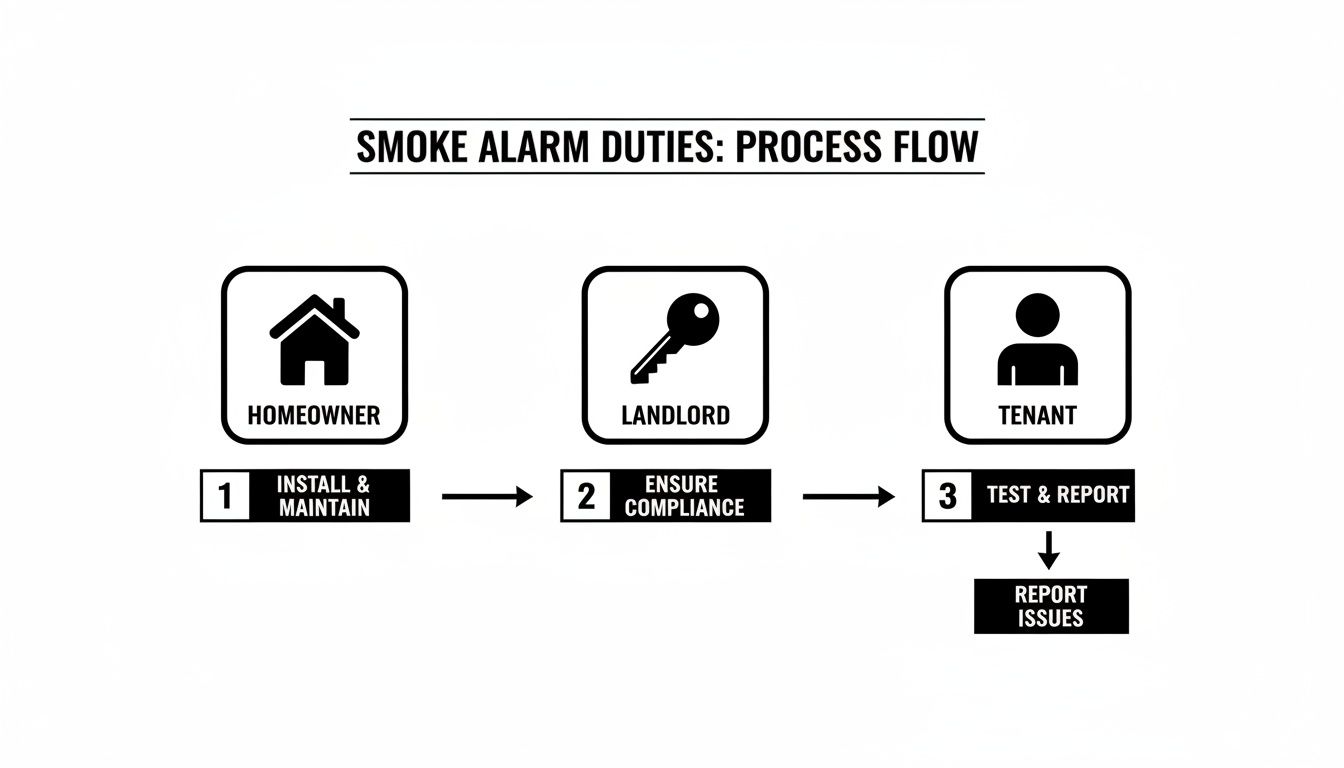
As the flowchart shows, whether you’re a homeowner, landlord, or tenant, you have specific duties to keep the property safe and compliant. These aren’t just suggestions; they’re legal requirements.
Here’s a critical point: if you’re replacing an existing hardwired alarm, you must replace it with another hardwired unit. You can’t just swap it out for a battery-only model. It’s also worth understanding the financial side of things, including how your insurance might cover costs to meet new building codes through what’s known as ordinance or law coverage.
This is where a lot of people get stuck, but the rule is simple. While some parts of this process are DIY-friendly, anything that involves your home’s 240V wiring is strictly a job for a licensed professional.
Attempting to install a 240V hardwired smoke alarm yourself is not only illegal in Queensland but also incredibly dangerous. Faulty wiring can cause the entire system to fail or, worse, create an electrical fire—the very disaster you’re trying to prevent.
So, when should you pick up the phone?
You MUST call a licensed electrician like DLG Electrical if:
You CAN handle it yourself if:
For homeowners who want the gold standard in safety and reliability, a professionally installed hardwired system is always the best choice. If you’re unsure about any step in this process, from testing to installation, getting expert advice is the safest bet. You can also explore our professional smoke alarm testing services to make sure your system is working exactly as it should be.

When you’re upgrading your smoke alarms to meet Queensland’s strict new laws, there’s one area where cutting corners is simply not an option: any and all electrical work.
Sure, installing a 10-year battery-powered alarm might feel like a straightforward DIY job. But the moment you’re dealing with 240V mains power, it’s an entirely different ball game.
Attempting to install or replace hardwired smoke alarms yourself isn’t just illegal in Australia—it’s incredibly dangerous. This isn’t like hanging a picture frame; you’re tapping directly into your home’s electrical system, and a single mistake can have devastating consequences.
Let’s be blunt about the risks here. Incorrect wiring can do more than just cause an alarm to fail. A shoddy installation could be the very thing that starts a fire, completely defeating the purpose of the upgrade and putting your family in even greater danger.
Think of an interconnected system like a chain. If just one link is faulty, the whole thing breaks. If the wiring is done incorrectly, the entire network of alarms can fail, leaving you with a false sense of security when you need protection the most.
Engaging a licensed electrician isn’t just about following the law; it’s a critical investment in your family’s safety. A professional guarantees that the system not only works on day one but will continue to work reliably when you need it most.
A professional installation ensures every connection is secure, every alarm “talks” to the others flawlessly, and the entire system is safely integrated into your home’s main power.
Hiring an expert electrician from a team like DLG Electrical gives you more than just a correctly installed alarm. It delivers total peace of mind and legal assurance—and you can’t put a price on that.
Here’s what a licensed electrician guarantees:
Essentially, a professional sparkie handles all the technical complexities so you don’t have to. You can learn more about what to look for in our guide to choosing licensed electricians near me.
While the upfront cost might seem like an extra expense, it pales in comparison to the potential cost of an electrical fire or a non-compliant system that fails when every second counts.
Even with a comprehensive guide, there are always a few specific questions that pop up. We get them all the time. To make sure you’ve got everything covered, here are the most common queries we answer about Queensland’s smoke alarm legislation. Think of this as your quick-reference cheat sheet to finalise your compliance plan.
This is easily the number one question we hear, and the answer really boils down to what type of alarm you’re installing.
Yes, you do. The legislation is designed to create a complete, failsafe system across your entire home. There’s no room for a mix-and-match approach.
If you have to replace a single alarm—whether it’s faulty, has expired, or you’re renovating—the entire property must be brought up to the current standard. That means installing interconnected photoelectric alarms in every bedroom, hallway, and on each level. You can’t just swap out one old alarm for another like-for-like model.
The law doesn’t allow for partial compliance. As soon as one alarm in an older system needs replacing, it triggers the requirement to upgrade the whole dwelling to the full 2027 standard.
Regular testing is non-negotiable for ensuring your alarms actually work when you need them most. Who is responsible for testing depends on who lives in the property:
All it takes is a simple press of the “test” button on each unit.
The penalties for ignoring Queensland’s smoke alarm laws are serious. For landlords, failing to install compliant alarms can attract fines upwards of $6,000.
Perhaps more importantly, non-compliance can give your home insurance provider a reason to void your policy in the event of a fire, leaving you completely exposed financially when you need that cover the most.
Navigating the smoke alarm laws in Queensland doesn’t have to be a headache. For guaranteed compliance and professional, fuss-free installation, you can trust the experts at DLG Electrical. We’ll make sure your home is safe, secure, and fully compliant with all the latest regulations.
Contact us today for a free quote and complete peace of mind.

Master Electrician with over 30 years of experience. Founded DLG Electrical in 2005 after international project work including electrical installations at Stamford Bridge Stadium, London(Home of Chelsea FC).

Local Electricians that can fix all Electric Hot water Systems.
Motion sensor lights are a versatile addition to any home, offering nu
