83 Jean St, Grange QLD 4051
Mon-Fri 07:30 AM - 04:00 PM - Sat - 8:00 - 12 - Sunday Closed
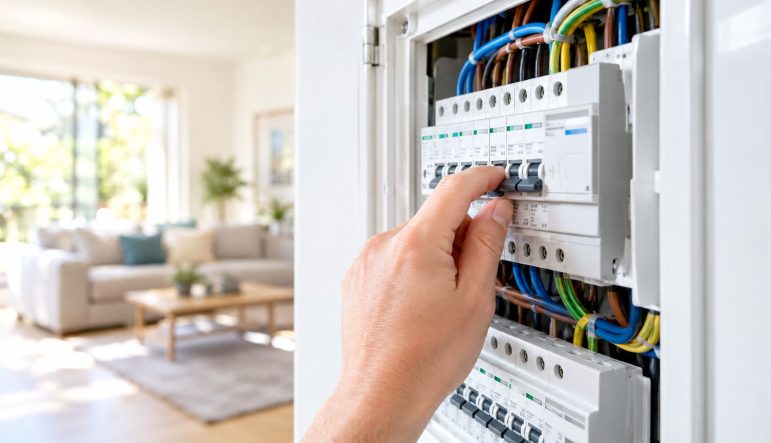
You're standing in the kitchen of your Brisbane home when the lights go out. The air conditioner is running, someone has switched on the kettle, and a breaker on the switchboard has moved to the off position. Or perhaps you've opened an older switchboard and found ceramic fuses, crowded wiring and no obvious test buttons.
These situations raise a common question: what does a switch with circuit breaker do, and is replacing one device enough? The answer depends on whether the problem is a single circuit, missing shock protection, limited switchboard capacity or a larger upgrade involving solar, an electric vehicle charger or three-phase equipment.
A switch and a circuit breaker may sit beside each other, or they may be combined in one switchboard device. They look similar because both can interrupt power, but they don't perform the same job. One gives you control or isolation. The other responds automatically when electrical conditions become unsafe.
For example, a circuit breaker may trip because a damaged appliance has created a short circuit, or because too much current is passing through a circuit. Resetting it without finding the cause can leave the underlying fault in place. A licensed electrician needs to determine whether the breaker is faulty, the circuit is overloaded, or an appliance is causing the problem.
The more important distinction concerns personal protection. Circuit breakers protect wiring and appliances from overloads and short circuits. Safety switches protect people from electric shock. Queensland electrical guidance explains that these devices address different risks, even when modern switchboards place them together in one installation. Queensland electrical safety guidance describes the separate roles clearly.
Australia's shift towards stronger residential protection has developed over decades. Safety guidance says that about 15 Australians are killed and around 300 are hospitalised each year in preventable home electrical accidents where a safety switch could have helped, as outlined in this Australian electrical safety document. The same source notes that residual current devices became mandatory on all power and lighting circuits in new Australian houses in 1991.
That history matters in Brisbane because many homes combine older wiring and fuse arrangements with newer appliances. A switchboard that was adequate for its original loads may need a different protection arrangement today. By the end of this guide, you'll understand what each device does, how to recognise the right upgrade path and when a single replacement isn't enough.
Start with a simple water-pipe comparison. A switch works like a tap. You operate it when you want to allow or stop normal flow. A circuit breaker acts more like an automatic safety valve. If pressure or flow becomes excessive, it shuts the line to protect the pipe.
Electrical current normally travels through a circuit and returns along its intended path. A switch opens or closes that path when someone operates it. A circuit breaker monitors the current passing through the circuit and trips when an overload or short circuit creates a risk to conductors and connected equipment.
A basic MCB, or miniature circuit breaker, handles overcurrent protection. It trips when a circuit draws more current than its wiring and breaker arrangement should carry, or when a short circuit occurs. This helps limit overheating and damage.
An RCD, commonly called a safety switch, looks for current leaving the intended path. Queensland's official guidance says safety switches disconnect power in a fraction of a second when leakage current is detected, and describes them as protection against electric shock. The device is responding to an imbalance, not just to a high total current.
An RCBO combines residual-current protection and overcurrent protection in one device. In practical terms, it can provide the functions of a safety switch and circuit breaker for an individual circuit, subject to correct selection and installation.
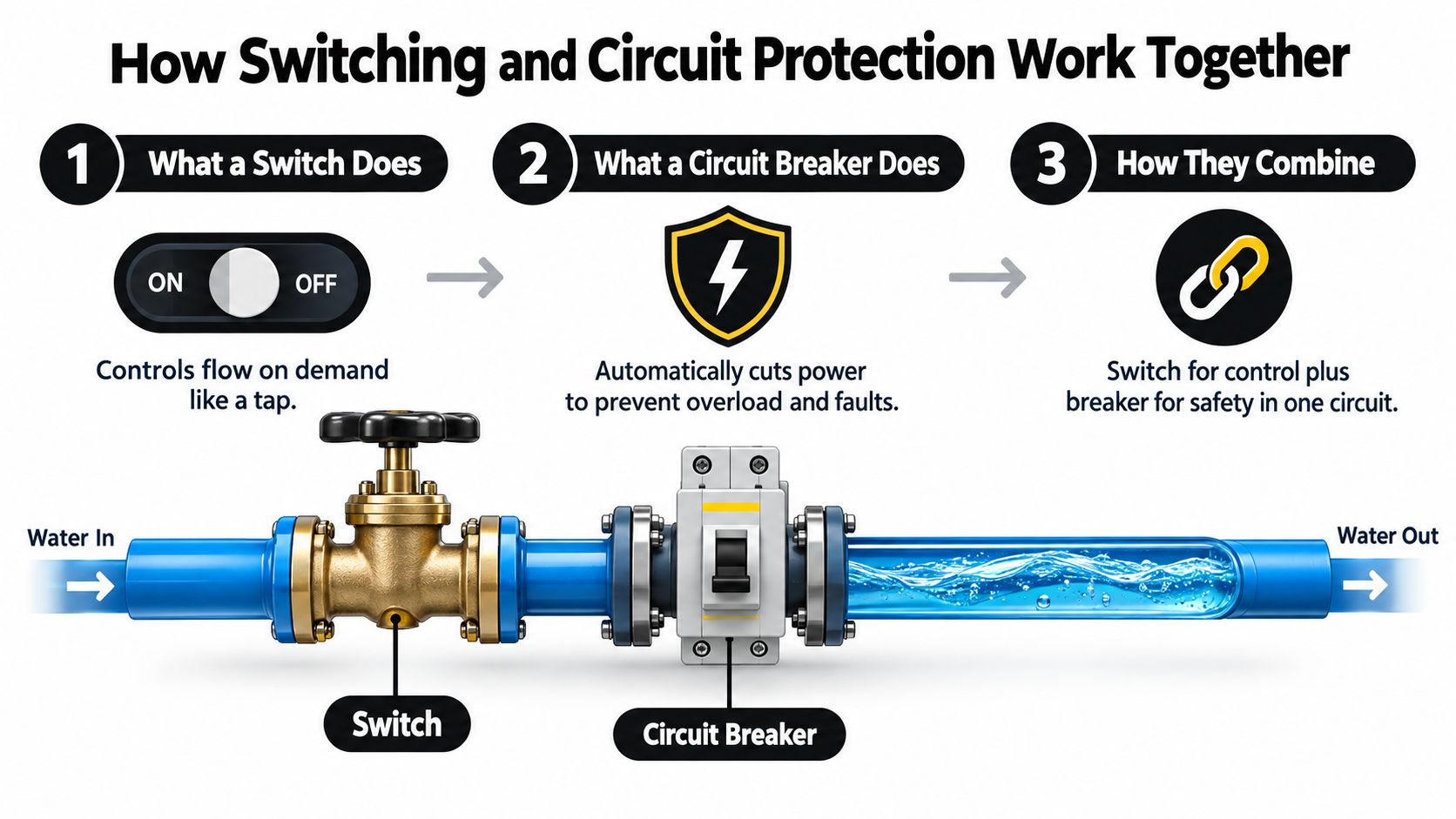
A combined switch with circuit breaker can therefore offer convenient control alongside automatic overcurrent protection. It doesn't automatically mean the circuit has personal shock protection. The electrician must confirm whether the device also includes residual-current detection, or whether a separate RCD or RCBO is installed.
For readers working around larger facilities, the same basic separation appears in plant-level electrical fault detection, where teams distinguish fault monitoring from physical isolation. At home, the equipment is smaller, but the reasoning remains useful.
The difference between an RCD and a circuit breaker is worth checking before you interpret a trip or plan a replacement.
Core principle: A switch controls power, a circuit breaker protects against excessive current, and an RCD or RCBO addresses leakage that can cause electric shock.
Switchboards often contain several devices that look alike but have different responsibilities. The label on the front may say “main switch”, “power”, “lights”, “RCD” or something more specific. The label helps, but it doesn't replace an inspection of the device and wiring arrangement.
| Device Type | What It Protects | Trips On | Typical Use in Brisbane Homes |
|---|---|---|---|
| Main switch | Provides control and isolation for the installation | Manual operation, depending on device design | Turning the home's supply off for authorised work |
| Switch-disconnector | Helps isolate a circuit or section of the board | Usually operated manually rather than as overload protection | Isolation for equipment and maintenance |
| MCB | Wiring and appliances | Overload and short circuit | Individual lighting, socket-outlet and appliance circuits |
| RCD safety switch | People from electric shock caused by leakage current | Residual-current imbalance | Protection for nominated circuits, including areas requiring additional attention |
| RCBO | Wiring, appliances and people, through combined functions | Overload, short circuit and residual-current leakage | Individual circuits where separate, targeted protection is preferred |
A main switch circuit breaker can disconnect the home's supply and trip under an overcurrent condition. It protects the installation and network connection from faults such as overloads and short circuits, as described in the discussion of three-pole circuit breakers and switchboard applications. That doesn't make it a replacement for an RCD on every circuit.
The Queensland Electrical Safety Office separates the functions directly. A circuit breaker protects wiring and appliances. A safety switch monitors current flow and disconnects power when leakage is detected. The homeowner's question should therefore be, “Which hazard does this device address?” rather than, “Does this device switch off?”
A board may contain a main switch, several MCBs and one or more RCDs. Another board may use RCBOs for individual circuits. Both arrangements can look tidy, but their coverage and fault behaviour differ. If one circuit has a problem, individual RCBO protection may limit the outage to that circuit, while a shared RCD arrangement can affect several circuits depending on the board design.
A product described casually as a switch with circuit breaker might be a manually operated switch beside an MCB, a switch-disconnector, a main switch circuit breaker or an RCBO. The name alone doesn't confirm its rating, pole arrangement, fault-clearing capability or shock-protection function.
That's why a Brisbane electrician needs to inspect the actual board, cable sizes, circuit arrangement and intended load. Replacing a device with one that fits the rail can still create a poor result if the protection duty doesn't match the installation.
The right arrangement depends on the circuit's job and the home's future electrical plan. A lighting circuit, a split-system air conditioner and an EV charger don't place the same demands on a switchboard, so they shouldn't be approached as identical replacements.
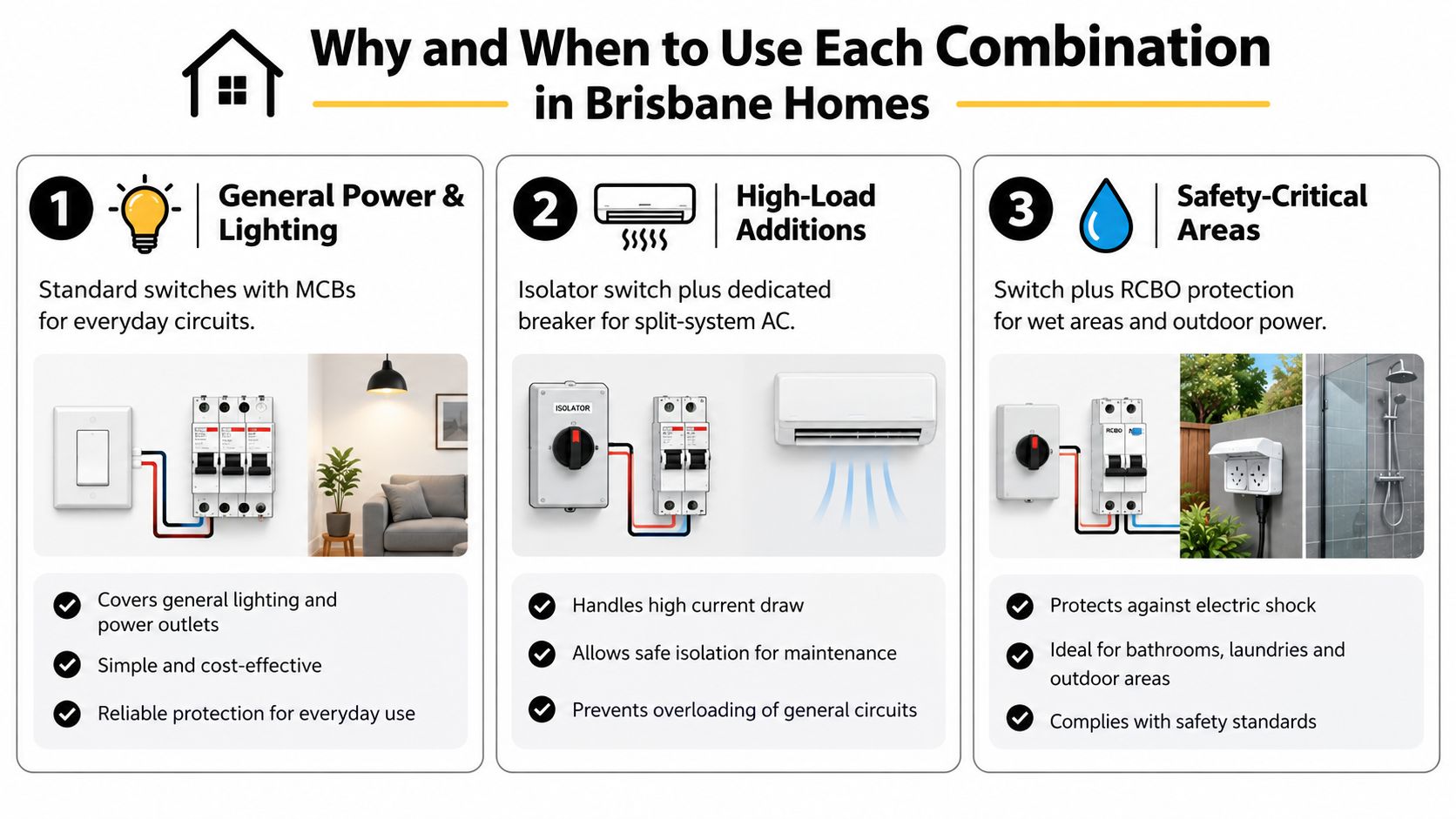
General lighting and socket-outlet circuits commonly use circuit breakers suited to the installed wiring and expected load. A local switch or isolator may be used where equipment needs a clear means of control, while the breaker provides automatic protection against overcurrent.
If one breaker repeatedly trips after a particular appliance is connected, the answer isn't always a larger breaker. The existing cable, circuit design and appliance condition all matter. Increasing the breaker size without checking those factors can remove the protection the wiring relies on.
Air conditioning, solar systems, batteries and EV chargers can change the way a home uses its switchboard. These additions may need dedicated circuits, local isolation, suitable overcurrent protection and an assessment of the board's available capacity.
A single main switch circuit breaker may be appropriate when the existing board, service arrangement and load assessment support it. It isn't enough when the board lacks space, has deteriorated components, provides incomplete RCD coverage or can't coordinate safely with the new equipment.
Solar and battery work can introduce generation into the installation, so the electrician must consider how supply and protection operate under different conditions. An EV charger can also create a substantial dedicated load, making capacity planning more important than adding another breaker to an empty position.
Three-phase installations require careful device selection and phase management. Three-pole breakers can disconnect the relevant phases together, but the electrician still needs to verify coordination, load distribution and compatibility with the switchboard.
Decision rule: Replace one device when the fault is genuinely local and the existing board remains suitable. Plan a board-wide upgrade when the new load exposes limitations in capacity, protection, condition or compliance.
A full upgrade becomes more likely when an older board mixes ceramic fuses, outdated breakers and partial safety-switch coverage. Queensland guidance recommends safety switches on all circuits for maximum protection and regular testing, so a board with limited coverage deserves a broader assessment rather than a cosmetic device swap.
For a solar, EV or three-phase project, ask the electrician to assess the incoming supply, spare space, phase balance, existing loads, earthing and protection coordination. This decision prevents a new switch with circuit breaker from becoming an isolated fix inside a board that still can't support the home's electrical direction.
A Brisbane home may only need one switch with circuit breaker replaced, yet the same job can reveal a board that needs wider work. The decision depends on the cable, expected load, fault conditions, available space and how the existing protective devices operate together.
Australian installation requirements are governed by AS/NZS 3000:2018. It sets requirements for safe electrical installations and the selection and installation of equipment. The Standards Australia information for AS/NZS 3000:2018 provides useful standards context.
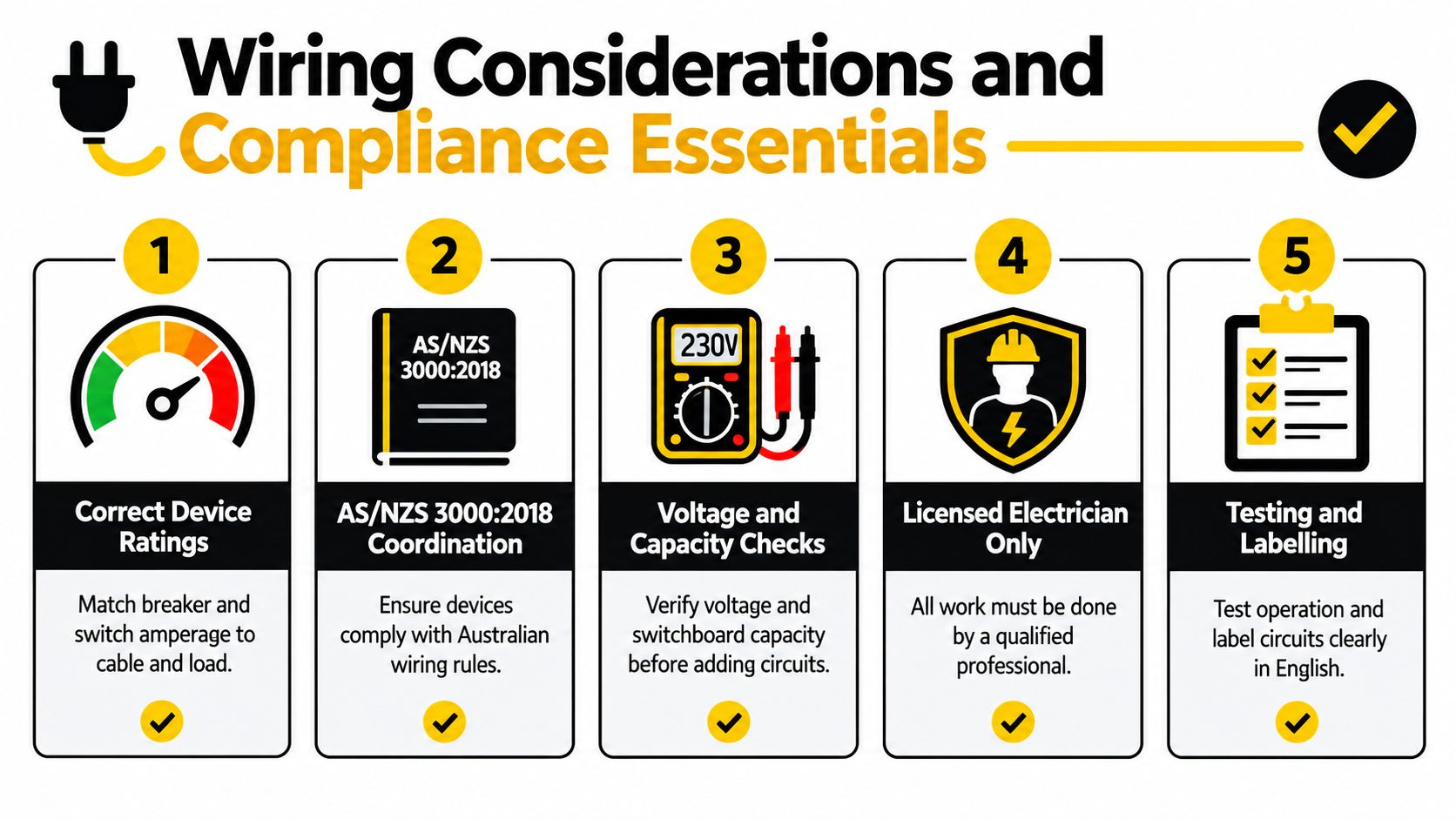
A breaker protects conductors only when its rating and operating characteristics suit those conductors. An electrician may inspect cable condition, terminations, busbar connections, enclosure space, earthing and the relationship between the incoming supply and outgoing circuits.
The electrical wiring guidance from DLG Electrical explains why switching equipment cannot be assessed separately from the wiring behind it.
For a simple replacement, the electrician should confirm that the existing board, circuit wiring and protective arrangement remain suitable. If the home is adding solar, an EV charger or three-phase equipment, the assessment needs to cover capacity, phase loading, supply arrangements and future board space.
Queensland guidance also recommends regular safety-switch testing. The test button checks that particular device and its connected arrangement. It does not prove that every circuit in the home has RCD protection.
A compliant result should leave you with clear circuit labels, suitable protection and advice about safe testing and future additions.
The following Brisbane examples are illustrative scenarios, not a substitute for an inspection. Each shows why the same phrase, “replace the breaker”, can lead to different recommendations.
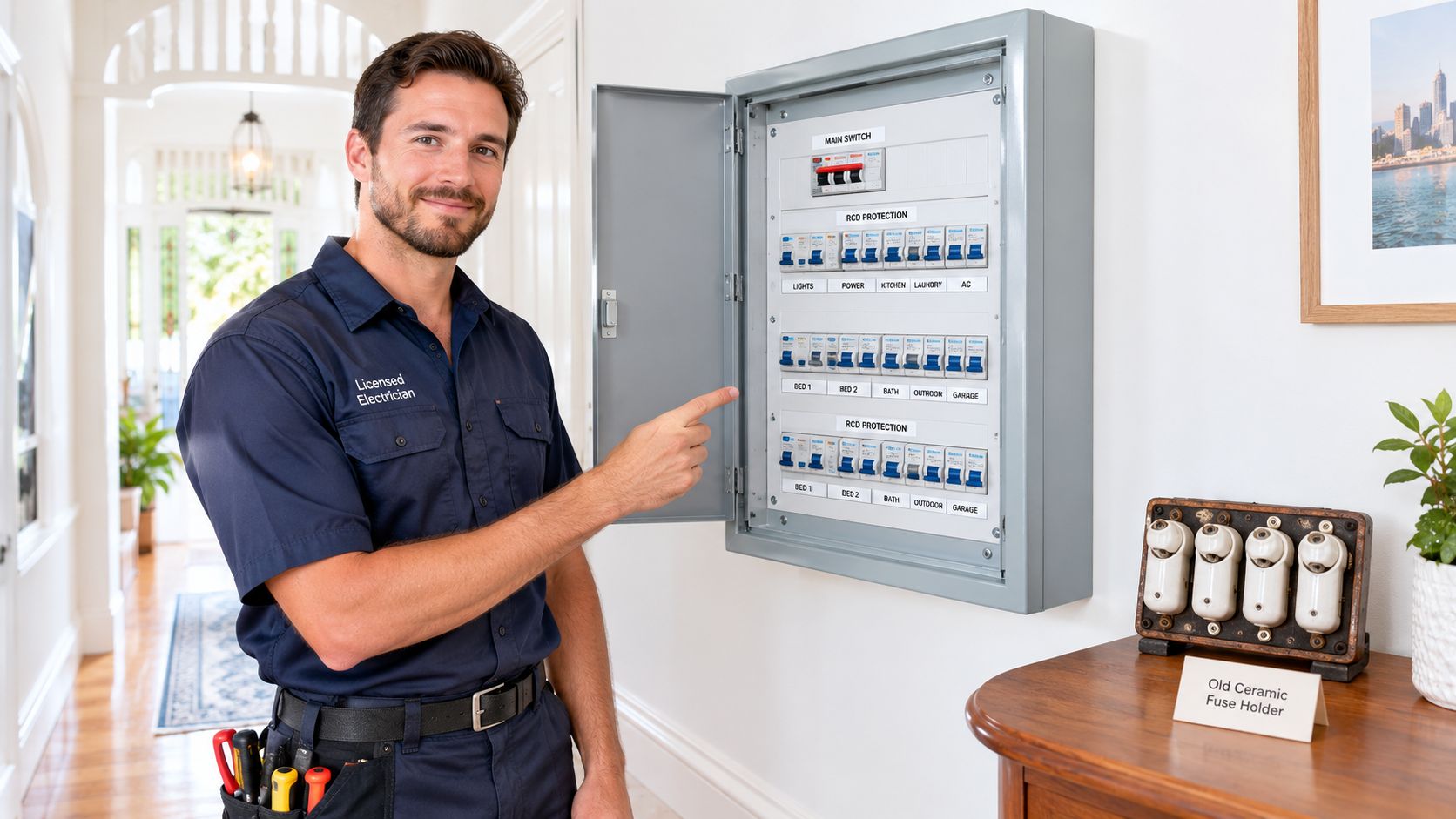
A Grange homeowner notices that a fuse has failed after several appliances were used in the kitchen. The board has ceramic fuse carriers and no obvious safety-switch test buttons.
Replacing the fuse alone restores power, but it doesn't address the board's limited protection arrangement. An electrician would assess the wiring, earthing, enclosure and circuit layout before recommending modern circuit breakers, RCD protection or a complete switchboard replacement.
The lesson is simple: a failed fuse can be the visible symptom of an outdated board, not merely a one-off inconvenience.
A renovated Windsor property adds split-system air conditioning to an existing board. There is a spare position, but the electrician still needs to confirm that the circuit can carry the load, that the equipment has suitable isolation and that the board's protective devices coordinate correctly.
If the board is in good condition and has suitable protection, a dedicated circuit with the correct switch and breaker arrangement may be enough. If the board has damaged components or incomplete protection, the air conditioner becomes a reason to plan a broader upgrade.
A North Brisbane homeowner wants solar now and an EV charger later. Adding one breaker today without considering the future equipment can lead to crowded spaces, poor load planning or an unsuitable main protection arrangement.
The electrician should review the existing supply, generation connection, proposed charger, phase requirements and available board capacity. The best solution may be a staged switchboard upgrade rather than repeated small replacements.
A future load should be discussed before the first new breaker is installed, not after the board has run out of practical options.
Start with observation, not intervention. Note which circuit trips, what was operating at the time and whether the breaker resets immediately or trips again. Don't keep resetting a device that repeatedly operates, and don't open the switchboard to investigate internal wiring.
Book a licensed electrician promptly if you notice:
If a single breaker has failed and the rest of the board is suitable, a targeted circuit breaker installation may solve the problem. If the board is old, crowded, damaged or missing broad RCD coverage, ask for a switchboard upgrade assessment instead.
DLG Electrical can inspect Brisbane residential switchboards, discuss circuit protection and plan upgrades around current and future loads. Take photographs of the closed switchboard, record the symptoms and arrange a licensed assessment before choosing between a single switch with circuit breaker replacement and a complete upgrade.
DLG Electrical provides Brisbane switchboard upgrades, circuit breaker work and electrical safety assessments for homes, renovations and planned solar or EV installations. Visit DLG Electrical to discuss your switchboard symptoms or request a practical quote for a safer, future-ready solution.

Master Electrician with over 30 years of experience. Founded DLG Electrical in 2005 after international project work including electrical installations at Stamford Bridge Stadium, London(Home of Chelsea FC).

Local Electricians that can fix all Electric Hot water Systems.
Motion sensor lights are a versatile addition to any home, offering nu
