83 Jean St, Grange QLD 4051
Mon-Fri 07:30 AM - 04:00 PM - Sat - 8:00 - 12 - Sunday Closed

Picking the right downlight is about more than just aesthetics; it’s about choosing the perfect lighting tool for the job. The main players you’ll come across are recessed, surface-mounted, and adjustable downlights. Each has its own strengths, whether you need broad room-filling light, focused task lighting, or a spotlight to show off a feature.
Downlights are a staple of modern Australian interior design, and for good reason. They offer a clean, unobtrusive look while delivering incredibly effective light right where you need it. It helps to think of them not as individual lights, but as a complete system working together to set the mood and functionality of a room.
Their popularity has exploded with the widespread move to energy-efficient technology. The days of old, power-hungry halogen bulbs are well and truly behind us. Today, LED is king, bringing with it a massive lifespan, lower power bills, and far better control over the quality of your light.
In fact, the Australian LED lighting market was recently valued at around AUD 1.88 billion and is expected to climb to AUD 4.74 billion. That’s a pretty clear signal of just how central they’ve become in our homes.

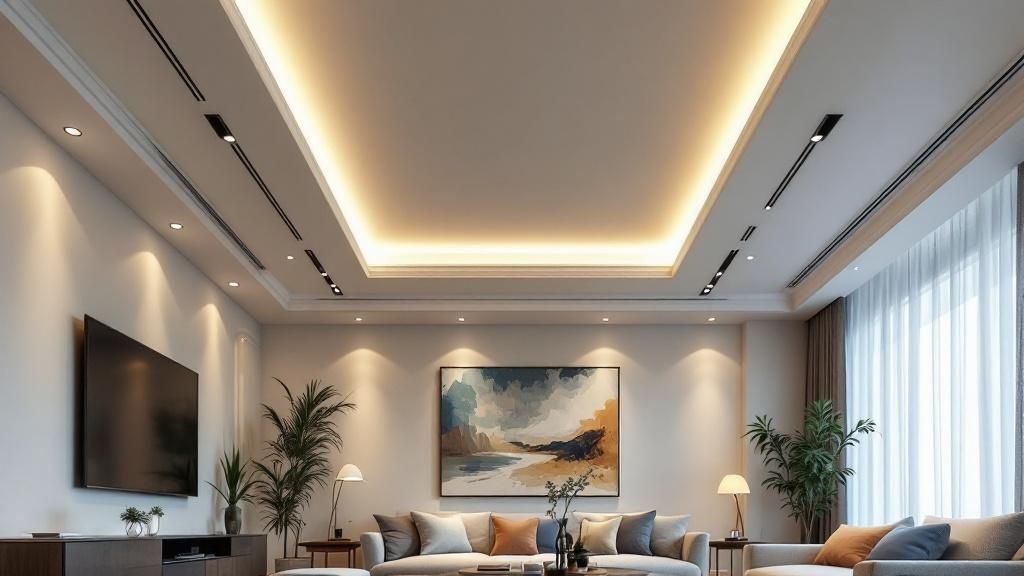
The image above gives you a great visual breakdown of the main categories we’ll be diving into. It really comes down to three core choices: recessed for that seamless, integrated finish; surface-mounted for when you can’t cut into the ceiling; and adjustable for when you need to direct the light with precision.
To get you started, let’s take a quick look at how these different downlights stack up.
This table provides a quick summary of the main downlight categories, their primary function, and where they shine.
| Downlight Type | Primary Function | Best For |
|---|---|---|
| Recessed Downlights | General ambient lighting | Creating a flush, minimalist look in living rooms, kitchens, and hallways. |
| Surface-Mounted Downlights | General lighting for solid ceilings | Concrete ceilings or areas where cutting a recess isn’t an option. |
| Adjustable Downlights | Accent and task lighting | Highlighting artwork, architectural features, or specific work areas like kitchen benches. |
Each of these types serves a distinct purpose, and choosing the right one is the first step towards a perfectly lit space.
Getting a handle on the fundamentals is key. Here’s a bit more on what each category means for your home:
Understanding the massive leap from old tech to new is also crucial. If you’re currently upgrading from old fixtures, our guide comparing LED lights vs halogen is essential reading. Making the right choice from these foundational types of downlights will set the stage for a space that is both beautiful and functional.
When you picture a modern, beautifully lit room, chances are you’re thinking of fixed downlights. They’re the unsung heroes of general illumination, responsible for casting that broad, even light that fills an entire space. As the name implies, they’re static fixtures that shine light directly downwards, creating a seamless and consistent layer of light.

Think of fixed downlights as the reliable workhorse of the lighting world. Their main job is to provide ambient light—the foundational light that fills a room, letting you move around safely and comfortably. They are perfect for bathing living areas, kitchens, hallways, and bedrooms in clean, consistent light.
Their straightforward design makes them one of the most popular choices for new builds and renovations. Because they sit flush with the ceiling, they offer a minimalist aesthetic that doesn’t draw attention to itself. This lets your interior design take centre stage, resulting in clean ceiling lines and an uncluttered, modern feel.
The real secret to a great fixed downlight setup is creating an even wash of light. You want to avoid any distracting dark spots or overly bright overlaps. Getting this right comes down to two things: choosing the right beam angle and spacing the fittings correctly.
A wider beam angle, typically 60 degrees or more, is perfect for general ambient lighting because it spreads light over a larger area. This often means you need fewer fittings to light up a room. For most standard Aussie ceiling heights (around 2.4 to 2.7 metres), spacing your downlights about 1.2 to 1.5 metres apart is a solid rule of thumb.
A common planning method is to aim for one downlight for every 2.3 square metres of ceiling area. This helps you get that balanced, uniform illumination without creating a “runway” effect of harsh, isolated pools of light.
Proper spacing is what prevents that “scalloping” effect you sometimes see on walls, where the light beams create noticeable arcs. By overlapping the edges of each beam just slightly, you create a smooth, unified field of light that makes the whole room feel bright and welcoming.
Beyond just providing light, fixed downlights play a subtle but important role in your home’s overall look. The visible part of the fitting, called the trim, comes in various materials and finishes that can either blend in or stand out.
Choosing a finish that complements your other fixtures and design elements helps tie the room together for a cohesive and polished look. This attention to detail is what elevates your lighting from being purely functional to an integral part of your interior design.
While fixed downlights lay the groundwork for general lighting, adjustable downlights are where the real artistry begins. Often called gimbal or tilt downlights, these versatile fixtures empower you to aim light with incredible precision. Think of them as the secret weapon in a lighting designer’s toolkit, used to transform a flat, evenly lit room into one with genuine depth, focus, and character.
Unlike their fixed cousins, adjustable downlights have an inner housing that can pivot. It’s a simple tilting mechanism, but it’s a total game-changer. It allows you to direct the beam of light exactly where you want it, making them the perfect choice for accent lighting. You can turn a beautiful piece of art, a textured feature wall, or a unique architectural detail into an immediate and captivating focal point.
Their real genius, though, often lies in their problem-solving ability. By directing light away from certain spots, you can finally kill that annoying glare on your TV or computer screen—a common headache caused by poorly positioned fixed lights.
Rooms with sloped or raked ceilings pose a unique challenge. A standard fixed downlight would cast its beam at an awkward angle, hitting a wall instead of the floor. Adjustable downlights solve this problem in an instant. You can simply tilt the internal lamp to point straight down, ensuring you get perfect vertical light right where it’s needed.
They’re also fantastic for lighting specific task areas. Think about the focused work you do on a kitchen benchtop or island. An adjustable downlight can be aimed to flood that zone with bright, clear light, making everything from chopping vegetables to reading a recipe safer and much easier.
For a truly sophisticated, layered lighting design, use a combination of fixed downlights for general ambient light and a few strategically placed adjustable downlights. This approach creates visual interest and makes a room feel professionally curated.
The true magic of an adjustable downlight is its power to create drama. By angling a beam to “wash” down a textured surface like a stone or brick wall, you can highlight its unique finish. This casts subtle shadows that add immense depth and visual texture, a technique known as wall grazing that can completely transform a plain wall.
Here’s how to put them to work effectively:
By embracing the flexibility of adjustable downlights, you’re moving beyond just lighting a room. You’re starting to paint with light, adding layers and focus that give your space a polished, distinctive personality.
Ready to step into the future of home lighting? Smart downlights are a game-changer and a standout choice among the different types of downlights on the market today. These aren’t just simple light fixtures; they’re intelligent, connected devices that link straight to your home’s Wi-Fi network. This gives you incredible control over your lighting right from your smartphone, with voice commands, or through your home automation system.

Imagine changing the entire mood of a room without ever getting up from the sofa. Smart downlights go way beyond a basic on/off switch, unlocking a suite of features that completely redefine what your home lighting can do. They deliver a level of convenience and customisation that used to be reserved for expensive, professionally programmed systems.
This blend of convenience and power is exactly why they’re becoming so popular. Modern homeowners expect technology to simplify their lives, and smart lighting fits that need perfectly.
The real magic of smart downlights is their ability to adapt to your life in an instant. You can completely transform a room’s atmosphere with just a few taps on an app or a simple voice command. This fine-tuned control comes down to a few key features.
This move towards advanced LED solutions is a massive trend across Australia. Homeowners are embracing smart, efficient lighting for both new builds and retrofits, making it the new standard. In fact, projections show that around 79% of Australian consumers plan to use LED lighting soon. This shift has already helped slash residential lighting energy consumption by about 65%, playing a big part in reducing the nation’s CO2 emissions. You can find more details on these energy trends at expertmarketresearch.com.
One of the biggest advantages of smart downlights is how easily they fit into a connected home. Most are designed to work flawlessly with popular smart home ecosystems like Google Home, Amazon Alexa, and Apple HomeKit.
This means you can control individual lights, groups of lights, or entire rooms with simple voice commands like, “Hey Google, set the living room lights to movie mode,” or “Alexa, dim the kitchen lights to 50%.”
It creates a truly hands-free experience that you’ll quickly find you can’t live without. Whether you’re setting the perfect lighting for dinner or making sure all the lights are off from the comfort of your bed, smart downlights offer a level of control and flexibility that’s perfect for modern living.
Choosing between different types of downlights goes far beyond just what they look like. To make a smart choice, you really need to get your head around a few technical details. These are the things that determine how the light will actually look and feel in your space.
Getting these factors right is the key to creating lighting that’s not just functional but also comfortable and safe. Think of them as the DNA of your light—they dictate everything from the mood of the room to how accurately you see colours.
When you start comparing downlights, you’ll come across a few key terms. They might sound a bit technical, but they’re actually simple concepts that have a huge impact on your home.
Getting these technical details right is crucial for creating a comfortable and functional environment. A light that’s too cool can feel clinical, while one with a low CRI can make your vibrant decor look dull and lifeless.
Beyond performance, safety and compliance are completely non-negotiable. This is especially true in certain areas of your home.
For any room with moisture, like bathrooms and laundries, you must check the IP (Ingress Protection) rating. A rating of IP44 or higher is essential, as it ensures the fitting is protected against water splashes. For even more robust protection, particularly outdoors, our guide to garden lighting options offers more great insights.
It’s also worth knowing that government policies in Australia heavily influence the downlights you see on the shelves. The National Construction Code (NCC) sets strict energy efficiency standards, which is exactly why high-efficiency LEDs have become the go-to choice. These rules ensure new installations save energy, which is a win for both your power bills and the environment.
And remember, downlights are just one piece of the puzzle. You can enhance specific areas with other specialised lighting, such as practical and aesthetic under cabinet lighting solutions to completely transform your kitchen.
Even after diving into the different types of downlights, you might still have a few practical questions kicking around. That’s completely normal. This section is all about giving you clear, straightforward answers to those common queries, so you can lock in your lighting decisions with total confidence.
This is a classic question, and the answer really depends on the space itself. You need to consider the room’s size, how high the ceiling is, and the brightness (lumens) and beam angle of the downlights you’ve chosen.
As a good starting point, we often space downlights between 1.2 to 1.5 metres apart to get nice, even coverage without creating patchy spots.
If you want a rough calculation for general ambient light, you can multiply the room’s square metres by 250. Then, just divide that total by the lumen output of a single downlight you’re considering. But honestly, this is just a ballpark figure—it’s always best to get a licensed electrician to draw up a professional lighting plan.
Absolutely! In fact, swapping out old halogens for LEDs is one of the best upgrades you can make for your home. You can find modern LED downlights designed specifically to fit neatly into the existing cut-outs left by old halogen fittings.
But here’s the crucial part: you have to make sure your old transformers are compatible. Even better, replace them entirely with dedicated LED drivers. If you try to run a new LED on an old halogen transformer, you’re asking for trouble—it can lead to annoying flickering and will dramatically cut the LED’s lifespan. For safety and compliance, this is definitely a job for a qualified electrician.
The core difference between fixed and adjustable downlights is control. A fixed downlight offers general, even illumination by shining light straight down, while an adjustable model lets you aim the beam to highlight specific features or task areas.
Some of the best modern lighting setups go a step further by incorporating other smart technologies. For instance, you can learn more about how motion sensor lights can enhance your home in our dedicated guide. When you combine clever features like these with the right downlights, you create a home that’s not just well-lit, but truly efficient and intuitive.
Ready to transform your home with the perfect lighting? The expert team at DLG Electrical is here to help you select and install the ideal downlights for your space. Contact us today for a free quote

Master Electrician with over 30 years of experience. Founded DLG Electrical in 2005 after international project work including electrical installations at Stamford Bridge Stadium, London(Home of Chelsea FC).

Local Electricians that can fix all Electric Hot water Systems.
Motion sensor lights are a versatile addition to any home, offering nu
