83 Jean St, Grange QLD 4051
Mon-Fri 07:30 AM - 04:00 PM - Sat - 8:00 - 12 - Sunday Closed

If you’ve ever looked at a commercial power bill and wondered why it’s so complex, you’re not alone. One of the biggest culprits behind high energy costs in commercial and industrial settings is something called power factor. Getting it wrong means you’re paying for electricity you can’t even use.
Power factor correction is simply a way to stop that electrical waste. It involves installing specific equipment—usually capacitor banks—into your system to make it run more efficiently. In short, it helps ensure the power you pay for is the power you actually use.
Before we get bogged down in technical jargon, let’s use an analogy everyone can understand: ordering a glass of beer. It’s the perfect way to wrap your head around the different types of electrical power your business is billed for.
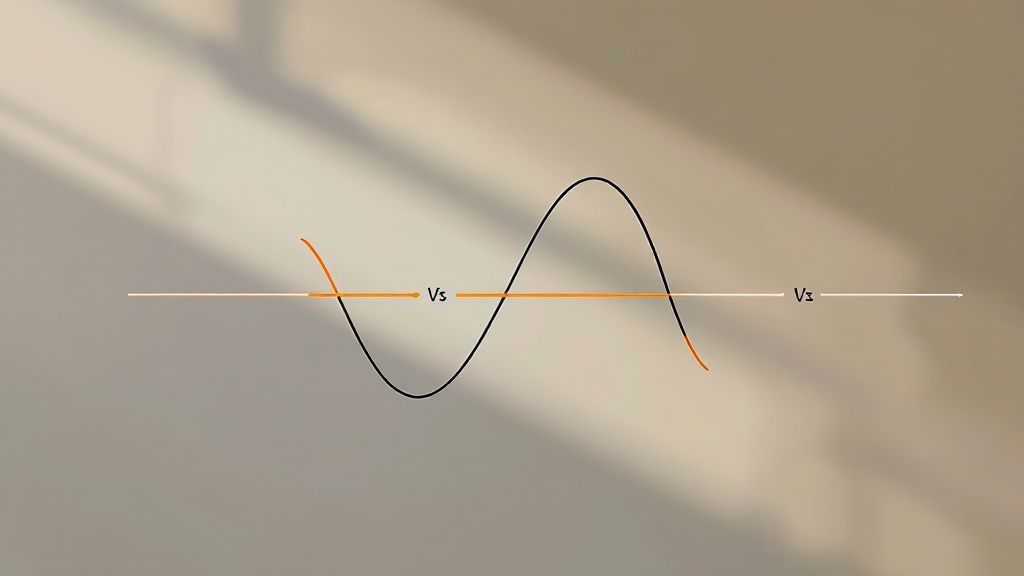
When the bartender pours your beer, you get two things in the glass: the liquid beer you actually want to drink, and the frothy foam on top. Your electrical system works in a very similar way.
A low power factor is a clear sign your electrical system has too much “foam” (reactive power) and not enough “beer” (real power). You’re being forced to draw more total power from the grid than your equipment is actually using, which directly leads to higher energy bills.
To put it simply, power factor is just the ratio of your useful power to the total power you draw. A perfect power factor is 1.0, meaning 100% beer and no foam—no waste at all.
However, a business running lots of motors might have a power factor of 0.75. That sounds pretty good, but it means a whopping 25% of the power you’re paying for is non-productive foam.
To make this crystal clear, here’s how the beer analogy translates to your electricity bill.
| Power Type | Technical Term | Beer Analogy | Its Job in Your Business |
|---|---|---|---|
| Useful Power | Real Power (kW) | The liquid beer | Runs machinery, lights, computers, and tools. |
| Wasted Power | Reactive Power (kVAR) | The foam on top | Creates magnetic fields for motors, but does no actual work. |
| Total Billed Power | Apparent Power (kVA) | The entire glass (beer + foam) | The total power you draw and are often billed for. |
Understanding these components is the first step to taking control of your energy costs.
So, power factor correction is the process of getting rid of that wasteful “foam.” By installing corrective equipment, you reduce the demand for reactive power from the grid and bring your power factor as close to 1.0 as possible.
This means you’re mainly paying for the “beer” your business actually consumes. It’s one of the smartest financial moves a commercial operation can make. If you want to dive deeper into the electrical principles, this guide on the kVA to kW conversion is an excellent resource.
A poor power factor isn’t just a technical issue on a spec sheet; it’s a direct and often painful hit to your business’s bottom line. The best way to think about it is like ordering a beer from the grid that’s mostly wasteful foam. You’re forced to draw a much larger glass than you actually need, and you’re paying for all of it. This inefficiency creates a financial drag that many businesses don’t even realise is happening.
When your site has a poor power factor, it has to draw more current from the network to get the exact same amount of useful work done. This extra current doesn’t just disappear—it creates very real problems that show up as extra costs on your bill.
The financial penalties for inefficient power use go way beyond the main meter reading. They quietly creep into your operational costs in several ways:
Here in Australia, a poor power factor directly increases your kVA demand, and many electricity suppliers are now charging for it as a separate line item. Keeping your power factor between 0.90 and 0.95 is the key to keeping these tariff costs down and staying compliant, as explained further in these regulatory demands on Australian Rectifiers.
Essentially, you’re paying for oversized infrastructure and wasted energy simply to support the non-productive reactive power your site needs. It’s like paying for a delivery truck that’s only a quarter full.
This kind of inefficiency is often one of the main culprits behind a surprisingly high power bill. If you’re wondering what other factors could be at play, our guide explains more about why your electric bill might be so high. Ultimately, understanding the link between power factor and your operational budget is the first step toward unlocking some serious savings.
Now that we understand the problem of poor power factor, the solution is thankfully straightforward and incredibly effective. Power factor correction (PFC) is all about installing equipment—usually capacitor banks—that creates a local reservoir of reactive power right inside your facility.

Think of it this way: instead of constantly pulling the “beer foam” (reactive power) all the way from the distant electricity grid, your equipment gets it instantly from the PFC unit installed on-site. This simple but powerful change dramatically reduces the total apparent power (kVA) your facility needs to draw from the supplier.
This adjustment has an immediate and welcome impact on your operational costs. By supplying that reactive power locally, the PFC unit lowers the total current flowing through your entire system.
For many Australian businesses, installing a PFC system can lead to savings of up to 20% on electricity costs. It works by slashing those kVA demand charges and helping you avoid penalties for a poor power factor. These automated units supply reactive power exactly when it’s needed, smoothing out demand spikes and improving your overall power quality.
This is why we see power factor correction not as an expense, but as a high-return investment. It’s particularly valuable for any business with significant motor-driven loads, like manufacturing plants, refrigerated warehouses, or large commercial buildings.
By optimising your power factor, you’re essentially stopping payment for electricity that does no useful work. The savings go straight to your bottom line, often providing a return on investment in under two years.
But the benefits don’t stop at the power bill. Another significant advantage is the newfound capacity it creates in your electrical system.
By lowering the overall current, PFC frees up your transformers, switchboards, and cabling to handle more productive loads. This can delay or even eliminate the need for expensive infrastructure upgrades as your business grows.
It’s crucial to understand how this efficiency translates into real dollars saved. For a deeper dive into measuring your usage, check out our guide on how to calculate electrical energy consumption. In short, PFC makes your entire electrical network more robust and efficient from the ground up.
Picking the right power factor correction strategy isn’t a one-size-fits-all job. The best approach really comes down to your facility’s specific electrical loads and how you operate day-to-day. To get a better sense of where PFC fits into the grand scheme of things, it helps to understand a bit about what is MEP engineering, which covers the mechanical, electrical, and plumbing systems that are the lifeblood of any commercial building.
Generally, there are three main ways to tackle power factor correction, each designed for different situations.
Deciding between these options nearly always requires a professional assessment. For bigger commercial or industrial sites, a solid understanding of a three phase power installation is crucial to making the right call.
Key Takeaway: The goal is to apply correction as close as you can to the source of the poor power factor without breaking the bank. A qualified electrician can run a power quality analysis to pinpoint the best strategy for your business.
Modern PFC systems are often split into two camps: passive (your standard capacitor banks) and active. The image below shows a quick comparison between the performance of traditional capacitor banks and the newer active PFC modules.
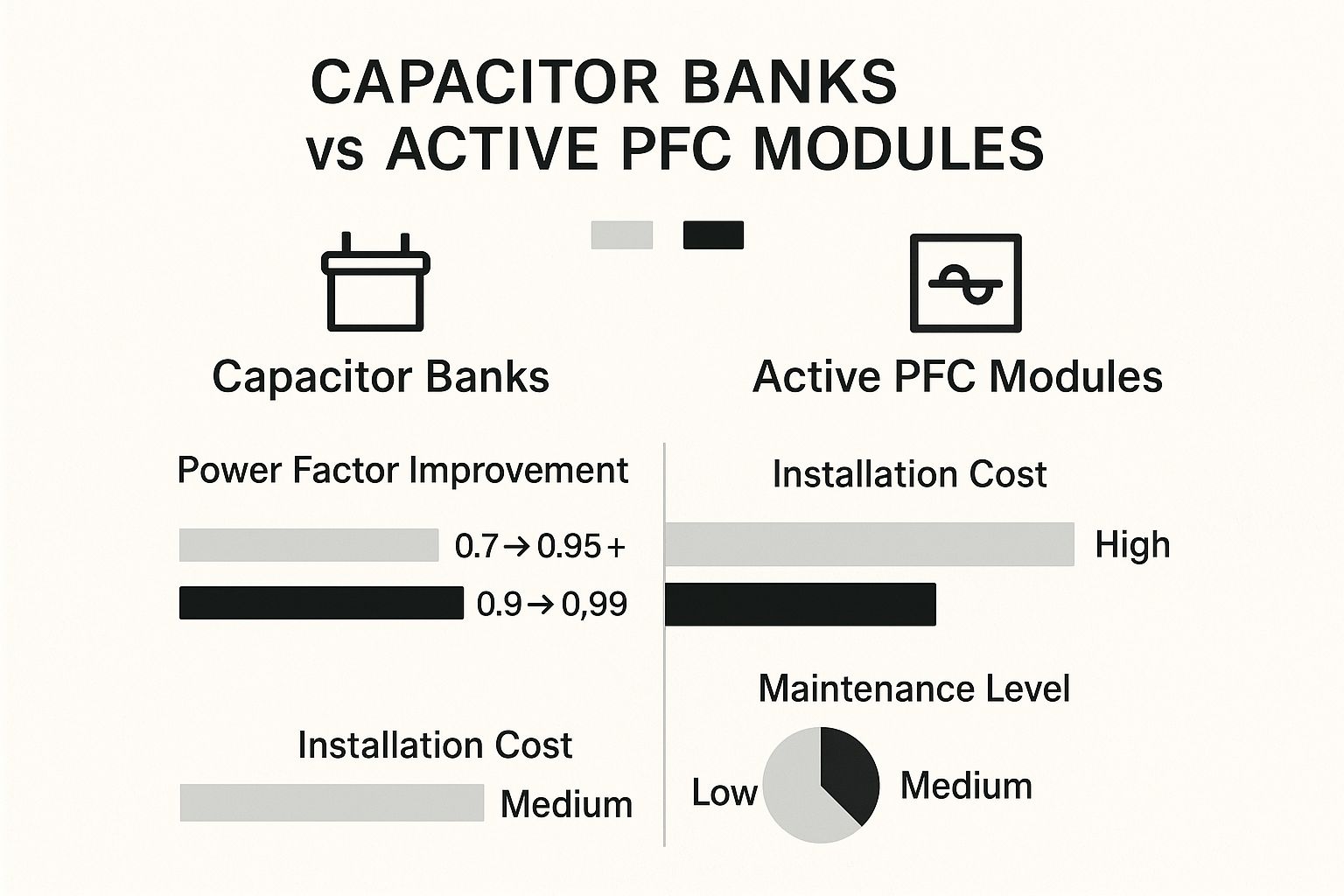
Here’s a closer look at how these different PFC installation approaches stack up, helping you figure out which might be the best fit for your facility.
| Correction Method | Ideal Application | Key Advantages | Potential Drawbacks |
|---|---|---|---|
| Individual | Single, large inductive loads like a big motor or welder. | Highly precise correction, right at the source. | Can be the most expensive option if many units are needed. |
| Group (or Zonal) | A cluster of similar machines in one area, fed from a single sub-board. | Good balance between cost and effectiveness. | Not as precise as individual correction. |
| Central (or Bulk) | Facilities with many small, distributed motors that operate at the same time. | Most cost-effective upfront for large-scale application. | Doesn’t correct for losses in the downstream circuits. |
| Active PFC | Facilities with sensitive electronics, variable loads, or strict power quality needs. | Superior, real-time correction and harmonic filtering. | Higher initial investment compared to passive systems. |
While active systems do have a higher upfront cost, they offer far better efficiency and are the go-to choice for any facility with sensitive electronics that can’t tolerate anything less than perfect power quality.
Sure, power factor correction is great for trimming your energy bills, but the real magic is in the secondary benefits that ripple through your entire electrical system. One of the biggest wins is unlocking more capacity from the infrastructure you already own—a game-changer for any growing business.

By dialling down the total current coursing through your system, power factor correction essentially frees up your transformers and main switchboards. Think of it like adding an extra lane to your highway without laying a single strip of new asphalt. This often means you can bring in more machinery or expand your operations without having to stomach the cost and disruption of major electrical upgrades.
Fixing your power factor doesn’t just save money; it creates a much healthier and more stable electrical environment for your valuable equipment. Lower system currents mean less heat buildup in cables, switchgear, and transformers. It’s this thermal stress that quietly wears down components and leads to premature failure.
You’ll see tangible improvements right across your facility:
By improving power quality right at the source, PFC acts as a powerful preventative measure. It protects your assets, helps them last longer, and means fewer interruptions and greater reliability for your operations.
Finally, let’s not forget the bigger picture. Improving your energy efficiency has a direct, positive impact on your corporate sustainability goals. When you draw less total power from the grid to get the same amount of work done, you’re actively shrinking your carbon footprint. For modern Australian businesses looking to operate more responsibly, that’s a goal worth pursuing.
So, how can you tell if your business is bleeding money from a poor power factor? The warning signs are usually hiding in plain sight, showing up as direct costs on your electricity bill and putting subtle strains on your equipment. Recognising these red flags is the first step toward getting it sorted.
One of the most obvious giveaways is consistently high energy bills, especially if you see line items for kVA demand charges. Many Australian energy retailers penalise businesses for this kind of inefficiency, and these charges are basically a direct tax on wasted power. If you’re seeing penalties or notes about low power factor on your utility statements, it’s a clear signal to dig deeper.
Another major clue is the type of machinery you’re running. Any facility with a lot of inductive loads is a prime candidate for a poor power factor. This covers all the common equipment that relies on magnetic fields to get the job done.
If your workshop or factory is full of this kind of equipment, it’s almost guaranteed you could benefit from power factor correction.
A professional power quality audit is the only surefire way to diagnose the problem. This analysis gives you precise data on your power factor, pinpoints the source of the issue, and allows an expert to size a corrective solution that actually fits your needs.
The push for better grid efficiency isn’t just a local trend. The Asia-Pacific power factor correction market is expected to rocket past USD $4.34 billion by 2035. This growth shows a much bigger industry shift towards cutting transmission losses and boosting reliability, a topic covered in this detailed market analysis.
We get a lot of questions about power factor correction from Australian business owners. Here are some of the most common ones, with straight-to-the-point answers.
Absolutely. While the savings are massive for large industrial sites, any business running motors can benefit. Think refrigeration, air conditioning, pumps, or workshop machinery—if you have these, you can cut your kVA demand charges.
Most businesses see a return on their investment in just 1-3 years, which makes it a really smart financial move.
Definitely not. This is a job strictly for the pros. PFC installation means working with high-voltage electrical equipment and must be done by a licensed commercial electrician.
They’ll make sure the system is sized correctly, installed safely, and meets all Australian electrical standards.
A professional installation is crucial for both safety and effectiveness. An incorrectly sized or fitted unit can fail to deliver savings and may even pose a risk to your equipment and personnel.
It’s actually the opposite. A professionally installed power factor correction system improves the conditions your equipment runs under.
By delivering a more stable voltage and reducing stress on the electrical system, it helps motors run cooler. This can even extend the lifespan of your expensive machinery.
Commercial-grade PFC units are built tough. With a quality installation and routine maintenance checks from a qualified electrician, a good PFC system will keep delivering savings for 15 to 21 years.
Ready to stop paying for wasted energy and get the most out of your electrical system? The expert team at DLG Electrical can run a professional power quality audit, identify your exact needs, and design a solution to maximise your savings. Contact us today for a free, no-obligation quote.

Master Electrician with over 30 years of experience. Founded DLG Electrical in 2005 after international project work including electrical installations at Stamford Bridge Stadium, London(Home of Chelsea FC).

Local Electricians that can fix all Electric Hot water Systems.
Motion sensor lights are a versatile addition to any home, offering nu
