83 Jean St, Grange QLD 4051
Mon-Fri 07:30 AM - 04:00 PM - Sat - 8:00 - 12 - Sunday Closed
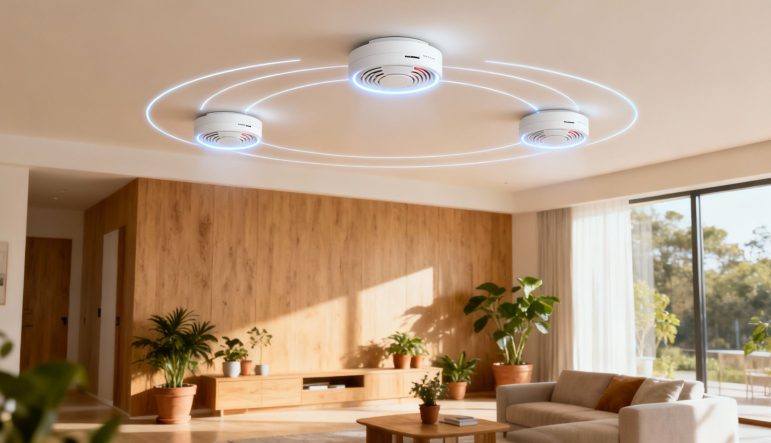
Picture this: a single smoke detector is like a lone guard watching over a massive house. If a fire kicks off in the garage, an alarm on the top floor might not go off until it’s far too late. Now, imagine a team of guards all linked by radio, instantly alerting everyone the second one of them spots trouble. That’s the game-changing power of wireless interconnected fire alarms.
This guide is all about how this technology creates a synchronised safety net for your family. We’ll break down how these systems work, the life-saving benefits they bring to the table, and what you need to know to meet Queensland’s strict compliance laws. We’ll also cover the practical side of things—choosing, installing, and maintaining your alarms.
Upgrading isn’t just about ticking a box for compliance; it’s about adding a smarter, faster, and more reliable layer of protection for what matters most. In a real emergency, every single second counts.
The biggest advantage of a connected system is pure speed. When one alarm detects smoke, it doesn’t just sound its own siren—it sends an instant signal to every other alarm in the house. This triggers a simultaneous, house-wide alert that can give you precious extra time to get out safely.
A fire can double in size every 60 seconds. An interconnected system slashes the time between the first sign of smoke and a whole-home alert, turning what could be dangerous delays into life-saving seconds.
This infographic lays it out perfectly, showing the huge difference in alert times between a standalone alarm and an interconnected system.
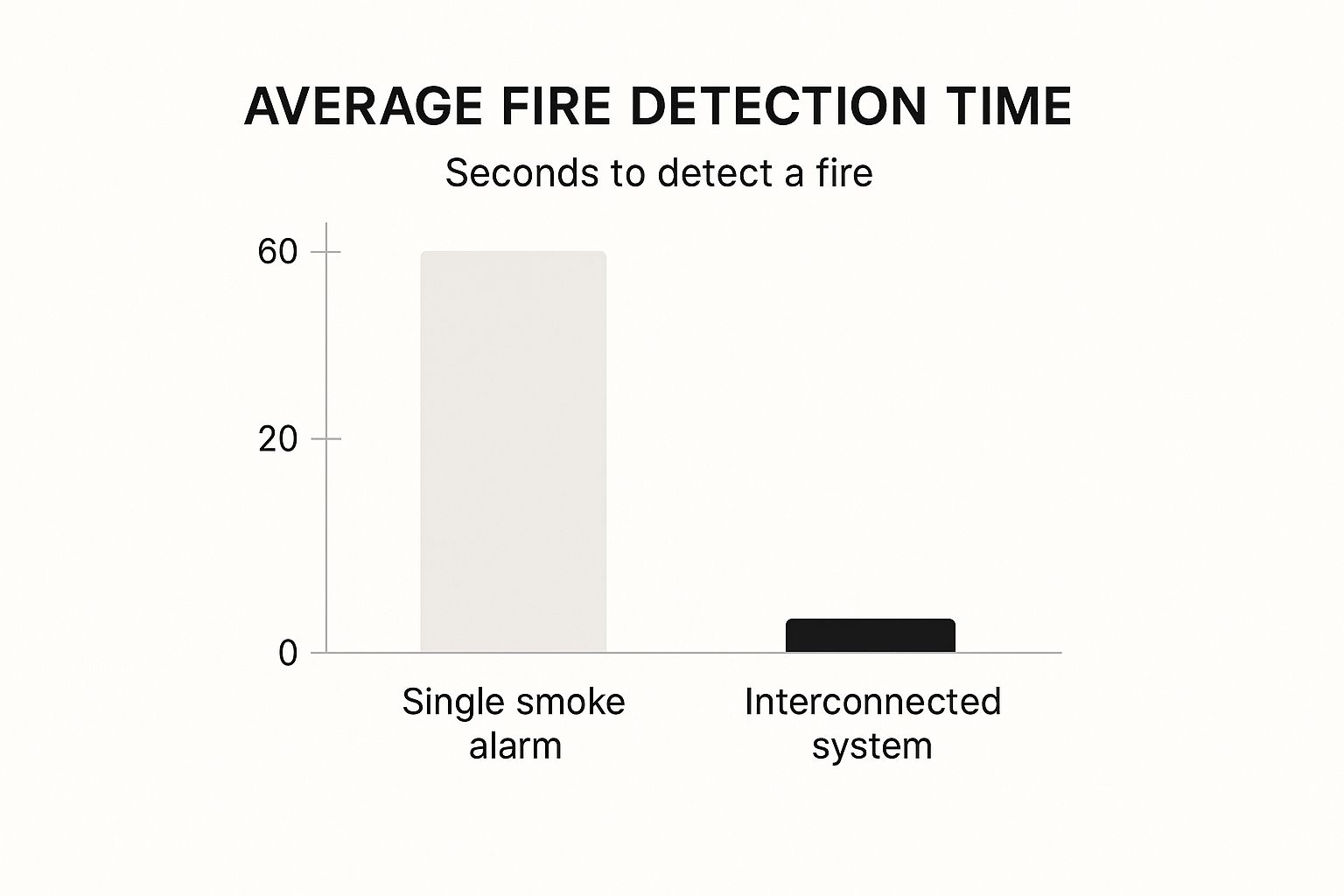
As you can see, the data shows an interconnected network can alert everyone in the house up to 12 times faster than a single, isolated alarm.
So, how does this lightning-fast communication happen? It’s all done over a dedicated radio frequency (RF) signal. When the alarms are installed, they are ‘paired’ together, creating their own secure, closed-loop network where they constantly listen for each other’s signals. If you want to get into the technical nitty-gritty, you can learn more about the advantages of Brooks mesh technology, which is a prime example of this ultra-reliable communication.
This setup means a fire detected in the garage will set off the alarm in a third-floor bedroom in a matter of seconds—long before the smoke itself could ever travel that far.
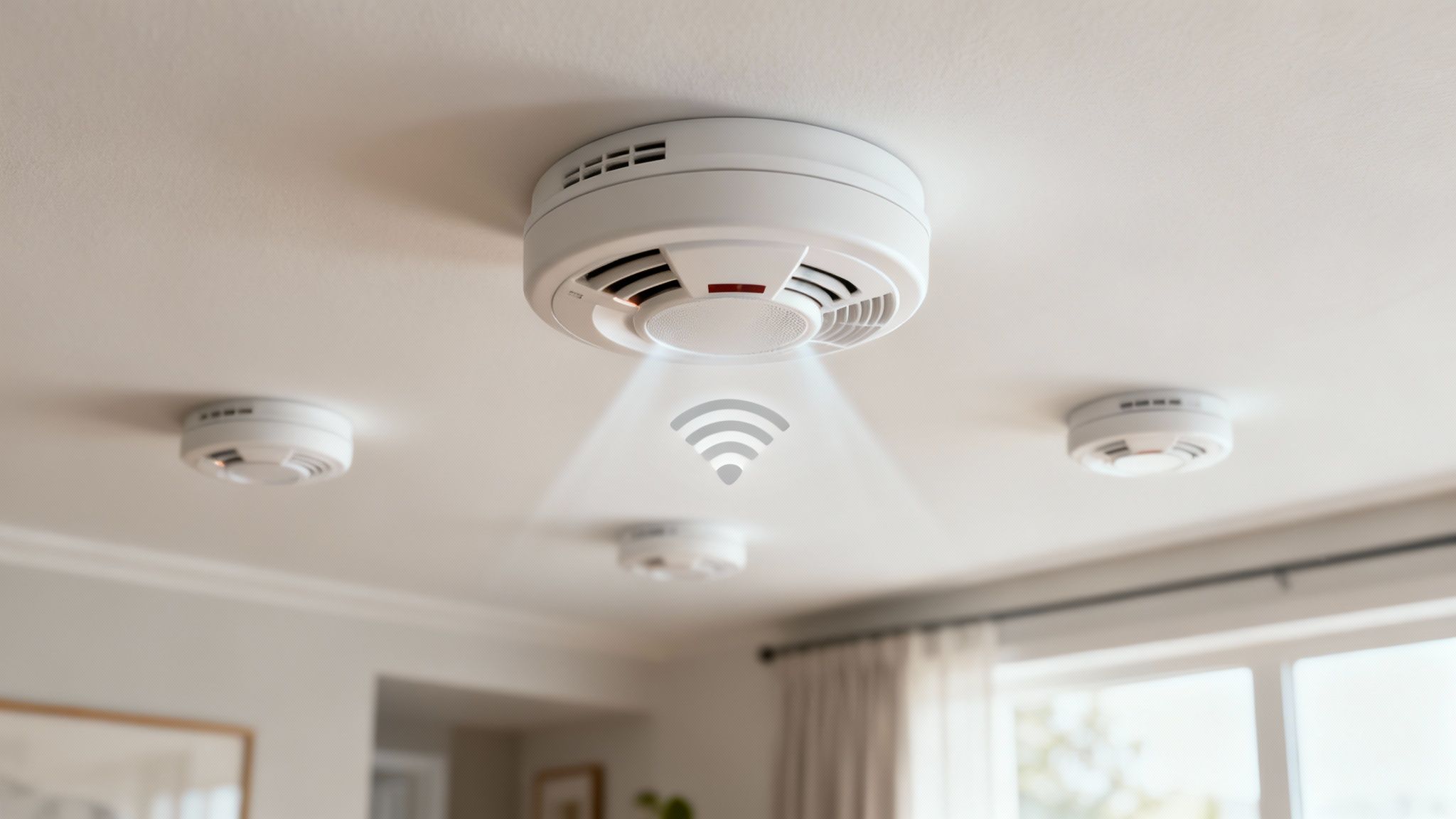
So, what’s the secret behind how these alarms work together? It’s simpler than you might think. Imagine your network of wireless interconnected fire alarms as a dedicated, private radio station inside your home, broadcasting one critical message: “FIRE!”
When one alarm senses smoke, it doesn’t just scream by itself. Instead, it instantly sends out an emergency signal to every other alarm paired with it. This all happens over a special radio frequency (RF) signal, much like a set of high-tech walkie-talkies, but far more secure and reliable.
During setup, each alarm is ‘paired’ to the others in the house. This quick step creates a closed-loop system where all the units are constantly listening for a signal from their teammates. This digital handshake makes sure they only talk to each other and won’t get confused by your Wi-Fi router, cordless phone, or other wireless gadgets.
The core idea is simple: an alarm in one room becomes the eyes and ears for every other room. This turns a bunch of separate detectors into a single, intelligent safety net that responds all at once.
This synchronised blast of sound is what makes the system a game-changer. A fire starting in a closed-off garage can trigger the alarm in a third-floor bedroom in seconds, long before smoke or heat could ever travel that far. You get a simultaneous, house-wide alert that buys you precious extra time to get out safely.
The communication between alarms is incredibly quick and direct. When one unit detects danger, it doesn’t need to connect to the internet or dial out to a central hub; it speaks directly to its paired devices. This direct line is why the system is so fast and dependable.
This technology has truly changed the face of fire safety in Australia over the last decade. Unlike traditional hardwired systems that are expensive and messy to install, wireless interconnected alarms let multiple devices link up instantly without needing a single cable run through your walls. You can read more research on the growth of wireless fire detection in Australia to see just how big its impact has been.
To really understand the difference, let’s look at how a real-world fire scenario would play out with old-school alarms versus a modern interconnected system.
The table below paints a clear picture of how crucial those first few moments are.
| Event | Traditional Alarm Response | Interconnected Alarm Response |
|---|---|---|
| Fire Starts | A fire begins in a remote area like a garage or basement. | A fire begins in a remote area like a garage or basement. |
| Smoke Detected | The local alarm senses smoke and sounds its siren after 30-60 seconds. | The local alarm senses smoke and sounds its siren after 30-60 seconds. |
| Occupants Alerted | Occupants in distant rooms (e.g., upstairs bedrooms) hear nothing. | All other alarms instantly receive the RF signal and sound their sirens simultaneously. |
| Time to Whole-Home Alert | Several minutes, or only when smoke physically reaches other alarms. | Less than 5 seconds from the initial detection. |
The comparison makes it obvious. The difference isn’t just a few seconds; it’s the entire critical window you and your family need to wake up, react, and execute your escape plan safely.
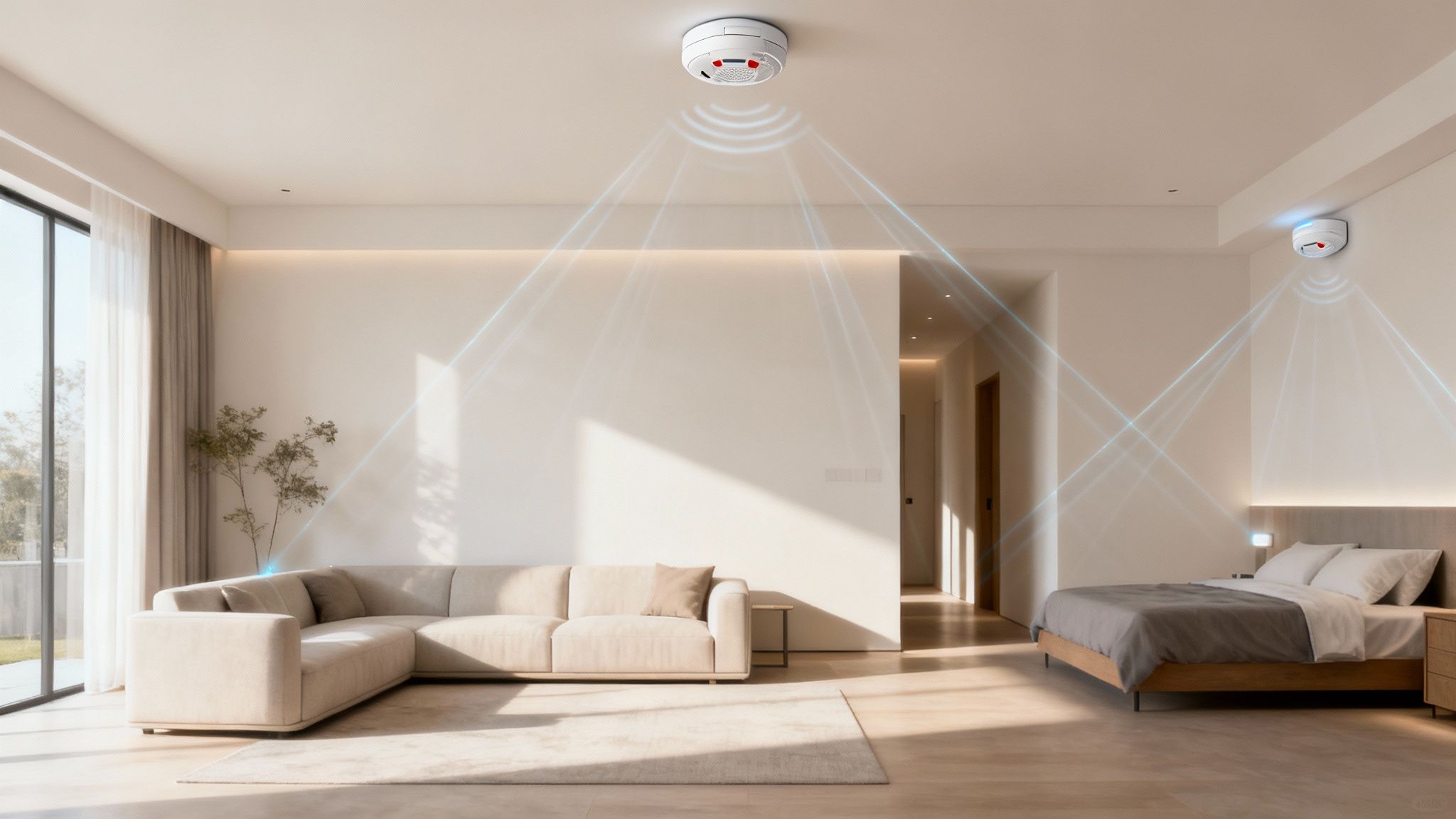
Upgrading to a connected system isn’t just about ticking a box. It delivers real, tangible benefits whether you’re a homeowner protecting your family or a landlord safeguarding an investment. The advantages go far beyond simply meeting a legal requirement, offering both a serious safety upgrade and day-to-day practical convenience.
For families, the biggest win is an incredible level of peace of mind. A fire doesn’t wait for everyone to be in the same room. A wireless interconnected fire alarm system means a smouldering fire in the kitchen instantly triggers the alarm in a child’s bedroom upstairs, even with the door shut.
This all-at-once alert system gets rid of the dangerous delay that happens when you’re waiting for smoke to creep through the house. It buys you those precious extra seconds needed for everyone to wake up, react, and get out safely.
Beyond the immediate safety boost, these systems have some seriously practical perks, especially if you live in an older or multi-storey home. Trying to retrofit a property with traditional hardwired alarms can be a massive job. Think drilling through walls, running new cables, and then dealing with the plastering and painting afterwards.
A wireless system, on the other hand, offers a clean, disruption-free installation. Because there’s no wiring, it’s both simpler and more affordable to get full coverage throughout your home. You can bring modern safety standards to any property without all the mess and expense.
For homeowners, the value is clear: you get a superior level of protection for your family with a faster, cleaner, and often more cost-effective installation process compared to traditional hardwired systems.
This makes upgrading your home’s fire safety an easy weekend project rather than a major renovation.
For landlords in Brisbane, the benefits of wireless interconnected fire alarms are twofold, hitting on both compliance and liability. Meeting Queensland’s tough fire safety legislation isn’t optional, and these systems are the most effective way to make sure you’re fulfilling your legal duties.
Failing to comply can lead to hefty fines, but more importantly, it puts your tenants and your property at serious risk. By installing a compliant interconnected system, you’re creating a safer living environment, which pays off in several key ways:
Ultimately, installing these alarms is a smart, proactive move that safeguards your tenants, protects your investment, and keeps you squarely on the right side of the law.
When it comes to fire safety in Queensland, knowing the law isn’t just a good idea—it’s non-negotiable for property owners. The rules are crystal clear and designed for one thing: to keep people safe. This has made wireless interconnected fire alarms a standard requirement, not just a fancy upgrade. Getting this right is about protecting lives and avoiding some pretty hefty penalties.
At the heart of the legislation is a simple but powerful mandate: every home must have interconnected, photoelectric smoke alarms. The government didn’t pick this technology by accident. Photoelectric alarms are far better at detecting the slow, smouldering fires that are most common in homes—the kind that produce a lot of smoke long before big flames appear.
This move towards smarter, connected systems is part of a much bigger picture. The fire and security alarm installation industry in Australia is seeing huge growth, driven by homeowners and landlords fitting these advanced systems. You can get a sense of the scale of these upgrades by looking into the fire and security installation market in Australia. It’s all about using modern tech to give people the earliest possible warning, because every second counts.
You can’t just stick alarms on the ceiling and call it a day. To be compliant, you need to follow specific placement rules that ensure the entire home is covered.
The law requires alarms to be installed in these key areas:
Sticking to these placement rules is critical. When you have a properly installed system of wireless interconnected fire alarms, a fire picked up in one room will trigger every single alarm in the house at the same time. No delays, no quiet zones—just an immediate, house-wide alert.
“All dwellings must be fitted with photoelectric smoke alarms that comply with Australian Standard (AS) 3786-2014. The smoke alarms must be interconnected with every other smoke alarm in the dwelling so they all activate together.”
That last part is the game-changer: if one goes off, they all go off. For a more detailed breakdown, our guide on the current smoke alarm legislation in QLD gets right into the specifics.
The deadlines for meeting these rules depend on your property. It’s absolutely crucial to know which category you fall into so you don’t get caught out. Landlords, renovators, and anyone selling their home have been required to comply for a while now. For all other homeowners, the final deadline to get these essential upgrades done is fast approaching.
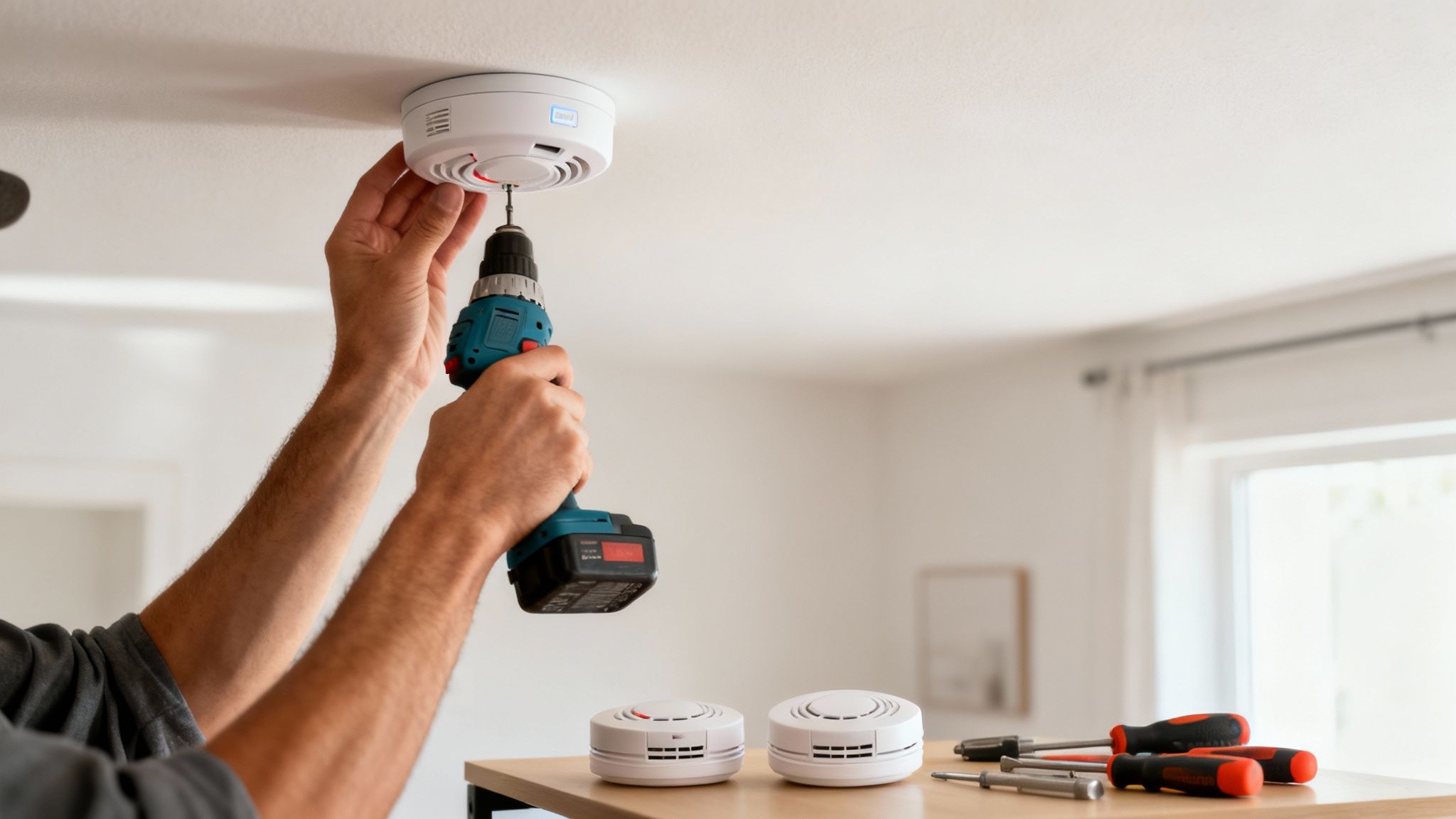
Alright, you understand the benefits—now it’s time to put that knowledge into action. Choosing and installing the right system of wireless interconnected fire alarms isn’t as daunting as it sounds. With a bit of know-how, you can move from purchase to protection smoothly, making sure your property is both safe and fully compliant.
The first job is picking the right alarms. They’re not all made equal, and knowing what to look for is critical for meeting Queensland’s legal requirements and, more importantly, keeping people safe. The market for these alarms is growing fast, and for good reason—government safety policies are driving strong demand.
This isn’t just a local trend. Across the Asia-Pacific, the wireless fire detection market is set to explode, projected to grow from USD 5.49 billion in 2024 to USD 11.35 billion by 2032. That’s a huge jump, and it tells you just how vital this technology has become. You can read more about the expanding wireless fire detection market on databridgemarketresearch.com. While this boom means more choice for you, it also makes it even more important to choose wisely.
When you’re out shopping for alarms, there are a few non-negotiable features you need to insist on. This will ensure you end up with a reliable system that won’t give you headaches down the track.
Once you’ve got your alarms picked out, you need to work out how many you’ll need. The easiest way is to grab a floor plan of your home and mark a spot in every bedroom, in the hallways that connect them, and one on each level of the house. This quick sketch will give you an exact count.
Remember, the goal is total coverage. A gap in your network is a gap in your safety. A quick walkthrough ensures every critical area is protected according to legal standards.
The good news is that installing wireless interconnected fire alarms is a pretty straightforward DIY job for most people.
While DIY installation is a great option, sometimes calling in a pro is the smarter move. If you’re not confident about placement, have really high ceilings, or just want the peace of mind that comes from an expert installation, a licensed electrician will get it done right, no worries.
Getting a system of wireless interconnected fire alarms installed is a massive step forward for home safety, but the job isn’t quite finished yet. It’s the ongoing maintenance that guarantees these critical devices will actually work when you need them most. The good news is, a simple and consistent routine is all it takes to keep your safety net strong.
Think of it like checking the oil in your car—a small action that prevents catastrophic failure down the road. The single most important habit you can form is the monthly test. All you need to do is press the ‘test’ button on each alarm for a few seconds. This quick check confirms the siren is working and, just as importantly, that all the units are still talking to each other.
Having a regular schedule takes all the guesswork out of alarm care and makes sure nothing gets missed. Beyond that monthly button-press, a bit of annual attention will go a long way.
Here’s a simple checklist you can follow:
Every smoke alarm has a use-by date. You need to check the manufacturer’s date printed on the unit itself—most alarms, even those with 10-year sealed batteries, must be replaced every 10 years to stay effective.
That replacement date isn’t a suggestion; it’s critical. Over time, the internal sensors lose their sensitivity and become less reliable, even if the test button still makes a noise. A great habit is to write the replacement date on your calendar the day you install a new alarm. It’s a proactive way to manage your family’s safety.
Failing to replace an expired alarm is like trusting a security guard who’s fallen asleep on the job. By sticking to this straightforward maintenance plan, you’re empowering your system to provide reliable, life-saving protection for years to come.
When you’re looking to upgrade your home’s fire safety, it’s natural to have a few questions about wireless interconnected fire alarms. Getting the right answers is key to making a confident decision and making sure your property is both safe and compliant. Let’s run through some of the most common queries we hear from homeowners.
Figuring out the right number of alarms is pretty straightforward once you know the Queensland rules. The legislation is designed to create a blanket of coverage, leaving no dangerous blind spots in your home.
You need to have an interconnected photoelectric alarm installed in a few key places:
The easiest way to get this right is to grab a floor plan of your house and mark each spot where an alarm needs to go. It’s a simple step that guarantees you buy the correct number of units and get the full, compliant protection you need. A properly mapped-out system means an alert will sound exactly where it needs to.
This one is a big one: you absolutely cannot mix and match different brands of wireless interconnected fire alarms. It might seem like a good way to save a few dollars or use an existing alarm, but it’s a critical mistake.
Each manufacturer uses its own private radio frequency to let the alarms talk to each other. Think of it like trying to use a TV remote from one brand on a TV from another—they just don’t speak the same language.
If you install alarms from different brands, sure, they’ll still work as individual smoke detectors. But they won’t interconnect. This completely defeats the purpose of the system. An alarm triggered in the kitchen won’t set off the one in the bedroom, leaving your family at risk. You have to stick to one brand for the entire network.
“A common mistake is assuming all wireless alarms can talk to each other. Sticking to one brand is non-negotiable for creating a true interconnected safety net.”
The legislation is very specific about requiring photoelectric technology, and for a very good reason. These alarms are far better at detecting the slow, smouldering fires that are unfortunately the most common—and deadliest—type of house fire.
They’re designed to pick up on the visible smoke particles these fires create long before they erupt into fast-moving flames. The older ionisation-style alarms just aren’t as effective in these scenarios, which is why photoelectric is now the standard for giving you the earliest possible warning.
For a professional assessment and installation of your fire alarm system, trust the experts at DLG Electrical. Ensure your Brisbane home is safe and compliant by visiting us at https://dlgelectrical.com.au.

Master Electrician with over 30 years of experience. Founded DLG Electrical in 2005 after international project work including electrical installations at Stamford Bridge Stadium, London(Home of Chelsea FC).

Local Electricians that can fix all Electric Hot water Systems.
Motion sensor lights are a versatile addition to any home, offering nu
