83 Jean St, Grange QLD 4051
Mon-Fri 07:30 AM - 04:00 PM - Sat - 8:00 - 12 - Sunday Closed

Think of an old-school neighbourhood watch, where one person spots trouble and instantly alerts everyone on the street. That’s the basic idea behind wireless interconnected smoke alarms, but for your home. It’s a network of vigilant guards all working together.
Instead of one lonely alarm chirping away in a basement while you’re fast asleep upstairs, this system creates a synchronised, property-wide safety net. It completely changes how you’re alerted to danger.
So, how does it actually work? When a single alarm senses smoke particles, it doesn’t just make a noise on its own. It instantly sends out a radio frequency (RF) signal to every other alarm it’s paired with, telling them all to sound the alarm.
This immediate, all-in-one communication is what makes the system so powerful.
The difference this makes in a real emergency is massive. A fire starting in the garage could go unnoticed for precious minutes if the only person home is sleeping in a bedroom at the other end of the house. With an interconnected system, the second the garage alarm goes off, so does the one in the bedroom.
This technology is a game-changer, especially for older Brisbane homes where pulling new cables through walls and ceilings is a messy, expensive nightmare. It’s a perfect example of how modern wireless solutions can deliver huge safety upgrades without needing a full-scale renovation.
This diagram shows just how simple but effective the concept is.
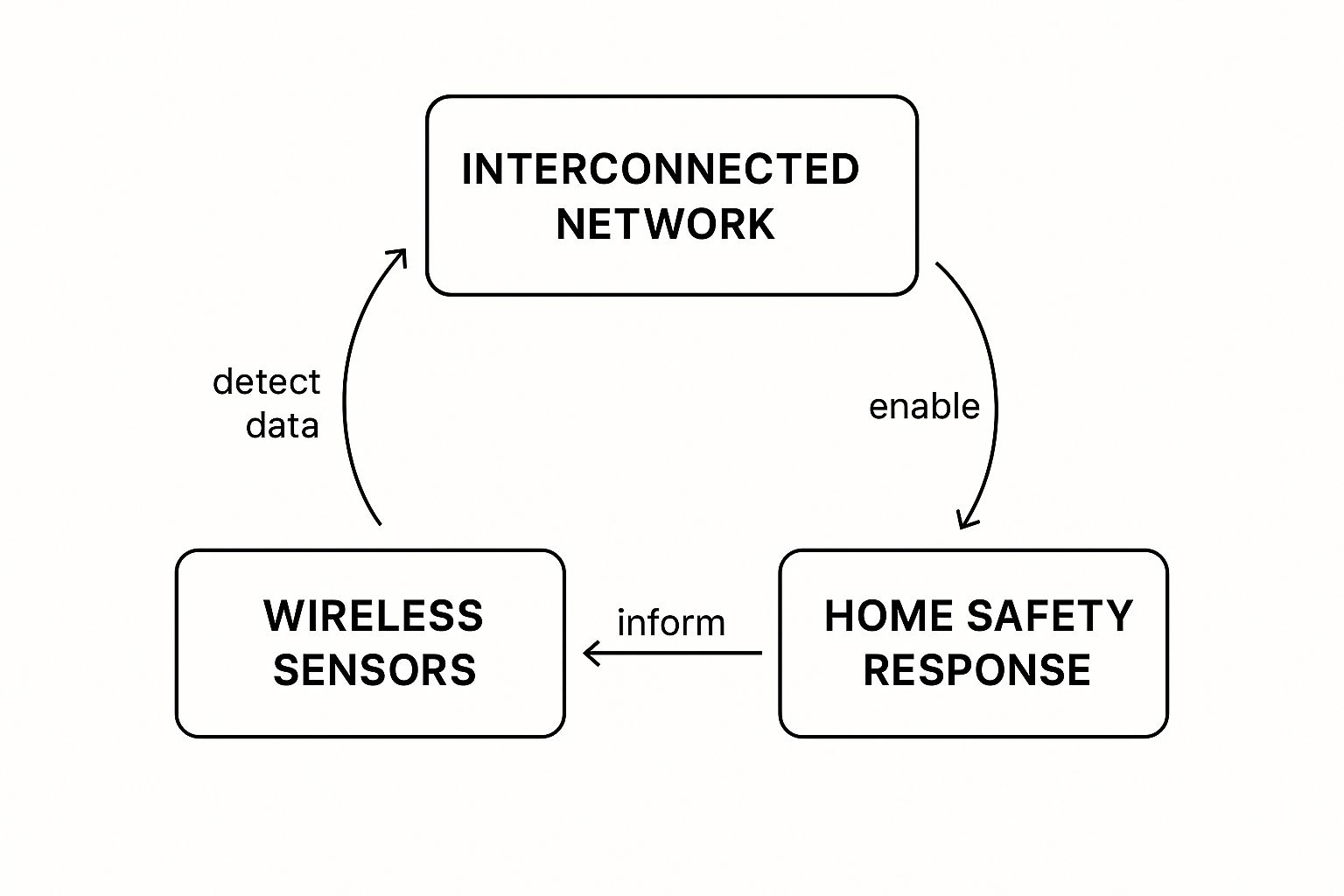
You can see how the network is the key—it turns a single trigger event into a maximum, house-wide alert that’s impossible to ignore.
To really appreciate the leap in safety, it helps to see the two types of alarms side-by-side. The difference is stark.
| Feature | Standalone Smoke Alarms | Wireless Interconnected Smoke Alarms |
|---|---|---|
| Alert System | Only the detecting alarm sounds. | When one alarm detects smoke, all alarms sound simultaneously. |
| Early Warning | Limited. You only hear it if you’re close enough. | Excellent. Provides immediate, whole-home notification. |
| Best For | Small, single-level apartments or studios. | Multi-level homes, large properties, and homes with attached garages. |
| Installation Complexity | Very simple; just mount it on the ceiling. | Simple wireless pairing; no new wiring needed. |
| Overall Safety | Provides a basic level of protection. | Offers a far superior, faster, and more reliable safety net. |
As the table shows, while standalone alarms meet a minimum standard, interconnected systems offer a truly comprehensive approach to fire safety.
These systems are built to work in the real world, easily overcoming the things that block sound, like closed doors and different floor levels. The RF signals they use are incredibly reliable, giving you robust coverage right across your property.
In fact, these alarms can typically communicate across distances of up to 30 metres between each unit and maintain a connection up to 100 metres away in open air. They’re even designed to work through solid concrete walls and floors.
The biggest advantage you get is time. By sounding the alarm everywhere at once, an interconnected system gives your family the most valuable thing in an emergency—those crucial extra seconds needed to get out safely.
Think about how this applies to a typical Brisbane home layout:
This isn’t just about making a louder noise. It’s a smarter, faster, and fundamentally safer way to protect your home and family.
Think back to old black-and-white movies. A house fire would start slowly, giving the family precious minutes to wake up and get out. That’s no longer our reality. Today’s homes are packed with synthetic materials in our couches, carpets, and electronics. These materials don’t just burn – they burn incredibly hot and dangerously fast.
This modern reality means a fire can become lethal in less than three minutes, spewing thick, toxic smoke that fills a house in the blink of an eye. Your safe escape window shrinks from several minutes down to just seconds. It’s a terrifying race against the clock, and it’s why a single, lonely smoke alarm in the hallway just doesn’t cut it anymore.

Let’s paint a picture to show why an interconnected system is so vital. Imagine it’s 2 AM, everyone is fast asleep, and a small electrical fault starts a fire in your downstairs living room.
With a basic, standalone smoke alarm, only that one device in the living room goes off. To wake you, the sound has to sneak through walls, creep up the stairs, and somehow get past your closed bedroom door. By the time that faint beeping finally registers, the fire has grown, and your main escape route could already be cut off by smoke.
This dangerous time lag is exactly the problem wireless interconnected smoke alarms were built to solve. They don’t wait for smoke to travel; they send an immediate digital alert.
Now, let’s replay that same fire with a modern interconnected system. The moment the living room alarm sniffs the first wisp of smoke, it doesn’t just scream on its own. It instantly blasts a radio signal to every other alarm in the house.
Suddenly, the alarms in every bedroom, hallway, and on every level erupt at full volume. The family is woken up at the same time, not one by one. This whole-home alert completely removes that deadly delay, turning what could have been a tragedy into a successful escape.
This immediate, unified alert gives you the most precious thing in a fire: more time. It’s the difference between waking to a muffled, distant beep and being jolted awake by a shrieking alarm right outside your bedroom.
A fire in a modern home can double in size every 30 to 60 seconds. An interconnected system gives you a whole-home alert from the very first detection, maximising your family’s chance of getting out safely before the situation becomes critical.
This isn’t just theory. Research from Fire and Rescue NSW has shown that fire detection is far more effective when smoke alarms are interconnected. Their studies confirm that a system where all alarms sound together ensures everyone gets the message, no matter where they are in the house, which dramatically boosts survival rates. You can read more about the findings on fire safety in Australian homes to see the data for yourself.
The logic is simple but incredibly powerful. A fire doesn’t stay put in one room, so your alarm system shouldn’t either. The serious risks posed by modern building materials and furnishings demand a faster, smarter, and more comprehensive warning.
A whole-home alert system has moved from being a ‘nice-to-have’ feature to an essential layer of protection for any Brisbane family. By making sure the earliest possible warning reaches everyone in the house simultaneously, you are actively fighting back against the speed and toxicity of modern house fires. This technology gives you the critical head start you need to keep your loved ones safe.
Queensland is now setting the pace for home fire safety in Australia, rolling out some of the most comprehensive smoke alarm regulations in the country. These aren’t just guidelines; they’re a mandatory standard designed to give every household the best possible chance of escape in a fire.
For anyone owning, renting, or managing a property in Brisbane, getting your head around these rules is crucial for both safety and legal compliance. The changes are a big deal, moving us away from old, isolated alarms to a much smarter, fully connected network.
The heart of the new legislation is the mandatory switch to interconnected photoelectric smoke alarms. What this means is simple: when one alarm detects smoke, every single alarm in the house goes off at the same time. This creates an impossible-to-ignore, whole-home alert, buying you precious time to get out safely.
This move to interconnection is a direct response to the frightening speed of modern house fires. A single, beeping alarm in a distant hallway just doesn’t cut it anymore.
The legislation is also very specific about where these alarms need to be placed to create a safety net across your home:
This strategic placement ensures there are no blind spots where a fire can take hold unnoticed. For a more detailed breakdown of the requirements for Queensland properties, check out our guide on interconnected smoke alarms in QLD.
The law is also crystal clear about the type of technology required. Queensland now insists on photoelectric alarms, which means the old ionisation models are officially on the way out. This isn’t just a random preference; it’s a decision based on solid fire safety science.
Photoelectric alarms are designed to “see” smoke using a beam of light. They are far superior at detecting the large smoke particles produced by smouldering fires—the kind that often start in furniture or from an electrical fault. These fires can fill a home with deadly, toxic smoke long before any visible flames appear.
The Queensland Government has mandated photoelectric alarms because they give a faster warning for the most common and deadliest types of house fires. This single change gives families a massive advantage, providing more time to escape safely.
The rollout of these new rules has been phased, but some key dates have already passed, and the final deadline is getting very close. It’s vital you know which category your property falls into to avoid fines and, more importantly, to ensure you’re protected.
Compliance Timeline:
This statewide upgrade has truly set a new benchmark for fire safety in Australia. The rules are clear, and the deadline is firm, ensuring every Queenslander has the highest level of protection in their home.
Picking out the right wireless interconnected smoke alarm system can feel a bit daunting with all the technical jargon and different features out there. But when you know what to look for, making a smart choice is actually pretty straightforward. The goal isn’t to buy the most expensive gadget; it’s to find a system that perfectly suits your home’s layout, meets your safety needs, and gives you reliable protection without being overly complicated.
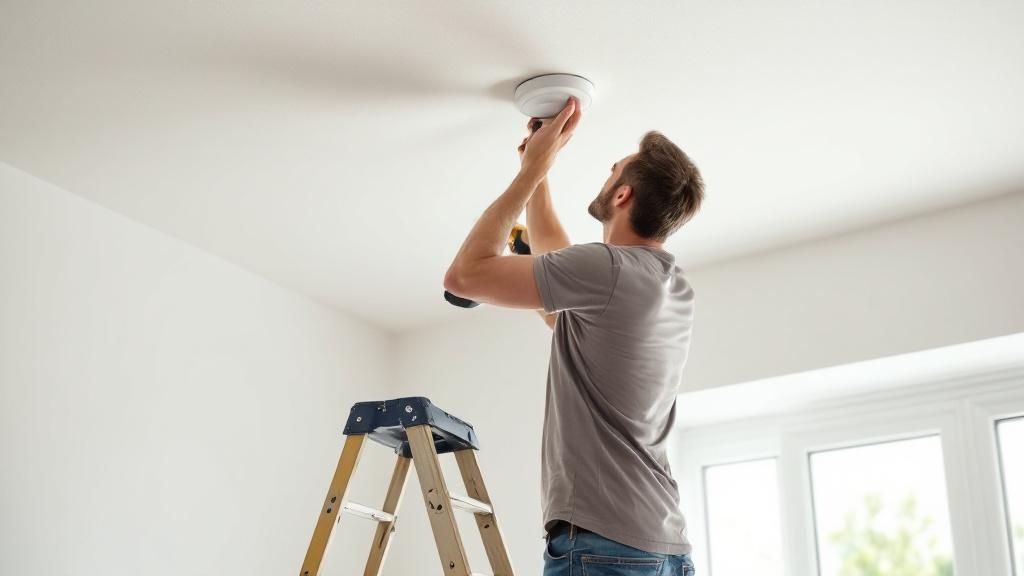
It’s all about matching the right features to your property. From how the alarms are powered to how many you can link together, let’s break down the key factors that will help you make the right call.
One of the first decisions you’ll make is about the batteries that power your alarms. This choice directly impacts how much maintenance you’ll have to do and how reliable the system is in the long run.
For peace of mind and hassle-free operation, sealed lithium batteries are easily the better choice, ensuring your system is powered up and ready to go for a full decade.
The “wireless” magic of these systems depends on a strong, stable radio frequency (RF) signal. The effective range of that signal dictates how far apart you can place your alarms while making sure they can still talk to each other reliably.
Most wireless interconnected smoke alarms have an indoor range of around 30-50 metres, which is plenty for the vast majority of Brisbane homes. But if you’re in a very large property, have multiple levels with dense materials like concrete, or want to link a detached garage or shed, you’ll need to double-check the maximum range.
You should also look at how many alarms can be linked together on one network. Most systems allow you to connect anywhere between 12 to 40 units. A standard three-bedroom house might need 5-7 alarms, so most systems on the market will have you well and truly covered.
A fire isn’t the only danger, and not all smoke is the same. To create a really robust safety net, you can add specialised alarms to your interconnected network. This is where you can tailor your system to handle specific risks in different parts of your home.
One of the best additions you can make is a heat detector. These don’t sense smoke at all; they’re triggered by a rapid jump in temperature.
Adding specialised alarms means you get the right type of detection for the right space. You can get more great tips on setting up the perfect system in our detailed guide to wireless linked smoke alarms.
To help you get a sense of what’s out there, we’ve put together a quick comparison of what you can generally expect from different tiers of wireless interconnected alarm systems available in Australia. This should help you balance your budget with the features you need.
| Feature | Entry-Level System | Mid-Range System | Premium System |
|---|---|---|---|
| Battery Type | Replaceable AA or 9V | 10-Year Sealed Lithium | 10-Year Sealed Lithium |
| Interconnection | Basic RF linking (up to 12 units) | Robust RF linking (up to 24 units) | Advanced RF linking (up to 40+ units) with signal boosters |
| Specialised Alarms | Smoke alarms only | Compatible with heat detectors | Compatible with heat, CO, and multi-sensor alarms |
| Extra Features | Test/Hush button | Location-based alerts, remote control hush | Smart home integration, app notifications, detailed diagnostics |
| Best For | Small apartments, budget-focused upgrades | Standard family homes, multi-level properties | Large homes, tech-savvy owners, ultimate safety integration |
Ultimately, the best wireless smoke alarm system is the one that gives you complete, reliable coverage for every corner of your property. By thinking about these key factors, you can confidently choose a system that will keep your home and family safe for years to come.
One of the best things about modern wireless interconnected smoke alarms is that installation is a job you can absolutely tackle yourself. This guide will walk you through the whole process, from cracking open the box to getting your complete safety network up and running. Forget about complicated wiring—the real keys to success are pairing the units correctly, placing them strategically, and testing the system to make sure they all work as one.
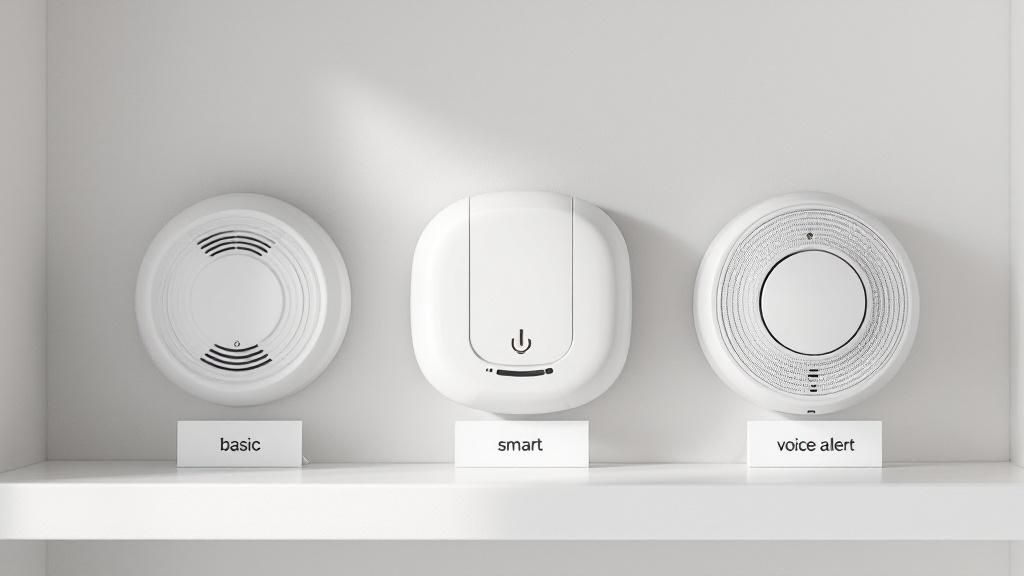
Before you even think about picking up a drill, the first and most critical step is teaching all the alarms to talk to each other. This is all about creating that synchronised, whole-home alert.
Think of this part like introducing all the members of a new team so they know who to work with. It’s vital you do this on a table or benchtop before you start climbing ladders and mounting them on the ceiling. Every brand has a slightly different button-press sequence, but the basic idea is always the same.
Seriously, take a moment to read your product manual. It will have the exact instructions for your specific model and save you a lot of guesswork.
Where you put your alarms is just as important as having them in the first place. Bad placement can create “dead air” spots where smoke builds up slowly, or it can trigger those infuriating false alarms every time you make toast. The good news is that the Australian Standards (AS 3786:2014) give us clear, common-sense rules to follow.
Key Placement Rules:
Following these simple rules ensures your alarms are in the best possible position to detect a real fire as early as possible, giving you and your family precious extra seconds to escape without the constant annoyance of false alarms.
This is the final and most satisfying step—the one that proves your new safety network is ready to go. You aren’t just testing a single alarm here; you’re confirming the connection between all of them.
Performing this full network test gives you complete peace of mind. It’s the final confirmation that if one alarm senses smoke, they all scream together—delivering the whole-home alert that is the entire point of a wireless interconnected smoke alarm system.
Think of your wireless interconnected smoke alarm system as a silent guardian, always on watch. To make sure it performs flawlessly when it matters most, a simple and regular maintenance routine is all it takes. Investing just a few minutes here and there ensures your entire network remains a reliable lifesaver.
Keeping the system in top shape is surprisingly easy. Because the alarms are all linked together, you only need to press one test button to check the whole network. This completely removes the hassle of dragging a ladder into every room just to test each unit one by one.
The most important habit you can build is testing your system every month. This quick check confirms not only that the alarms have power but also that their wireless connection is strong and stable. It’s like a fire drill for your technology.
A monthly test ensures every single unit is communicating correctly with the others. For a detailed walkthrough, our post on how to properly test a fire alarm gives you clear, step-by-step instructions.
Beyond testing, a bit of cleaning goes a long way. At least twice a year, gently vacuum the outside of your alarms using a soft brush attachment. This simple action clears away dust, cobwebs, and insects that can obstruct the sensors, which can either trigger annoying false alarms or, worse, prevent the unit from detecting real smoke.
Regular maintenance isn’t just about ticking a compliance box; it’s about confidence. A well-maintained system gives you the peace of mind that your family is protected by a network that’s always ready to respond instantly.
Your alarms are designed to tell you what they need. A single, intermittent chirp every minute or so usually signals a low battery, though this is quite rare with modern 10-year sealed lithium battery models.
The most critical signal to recognise is the end-of-life warning. After about a decade of service, the alarm’s internal sensors naturally degrade. When this happens, the unit will start chirping consistently to let you know it’s time for a full replacement. Never ignore this alert. It means the alarm has reached the end of its reliable service life and must be replaced entirely to keep your home properly protected.
Of course. Here is the rewritten section, crafted to sound like a human expert while preserving all the original information, links, and formatting requirements.
Making the jump to a modern safety system is a big deal, and it’s totally normal to have a few questions floating around. Let’s tackle some of the most common things Brisbane homeowners ask us when they’re thinking about upgrading to wireless interconnected smoke alarms.
First up, the big one: cost. Yes, the initial price tag is a bit higher than what you’d pay for a single, old-school standalone alarm. But you’re not just buying a product; you’re investing in a whole-home safety net that gives everyone a much faster, more reliable warning when it matters most.
Another common query is about mixing and matching different brands. Our strong advice? Don’t do it. It is not recommended to mix different brands within the same interconnected network. Each manufacturer uses its own radio frequency and communication protocols. Think of it like trying to get two different brands of walkie-talkies to chat—they’re just not on the same channel. For a system that works flawlessly, stick with one brand throughout the house.
This is where the flexibility of wireless interconnected smoke alarms really comes into its own. They’re a fantastic solution for pretty much any type of Brisbane property.
The goal is to create your own secure, independent network within your home or unit. This way, a bit of burnt toast in your neighbour’s kitchen won’t trigger every alarm in your place. You get a reliable safety bubble that’s all your own.
This is a really important point and a source of a lot of confusion. Let’s clear it up: these smoke alarms do not use your home Wi-Fi to talk to each other. They operate on their own dedicated, low-frequency radio signal.
So, if the NBN drops out or a storm knocks out the power, it makes no difference. The alarms will keep communicating with each other without a hitch, running on their long-life backup batteries. Your safety net stays up and running, no matter what.
Ready to secure your home with a fully compliant, professionally installed smoke alarm system? The expert team at DLG Electrical is here to help. Contact us today for a free quote and enjoy the peace of mind that comes with superior fire protection.

Master Electrician with over 30 years of experience. Founded DLG Electrical in 2005 after international project work including electrical installations at Stamford Bridge Stadium, London(Home of Chelsea FC).

Local Electricians that can fix all Electric Hot water Systems.
Motion sensor lights are a versatile addition to any home, offering nu
