83 Jean St, Grange QLD 4051
Mon-Fri 07:30 AM - 04:00 PM - Sat - 8:00 - 12 - Sunday Closed

If you’re trying to make sense of the wiring behind your walls, you’ve probably noticed it’s not just a random jumble of colours. Those colours are a critical safety language, telling electricians exactly what each wire does. Get it right, and the system is safe. Mix them up, and the consequences can be disastrous.
In Australia, the colour-coding system has evolved over the years, which is a key reason you should never tackle electrical work yourself. What you find in an older home can be completely different from a new build.
At its core, the colour system helps electricians quickly identify a wire’s function—whether it’s active (carrying power), neutral (completing the circuit), or earth (the safety wire). Think of it like a universal alphabet for electricity that prevents shocks, short circuits, and fires.
This guide will walk you through the current standards and the older ones you might still find in your home, giving you a better understanding of what your electrician is looking at.
The biggest point of confusion for homeowners is the shift in Australian wiring standards. A major change happened around the early 2000s to harmonise our local codes with international ones. Before this, Australia used a completely different set of colours for active and neutral wires.
Recognising which system your home has is the first step in any electrical assessment, but it’s a job for a professional with a multimeter, not just a visual check.
“A standardised colour code is all about safety and efficiency. It lets electricians identify wires with confidence, especially during renovations or emergencies. Fewer mix-ups mean safer homes and faster, more accurate work.”
This harmonisation, governed by the AS/NZS 3000 wiring rules, has played a massive role in improving electrical safety nationwide. Since the standards were formalised and updated, we’ve seen a huge drop in electrical accidents. In fact, electrocution incidents among workers fell by over 50%, from 4.2 per 100,000 in the 1980s to just 2.1 by 2020, largely thanks to clearer, safer standards like these.
This image neatly illustrates the divide between the two main eras of Australian wiring.
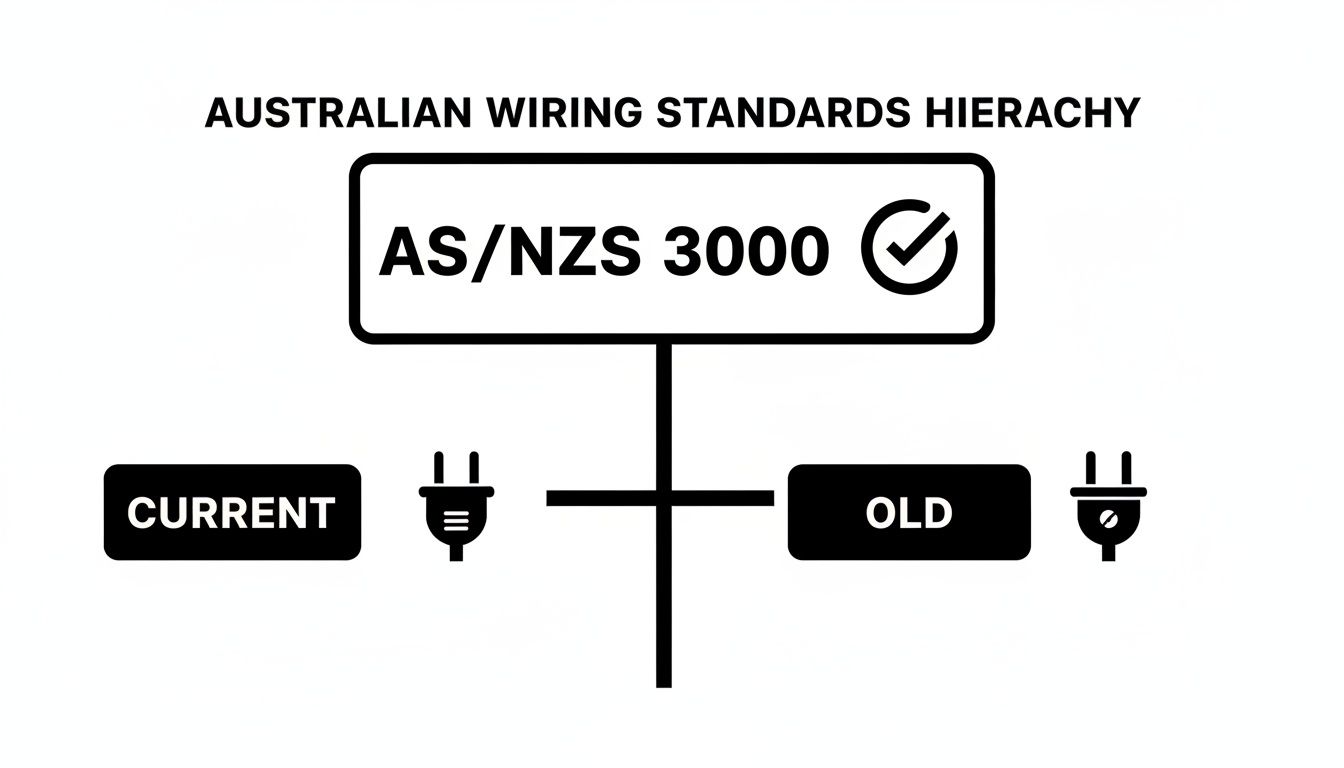
On one side, you have the modern, internationally-aligned colours, and on the other, the legacy system still present in many older Australian homes. It perfectly highlights why correct identification is so critical.
To give you a quick visual reference, here’s a simple table comparing the modern colours with the old system you’re likely to find in pre-2000s properties.
| Function | Current Colour (Post-2000) | Old Colour (Pre-2000) |
|---|---|---|
| Active/Live | Brown | Red |
| Neutral | Light Blue | Black |
| Earth | Green & Yellow stripes | Green |
While this table is a great starting point, remember the golden rule of electrical work: never assume a wire’s function based on its colour alone. Old wiring, DIY mistakes, or non-compliant work can all lead to dangerous surprises. Always trust a licensed electrician to test and verify every connection before starting any job.
If you’ve ever looked at the wiring in a modern Australian home, you might wonder why sparkies use the colours they do. It wasn’t an arbitrary choice; it was a critical step forward for electrical safety, governed by a document called AS/NZS 3000, also known as the “Wiring Rules.”
This standard is the bible for every licensed electrician in Australia and New Zealand. It sets the benchmark for safe electrical design and installation, ensuring every new job is consistent, reliable, and—most importantly—safe. The big push was to harmonise our local standards with those used internationally, especially in Europe.
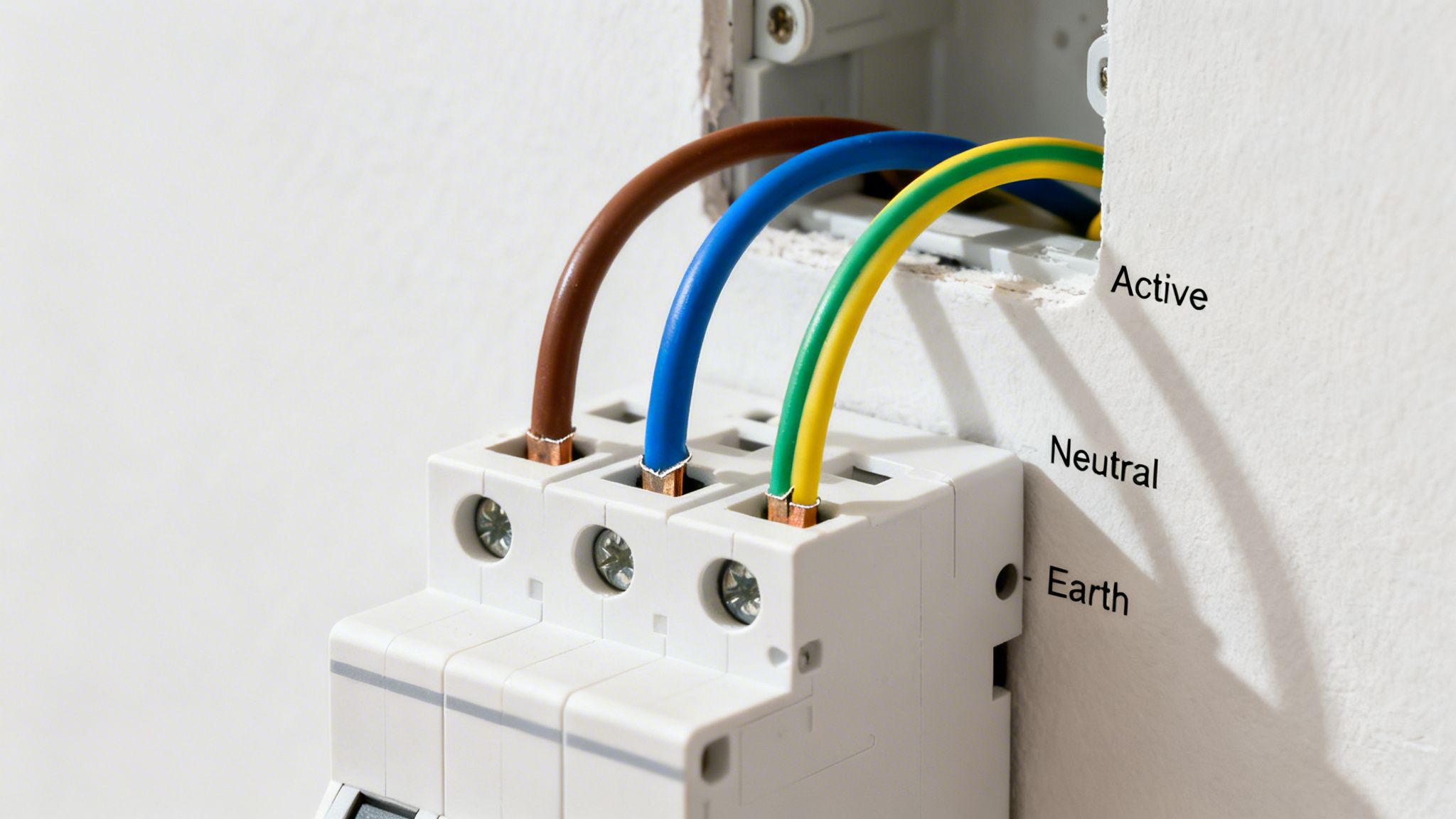
Think about it: with appliances and light fittings coming in from all over the world, having a common colour “language” is just plain common sense. It drastically reduces the risk of dangerous installation errors, making sure that imported pendant light follows the same safety logic as a locally installed power point. This minimises confusion and potential hazards for the professionals working on the system.
The easiest way to think about your home’s standard single-phase wiring is like a simple, dedicated traffic system designed to control the flow of electricity. Each colour has a distinct and non-negotiable role. Getting these roles straight is key to understanding why the AS/NZS 3000 standard is so vital for protecting your property and your family.
Here’s how the modern system breaks down:
This straightforward, three-colour system is the backbone of modern electrical safety. It creates a predictable and logical framework that removes the guesswork—and when you’re dealing with electricity, guesswork is the last thing you want.
So, what’s the practical benefit of aligning with international standards? It all comes down to safety and reliability. Before this change, the old Australian system used a black wire for the neutral function. Here’s the catch: in the modern three-phase system, a black wire is now used as a live (active) wire.
This is a critical distinction, and it’s where things can get dangerous. An electrician working on a system with a mix of old and new wiring has to be extremely careful not to confuse an old neutral wire with a new active one. Making that mistake could energise the metal frame of an appliance or cause a short circuit, creating an immediate fire or shock risk. You can learn more by exploring the details of electrical wiring standards in Australia and see why they are so vital for home safety.
Ultimately, the AS/NZS 3000 standard provides a clear, modern framework that supports safe installations and reduces the chance of catastrophic errors, ensuring your home’s electrical system is as safe as it can possibly be.
Cracking open a light switch or poking your head into the roof space of an older Aussie home can be like stepping back in time. Instead of the familiar brown, blue, and striped green/yellow wires of a modern installation, you might find yourself looking at a trio of red, black, and green.
Seeing these colours is an instant sign that your home’s electrical system dates back to a previous era.
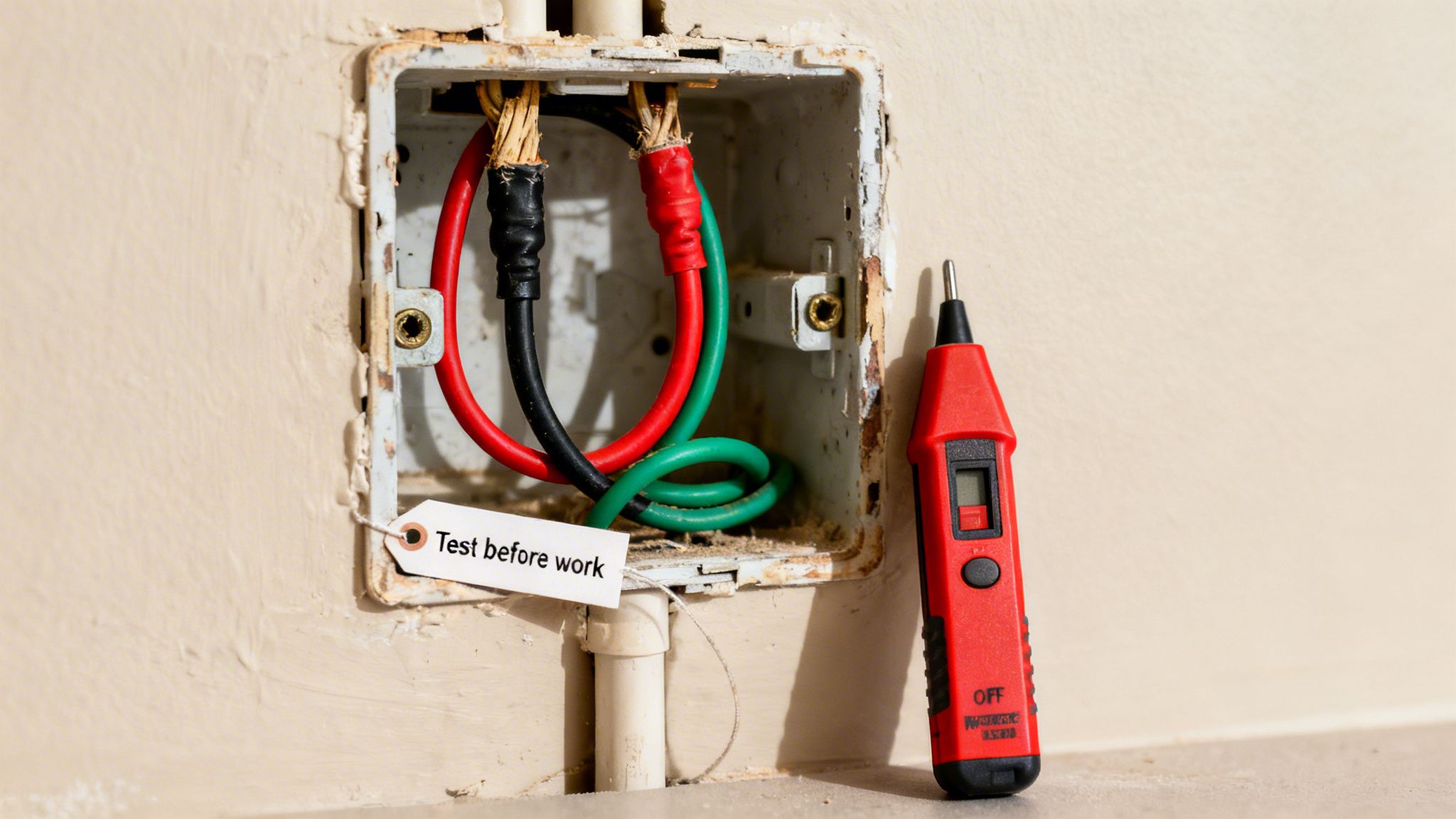
This legacy wiring isn’t automatically dangerous—it powered homes perfectly well for decades. But it’s a massive red flag. Its presence strongly suggests your home is missing modern safety essentials like circuit breakers and safety switches (RCDs), which are now non-negotiable under Australian law.
The single biggest mistake you can make with old wiring is to assume a wire’s job based on what colour it is. It’s a gamble you should never take.
Over the years, countless renovations, extensions, or dodgy DIY jobs could have completely changed the original circuit. A wire that looks like a neutral might have been repurposed as an active, creating a lethal trap for the next person who works on it.
Back in 1894, Australian wiring codes were just voluntary guidelines. It wasn’t until 2000, with the introduction of the AS/NZS 3000 standard, that things got serious and uniform. Before that, the old system was standard: red for active, black for neutral, and solid green for earth.
Golden Rule of Electrical Work: Never, ever trust colour alone. Every single wire must be professionally tested and identified before you even think about touching it. A colour code is a guide, not a guarantee.
This is the rule every licensed electrician lives by. We never rely on sight alone. We use multimeters and testers to confirm the function of every single wire in a circuit. It’s the only way to eliminate guesswork and prevent a disaster. When faced with old or unidentifiable wires, a critical first step is to test continuity with a multimeter to safely trace where each circuit goes.
Discovering old red, black, and green wiring doesn’t mean you need to panic, but it is a clear signal to take action. This wiring system is a tell-tale sign that your property is decades old and almost certainly overdue for a professional safety check. An outdated switchboard paired with old wiring is a significant fire risk and simply wasn’t designed to handle the load of modern appliances.
Here’s exactly what you need to do:
Treating old wiring with the respect it deserves is crucial. It comes from a time with different safety standards, and bringing your home up to modern code is the best way to protect your property and the people in it.
Not all electricity arrives at your property in the same way. When you open up an Australian switchboard, you’re looking at one of two main supply types: single-phase or three-phase power. Figuring out which one you have is the first step to understanding why your home’s wiring is set up the way it is.
Think of it like roads. Single-phase power is the standard two-way street that runs through most neighbourhoods. It’s perfectly fine for the everyday “traffic” of a typical home—handling your lights, toaster, TV, and other standard appliances without a problem.
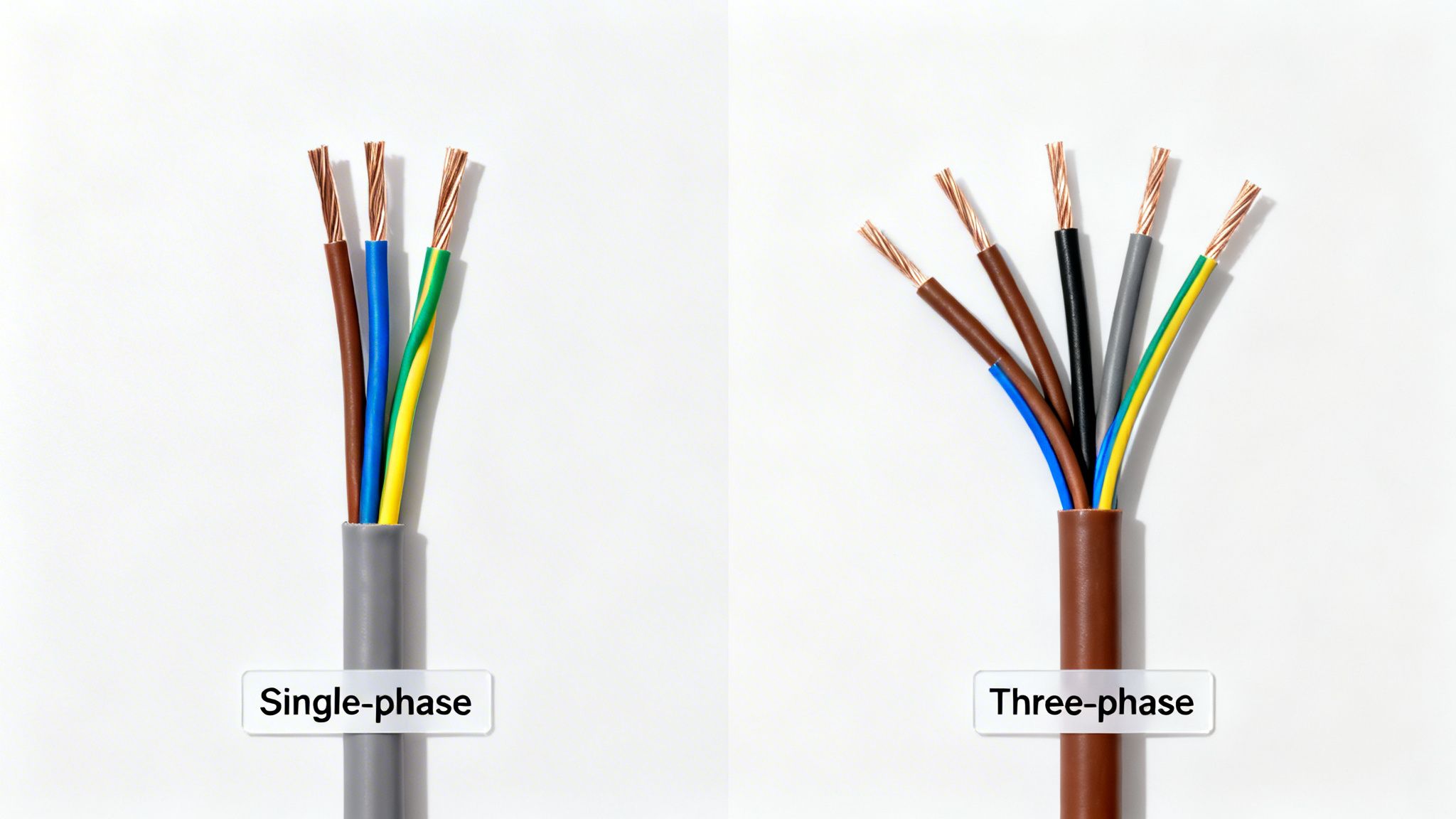
Three-phase power, on the other hand, is like a three-lane highway. It’s built to handle a much heavier and more consistent flow, delivering a serious amount of power. While it’s standard for commercial and industrial sites, it’s becoming much more common in larger, modern homes with high-demand appliances.
For the vast majority of Aussie homes, a single-phase system is all that’s needed. The wiring colours for this setup are nice and simple, following the modern AS/NZS 3000 standard. It’s a basic trio of wires working together to safely power your daily life.
This setup is rock-solid and more than capable of handling the electrical load of an average family. The only time it might run into trouble is when your power demands start to get really high, and that single “road” becomes congested.
If your home runs some seriously power-hungry gear, a single-phase supply might start to struggle. This is where a three-phase connection comes into its own. We’re talking about things like large ducted air conditioning systems, big swimming pool heaters, workshop machinery like welders, or even some of the more powerful electric vehicle chargers.
A three-phase system delivers power more smoothly by providing three separate active connections. This is where the wiring colour codes Australia get a bit more complex, as you now have three active wires to keep track of instead of just one.
A three-phase supply essentially triples your home’s electrical capacity. It splits the total load across three circuits, preventing any single one from being overloaded and ensuring those high-draw appliances run smoothly without causing flickering lights or tripping breakers.
The modern colours for a three-phase setup are:
Take a good look at that list. Black is now an active wire. This is a massive safety point to remember, especially if you’re used to the old system where black was neutral. Getting this wire mixed up could have catastrophic results.
For homeowners thinking about a power upgrade, it’s worth reading up on the process of a three-phase power installation to get a handle on the benefits and what’s involved.
Ultimately, knowing whether your home is single or three-phase helps you understand its electrical limits and have a much better-informed chat with your electrician about any future upgrades.
Once you get past the standard Active, Neutral, and Earth wires, things can get a bit more confusing. Some circuits use different colours or even familiar colours in unexpected ways, leaving many homeowners scratching their heads. Understanding these setups shows just how complex electrical work can be, and it’s a stark reminder of why you should only ever let a licensed sparkie open up a switch or power point.
Making assumptions about wiring is one of the most dangerous things you can do. A wire’s colour is just a guide; its true purpose can only be confirmed with proper testing gear. Let’s pull back the curtain on a few common wiring mysteries you might come across.
Ever opened a light switch in a modern home and found a random red wire when you were expecting brown? Or maybe you’ve seen an odd colour like orange or purple lurking in there? Chances are, you’re looking at a switched active, sometimes called a “switched live.”
Here’s the logic: a permanent active wire (brown in modern wiring) brings constant power to the switch. When you flick that switch on, the power then travels from the switch up to the light fitting. The wire carrying this “switched” power is the switched active.
Electricians often use a different colour for this wire to avoid mixing it up with the permanent active feed. In older homes, red was a common choice for this, which can definitely cause confusion when you see it alongside modern brown wiring.
The classic example of tricky wiring is a two-way switch setup, where you can control one light from two different spots—like at the top and bottom of your stairs. It’s incredibly handy, but it means there are more wires packed into the circuit.
To get this to work, electricians run special wires called strappers or travellers between the two switches. These wires don’t follow the standard brown, blue, and green-yellow colour scheme.
It’s in setups like two-way switching that the importance of the wiring colour codes Australia really hits home. While the standards provide a baseline, these specific applications need a sparkie’s expert eye to interpret safely and correctly.
Finding an unexpected wire colour can be a bit unsettling, but there’s almost always a logical reason for it. Electricians use these non-standard colours to identify specific parts of a circuit that aren’t your typical active, neutral, or earth.
Common uses for colours like white, orange, or even purple include:
The single most important takeaway here is to never assume a wire’s function based on its colour, especially if it isn’t the standard brown, blue, or green/yellow. Looking is one thing, but touching is another. Any action requires a licensed professional with the right testing tools to verify exactly what each wire is doing.
Understanding the theory behind wiring colour codes Australia is one thing, but actually grabbing the tools and putting that knowledge into practice is a whole different world. It can be mighty tempting to save a few quid by tackling what seems like a simple job—a new power point here, a light fitting there—but this is one gamble you should never take. The risks aren’t just about making a simple mistake; they’re about life and death.
Right across Australia, it’s illegal for anyone without a licence to perform electrical work, and for a very good reason. A single wire in the wrong place can create a ticking time bomb inside your walls, ready to spark a fire. It can also turn a harmless metal appliance like your kettle or toaster into a lethal electrocution hazard. And the scariest part? A faulty installation might not show any signs of trouble for years, lying dormant until disaster strikes.
Beyond the immediate threat to your safety, uncertified electrical work can be financially devastating. If an electrical fault or fire is traced back to your DIY handiwork, you can bet your home insurance policy will be instantly voided. That could leave you on the hook for hundreds of thousands of dollars in damages, all because you wanted to save a small fee for a professional.
On top of that, state regulators don’t mess around. They can issue crippling fines for unlicensed electrical work, with penalties soaring into the tens of thousands of dollars. The serious dangers of electricity aren’t just confined to big industrial sites; learning about workplace safety risks in electric utilities really drives home why only trained, qualified professionals should ever handle wiring, whether it’s on a job site or in your own home.
When you hire a licensed sparkie, you’re getting so much more than just someone to connect a few wires. You’re investing in their years of rigorous training, their deep understanding of the AS/NZS 3000 safety standards, and their professional guarantee of a safe, compliant job.
A true professional never relies on colour alone. They use specialised testing equipment like multimeters and insulation resistance testers to confirm what every single wire is doing. This is the only way to be 100% certain that a circuit is wired correctly, free from hidden faults, and absolutely safe to use.
A licensed electrician will always provide a Certificate of Compliance for their work. This is a crucial legal document. It’s your official proof that the installation is safe, meets all Australian standards, and protects both your insurance policy and your property’s value. It’s the ultimate peace of mind.
At the end of the day, the choice is clear. Knowing your wiring colours is great—it helps you have an intelligent conversation with your electrician and spot obvious red flags. But when it comes to the actual hands-on work, it must always be left to a licensed professional who can guarantee the safety of your home, your family, and your financial future.
Even when you know the rules, real-world wiring can throw some curveballs. Let’s tackle some of the most common questions our electricians get asked about Australian wiring colours, always keeping safety front and centre.
Absolutely, and it’s something we see almost every day. If your home has had an extension, a renovation, or even just a single new circuit installed over the years, you’ll likely have a mix of the old (red/black/green) and the new (brown/blue/green-yellow) wiring.
This isn’t automatically dangerous, as long as a licensed electrician did the work. A professional will use compliant junction boxes to safely connect the two systems, often labelling the transition so it’s clear how the old colours map to the new ones. If you do find mixed wiring, it’s always a good idea to get an electrical inspection to make sure everything is safe and up to scratch.
Finding an orange, purple, or white wire can be confusing, but whatever you do, don’t make assumptions about its job. Electricians sometimes use these non-standard colours for very specific functions in more complex circuits where the usual colours are already taken.
Never assume an unusual wire colour is safe to touch. Non-standard colours are often used for specific functions like two-way switching or ceiling fans, but their purpose can only be confirmed through professional testing.
For instance, an orange wire might be used as a ‘strapper’ between two-way light switches. In much older three-phase installations, a white wire was actually a live active conductor. Mistaking that for a neutral could be a fatal mistake. The only safe move is to call a qualified electrician to test the wire and figure out its exact role.
While there’s no single rule set in stone, a good rule of thumb is to have a full electrical safety inspection every 5 to 10 years. It’s especially critical if you’re buying an older home, as an inspection can uncover hidden dangers before they turn into serious hazards.
You should also call a sparkie straight away if you spot any of these warning signs:
These symptoms often point to serious underlying issues with your wiring that need immediate professional attention.
At DLG Electrical, we’ve dealt with every wiring combination you can imagine, and we know how to safely navigate the mix of old and new systems. If you have any worries about your home’s electrical safety, don’t guess—get an expert opinion. Contact us for a comprehensive electrical inspection and get the peace of mind you deserve.

Master Electrician with over 30 years of experience. Founded DLG Electrical in 2005 after international project work including electrical installations at Stamford Bridge Stadium, London(Home of Chelsea FC).

Local Electricians that can fix all Electric Hot water Systems.
Motion sensor lights are a versatile addition to any home, offering nu
