83 Jean St, Grange QLD 4051
Mon-Fri 07:30 AM - 04:00 PM - Sat - 8:00 - 12 - Sunday Closed

Electrical Switch Boards. Your electrical switchboard is the central nervous system of your home’s power supply. In simple terms, it takes the raw power coming in from the street and safely distributes it to every light, power point, and appliance you rely on every single day.
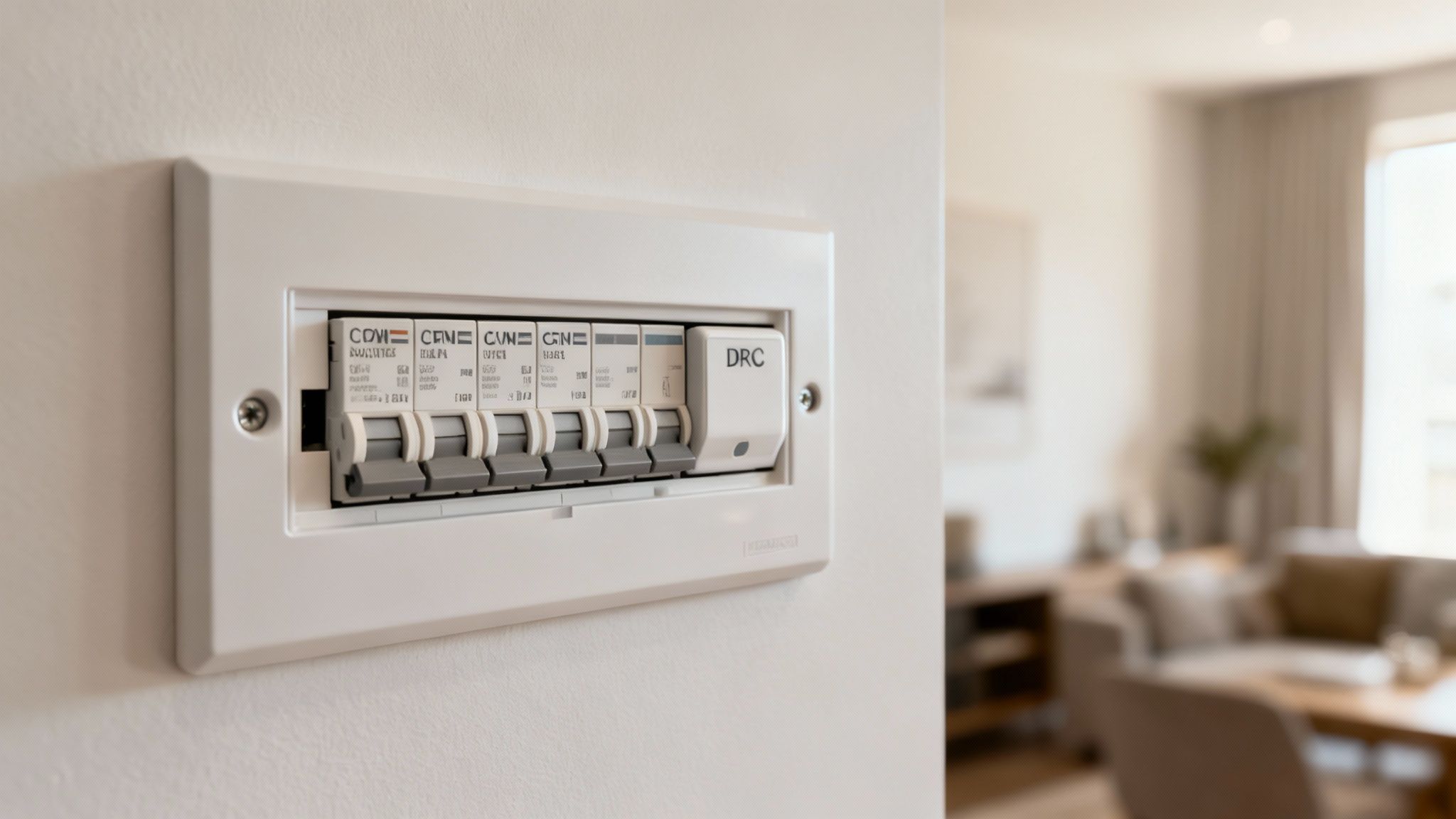
Think of your electrical switchboard as the heart of your home. It pumps electricity through the wires (the “arteries”) to exactly where it’s needed. It’s the command centre that manages the entire flow of power, making sure every circuit gets the right amount of current without being overloaded. When something goes wrong, this is where the power gets shut off instantly to prevent disaster.
Without a functioning switchboard, your home is just a building with no power. It’s a completely non-negotiable piece of equipment for modern living, especially here in Brisbane where our reliance on power-hungry appliances like air conditioners is massive. A modern, well-maintained board isn’t just about convenience—it’s absolutely critical for safety.
Behind that plain metal cover, you’ll find a series of switches and safety devices that act as the guardians for your home’s electrical circuits. Each one has a specific job, and they all work together to protect your property and, more importantly, your family.
Here’s a quick look at the key components inside a typical residential switchboard and what they do to keep your home powered and safe.
| Component | Primary Function |
|---|---|
| Main Switch | Your master kill-switch. It allows you to shut down the entire power supply to your property in an emergency or for repairs. |
| Circuit Breakers | These are the workhorses. They automatically ‘trip’ (turn off) if a circuit draws too much current, preventing overheating and potential fires. |
| Safety Switches (RCDs) | These are genuine life-savers. They detect tiny, dangerous disruptions in electrical flow and cut the power in milliseconds to prevent severe electric shock. |
Understanding what these parts do makes it clear why a switchboard upgrade is so important for older homes.
A circuit breaker protects your home’s wiring and appliances. A safety switch is designed to protect people. Queensland law now mandates safety switches on all domestic circuits for this very reason.
Getting your head around each component is the first step to appreciating why keeping your switchboard up-to-date is so vital. You can learn more by checking out our detailed guide on choosing the right electric switchboard for your home. This single box is truly the foundation of your home’s entire electrical safety system.

Your electrical switchboard is the silent guardian of your home, working away behind the scenes. But when it starts showing signs of trouble, it’s not something you can afford to ignore. An old or failing board isn’t just an inconvenience; it’s a serious safety risk hiding in plain sight.
So, how do you know if your switchboard is struggling to keep up? Some signs are obvious, while others are a bit more subtle. Let’s walk through what to look for.
The most common signs of a switchboard on its last legs are often brushed off as minor quirks. In reality, they’re symptoms of a much bigger problem.
These aren’t “wait-and-see” issues. They’re clear warnings that your electrical switch board needs a professional inspection, and fast.
Your home’s electrical system should operate silently and seamlessly in the background. Constant disruptions like tripping circuits or flickering lights are your system’s way of crying for help.
Sometimes, the need for an upgrade isn’t about a fault but about future-proofing your home. Your current board might seem fine today, but it could be dangerously unprepared for what’s coming next.
You should be seriously thinking about an upgrade if you are:
It can be hard to know if your switchboard is up to scratch just by looking at it. This simple checklist helps you compare the outdated, risky features of old systems with their modern, safe alternatives.
| Warning Sign (Old System) | Modern Solution (New System) | Associated Risk |
|---|---|---|
| Ceramic/Rewirable Fuses | Circuit Breakers (MCBs) | Slow to react, fire hazard, requires manual replacement. |
| No Safety Switches | Residual Current Devices (RCDs) | High risk of severe electric shock from faulty appliances. |
| One or Two Circuits for the Whole House | Dedicated Circuits for Major Appliances | Frequent tripping, overloaded wiring, and fire risk. |
| Visible Scorch Marks or Damage | Clean, Well-Organised Enclosure | Indicates overheating and an immediate fire hazard. |
| Asbestos Backing Panel | Modern Fire-Rated Enclosure | Health hazard from asbestos fibres during any work. |
If your switchboard has any of the features in the “Warning Sign” column, it’s a clear signal that an upgrade isn’t just a good idea—it’s essential for the safety of your home and family.
For any Brisbane homeowner, keeping up with Queensland’s electrical safety laws isn’t just about paperwork—it’s about keeping your family and your property safe. These rules are in place for a very good reason: to prevent electrical tragedies. Understanding them is key, especially when looking at your home’s electrical switch board, as the laws dictate exactly what needs to be inside it.
The biggest rule change for homeowners in recent years revolves around safety switches, which you might also know as Residual Current Devices (RCDs). These are the absolute lifesavers in your switchboard. They work by detecting the tiniest leak of electrical current—the kind that can cause a fatal electric shock—and shutting the power off in a fraction of a second. A common myth is that you only need them on your power points. That’s no longer the case.
In Queensland, the law is crystal clear: all domestic homes must have safety switches fitted on every single circuit. That includes power points, lights, air conditioners, ovens, and even your hot water system. This isn’t just for new builds; it applies to existing homes whenever certain electrical work is done.
This all-encompassing rule is often the trigger for a switch board upgrade. If you’re renovating or installing a big new appliance, an electrician will find that an old board simply doesn’t have the physical room or the right setup to add a safety switch for every circuit.
Another major piece of Queensland legislation that often leads to a switch board upgrade is the interconnected smoke alarm law. Since 2022, any home being sold or leased must have interconnected photoelectric smoke alarms. These alarms must be hardwired directly to your home’s main power supply (or run on a special 10-year non-removable battery).
Most homeowners go for the more reliable hardwired option, but doing so creates a brand new electrical circuit that needs to be protected just like any other.
So, the simple act of making your home compliant with smoke alarm laws can quickly highlight that your old switch board is no longer up to the job. This makes an upgrade not just a good idea, but a necessary step to meet your legal and safety obligations.
For a deeper dive into the nitty-gritty, you can learn more about the various Australian electrical wiring standards that every licensed electrician must adhere to. A qualified professional ensures every part of your installation—from RCDs to smoke alarm wiring—meets these strict safety standards, giving you total peace of mind.
Thinking about getting a new electrical switchboard installed might sound like a major, disruptive job, but you’d be surprised how smoothly it runs when handled by a professional. For the vast majority of Brisbane homes, a full upgrade is a clean, single-day affair.
Knowing the steps involved demystifies the whole thing and helps you understand exactly what to expect on the day.
The journey always kicks off with a thorough on-site inspection. A licensed electrician will come out to assess your current switchboard, your home’s wiring, and the overall electrical load you’re placing on the system. This is far more than a quick glance; it’s a proper safety evaluation to pinpoint outdated dangers like old ceramic fuses or asbestos panels and to figure out the capacity you’ll need for a modern lifestyle.
After this assessment, you’ll get a detailed, fixed-price quote that clearly breaks down all the work, materials, and costs. No surprises.
Once you give the green light on the quote, we’ll schedule the installation. The process is handled methodically to guarantee safety and compliance at every single stage.
This flowchart gives you a simple visual of the path from understanding the legal requirements to getting a fully compliant upgrade sorted.

As you can see, the legal rules are what kickstart the need for an inspection and, often, an upgrade, creating a clear chain of compliance. Of course, understanding the costs involved is a big part of the picture. You can learn more about the factors that influence the price of a switch board upgrade in Brisbane in our detailed guide.
When it comes to your home’s electrical switchboard, there’s only one rule: call a professional. Let’s be blunt—DIY electrical work isn’t just a bad idea. It’s illegal, incredibly dangerous, and could instantly void your home insurance policy.
This is one area where trying to save a few dollars can lead to catastrophic results, from devastating house fires to fatal electric shocks. There are no second chances.
Hiring a licensed electrician is your only guarantee of safety, quality work, and full compliance with Queensland’s strict regulations. These professionals have spent years in rigorous training to master the complex standards that govern electrical installations. They are the only people legally authorised to touch your switchboard and, crucially, issue the Certificate of Compliance when the job is done. That certificate is your formal proof that the work was performed safely and to code.
Not all sparkies are created equal. Before you let anyone near your wiring, it’s vital to do a few quick checks to protect your home and your investment.
Here’s what you absolutely must verify:
Making an informed decision when hiring an electrician isn’t just about ticking boxes; it’s about safeguarding your most valuable asset. Verifying these credentials ensures your switchboard upgrade is performed safely and legally, protecting your home and family.
When you’re choosing a licensed electrician, don’t forget to consider their professionalism and how they handle communications, especially when you have an urgent issue. It’s interesting to see how modern tools are helping skilled electricians ensure they never miss a critical call for help.
Ultimately, taking a few minutes to vet a professional is a small step that delivers huge returns in safety and reliability.
We get a lot of the same questions from Brisbane homeowners about their switchboards. It’s completely understandable—they’re complex bits of kit, but getting your head around the basics is key to making smart, safe decisions for your property.
Let’s clear up some of the common points of confusion.
How Long Does a Modern Switchboard Last?
A professionally installed, modern switchboard from a quality brand should give you 20 to 30 years of reliable service.
Of course, that lifespan can be shortened by Brisbane’s classic humidity and heat, not to mention how heavily you use your power. That’s why we recommend a quick professional inspection every 5 years or so, just to make sure all the components are still in top shape and doing their job safely.
What Is the Difference Between a Circuit Breaker and a Safety Switch?
This is one of the most important distinctions to understand. They both trip and cut the power, but they do it for completely different, life-saving reasons.
A circuit breaker is there to protect your home’s wiring and appliances. It trips when it detects an overload—too much current being drawn through the circuit. Think of running a power-hungry dishwasher and a clothes dryer on the same circuit; the breaker will trip to stop the wires from overheating and creating a fire risk.
A safety switch, or RCD (Residual Current Device), is there to protect people. It monitors the flow of electricity and, if it detects even a tiny amount leaking out of the circuit (like through a person), it shuts down the power in milliseconds. It’s what stops a simple accident from becoming a fatal electric shock.
To put it simply:
Is My Old Switchboard With Ceramic Fuses Illegal?
Technically, an old ceramic fuse box isn’t “illegal” if it was compliant when it was first installed decades ago.
However, it’s a world away from today’s safety standards. These old boards lack the mandatory RCD protection that is now legally required on all new work in Queensland. If you’re planning any renovations, adding a new power point, or installing a major appliance, that old board will have to be upgraded to meet current rules.
Can I Install a New Air Conditioner With an Old Switchboard?
Almost certainly not. High-power appliances like a new air con unit need their own dedicated circuit, protected by a modern safety switch.
An old fuse box simply doesn’t have the space, capacity, or safety features to handle this. Trying to run a new air conditioner off an old board is a recipe for constant nuisance tripping, overloaded circuits, and a significant safety risk. An upgrade is pretty much always required to do the job properly and safely.
In Queensland, the law is clear: every new or altered domestic circuit must be protected by an RCD to ensure maximum safety and compliance. There are no shortcuts.
If you’ve still got questions or you’re unsure about the state of your own switchboard, just give us a call. Our team is always happy to offer detailed, no-cost advice.
Contact DLG Electrical for a free quote and let’s make sure your home is safe.

Master Electrician with over 30 years of experience. Founded DLG Electrical in 2005 after international project work including electrical installations at Stamford Bridge Stadium, London(Home of Chelsea FC).

Local Electricians that can fix all Electric Hot water Systems.
Motion sensor lights are a versatile addition to any home, offering nu
