83 Jean St, Grange QLD 4051
Mon-Fri 07:30 AM - 04:00 PM - Sat - 8:00 - 12 - Sunday Closed

Your business’s success, whether it’s a brand-new retail fit-out or a major industrial upgrade, hangs on the quality of its electrical backbone. Choosing the right commercial electrical contractor in Brisbane isn’t just about finding the cheapest quote—it’s a critical investment in your safety, day-to-day efficiency, and long-term peace of mind.

Unlike the wiring in your home, commercial spaces come with a whole different level of complexity and demand. These projects often involve heavy-duty three-phase power, intricate systems, and strict safety regulations that go well beyond what you’d find in a typical house.
This guide is designed to help you find more than just an electrician; it’s about finding a genuine project partner. The goal is to bring on a team that ensures your electrical systems are not only robust and compliant but also perfectly optimised for what your business actually does, all without causing chaos and disruption.
Think about it. A flickering light at home is a minor annoyance. In your retail store? It can actively drive customers away. A tripped circuit in your house is an inconvenience. In your commercial kitchen, it means lost revenue, wasted stock, and a serious headache. The financial and operational risks tied to subpar electrical work are dramatically higher in a business environment.
Here in Brisbane, the commercial electrical contracting market is full of companies that specialise in shops, offices, and large-scale refurbishments. These firms aren’t just one-man bands; they have dedicated electricians and project managers who understand the commercial landscape.
Choosing a contractor is ultimately about managing and reducing risk. A top-tier professional prevents expensive downtime, makes sure your business meets all its legal safety obligations, and protects your most valuable assets: your people and your property.
Grasping what really separates commercial from residential work makes it crystal clear why you can’t afford to hire a generalist. It’s a completely different ball game. The table below breaks down these distinctions, highlighting why specialised expertise is non-negotiable for any business project.
| Aspect | Commercial Electrical Systems | Residential Electrical Systems |
|---|---|---|
| Power Supply | Typically use three-phase power for heavy machinery and high-demand equipment. | Primarily use single-phase power for standard household appliances and lighting. |
| Wiring & Conduit | Often requires open wiring in conduit (like PVC or metal) for protection and accessibility. | Wiring is usually concealed behind drywall for aesthetic reasons. |
| Safety Regulations | Governed by strict Workplace Health and Safety (WHS) and the Electrical Safety Act 2002. | Adheres to residential building codes, which are less stringent than commercial standards. |
| System Demands | Must support high, constant loads from HVAC, industrial equipment, and extensive lighting. | Designed for intermittent, lower-load usage patterns. |
| Future Planning | Systems are designed for scalability to accommodate business growth and new technology. | Systems are generally static and built for the current household’s needs. |
This comparison shows it’s not just about more power; it’s a fundamental difference in strategy, safety, and foresight. A good commercial contractor thinks about where your business will be in five years, not just how to get the lights on tomorrow.
It can also be insightful to see how the best contractors present themselves. The most professional firms don’t just advertise; they educate, often sharing their expertise through articles and case studies that showcase their commitment to quality. If you’re curious, you can explore some of the real growth strategies for electricians to see what sets the industry leaders apart. For local businesses, finding a partner you can count on is everything. You can learn more about what that looks like by reading about reliable support for local businesses across Brisbane Northside.
Before you even start comparing quotes, there’s a crucial step that simply can’t be skipped. It’s all about doing your due diligence—verifying a contractor’s credentials and insurance. This isn’t just bureaucratic box-ticking; it’s the bedrock of protecting your business from some pretty serious financial headaches and safety risks.
For any commercial electrical contractor working in Brisbane, the absolute first thing you need to check is their Electrical Contractor Licence.
This licence is far more than just a piece of paper. It’s your assurance that they are legally allowed to do business and, more importantly, are held accountable for the quality and safety of their work. Letting an unlicensed individual touch your wiring is a recipe for disaster. It can void your insurance policy and open your business up to hefty fines and unacceptable dangers.
The image below shows the kind of clean, professional work you should expect from a properly licensed and experienced team—in this case, fitting out an office with modern LED panel lights.
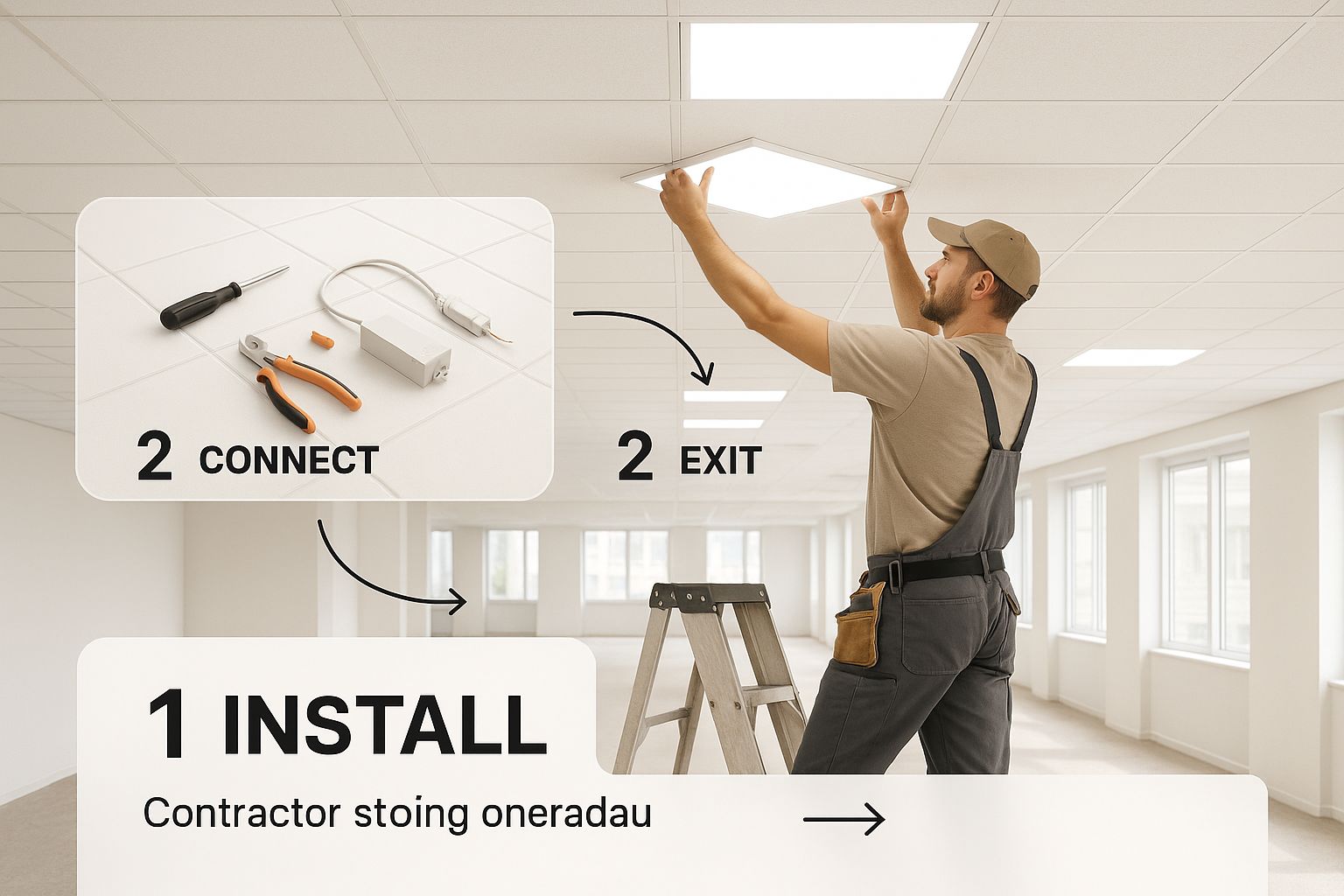
This level of meticulous, safe, and organised work doesn’t happen by accident. It’s the direct result of proper training, experience, and holding the right licences.
Thankfully, the Queensland Government has made this process completely transparent. You can easily verify any contractor’s licence status through the Electrical Safety Office (ESO) online public register.
Just ask your potential contractor for their licence number and pop it into the search tool on the ESO website. Any reputable electrician will hand this over without a second thought. If they get defensive, make excuses, or simply can’t provide it? That’s a massive red flag. Thank them for their time and walk away.
There’s absolutely no need to take a risk. With around 822 electricians working across Brisbane in everything from commercial fit-outs to renewable energy, you have plenty of qualified, professional options.
Licensing is just one side of the coin; insurance is the other. A professional commercial electrical contractor must carry the right insurance to protect you, your property, and their own people. There are two non-negotiable policies you need to see proof of.
Always ask to see a copy of their Certificate of Currency for both policies. Double-check that the business name on the certificate matches the contractor and, most importantly, that the policy is current. An expired certificate is as worthless as no insurance at all.
Beyond the essential licence and insurance, many projects require specific expertise. This is where specialised certifications come in, demonstrating a contractor’s commitment to staying on top of industry standards.
Ensuring your contractor has the right accreditations for your specific job is vital for a compliant and successful outcome. You can dive deeper into the importance of compliance with Australian Standards like AS/NZS 3000 in our detailed guide on the topic.
For example:
Hiring a contractor with these extra credentials ensures every part of your project is handled by a genuine specialist who knows exactly what they’re doing.

Not all electrical experience is created equal, especially when you step into the world of commercial work. A contractor might have 21 years of experience wiring suburban homes, but that doesn’t mean they’re the right fit for your new restaurant, warehouse, or retail fit-out. Your goal is to find a team whose expertise directly lines up with the unique demands of your project.
You need to look past the generic claims like “we do all commercial work.” Instead, dig deeper. Ask for a portfolio or case studies of projects similar to yours. If you’re setting up a cafe in Fortitude Valley, you need commercial electrical contractors in Brisbane who know the ins and outs of commercial kitchens—from 3-phase oven connections to specialised ventilation wiring—not a team that’s only ever wired up office blocks.
Your first chat with a potential contractor is the perfect chance to see how deep their knowledge really goes. This is where you can separate the true professionals from the salespeople. Come prepared with a few sharp questions to get past the pitch.
Here are a few powerful questions to get the ball rolling:
A confident, seasoned professional will welcome these kinds of questions. They’ll have detailed, specific answers ready to go, giving you a clear picture of their process and professionalism.
A contractor’s past projects are a direct reflection of their future performance. If their portfolio doesn’t include work similar to what you need, you’re taking a significant and unnecessary risk.
Don’t treat references as a tick-the-box exercise. They’re your inside look into what it’s really like to work with a contractor day-to-day. You need to ask more than just “were you happy with the work?”
When you get a reference on the phone, try asking these questions:
The answers will tell you far more than a simple “yes, they did a good job.” Beyond that, a deep understanding of local compliance is the hallmark of a true professional. You can read our guide on the importance of having knowledge of Brisbane-specific building codes, which is non-negotiable for any major commercial project.

Getting a few quotes is the easy part. The real work starts when you have to figure out which one is actually the best deal for your project. The total price is just one number, and honestly, it can be misleading. To properly compare offers from different commercial electrical contractors in Brisbane, you need to dig a little deeper.
A professional, transparent quote is so much more than a single figure on a page. It should be a detailed document that leaves no room for confusion about what’s included—and just as importantly, what isn’t. Look for a clear, itemised breakdown that separates the cost of materials from the cost of labour.
This level of detail is your best friend. It shows you exactly where your money is going and lets you compare quotes on a true like-for-like basis. If one quote comes in suspiciously low, an itemised breakdown will often show you why. Maybe they’ve specced lower-quality materials or, more commonly, they’ve underestimated the labour required to do the job properly.
In Brisbane, you’ll generally come across two main pricing structures for commercial electrical work. Knowing the difference helps you make sense of the quotes you receive.
If you are looking at hourly rates, it helps to know the going rate. In Brisbane, an entry-level electrician might charge AUD 50-75 per hour, while a more seasoned professional will be in the AUD 75-100 range. For highly specialised work, a master electrician can command rates from AUD 100 up to AUD 150 per hour.
A vague quote is a massive red flag. A quality proposal from a professional contractor should almost feel like a mini project plan. It needs to clearly state the scope, itemise the costs, and lay out the terms of your agreement.
The cheapest quote often hides the biggest risks. Prioritise transparency and detailed scope over the lowest price tag. This simple shift in mindset protects you from unexpected costs and shoddy workmanship down the line.
When you’re sifting through quotes, knowing what a good one looks like is half the battle. If you want to see what a truly professional submission looks like, it can be helpful to review some winning bid proposal examples.
Ultimately, a great quote will clearly detail:
A contractor who takes the time to provide this level of detail isn’t just being organised; they’re showing you their professionalism and commitment to transparency right from the start. It’s one of the strongest signs that you’ve found a reliable partner for your project.
Let’s be honest—technical skill is just the ticket to the game. It’s the professional skills that truly separate the good from the great commercial electrical contractors in Brisbane. I’ve seen it time and time again: a complex project can fly off the rails without clear, consistent communication and rock-solid project management.
In fact, poor communication is one of the biggest culprits behind project failures and budget blowouts.
Think of it this way: your contractor’s technical expertise is the engine, but their project management is the steering wheel. Without someone confidently steering, even the most powerful engine will end up in a ditch. This is exactly why you need to dig into how they plan to manage your project from start to finish.
For any commercial job, having a single point of contact is non-negotiable. This might be a dedicated project manager on a large-scale build or the lead electrician on a smaller fit-out. Whoever it is, this person becomes your go-to for updates, questions, and critical decisions, preventing the absolute chaos of mixed messages coming from different team members.
Their job is to translate the technical jargon into plain English, keep you in the loop on progress, and make sure project milestones are being hit on schedule. This is where reliable service really shines. Many top-tier contractors even use specialised tools, like an answering service for contractors, just to make sure no call or query ever gets missed.
A great contractor doesn’t just install wires; they manage expectations. They are proactive, transparent, and take full ownership of the project’s flow, ensuring you’re never left in the dark about what’s happening on your site.
This proactive approach becomes incredibly valuable when things don’t go exactly to plan—which, let’s face it, can happen on any complex project.
Let’s play out a common scenario: there’s a supply delay on the specialised light fittings for your new retail fit-out. It happens. But how it’s handled makes all the difference.
Here’s how two different contractors might approach it.
Contractor A (The Silent Type):
Contractor B (The Proactive Partner):
See the difference? Contractor B’s approach doesn’t just solve the immediate problem; it reinforces that you’ve hired a genuine partner who respects your timeline and budget. This is the level of professional project management you should demand. A reliable contractor will have clear processes for pre-start meetings, regular progress reports, and a transparent system for handling any curveballs.
Even when you’ve done your homework, a few last-minute questions often pop up before you hire a commercial electrical contractor in Brisbane. It’s completely normal. Getting clear, straight answers to these common queries is the final step to feeling confident you’re making the right call for your business.
Let’s run through some of the questions we hear most often from business owners about to kick off a project. The goal here is to cut through the industry jargon and give you the practical answers you need.
This is probably the most important distinction to get your head around. A commercial electrician is licensed and experienced in the heavy-duty, complex systems you find in a business environment. We’re talking about three-phase power for machinery, specialised data wiring, and navigating the maze of workplace safety regulations that just don’t apply to a residential home.
A domestic electrician, on the other hand, mainly deals with the single-phase power systems in houses. While they’re experts in their own field, they typically don’t have the specific training, tools, or deep knowledge of commercial compliance. It’s not a case of one being better—it’s about matching the right specialist to the unique demands of the job.
The single most effective way to keep your project on budget is to start with a detailed, fixed-price quote. It needs to clearly itemise the entire scope of work, all the materials involved, and the total labour costs. A vague, one-line quote is a red flag and often a recipe for costs blowing out down the track.
You should also insist on a clear process for handling ‘variations’—that is, any changes or additions to the original plan.
A professional contractor will always require your written approval before starting any work that will change the final cost. This simple step is your best defence against surprise bills and keeps the budget completely transparent from start to finish.
This process eliminates any grey areas and keeps you firmly in control of the finances.
Absolutely. Thinking beyond the initial project and choosing a contractor who also provides ongoing and preventative maintenance is a seriously smart long-term move. Your relationship shouldn’t end the moment the last switch is installed. A great contractor becomes a partner in your business’s continuity.
Look for a team that offers key maintenance services like:
When you build a relationship with a team that offers these services from day one, they develop an intimate understanding of your electrical systems. This makes any future work—planned or unplanned—far more efficient and effective.
At DLG Electrical, we don’t just finish jobs; we build lasting partnerships with Brisbane businesses. Our fully licensed and insured team is ready to provide transparent quotes, expert project management, and reliable ongoing maintenance to keep your operations running smoothly. For a free, no-obligation discussion about your project, visit https://dlgelectrical.com.au today.

Master Electrician with over 30 years of experience. Founded DLG Electrical in 2005 after international project work including electrical installations at Stamford Bridge Stadium, London(Home of Chelsea FC).

Local Electricians that can fix all Electric Hot water Systems.
Motion sensor lights are a versatile addition to any home, offering nu
