83 Jean St, Grange QLD 4051
Mon-Fri 07:30 AM - 04:00 PM - Sat - 8:00 - 12 - Sunday Closed
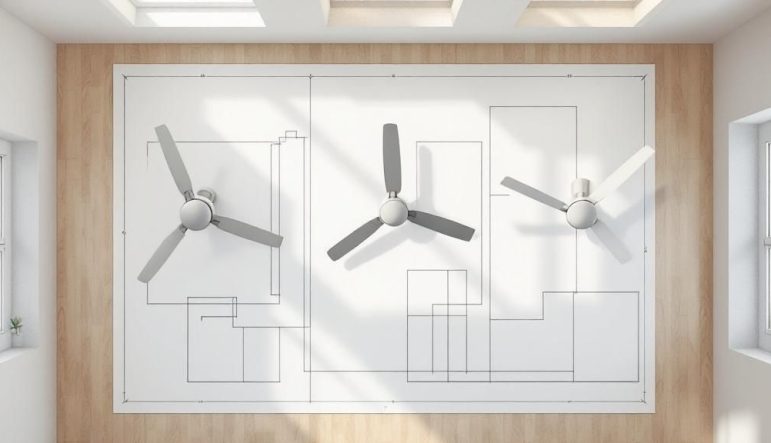
When it comes to picking the right ceiling fan, the single most important decision is matching its blade span to the size of your room. Think of it like choosing the right-sized engine for a car – you need enough power to do the job efficiently without overdoing it.
As a rule of thumb, small rooms up to 7 square metres (like a study or laundry) are best served by a compact 76-91cm fan. For most standard bedrooms or kitchens between 7-16 sq m, a 107-122cm model is usually the sweet spot. Once you get into larger living areas over 16 square metres, you’ll want to look at fans 132cm or larger to guarantee you’re moving enough air to feel the difference.
Choosing the right ceiling fan size is about so much more than just how it looks. It’s fundamentally about performance and energy efficiency. A fan that’s too small for a large room will have to work tirelessly just to stir the air, leaving hot spots and driving up your power bill for very little reward.
On the flip side, putting a massive fan in a tiny room is a recipe for a wind tunnel. It can create an uncomfortable, turbulent breeze that makes the space feel chaotic rather than relaxing.
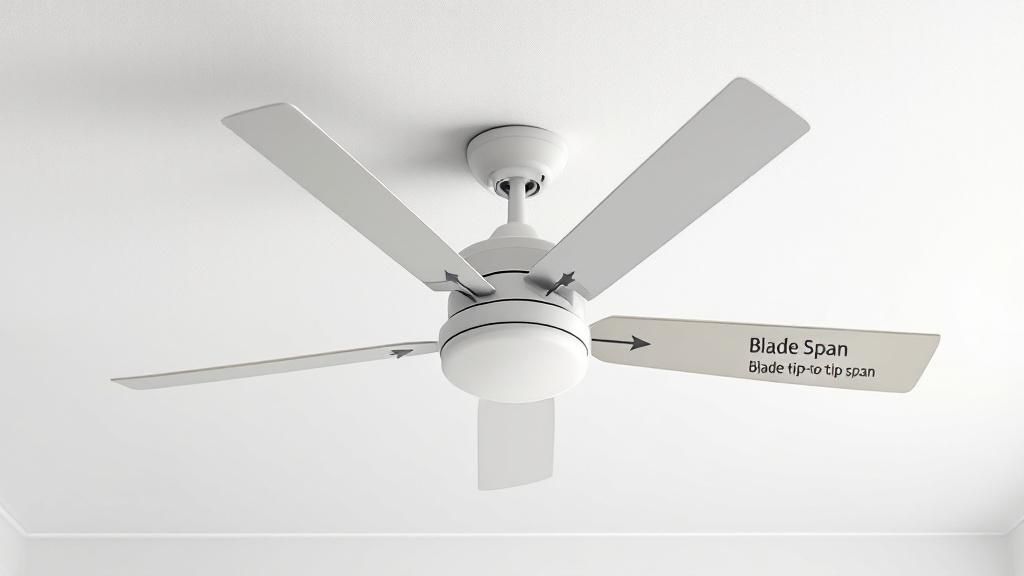
The key is to match the fan’s diameter (also called the blade span) to your room’s square metreage. This is the first and most crucial step to ensuring even, consistent air circulation and genuine comfort.
The great news? A correctly sized fan is incredibly cheap to run. For most Australian homes, a ceiling fan costs just AUD 0.17 to AUD 1.90 cents per hour, depending on its speed. Over a whole summer, that’s a tiny dent in your electricity bill. You can learn more about the operational costs of ceiling fans from recent market reports.
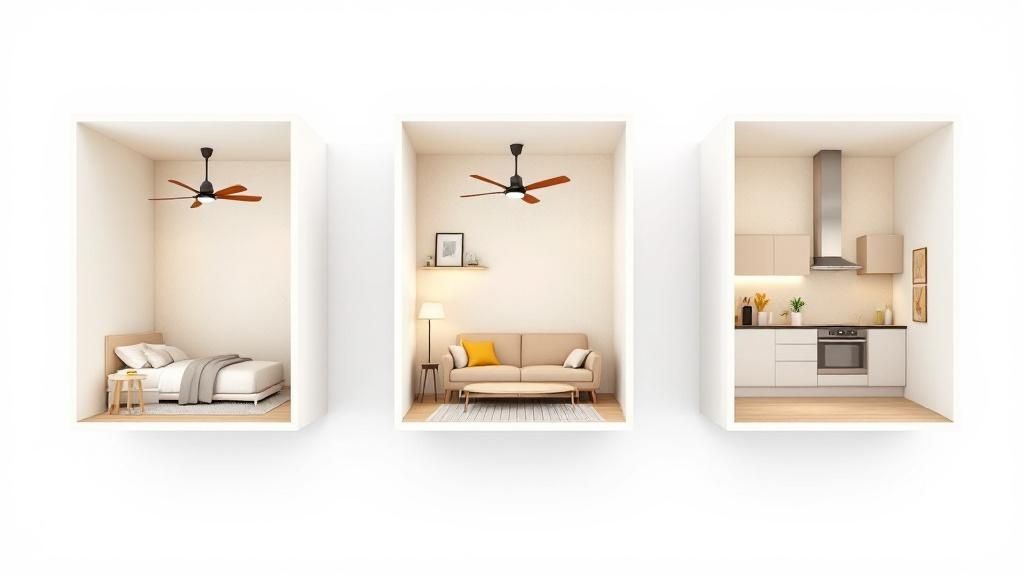
To make things even clearer, this chart gives you a great visual guide, connecting common room types with the fan sizes that suit them best.
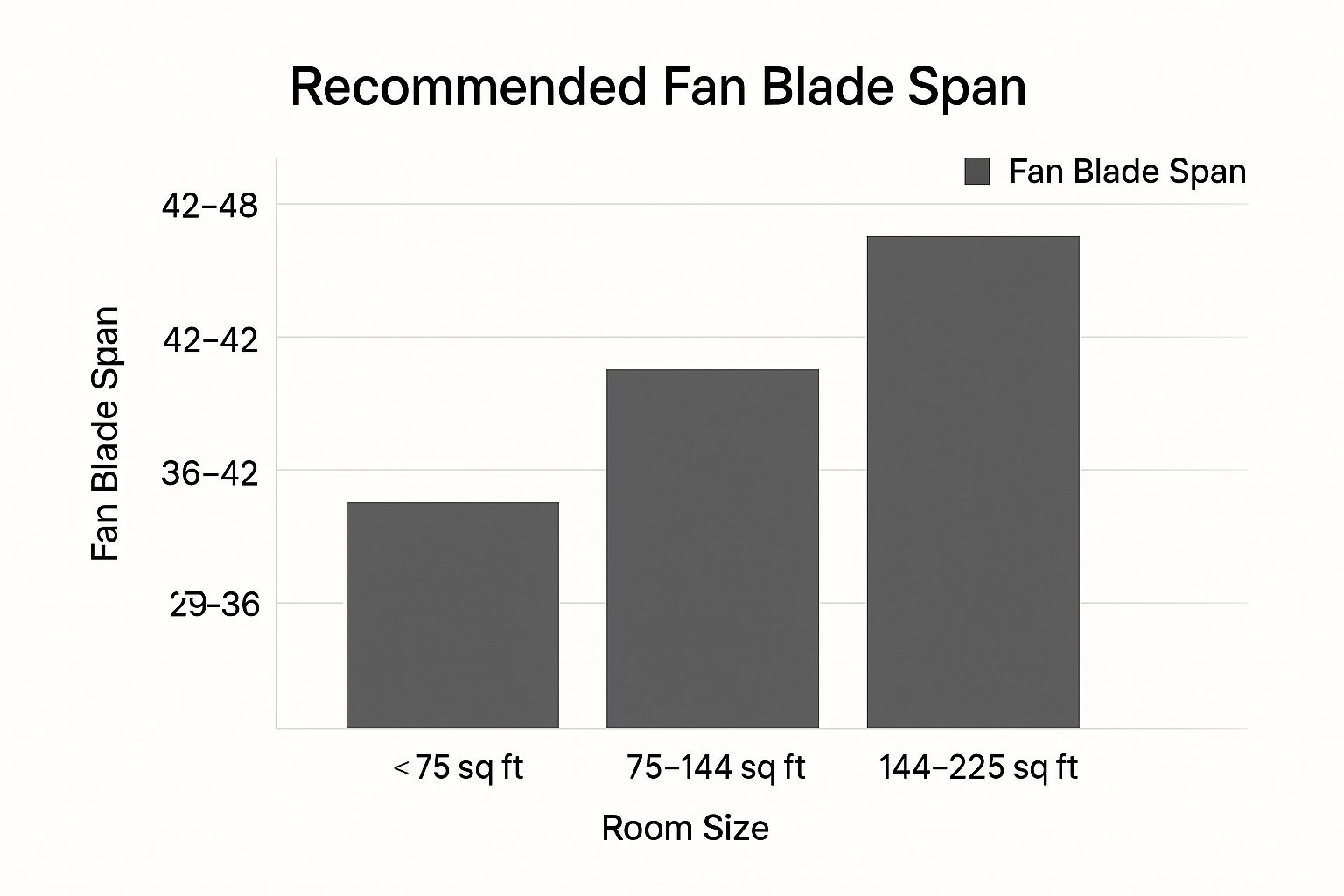
As you can see, there’s a direct relationship between a room’s footprint and the blade span needed for effective, whole-room cooling.
Need an answer right now? This table cuts straight to the chase. We’ve laid out the most common room sizes found in Australian homes and paired them with the ideal fan diameter, taking all the guesswork out of your decision.
Quick Reference Fan Size Chart by Room Area
| Room Size (Square Metres) | Recommended Fan Diameter (cm) | Common Room Type Examples |
|---|---|---|
| Up to 7 m² | 76cm – 91cm | Small Bedroom, Home Office, Laundry |
| 7 m² – 16 m² | 107cm – 122cm | Master Bedroom, Kitchen, Dining Room |
| 16 m² – 30 m² | 132cm – 142cm | Living Room, Large Family Room, Loft |
| Over 30 m² | 147cm or larger | Great Room, Open-Plan Areas |
Simply measure your room’s length and width, multiply them together to get the square metres, and find your perfect match in the chart above. It’s the most reliable way to ensure you’ll be happy with your fan’s performance for years to come.

When you’re choosing a ceiling fan, the blade span is much more than just a measurement—it’s the engine that drives your room’s airflow. Getting this right is the secret to picking a fan that actually performs, not just one that looks good. The right size guarantees effective air circulation, while the wrong one is a recipe for disappointment.
Think of it like a boat propeller. A tanker ship needs a massive propeller to move a colossal volume of water with slow, powerful turns. A small speedboat, on the other hand, uses a nimble, focused propeller for speed. Ceiling fans work on the very same principle.
A fan with a wide blade span is built to move air through a large, open-plan living area. Its long blades push a huge column of air with every single rotation. In contrast, a smaller fan is perfect for creating a more direct, concentrated breeze in a compact space like a bedroom, study, or laundry.
There’s a reason blade span (or fan diameter) became the industry standard: it directly relates to the fan’s ability to move a certain volume of air. It’s the most reliable starting point for matching a fan to a room.
The biggest mistake we see is people choosing a fan based on looks alone, which can completely sabotage its performance. You might fall in love with a sleek, 91cm fan, but if you install it in a spacious 25 square metre living room, you’ll barely feel a thing. The fan is simply too small to circulate air effectively across that distance.
A fan that’s too small for the room has to spin at frantic speeds just to make an impact. This usually creates more noise than a breeze, leading to frustration and inefficiency, all while failing to properly cool the space.
The goal is to move air gently and consistently across the entire room. A correctly sized fan can achieve this on a lower, quieter speed, making your home feel comfortable without that annoying wind-tunnel effect.
While blade span sets the potential for airflow, the motor is what actually delivers the power. You could have two fans with the exact same 132cm diameter, but they might perform very differently depending on their motors. A weak motor paired with long blades will just struggle—it’s like putting a hatchback engine in a semi-trailer.
This is where modern fan technology really shines. Advanced motors, especially DC (Direct Current) models, are engineered to deliver strong, consistent torque even at low speeds. They handle longer blades with ease, moving huge volumes of air without strain or noise. To see how much of a difference the motor makes, check out our in-depth guide to DC fans vs AC fans.
Here’s a quick summary of how these parts work together:
So, is a fan with five blades better than one with three? When it comes to sizing, the number of blades is mostly about style. It has far less impact on performance than the overall blade span.
While more blades can sometimes make a fan operate more quietly by pushing air more fluidly, it doesn’t change the basic sizing rules. Your first and most important job is to match the fan’s total diameter to your room’s dimensions. A 122cm three-blade fan and a 122cm five-blade fan are both designed for the same size room.
Ultimately, pairing the right blade span with a quality motor is the true recipe for powerful, efficient air movement.
While the blade span is a great place to start when sizing up a ceiling fan, it only gives you part of the picture. To understand how a fan will actually perform in your home, you need to look at its CFM rating.
CFM stands for Cubic Feet per Minute, and it measures the sheer volume of air a fan can move. It’s the true indicator of a fan’s cooling power, and it’s what separates a genuinely effective fan from one that just looks the part.
Think of it like two showerheads. One might have a huge, wide face, but if it only manages a weak trickle, it’s not going to be very satisfying. A smaller head that delivers a powerful, drenching spray is far more effective. That’s the difference CFM makes. It’s not about the size of the appliance; it’s about the force it delivers.
A fan’s blade span determines its potential reach, but its CFM tells you how well it moves air within that reach. This is a crucial distinction, as two fans with the exact same diameter can perform very differently.
A fan’s ability to churn out a high CFM rating doesn’t happen by accident. It’s the result of smart engineering, where every part works in perfect harmony to maximise airflow.
Several key factors contribute to this power, and understanding them shows you why just looking at ceiling fan sizes isn’t enough.
A fan’s efficiency is measured in CFM per watt. This tells you how much airflow you get for every watt of electricity consumed. A higher number signifies a more energy-efficient model, saving you money on your power bills while delivering superior comfort.
So, where do you find this all-important number? Reputable manufacturers will always list the CFM rating in their product specifications, both online and on the box. When you’re comparing different ceiling fan sizes, this should be one of the first things you look for.
To give you an idea of what to aim for, here’s a general guide for standard-sized rooms:
| CFM Range | Performance Level | Ideal For |
|---|---|---|
| Below 4,000 CFM | Gentle Airflow | Small bedrooms or spaces where only light air movement is needed. Good for ambience. |
| 4,000 – 6,000 CFM | Good Airflow | Excellent for most standard bedrooms, kitchens, and home offices. A reliable all-rounder. |
| Above 6,000 CFM | High Airflow | Perfect for large living rooms, open-plan areas, or any space where powerful cooling is a priority. |
Choosing a fan with a high CFM rating is becoming more and more important for Aussie households. The local ceiling fan market is set to grow to around USD 292.78 million by 2033, a trend driven by our demand for better, more energy-efficient cooling solutions. You can read more about the Australian ceiling fan market growth and see why performance metrics like CFM are so highly valued.
When you invest in a fan with a strong CFM rating, you’re not just buying an appliance. You’re guaranteeing your home stays a comfortable retreat, even on the most scorching summer days. It ensures your fan has the muscle to back up its size, delivering a refreshing breeze right where you need it most.
Standard sizing charts are a brilliant starting point for typical square or rectangular rooms. But let’s be honest, Australian homes are filled with unique spaces that demand a more thoughtful approach. Long living areas, rooms with soaring vaulted ceilings, or spaces with lower-than-average heights all need special consideration to make sure your fan is both safe and effective.
Think of it this way: trying to cool a long, rectangular room with a single fan in the middle is like trying to light a hallway with one lamp. The area right underneath gets all the attention, while the ends of the room are left stuffy and untouched. This is where a more strategic game plan for ceiling fan sizes and placement comes in.
For a long, narrow space like an open-plan living and dining area, one large fan often just can’t distribute the air evenly. The airflow simply doesn’t reach the far corners, creating pockets of warm, stagnant air.
The best solution is often to use two smaller, well-sized fans instead of one huge one. By placing a fan over each distinct “zone”—one over the living area and another over the dining space, for instance—you create overlapping columns of air that cover the entire room. This strategy ensures everyone feels a comfortable breeze, no matter where they are.
High or vaulted ceilings are fantastic for creating a sense of space and light, but they pose a real challenge for airflow. A standard fan mounted flush against a 4-metre ceiling will be too far away to have any real effect on you. The air it moves will just swirl uselessly far above your head.
This is where a downrod comes in. A downrod is a simple extension pole that lowers the fan from the ceiling, positioning it at the optimal height for air circulation—usually between 2.4 and 2.7 metres from the floor. This brings the fan closer to where you are, ensuring you actually feel the cooling breeze.
Getting the size right for your ceiling fan is just as critical as it is for other major home systems. For example, the efficiency of your home’s heating and cooling depends heavily on the proper sizing of HVAC equipment like heat pumps. Both require careful calculation to get the best results.
To make it easy, here’s a quick guide to help you choose the right downrod for your ceiling height.
To ensure your fan is both safe and performing at its best, use this table to match the right downrod length to your ceiling height.
| Ceiling Height (metres) | Recommended Downrod Length (cm) | Purpose |
|---|---|---|
| 2.7 m (Standard) | 15 cm | Lowers the fan slightly for improved airflow. |
| 3.0 m | 30 cm | Brings the fan to an ideal height in common high-ceiling rooms. |
| 3.6 m | 60 cm | Necessary for ensuring effective air circulation in taller spaces. |
| 4.2 m | 90 cm | Lowers the fan significantly to create a breeze you can feel. |
| 4.8 m or higher | 120 cm or more | Essential for vaulted ceilings or very high great rooms. |
Always measure your ceiling before buying, as selecting the correct downrod is key to getting the performance you paid for.
On the flip side, many older homes or basements have low ceilings. Here, safety is the absolute top priority. Thankfully, there’s a specific fan designed for exactly this situation: the low-profile or “hugger” fan.
These fans are built to mount directly against the ceiling, which maximises the clearance space below. This is incredibly important, as Australian safety regulations are strict. According to Australian standards, a ceiling fan’s blades must be installed at a minimum height of 2.1 metres from the floor and at least 300 mm from the ceiling itself. A hugger fan is often the only way to meet these safety rules in a room with a low ceiling.
Even in tight spaces like bathrooms, proper ventilation is key. To learn more, check out our guide on bathroom ceiling fans for specific advice. By choosing the right model for your room’s unique dimensions, you ensure both compliance and comfort.
The ceiling fans of today are worlds apart from the noisy, wobbly models you might remember from your childhood. They’ve evolved from simple air movers into sophisticated centrepieces of the modern smart home, blending high performance with incredible convenience.
This shift is all thanks to a few key technological advancements that completely change how we think about comfort and energy use in our homes.
At the heart of this evolution is the BLDC motor. This stands for Brushless Direct Current, and it’s a massive leap forward from the old AC (Alternating Current) motors that powered fans for decades. Think of an old AC motor as a brute-force tool—it gets the job done, but it’s often loud, inefficient, and gives you very little control.
A BLDC motor, on the other hand, is like a finely tuned instrument. It uses magnets and precise electronic controls to create rotation, which results in a fan that is whisper-quiet, incredibly energy-efficient, and capable of a much wider range of speed settings. This gives you exact control over your environment, from a barely-there gentle breeze to a powerful gust of air.
Beyond the motor itself, the integration of smart features has unlocked a whole new level of functionality. Modern fans are no longer just isolated appliances; they are connected devices that slot seamlessly into your smart home ecosystem. This is about more than just a fancy remote—it’s about automating your comfort.
Technological advancements like BLDC motors and smart home connectivity are quickly becoming the new standard in Australia, offering homeowners better energy efficiency and a longer lifespan for their appliances. You can read more about the rise of smart fans in the Australian market to see how these features are shaping what people buy.
These smart capabilities bring a host of practical benefits that make daily life easier and more efficient:
These advancements aren’t just about adding novelty features. A smart fan with a BLDC motor can consume up to 70% less energy than a traditional AC fan, making it a cornerstone of a sustainable, cost-effective modern home.
Ultimately, this blend of a superior motor and intelligent controls means that your choice of ceiling fan sizes is now backed by technology that ensures top performance. It guarantees that the fan you choose not only fits your room perfectly but also operates with maximum efficiency and convenience, adapting effortlessly to your lifestyle.
Knowing how to pick the right ceiling fan is only half the battle. Just as important is understanding the common pitfalls that can trip you up. Many homeowners make simple sizing errors that completely undermine their fan’s performance, leaving them with stuffy rooms or uncomfortable drafts.
By learning what not to do, you can walk into your next fan purchase with complete confidence.
The most frequent blunder we see is putting a tiny fan in a huge room. It might not seem like a big deal, but an undersized fan has to spin at its maximum speed just to make a dent in the airflow. This leads to weak circulation at the room’s edges, an annoying hum from the overworked motor, and a fan that just looks awkwardly out of proportion.
On the flip side, installing a fan that’s far too large for a small space is another classic mistake. You might think more power is always better, but an oversized fan can quickly turn a cosy bedroom or study into an unpleasant wind tunnel.
Instead of a gentle, consistent breeze, the powerful downdraft creates a turbulent, gusty environment. The room ends up feeling chaotic rather than comfortable. The goal is always balanced air movement.
A correctly sized fan circulates air effectively on a lower, quieter setting, giving you comfort without being disruptive. This not only improves how the room feels but also means you’re running a more efficient appliance. It’s a great way to manage energy bills, something you can learn more about by exploring the real-world cost of running air conditioning and other cooling methods.
Finally, a critical error is simply forgetting about ceiling height. Ceiling fans in Australia come in a massive range of sizes, from 42 inches (about 107 cm) up to 60 inches (152 cm) or more. This variety exists because getting the size right is essential for both performance and safety, which is why vertical space is a non-negotiable part of the equation.
According to Australian safety standards, fan blades must be at least 2.1 metres from the floor. Installing a standard fan on a low ceiling is a serious safety hazard, while mounting one on a very high ceiling without a downrod renders it almost useless.
Here’s a quick summary of these common mistakes and how to sidestep them:
Even with all the charts and technical details in front of you, a few practical questions always pop up when it comes to finding the perfect fit. Nailing the right ceiling fan size for your rooms often comes down to sorting out these specific scenarios. We’ve put together the most common queries we get from homeowners to give you quick, clear answers so you can make your final choice with complete confidence.
These questions tackle the real-world dilemmas people face, moving beyond the general rules to provide advice you can actually use.
This is a question we hear a lot, but it’s a strategy we strongly advise against. While it might seem logical that a bigger fan would deliver more cooling power, the reality is quite different. An oversized fan crammed into a small space doesn’t create a pleasant breeze; it creates a turbulent, chaotic wind-tunnel effect.
The powerful downdraft has nowhere to go, causing uncomfortable gusts of air that will make the room feel hectic instead of relaxing. For genuine comfort and efficiency, always stick to the recommended ceiling fan sizes for your room’s square metreage.
The goal of a ceiling fan is to create gentle, consistent air circulation, not a miniature cyclone. A correctly sized fan can run on a lower, quieter, and more energy-efficient setting while still making the entire room feel comfortable.
Figuring out your room’s size is a straightforward job that ensures you can use our sizing charts accurately. You don’t need any special tools—just a standard tape measure. Follow these simple steps to find your room’s square metres.
With this number in hand, you can confidently check any sizing chart to find the blade span that’s perfectly matched to your space.
The number of blades on a fan is mostly about looks and has very little to do with the fan size you should choose. Whether a fan has three, four, or five blades, the most critical measurement for performance is always the overall blade span (the fan’s total diameter).
While the blade count can subtly change the fan’s noise level and how the airflow feels, it doesn’t change the fundamental rule: match the fan’s diameter to your room’s dimensions. A 122cm three-blade fan and a 122cm five-blade fan are both designed for the exact same size room. Get the diameter right first, and you’ll guarantee performance.
At DLG Electrical, our experienced team can help you select and safely install the perfect ceiling fan for any room in your Brisbane home. Contact us today for a free quote

Master Electrician with over 30 years of experience. Founded DLG Electrical in 2005 after international project work including electrical installations at Stamford Bridge Stadium, London(Home of Chelsea FC).

Local Electricians that can fix all Electric Hot water Systems.
Motion sensor lights are a versatile addition to any home, offering nu

[…] can also play a role. If you want to dig deeper before buying, check out this excellent guide on Choosing Ceiling Fan Sizes in Australia for a more detailed […]