83 Jean St, Grange QLD 4051
Mon-Fri 07:30 AM - 04:00 PM - Sat - 8:00 - 12 - Sunday Closed
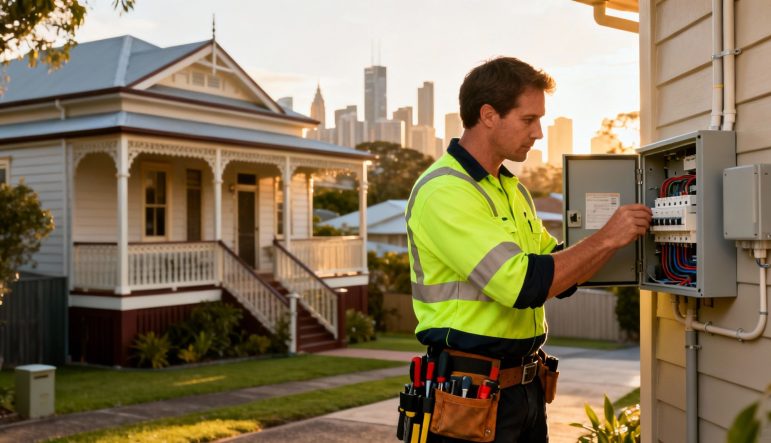
Before you even think about getting quotes, there’s one non-negotiable step every Brisbane homeowner needs to take. You absolutely must verify the electrician’s contractor licence and insurance.
This isn’t just bureaucratic box-ticking. It’s the critical first move that separates the genuine professionals from the cowboys. Taking a few minutes to do this protects your home, your family, and your wallet from the nightmare of dodgy, non-compliant electrical work.
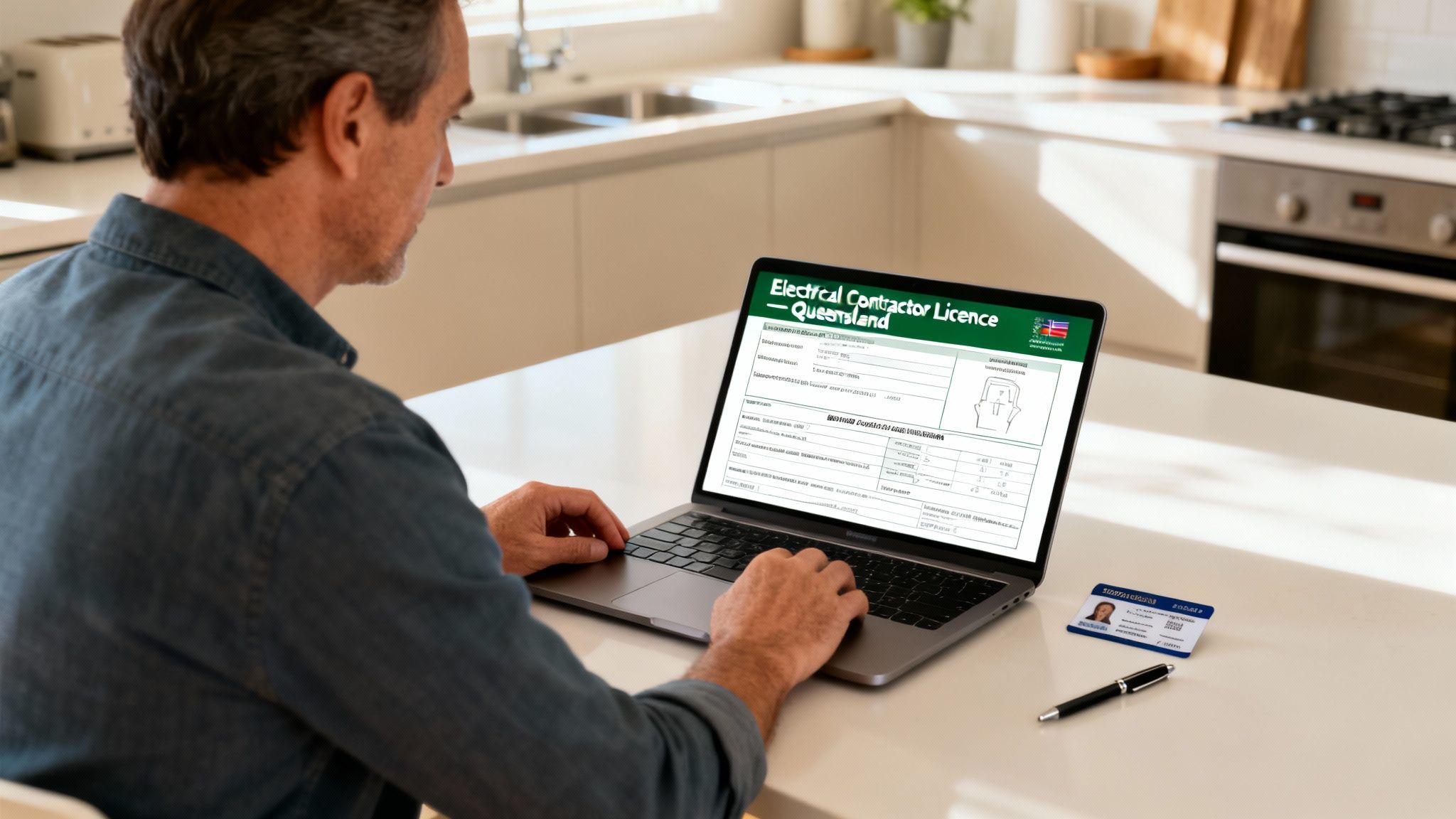
In Queensland, electrical work is strictly regulated for a very good reason—safety. Skipping the due diligence phase is a massive gamble, and it’s one you just shouldn’t take. The good news is that checking up on a contractor is straightforward and gives you immediate peace of mind.
Any sparkie operating legally as a contractor in Queensland must hold a current licence. This is your proof that they’ve done the hard yards—they have the qualifications, training, and competency to work safely and meet Australian Standards.
Thankfully, the Queensland Government has made this check incredibly simple. The Electrical Safety Office (ESO) maintains a public register. Just ask the electrician for their licence number, pop it into the search tool, and you’ll get your answer.
This quick search confirms two vital things:
Just as crucial is making sure your electrician has adequate Public Liability Insurance. Think of this as your financial safety net. If something goes wrong on the job—say, faulty wiring causes a fire or a mistake damages your property—their insurance is what covers the cost.
Without it, you could be left with a colossal repair bill. Any professional Brisbane electrician will have no problem showing you their Certificate of Currency for their policy. If they hesitate or make excuses, that’s a giant red flag. Walk away.
Key Takeaway: A valid licence proves their skill, while current insurance protects your property. Never hire an electrician who cannot immediately provide both. This simple check is the foundation of a safe and successful electrical project.
Imagine this scenario: a contractor is installing new downlights and accidentally drills through a water pipe in the ceiling. Without insurance, the responsibility for that expensive mess could land squarely on you. We dive deeper into why this matters in our guide to hiring licensed electricians near you. By getting these details sorted upfront, you ensure the person working in your home is a true professional who is accountable for their work, protecting you from completely avoidable disasters.
To make it even easier, we’ve put together a quick checklist to guide you through the process.
Before you commit to any electrician, run through this simple verification table. It’s a quick reference guide that ensures you’ve covered all the essential checks for a safe and compliant job.
| Verification Step | Why It’s Critical | How to Check |
|---|---|---|
| Electrical Contractor Licence | Confirms they are legally qualified and permitted to perform electrical work in Queensland. | Ask for their licence number and verify it on the QLD Electrical Safety Office (ESO) public register. |
| Public Liability Insurance | Protects you from financial loss if their work causes accidental damage to your property. | Request a copy of their Certificate of Currency. It should be current and show adequate coverage. |
| Online Reviews & Reputation | Provides insight into other customers’ experiences with their professionalism and quality of work. | Check their reviews on platforms like Google, hipages, or local business directories. |
| ABN/Business Registration | Verifies they are a legitimate business entity operating legally in Australia. | Search their business name or ABN on the Australian Business Register (ABR). |
Completing these checks gives you the confidence that you’re dealing with a reputable, professional, and accountable tradesperson. It’s a small investment of your time for a huge amount of security.
Whether you’re living in a charming old Queenslander with its original quirks or a brand-new build in one of Brisbane’s sprawling suburbs, every home has its own electrical personality. Understanding the common jobs you’re likely to face helps you make smart decisions about safety, compliance, and keeping your home running smoothly.
You don’t need to become an overnight expert, but knowing what to look out for is half the battle. Many people only call a sparky when something goes wrong, but much of our most important work is proactive—it’s about preventing a hazard before it even happens. This is especially true for older homes that simply weren’t designed for today’s power-hungry lifestyle.
Think of your switchboard as the heart of your home’s electrical system. If it’s old, it’s not just outdated; it’s a serious risk. Those old-school boards with ceramic fuses just don’t offer the protection a modern household needs. An upgrade isn’t a “nice to have,” it’s a critical safety investment.
A modern switchboard brings two essential protectors into your home:
In Queensland, it’s the law to have safety switches on all power and lighting circuits in new homes and whenever existing circuits are modified. If your switchboard is missing them, an upgrade should be at the very top of your to-do list to protect your family.
Waking up to a cold shower is a classic Brisbane problem, and more often than not, the electric hot water system is the culprit. While plumbers handle the pipes, any electrical fault needs a licensed electrician. Usually, the issue is a faulty thermostat, a burnt-out heating element, or a simple tripped circuit.
Before you call for help, it’s always worth checking your switchboard to see if the hot water circuit has tripped. If you reset it and it trips again straight away, you’ve definitely got an electrical fault that needs a professional to diagnose safely. For a deeper dive, check out our guide on common electrical home repairs in Brisbane.
There’s a good reason Queensland has some of the strictest smoke alarm laws in the country. By law, all homes must be fitted with interconnected photoelectric smoke alarms. This is a game-changer for safety—it means when one alarm detects smoke, they all go off, giving everyone in the house the earliest possible warning.
A qualified Brisbane electrician can make sure your home is fully compliant. This involves:
With Brisbane’s population growing by roughly 1.7% every year, the demand for qualified electricians to handle these essential safety and compliance jobs has never been greater. This boom underscores just how important it is to find a reliable professional you can trust with these critical tasks.
When you need an electrician, it’s tempting to grab the cheapest quote you can find. I get it. But in my experience, the lowest price often signals the highest risk. A vague, cheap quote can quickly blow out with “unforeseen” costs, or worse, lead to shoddy work that puts your home’s safety on the line.
The real goal is to find the best value, not just the lowest number on a piece of paper. A proper quote from a professional Brisbane electrician should be a clear, detailed document. It builds trust from the get-go and shows they’ve actually thought through what your job requires.
To get a quote you can actually rely on, you need to give the electrician the right information. The more detail you provide upfront, the more precise their estimate will be, leaving less room for surprises later.
Before you even pick up the phone, try to pull these details together:
A little bit of prep work on your end makes a huge difference and helps a good electrician give you a quote that won’t change dramatically once they’re on site.
A one-line quote scrawled on the back of a business card is a massive red flag. A professional estimate should be a transparent breakdown that gives you the confidence to make an informed decision.
A detailed quote isn’t just about the final price—it’s a sign of a professional’s commitment to transparency and quality. It proves they understand the job inside and out and respect your need for clarity.
Here’s what you should be looking for in any quote you receive:
To give you a clearer idea, let’s look at two hypothetical quotes for a common job: a switchboard upgrade.
| Quote Element | Electrician A (Vague Quote) | Electrician B (Detailed Quote) |
|---|---|---|
| Description | “Switchboard upgrade as discussed” | “Full switchboard upgrade including replacement of asbestos panel, installation of new metal enclosure, and individual RCD/MCB safety switches on all circuits to meet AS/NZS 3000 standards.” |
| Materials | “Parts and materials: $XXX” | “Hager 12-pole metal enclosure, 8 x Hager 16A RCBOs, 1 x Main Switch, new circuit labels. Includes sundries and fixings.” |
| Labour | “Labour: $XXX” | “Estimated 6 hours labour @ $XX/hr. Includes full electrical testing and safety certificate on completion.” |
| Exclusions | None listed. | “Excludes any Energex fees for service alterations or unforeseen faults found in existing wiring during testing.” |
| Total Price | $1,200 | $1,450 |
At first glance, Electrician A looks cheaper. But their quote is full of holes. What brand of parts are they using? What if they find asbestos? Is a safety certificate included? Electrician B’s quote is slightly higher, but it tells you exactly what you’re paying for, giving you complete peace of mind and no nasty surprises. That’s the kind of value you should be looking for.
For a deeper dive into what goes into electrical pricing, check out our guide on how much electricians charge.
The infographic below shows some of the most common jobs we see in Brisbane where getting a clear, itemised quote is absolutely essential.
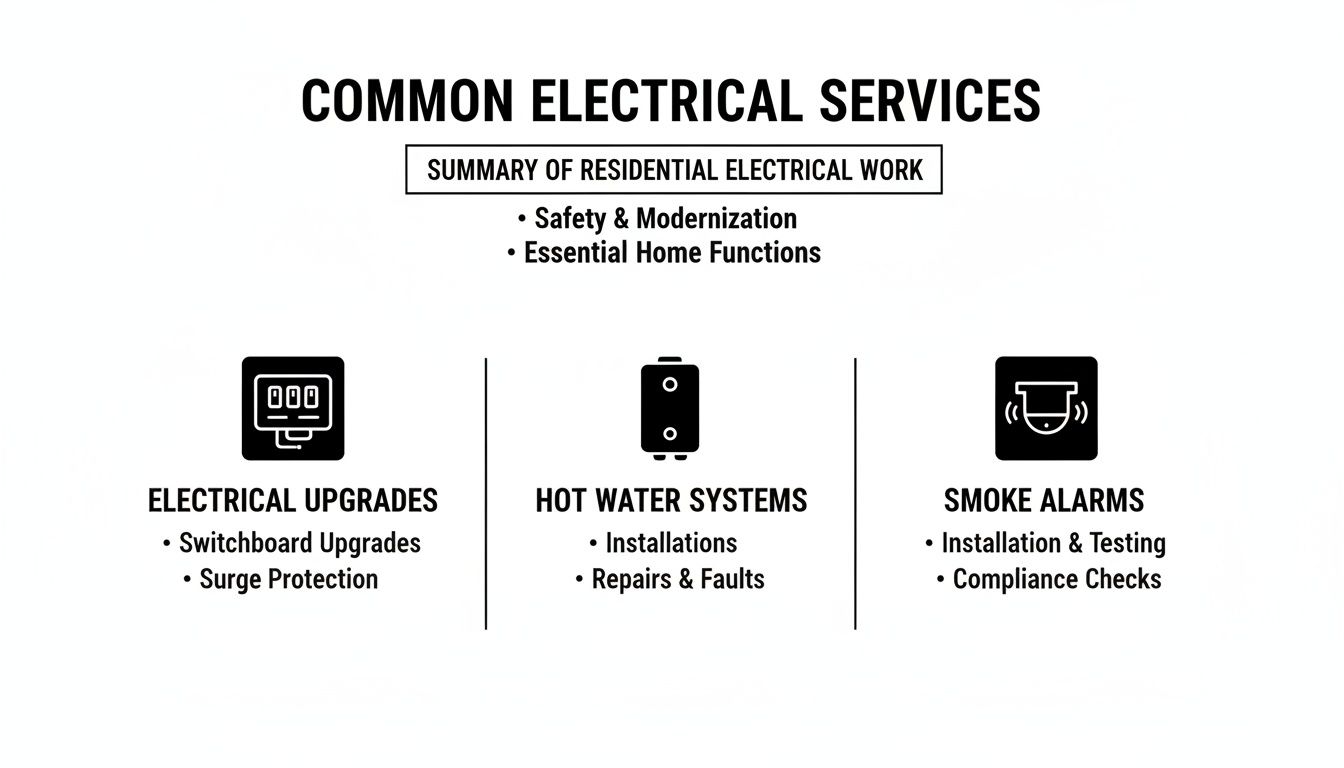
Whether you’re upgrading for safety or ensuring your property meets Queensland’s strict compliance laws, a detailed quote is non-negotiable. It’s the best way to protect your investment and ensure you get quality, lasting work.
So, you’ve booked your Brisbane electrician. What’s next? A little bit of prep work from your side can make a huge difference to how smoothly and safely the job goes. Think of it as a team effort—a few minutes of your time helps the electrician get straight to the important stuff.
First up, clear the decks. If they’re working on your switchboard, make sure the area around it is totally clear. That means moving the shoe rack, storage boxes, or anything else that’s usually parked there. Same goes for any other work area, like where a new power point or light is being installed. Shifting furniture out of the way beforehand is a simple step that avoids delays and protects your belongings from accidental bumps or dust.
It’s also a good idea to think about your family and pets. Electrical work means tools, a bit of noise, and sometimes temporary power cuts. To keep everyone safe and sound, it’s best to keep young children and pets secured in another part of the house, well away from where the work is happening.
A true professional doesn’t just walk in and start pulling wires. The first thing a good electrician will do is conduct a quick risk assessment of the area. They’ll identify any immediate hazards, run through their plan with you, and generally treat your home with the respect it deserves.
Now for one of the most important parts of the whole process: the paperwork. Once the job is done, particularly for new installations or changes to existing circuits, Queensland law is very clear. You must be given a Certificate of Testing and Compliance.
This certificate is your official, legally recognised guarantee that all the work meets Australian Standards (AS/NZS 3000), has been properly tested, and is completely safe to use. Never, ever consider a job finished until you have this document in your hands. It’s vital for your safety, your insurance, and your peace of mind.
This isn’t just a receipt. It’s a detailed record of the work performed and confirmation that crucial safety checks—like insulation resistance, polarity, and earth fault-loop impedance tests—have all passed with flying colours.
Good communication is the key to getting exactly what you want. Don’t ever feel hesitant to ask questions while the work is underway. A quality electrician will be more than happy to walk you through what they’re doing and explain why it’s necessary.
If you’ve got a bigger project on the go, like a full rewire or a major renovation, a quick chat at the start of each day can keep everyone aligned. It’s the perfect time to manage expectations, make small adjustments, and ensure the project is tracking just the way you envisioned. When you and your electrician work together, you ensure the job is completed safely, efficiently, and to your complete satisfaction.
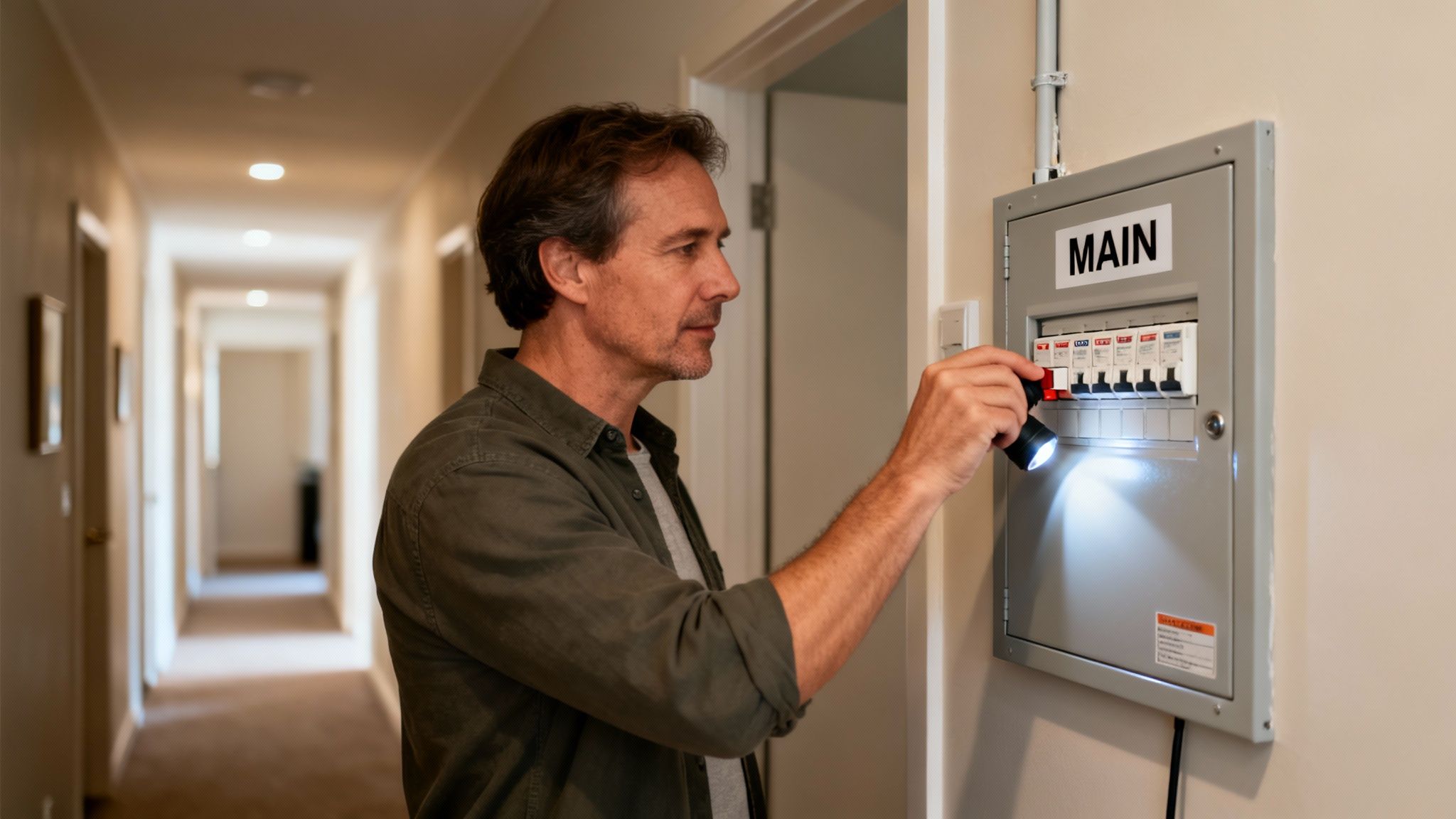
There’s nothing quite like the jolt of an electrical emergency. It’s one of the most confronting things a homeowner can go through. That sudden smell of burning plastic, the alarming sight of sparks from a power point, or the whole house plunging into darkness—it demands a cool head and a quick response.
The first hurdle is figuring out what constitutes a genuine, middle-of-the-night emergency versus something that can safely wait until morning. A real emergency isn’t just an inconvenience; it’s when there’s an immediate risk to people or your property.
Some situations are absolute red flags. If you spot any of these, it’s time to call an emergency Brisbane electrician without a second thought.
Keep an eye out for these critical signs:
If you can safely do so, the first thing you should do is head to your switchboard and turn off the main power switch. This one simple action can be the difference between a close call and a disaster, buying you crucial time while you wait for professional help.
Ringing for an after-hours electrician is a different beast to booking a standard job. The number one goal is to make the situation safe. Fast.
When the electrician arrives, their first priority will be to find the fault, isolate it, and remove any immediate danger to you and your home.
An emergency electrician’s job is to secure the site first and foremost. They will diagnose the problem, perform a temporary repair to restore essential power if possible, and then schedule a follow-up visit for a permanent fix during normal business hours.
It’s important to know that after-hours services come with a higher call-out fee and hourly rate. This is standard right across the trade, covering the cost of getting a skilled professional to your door at short notice.
In Australia, there are around 193,200 employed electricians, with Queensland accounting for 23.1% of that workforce. These are the dedicated professionals working unsociable hours to be there when you need them most. You can find out more about the workforce behind your electrical safety on Jobs and Skills Australia. Having the number of a trusted, local sparkie saved in your phone can make a world of difference when a crisis hits.
Even after you’ve done your homework, a few last-minute questions always seem to pop up. It’s completely normal. Getting straight answers to these common queries can provide that final bit of confidence you need before picking up the phone. Here are the most frequent questions we hear from Brisbane homeowners, with no-nonsense answers from our team.
This is usually the first thing people ask, and the honest-to-goodness answer is: it really depends on the job.
Something straightforward, like swapping a faulty power point, often comes with a fixed price. But for trickier work, like diagnosing a mysterious fault that keeps tripping your power, you’ll almost always be looking at an hourly rate plus a call-out fee. That initial fee covers the electrician’s travel and the time it takes to get set up and assess the situation.
Generally, you can expect a qualified Brisbane electrician’s hourly rate to be somewhere between $90 and $130. This can vary based on their experience, how complex the job is, and whether you need them after hours for an emergency.
For anything substantial—like a full switchboard upgrade or installing a new circuit for an air conditioner—always get a detailed, written quote before a single tool comes out. This is the best way to make sure there are no nasty surprises on the final bill.
Here in Queensland, this document is a non-negotiable legal requirement for pretty much all electrical installation work. It’s not an optional extra. Your electrician is legally obligated to give you a Certificate of Testing and Compliance any time they install new gear or make changes to existing wiring.
This covers a lot of common jobs, including:
Think of this certificate as your ironclad guarantee. It’s your official proof that the work was done by a licensed professional, has been properly tested for safety, and meets the strict Australian Standards (AS/NZS 3000). Always file this document away safely—you might need it for insurance purposes or if you ever decide to sell your home.
Let’s be crystal clear on this one: absolutely not. It is illegal for anyone without a current Queensland electrical licence to perform any kind of electrical work, no matter how small or simple it might seem.
Trying to DIY it is just not worth the risk. It’s incredibly dangerous, with a high chance of electrocution, and it’s a primary cause of house fires.
What’s more, if any damage or injury occurs because of illegal electrical work, your home and contents insurance will not cover it. That could leave you facing truly devastating financial consequences. For the safety of your home and your family, always leave it to the professionals.
Ready to get your electrical work done right, the first time? The experienced team at DLG Electrical is here to help. We provide clear, upfront quotes and guarantee all our work is safe, compliant, and completed to the highest standard. Request your free quote online today and let’s get your project sorted.

Master Electrician with over 30 years of experience. Founded DLG Electrical in 2005 after international project work including electrical installations at Stamford Bridge Stadium, London(Home of Chelsea FC).

Local Electricians that can fix all Electric Hot water Systems.
Motion sensor lights are a versatile addition to any home, offering nu
