83 Jean St, Grange QLD 4051
Mon-Fri 07:30 AM - 04:00 PM - Sat - 8:00 - 12 - Sunday Closed
The problem usually starts small. A light flickers in the hallway. A power point feels warm. A tenant sends a message about a tripping safety switch, and suddenly a simple repair turns into a question about compliance, liability, and whether the last electrical work was done properly.
That is where many Brisbane property owners get stuck. They do not just need someone to fix a fault. They need an electrician in brisbane who can tell the difference between a quick patch and a safe, legal long-term fix, especially when a rental property is involved.
Electrical work is one of those trades where the wrong decision can stay hidden for a long time. Bad painting looks bad straight away. Poor electrical work can sit behind plaster, above ceilings, or inside a switchboard until it causes nuisance tripping, equipment damage, or a dangerous fault.
Brisbane is not standing still either. The city’s population is growing at approximately 1.7% per annum and is projected to reach 3.6 million by 2041, which keeps pressure on housing, renovations, upgrades, and compliance work across the metro area, according to growth trends for electricians in Brisbane. More homes, more tenancies, and more electrical load mean more demand for competent tradespeople.
A customer might call about a dead oven circuit and discover the switchboard is overdue for an upgrade. A landlord might book smoke alarm work and find the property also needs broader electrical attention. Older homes in places like Grange and Windsor often carry layers of previous alterations, and not all of them were done with modern safety expectations in mind.
That is why selection matters. You are not just hiring labour. You are choosing someone to assess risk, explain options, and complete work that has to stand up to both practical use and Queensland compliance requirements.
Reliable contractors tend to be consistent in a few areas:
A good electrician protects your property twice. First by doing the work safely, then by documenting it properly.
For homeowners, that means peace of mind. For landlords, it means fewer grey areas when a tenant, property manager, or insurer asks questions later.
Homeowners often only think about electrical work when something stops working. In practice, the work usually falls into a few clear groups. Once you understand those groups, it becomes much easier to explain what you need when you call an electrician.
This is the bread-and-butter work most households run into first. Think faulty lights, broken power points, tripping circuits, damaged switches, or appliances that keep losing power.
Fault finding is the important part. Replacing a fitting without finding the underlying cause often wastes time and money. A light might flicker because the fitting is worn out, but it could also be loose termination, voltage drop, or moisture getting where it should not.
Some common calls include:
If you want a plain-English overview of how these jobs fit together, this guide on what electricians do is useful: https://dlgelectrical.com.au/dlg-blog/what-does-an-electrician-do/
This category matters most when a property has children, ageing wiring, tenants, or outbuildings with mixed usage. It also matters when a home has had piecemeal additions over the years.
Smoke alarms, security systems, and safety-related upgrades sit here. So do checks around switchboards, circuit protection, and compliance items tied to occupancy. These jobs are not glamorous, but they are the work that prevents the middle-of-the-night call.
If a home has changed occupants, had renovations, or shows signs of age, safety work should move up the priority list.
Some jobs are less about repairs and more about capacity. A switchboard upgrade is the clearest example. It is often the electrical equivalent of replacing an undersized heart in a home that now runs air conditioning, modern kitchen appliances, office gear, and outdoor power all at once.
Other common upgrade jobs include:
| Service | What it solves |
|---|---|
| Switchboard upgrade | Improves protection, supports modern loads, and tidies old circuit arrangements |
| Hot water electrical work | Restores supply, isolates faults, and ensures safe connection for repair or replacement |
| Ceiling fan and lighting installation | Improves comfort and usability without relying on portable gear |
| Security system wiring | Adds monitored protection and more reliable coverage than ad hoc wireless setups |
| EV charger installation | Supports regular home charging, provided the existing supply and panel capacity are suitable |
EV charging is where many homeowners need clearer answers. Plenty of electricians list it as a service, but fewer can explain compatibility, supply limits, charger choice, and what has to be checked before installation. That conversation tells you a lot about whether the contractor understands the work.
Electrical compliance is not paperwork for paperwork’s sake. It is the rulebook that separates safe, legal installation work from guesswork. For Brisbane homes and rentals, the key standard is AS/NZS 3000:2018 Wiring Rules.
In plain language, that standard sets the minimum requirements for how electrical installations are designed, built, and verified. It covers things like wiring systems, earthing, and protective devices. It is not optional.
In Brisbane, all electrical work must comply with AS/NZS 3000:2018, including 30mA RCDs on all final sub-circuits, and those RCDs can significantly reduce the risk of electrocution. The work also requires a Certificate of Compliance on completion to confirm the installation is safe and legal, as outlined in this guide to compliance with AS/NZS 3000.
That gives owners a practical checklist straight away:
For a plain explanation of why that document matters, this article on the certificate process is worth reviewing: https://dlgelectrical.com.au/dlg-blog/certificate-of-compliance/
Landlords often focus on repairs because that is what triggers a callout. Compliance is broader than repairs.
A rental property should be looked at with these questions in mind:
Are the smoke alarms current and correctly arranged for the property?
A lot of landlords only react when a property manager raises it before a lease event.
Does the switchboard provide suitable protection for the circuits in use?
This is especially relevant in homes with older wiring or years of add-on works.
Has recent electrical work been documented properly?
Missing records create problems when faults reappear or when responsibility becomes disputed.
Are there recurring electrical complaints from tenants?
Repeated tripping, buzzing fittings, and failed outlets usually point to underlying issues, not bad luck.
The biggest mistake landlords make is treating each issue in isolation. One failed fitting might just be a failed fitting. Several small issues across the same property often signal a bigger review is needed.
Owners sometimes assume compliance means “up to code” in a broad sense and leave it there. In practice, it is more specific. The installation has to be safe for the way the property is being used now, not just the way it was used years ago.
That matters in Brisbane because many homes have been extended, enclosed, renovated, or converted for rental use over time. New cooktops, split systems, office setups, security gear, and outdoor circuits all add demand and complexity. A switchboard that once handled a simpler house may no longer be the right fit.
For landlords, electrical compliance is not a one-off event. It is an ongoing obligation tied to the condition of the property and the work carried out on it.
If you own one rental or several, it helps to think in terms of a compliance file. Keep certificates, invoices, dates of major electrical work, and notes on recurring problems together. That makes future maintenance decisions faster and cleaner.
Price matters, but the cheapest quote is often where expensive problems begin. Electrical pricing only makes sense when you know what is included.
In Brisbane, client service rates for a licensed electrician typically sit around $70 to $120 per hour, while after-hours emergency work can run $90 to $150 per hour plus a call-out fee. For context, experienced employee wages average AU$35.89 per hour in 2026 according to PayScale’s Brisbane electrician hourly rate data.
A good quote is not just a number at the bottom of a page. It should separate the moving parts so you can see what is driving cost.
Look for these elements:
A vague quote causes problems later. If the wording is loose, disagreements often start when the electrician opens a switchboard, enters a roof space, or finds older wiring that changes the job.
There are usually valid reasons.
A straightforward power point replacement is not priced like a difficult fault in an older home. Access matters. Roof work matters. Working around tenants, business hours, or staged renovations matters. Commercial fit-outs and more complex supply arrangements also cost more than basic residential service work.
Some operators are also more organised in how they estimate jobs. Teams using structured systems, including specialised quoting software for electricians, tend to produce clearer scopes and fewer surprises because the quoting process itself is more disciplined.
If you want a local breakdown of how rates and quote structures work, this article helps: https://dlgelectrical.com.au/dlg-blog/how-much-do-electricians-charge/
A cheap quote can still be expensive if it leaves out testing, compliance paperwork, or the underlying cause of the fault.
Do not compare total price alone. Compare assumptions.
A useful way to assess quotes is:
| Compare this | Why it matters |
|---|---|
| Scope clarity | Prevents disputes about what was or was not included |
| Testing and compliance | Confirms the job will be finished properly, not just made to “work” |
| Materials specified | Helps you see if one quote allows for better protection or more suitable gear |
| Variations process | Shows how hidden issues will be handled if discovered mid-job |
If one quote is lower, ask why. Sometimes the answer is efficiency. Sometimes it is a missing step you expected to be there.
Choosing a contractor gets easier when you stop judging by confidence and start judging by evidence. A polished phone manner is useful. It is not a substitute for licensing, process, and job fit.
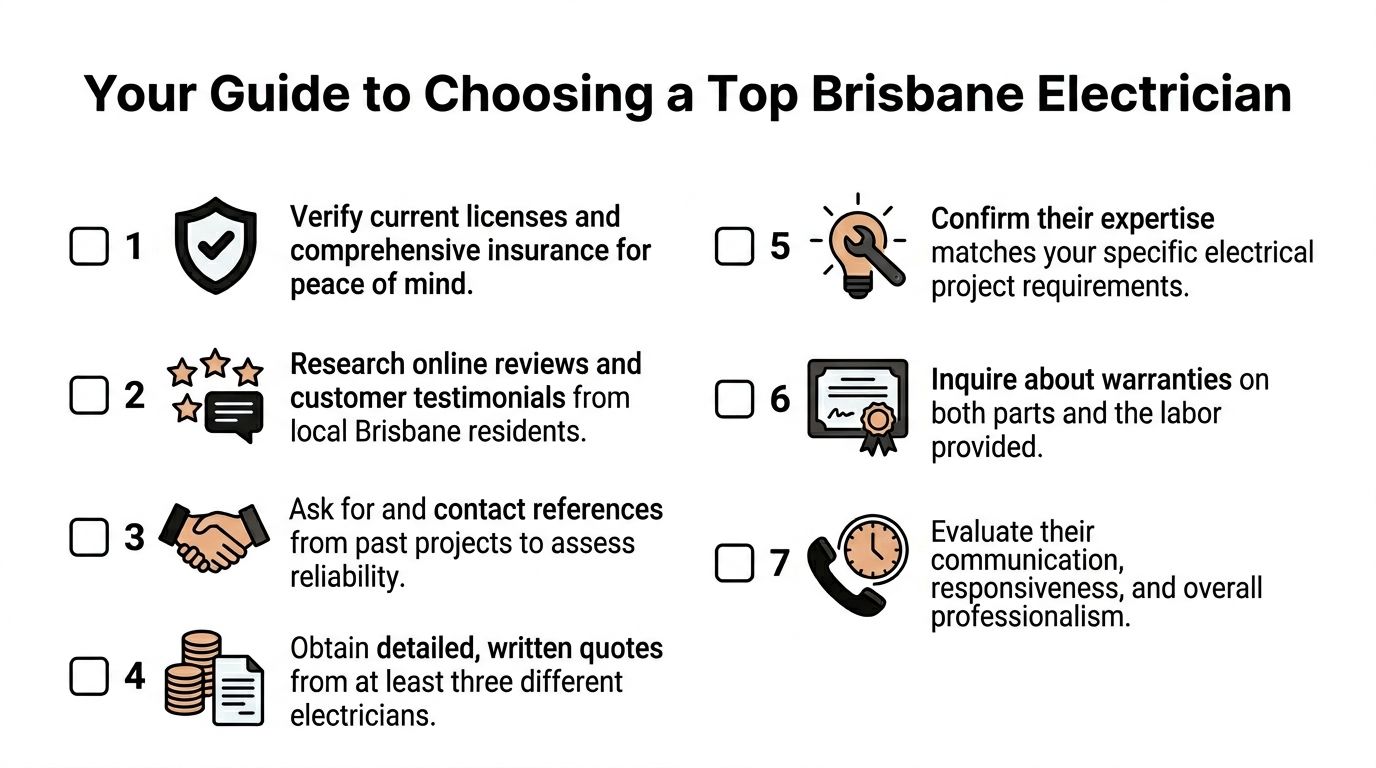
Not every electrician suits every job. That sounds obvious, but many owners only ask, “Can you come this week?”
A better first question is whether the contractor regularly handles the kind of work you need. General maintenance, rental compliance, switchboard upgrades, security systems, and EV charger installation each call for different levels of familiarity. DLG Electrical is one local option that handles residential and commercial electrical work including smoke alarms, switchboard upgrades, hot water repairs, security systems, and EV charger installation.
A practical example is EV charging. Many electricians mention it, but fewer can walk you through panel capacity, charger compatibility, likely installation pathway, and local rebate questions. As noted on DLG Electrical’s services page, asking directly about complex jobs like EV charger installations can reveal whether you are speaking to someone with genuine hands-on experience or someone who mainly does standard domestic callouts.
Use the conversation to learn how they work, not just what they charge.
Try questions like these:
The answers matter less than the detail behind them. Good contractors usually answer clearly and without irritation.
Some warning signs are small on their own but look worse when they stack up.
Reviews are not everything, but they are useful when they describe the same strengths repeatedly. You want signs of punctuality, clear communication, neat work, and follow-through after the job. Longstanding local operators also tend to understand the housing stock in areas such as Grange and Windsor, which helps when older switchboards, renovations, and tenancy obligations intersect.
The best contractor for your job is usually the one who can explain the risks, the fix, and the paperwork in plain language.
If you are a landlord, add one more test. Ask whether they can help you think beyond the immediate repair and identify anything else that could affect compliance or future maintenance. That answer often separates a repairer from a real long-term trade contact.
A professional visit should feel organised from the first call. You explain the issue, provide access details, and mention anything unusual such as tenants on site, repeated tripping, or recent renovation work.

On arrival, the electrician should inspect before acting. For a fault call, that means asking when the problem started, whether it is intermittent, and what else was running when it occurred. For installation work, it means confirming scope, access, and any likely constraints before tools come out.
As of 2025, Queensland’s Electrical Safety Regulation requires de-energisation before work near energised parts or in roof spaces, and a professional should carry out zero-voltage verification with a tester, as explained in this overview of electrical safety standards in Brisbane.
That is not theatre. It is a core safety step. If someone rushes past isolation and testing, that is a serious concern.
The walkthrough below gives a simple visual overview of what safe electrical work can involve during a residential visit.
Once the work is done, the electrician should test the installation, explain what was found, and tell you whether anything still needs attention. Good tradespeople also clean up their work area, label where needed, and make sure the client understands what has changed.
For landlords and property managers, this closeout matters as much as the repair itself. You need a clean record of what was done, whether any further work was recommended, and what documents should be kept on file.
Good electrical work is not just about getting the lights back on. It is about making sure the property is safe, the work is compliant, the quote is clear, and the result holds up under daily use.
That matters even more for landlords. A rental property carries ongoing obligations, and the right electrician helps you stay ahead of problems instead of reacting to them one tenant complaint at a time. Smoke alarms, switchboard condition, protection devices, fault history, and documentation all deserve attention. Waiting until a lease renewal or emergency callout usually costs more in time, money, and stress.
For homeowners, the same principle applies. Whether the job is a minor repair, a hot water fault, a security installation, or a larger upgrade, the right contractor should explain the trade-offs plainly. You should know what is being fixed, what is being improved, and what can reasonably wait.
In Brisbane suburbs such as Grange, Windsor, and across North Brisbane, local knowledge still counts. Housing age, renovation history, and occupancy patterns all affect how an electrician approaches a job. The right choice is the contractor who treats safety, paperwork, and communication as part of the work, not extras added at the end.
If you need practical advice or a quote for electrical work in Brisbane, DLG Electrical provides licensed residential and commercial services including switchboard upgrades, smoke alarm compliance, hot water repairs, security systems, EV charger installation, and general maintenance. For homeowners and landlords who want clear communication and compliant work, they are a straightforward local contact to speak with.

Master Electrician with over 30 years of experience. Founded DLG Electrical in 2005 after international project work including electrical installations at Stamford Bridge Stadium, London(Home of Chelsea FC).

Local Electricians that can fix all Electric Hot water Systems.
Motion sensor lights are a versatile addition to any home, offering nu
