83 Jean St, Grange QLD 4051
Mon-Fri 07:30 AM - 04:00 PM - Sat - 8:00 - 12 - Sunday Closed
Your switchboard's due for an upgrade, the smoke alarms are old, and the landlord wants the place ready before the next inspection. That's the point where many in Brisbane start ringing around for the cheapest quote. Don't. In Queensland, this is a compliance job first and a price job second, and the wrong hire can leave you with unsafe wiring, a failed inspection, and a paper trail that won't stand up when an insurer asks questions.
If you need a quick way to avoid missed calls and wasted back-and-forth, a useful tool like electrician missed call solution can help a contractor respond faster. That doesn't replace proper licensing or compliance, but it does matter when you're trying to sort genuine trades from casual operators.
In Queensland, hiring an electrical contractor is not a lifestyle choice. It's the legal way to get electrical work done under the state's electrical safety framework, and that framework is built around the Electrical Safety Act 2002, the Electrical Safety Regulation 2013, and the Queensland fire and building rules that sit on top of them. If the person doing the work can't lawfully perform it, supervise it, and certify it, you've got a problem before the first wire is touched.
The common mistake is treating electrical quotes like paint quotes. Cheap wins the day, then the job gets handed to a handyman, the paperwork never lands with the regulator, and the homeowner is left holding the risk. That risk isn't theoretical. It shows up in insurance disputes, failed inspections, and the sort of defects that become expensive the moment a sale, lease, or claim is involved.
A Brisbane homeowner who needs a switchboard upgrade should be asking one question first, not the usual three about price, speed, and convenience. Can this contractor legally do the work and prove it afterwards? If the answer is fuzzy, the quote is useless.
Practical rule: if the contractor can't explain the compliance path in plain English, don't book them.
Queensland also has very specific rules for photoelectric interconnected smoke alarms, switchboard alterations, and certificate lodgement. Those are the details that separate a real contractor from a bloke with a ute and a drill. If you want to avoid rework and arguments later, start there, not with the cheapest number on the page.
A Queensland electrical mechanic licence and an electrical contractor licence are not the same thing. The mechanic licence is the individual worker's authorisation to do electrical work. The contractor licence is the business licence that lets the company perform, supervise, and certify the job, which is the licence that matters when someone is quoting your house or rental.
That distinction matters because not everyone on site can sign off the job. Apprentices can assist, and qualified workers can carry out tasks under the right structure, but the contractor is the one who carries the business responsibility and the paperwork trail. If the quote only shows a logo and a mobile number, that's not enough. You want the licence details tied to the actual trading name you're paying.
Use the Electrical Safety Office register, not a Facebook page, not a van sign, and not a “licensed for years” line in a quote. The state regulator's public register is the place that tells you whether the licence is current, whether there are conditions, and whether the business name matches the licence. If anything looks off, call the ESO on 1300 362 128 and ask before work starts.
| What a Queensland Electrical Licence Authorises | |||
|---|---|---|---|
| Licence Type | Who Holds It | What It Permits | Why You Need It |
| Electrical mechanic licence | Individual electrician | Perform electrical work within their competency | Shows the person on site is legally qualified |
| Electrical contractor licence | Business or trading entity | Perform, supervise, and certify electrical work | Lets the business quote, manage, and lodge compliance paperwork |
A proper contractor also hands over the right completion documents. For most domestic electrical jobs, that means a signed Certificate of Compliance for Electrical Work, and where testing applies, a safety switch certificate or equivalent test record. Don't accept “we'll sort the paperwork later.” Later is where jobs go missing.
If you want a plain-English overview of contractor registration and business licensing, the internal guide on electrical contractor registration is worth reading before you shortlist anyone.
Brisbane homes generate the same few electrical jobs again and again, and every one of them sits under a rule set. That's good news, because you don't need to guess whether a contractor is working properly. You just need to know which standard applies to the task in front of you.
A switchboard upgrade is not about how old the board looks. Once you're altering the installation, renovating, or adding load, the work has to meet AS/NZS 3000:2018 and Queensland electrical safety requirements. That's where modern protection such as RCDs comes in, and that's why partial patch-up work is a red flag. If a contractor touches an old board and leaves the protection scheme half-done, the installation can still be non-compliant.
Smoke alarms are even stricter. Queensland requires compliant alarms to be photoelectric, AS 3786-2014 marked, interconnected, and either hardwired with a secondary power source or fitted with a 10-year non-removable battery. Hardwired 240V installation must be done by a licensed electrician, and if an existing hardwired alarm is replaced, it stays a hardwired 240V photoelectric unit. No downgrading to a battery-only unit because it's cheaper.
Hot water system work also needs proper treatment. Element and thermostat replacements on storage units, and dedicated circuit runs for instantaneous units, still need to be wired to the wiring rules and certified when prescribed electrical work applies. Security systems and sensor lighting are more nuanced. Low-voltage cabling isn't the issue, but anything tied to 240V mains belongs with a licensed contractor.
For a practical breakdown of switchboard compliance, see the guide on switchboard upgrade regulations. It's exactly the kind of job that should never be priced off a vague phone description.
| Common Job | Queensland Rule or Standard | Certificate Required |
|---|---|---|
| Switchboard upgrade | AS/NZS 3000:2018 and Queensland safety requirements | Certificate of Compliance for Electrical Work |
| Smoke alarm replacement | Photoelectric, interconnected, compliant Queensland requirements | Certificate of Compliance for Electrical Work |
| Hot water system wiring | Wiring rules and safety requirements for prescribed work | Certificate of Compliance for Electrical Work |
| 240V security or lighting work | Licensed electrical work under Queensland rules | Certificate of Compliance for Electrical Work |
The first phone call should feel like a vetting interview. If you're speaking to a good contractor, they won't act offended by that. They'll answer cleanly, because they're used to working inside the Queensland rules.
Start with the licence number, then keep going. Ask who turns up, whether the quote is written, and how the paperwork is handled after the job. The answers tell you more than the sales pitch ever will.
Ask for the licence number first. A contractor who hesitates there is already telling you something useful.
| Question Asked | Confident Contractor Says | Vague Contractor Says |
|---|---|---|
| Licence number | Gives it straight away | “We're fully licensed, mate” |
| Insurance proof | Sends a certificate | “We've got insurance” |
| Who does the work | Names the electrician or supervised apprentice | “One of the boys will sort it” |
| Quote format | Written, itemised, clear | “I can give you a rough price over the phone” |
| Compliance paperwork | Explains the process and timing | “Don't worry about that” |
The right answers protect you under Queensland's electrical safety system. The wrong answers usually show up later as arguments about scope, paperwork, or who was responsible for the job.
Quotes are only useful when they're written against the same scope. If one contractor is quoting a switchboard upgrade and another is pricing a tidy-up with no new protection, you're not comparing the same job. That's how homeowners get tricked by a low number that leaves out the parts that matter.
Write down the job in plain language before you call anyone. Tell each contractor exactly what you want done, whether it's a switchboard change, smoke alarm replacement, hot water circuit work, or security lighting. Then ask for a written quote that shows labour, materials, the licence number, warranty terms, and whether compliance paperwork is included.
For Brisbane homeowners, a useful sanity check is to compare the quote against normal market expectations, not fantasy pricing. A switchboard upgrade is commonly quoted around $800 to $1,800, smoke alarm replacement around $90 to $160 per alarm, and hot water system wiring around $200 to $500. Those figures are only a check, not a promise, but they'll help you spot nonsense quickly.
Don't get trapped by the cheapest quote when the job involves legal compliance. A contractor who excludes certificates, uses vague materials, or avoids the actual scope is not saving you money. They're moving risk into your lap.
Good quote, bad quote, simple test: if you can't tell what's included without ringing twice, the quote isn't ready.
For a straightforward pricing reference point on trade call-outs and labour, the guide to electrician hourly rate Brisbane gives context without pretending every job should be billed the same way.
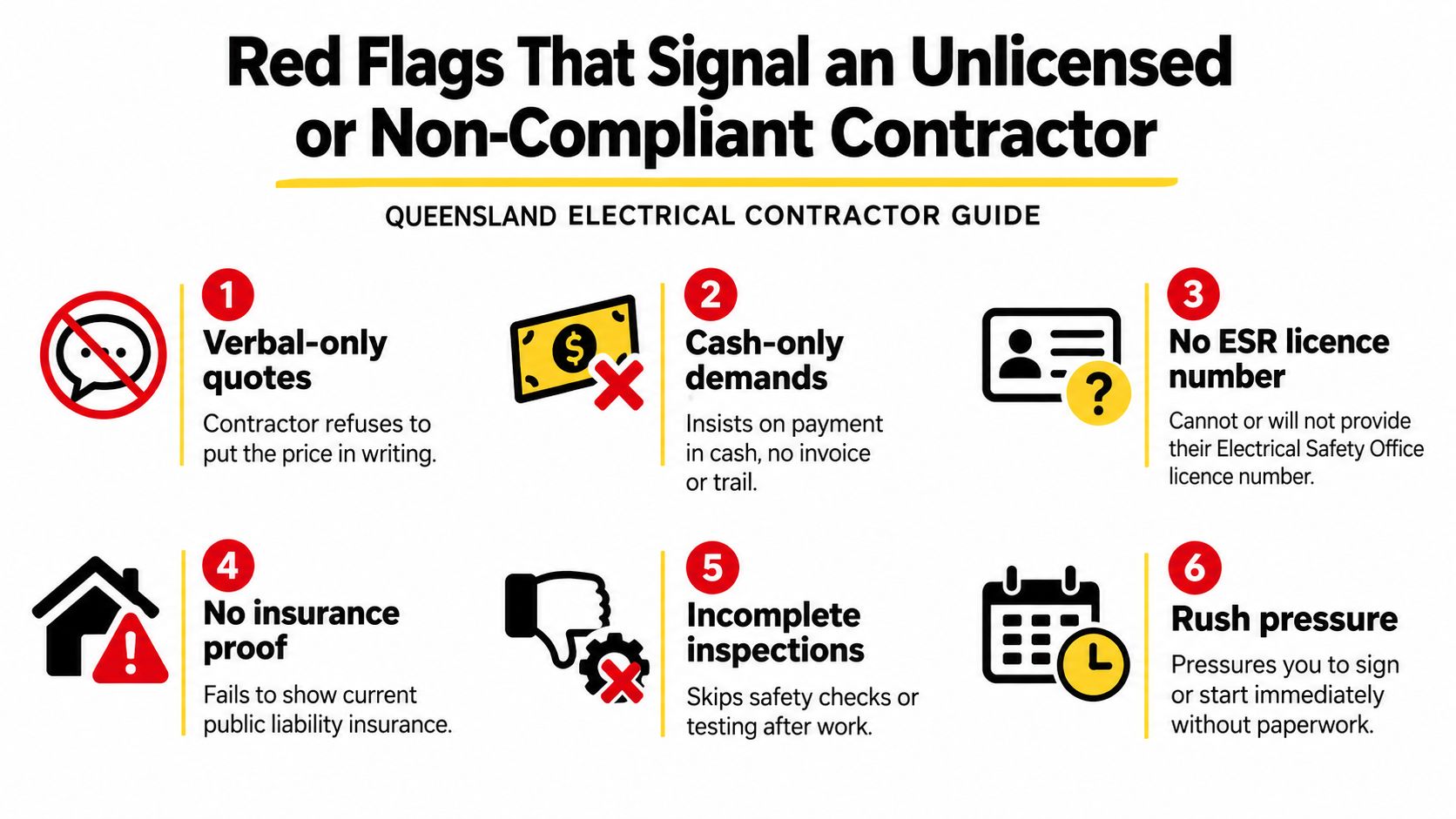
The worst contractors don't usually look reckless at first. They look busy, friendly, and cheap. Then they start dodging paperwork, and that's when you stop the conversation.
One more red flag deserves special attention. If a contractor suggests replacing hardwired 240V interconnected photoelectric smoke alarms with cheaper sealed battery units in a home that needs hardwired compliance, walk away. That's not a clever saving. It's the wrong product for the job under Queensland's rules.
Start with the licence register, not the quote. Confirm the contractor's Queensland electrical contractor licence number on the ESO public register, then shortlist two or three businesses and send each one the same written scope. Ask for itemised pricing that separates labour, materials, and call-out fees so you're comparing the same work, not different assumptions.
Next, ask for proof of public liability insurance and confirm who will do the work on site. For prescribed jobs such as switchboard upgrades and smoke alarm replacements, make sure the contractor is clear about compliance paperwork and any related form lodgement. If they can't explain that cleanly, they're not ready for your job.
For homeowners and landlords in Brisbane, DLG Electrical handles switchboard, hot water, security, and smoke alarm work with licensed electrical contracting and free itemised quoting across the local area. Use that as your benchmark when you compare other contractors, and don't settle for anything that can't be verified in writing.
If you want a Brisbane electrician who treats compliance like it matters, speak with DLG Electrical and ask for a free itemised quote before you book the job. They can help with switchboard upgrades, smoke alarm compliance, hot water system work, and security installations, and they'll put the scope in writing so you know exactly what's being done.

Master Electrician with over 30 years of experience. Founded DLG Electrical in 2005 after international project work including electrical installations at Stamford Bridge Stadium, London(Home of Chelsea FC).

Local Electricians that can fix all Electric Hot water Systems.
Motion sensor lights are a versatile addition to any home, offering nu
