83 Jean St, Grange QLD 4051
Mon-Fri 07:30 AM - 04:00 PM - Sat - 8:00 - 12 - Sunday Closed
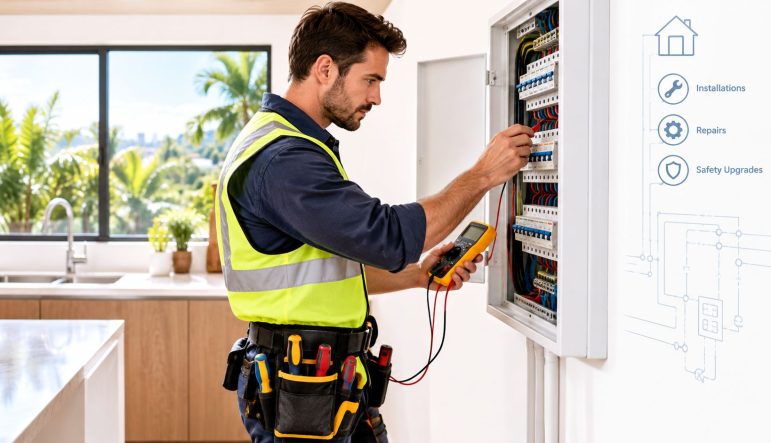
The kitchen lights flicker whenever the kettle, toaster or air conditioner starts. One power point feels warm, a safety switch trips without an obvious reason, and the switchboard looks like it belongs to another era. In a Brisbane home, those symptoms rarely tell the whole story.
A residential electrician service should look beyond the item that failed. The right inspection connects the fault, the switchboard, fixed wiring, smoke alarms, energy loads and the way the household uses the property. That approach helps you decide what needs attention today, what can be planned, and what Queensland requirements leave no room to postpone.
A callout to a 1970s kitchen in Grange might begin with flickering pendant lights. The homeowner may expect a loose lamp connection or a tired switch. Testing can reveal a heavily loaded circuit, an ageing connection or protection that doesn't match the home's present-day demands.
That doesn't mean every flickering light requires a complete rewiring project. It does mean the electrician has to establish whether the visible symptom is the fault or merely the warning. A careful residential electrician checks the relevant circuit, switchboard, connections, outlets and nearby fixed appliances before recommending work.
Australia's housing stock makes that broad view necessary. The Australian Bureau of Statistics housing snapshot recorded 10,852,208 private dwellings in the 2021 Census, including 70% separate houses, 13% townhouses and 16% apartments. A detached home, a townhouse and an apartment don't present the same access, cabling, shared-infrastructure or body-corporate issues.
A residential electrician service covers four working zones:
Installation, adding or replacing electrical equipment. Repair, finding and correcting faults. Maintenance, checking a system before a failure becomes urgent. Compliance upgrades, bringing safety equipment and fixed wiring into line with Queensland requirements.
Installation includes lighting, power points, fans, hot-water connections, appliance circuits, data cabling and outdoor power. Repairs include tripping circuits, failed outlets, damaged cables and intermittent lighting. Maintenance is more deliberate, particularly before a renovation, property purchase or change in occupancy.
Compliance work often appears during an ordinary repair. A switchboard may lack suitable residual-current protection. Smoke alarms may not be interconnected. An older home may have additions that were installed at different times and never assessed as one system.
Call promptly for burning smells, sparking outlets, buzzing switchboards, repeated trips, exposed wiring, water near electrical equipment or lights that change brightness when large appliances start. A minor inconvenience can wait only when the electrician has established that it is minor. If you're planning a new light, outlet or appliance connection, book an assessment rather than treating it as an emergency.
Most residential jobs fall into a few practical categories. Describing the job accurately helps the electrician bring the right test equipment, parts and time allowance.
A new power point isn't just a matter of cutting a hole and fitting a plate. The electrician needs to consider the circuit supplying it, the cable route, protection at the switchboard and the expected load. An air-conditioner, induction cooktop or workshop tool may need a dedicated circuit rather than another outlet on an existing general-purpose run.
Lighting work ranges from replacing a damaged fitting to designing a complete renovation layout. Downlights, pendants, exterior lights, dimmers and sensor fittings all need suitable mounting, switching and cable arrangements. In wet or exposed areas, the fitting and installation method must suit the location.
A tripping circuit tells you that protection has operated, not why it operated. The cause might be a faulty appliance, damaged cable, moisture, overload or a failing safety switch. A competent electrician isolates the likely cause, tests the circuit and repairs the problem instead of repeatedly resetting the device.
Queensland households use electricity continuously. The ABS electricity analysis recorded average consumption of 14.3 kilowatt-hours per day for Queensland two-person dwellings, approximately 5,220 kilowatt-hours across a year. Correctly sized circuits, dependable hot-water equipment, efficient lighting and a sound switchboard all matter at that level of everyday use.
Fixed appliances require more planning than plugging in a portable device. Electric hot-water systems, ovens, cooktops, heat pumps, pumps and air-conditioning equipment may need dedicated circuits, isolators and coordination with the existing main supply.
Sheds, patios, pools, gardens and driveways introduce distance, weather exposure and mechanical-protection questions. Outdoor outlets and lighting need appropriate equipment and installation methods, not an indoor fitting moved outside. Security lighting also works best when the sensor position, glare, switching and camera coverage are considered together.
| Service | Common trigger | Typical urgency |
|---|---|---|
| Fault finding | Tripping, flickering, buzzing or loss of power | Same-day assessment when safety is uncertain |
| Power-point repair | Loose, warm, cracked or sparking outlet | Prompt repair |
| Lighting installation | Renovation, poor illumination or failed fitting | Booked installation |
| Appliance connection | New oven, hot-water unit, cooktop or air conditioner | Booked installation |
| Outdoor electrical work | Shed, patio, garden or security-lighting project | Planned installation |
| Switchboard work | Ageing equipment, missing protection or added loads | Prompt assessment and scheduled upgrade |
If you need help outside normal office hours, a service that provides 24/7 electrician phone answering can make the first contact easier, especially when a property manager needs to record an urgent fault clearly. The answering service isn't a substitute for a licensed electrician. It helps capture the location, symptoms and urgency so the right response can be arranged.
The switchboard is where incoming supply is distributed, circuits are protected and the home's electrical layout becomes understandable. If it is crowded, poorly labelled, overheated or missing suitable safety devices, every later installation becomes harder to assess.
Older ceramic-fuse equipment deserves careful attention, particularly when a home has gained air conditioning, electric cooking, extra rooms, a workshop or a large outdoor load. Modern circuit protection can improve fault isolation and shock protection, but the correct solution depends on the existing supply, cabling, earthing and circuit arrangement.
A homeowner may notice flickering lights, frequent trips, a burning smell, discoloured components or unexplained outages. A missing safety switch is another important finding. A circuit breaker mainly protects wiring and equipment from overload or short circuit. A safety switch monitors current imbalance and can disconnect a circuit when electricity escapes through an unintended path.
A switchboard visit should be more than replacing one device. The electrician should identify each circuit, inspect terminations, check the main-switch rating, assess safety-switch coverage and look for heat damage or signs of overloading. They should also consider whether there is physical and electrical capacity for planned work.
That future planning matters when the household is considering solar, a battery, an electric vehicle charger, additional air conditioning or electric hot water. Queensland's transmission operator reported 765 MW of rooftop-solar growth in the previous 12 months and stated that 62% of Queensland households either had a battery or intended to buy one in its projections. Those figures appear in Powerlink Queensland's demand projections. They don't mean every home needs a battery-ready upgrade today. They do show why a switchboard decision should account for likely future loads.
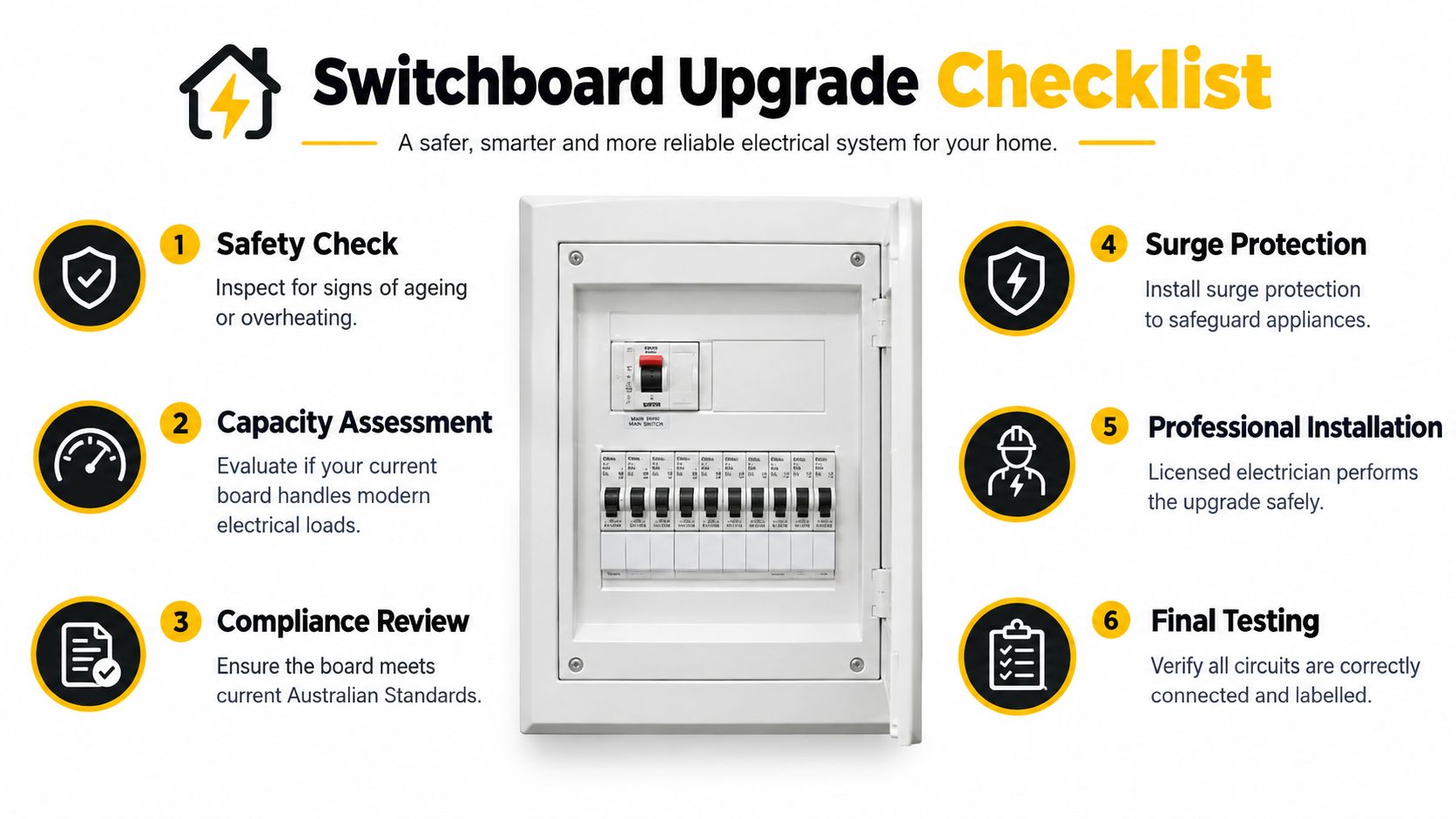
A repair may be sensible when the board is sound and the fault is isolated. An upgrade becomes more persuasive when the board has ageing components, inadequate protection, poor labelling, limited space or a history of nuisance trips.
The cheapest board replacement isn't automatically the best result. Ask whether the quote includes circuit identification, testing, labelling, safety-switch coverage and allowance for the loads you already plan. The switchboard upgrade regulations guide can help homeowners prepare questions, but the electrician still needs to inspect the property before specifying equipment.
A future-ready switchboard isn't the one with the most devices. It's the one that safely suits today's circuits and leaves a sensible path for tomorrow's loads.
A smoke alarm system protects occupants only when the alarms are the right type, correctly placed, interconnected, powered reliably and tested. Buying a sealed alarm from a hardware shelf doesn't resolve an installation that needs hard-wired connection, relocation or interconnection with other levels.
Queensland requires photoelectric, interconnected smoke alarms complying with AS 3786-2014 in every bedroom, hallways connecting bedrooms to the rest of the dwelling and every storey. Where a storey has no bedroom, an alarm belongs on the likely exit path. The Queensland Fire Department smoke-alarm guidance states that all Queensland dwellings must meet the standard by 1 January 2027.
New dwellings and substantially renovated homes generally require hard-wired 240-volt alarms, although permitted alternatives can include a non-removable 10-year battery. Existing hard-wired alarms need replacement with hard-wired photoelectric alarms, and a licensed electrician must perform hard-wired installation.
Interconnection is the part homeowners often miss. When one alarm detects smoke, every connected alarm should sound. That matters when smoke starts in a distant bedroom, on another level or behind a closed door.
For rented homes, the landlord must arrange testing and cleaning within the required period before a tenancy begins. Queensland's reform information explains the landlord and tenant responsibilities, including the tenant's obligation to test and clean alarms at least annually. Landlords can also ask Wisenet Security about alarms when comparing wider home-security or alarm-system considerations, while a Queensland electrician handles local electrical installation requirements.
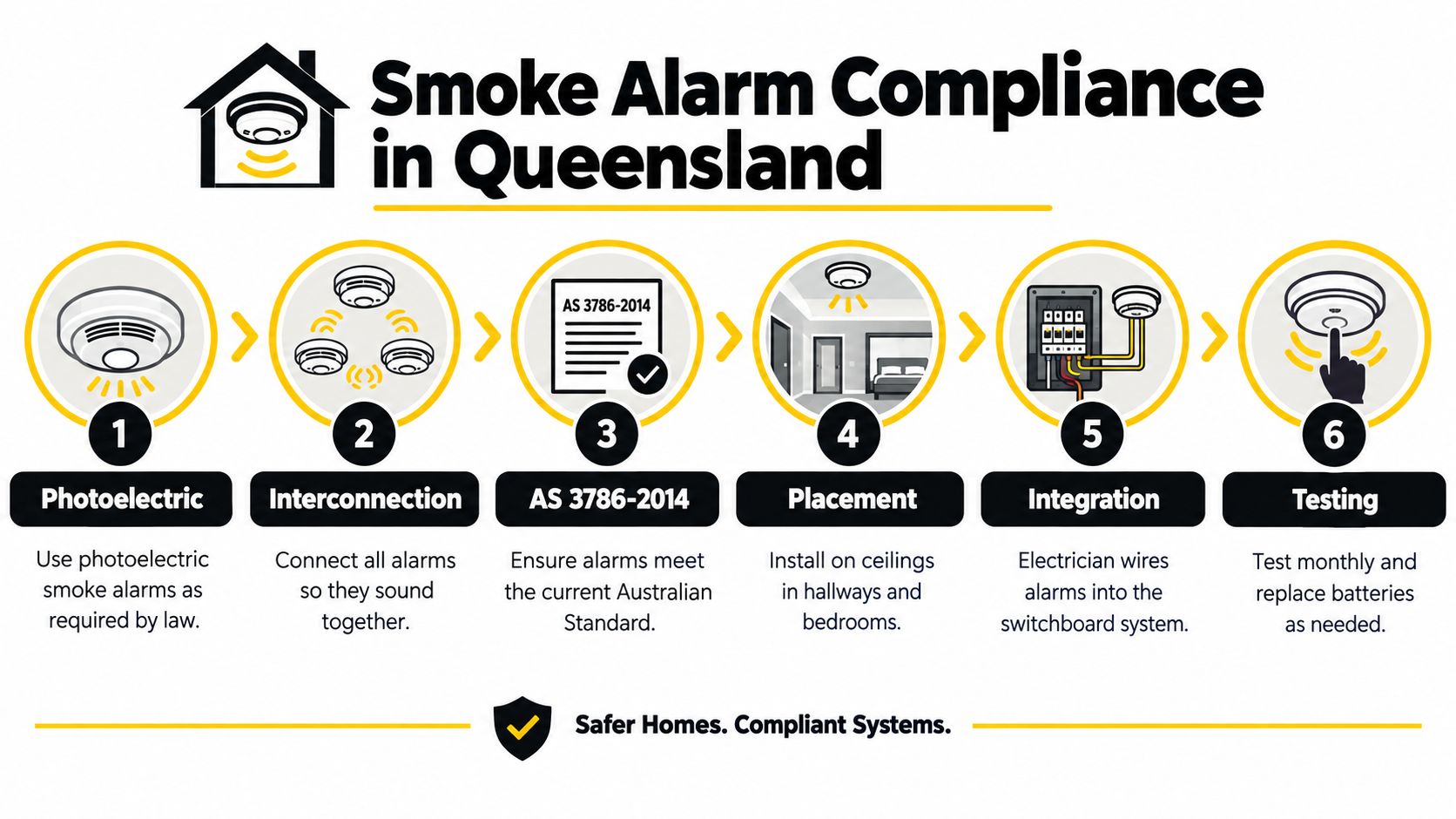
Use this checklist after installation, renovation or a change to the bedroom layout:
The Queensland smoke-detector installation requirements are useful when a renovation changes walls, doors or room use. A nuisance alarm also deserves investigation. Poor placement, dust, steam or a cooking-related location can create repeated alarms, and removing the battery defeats the system.
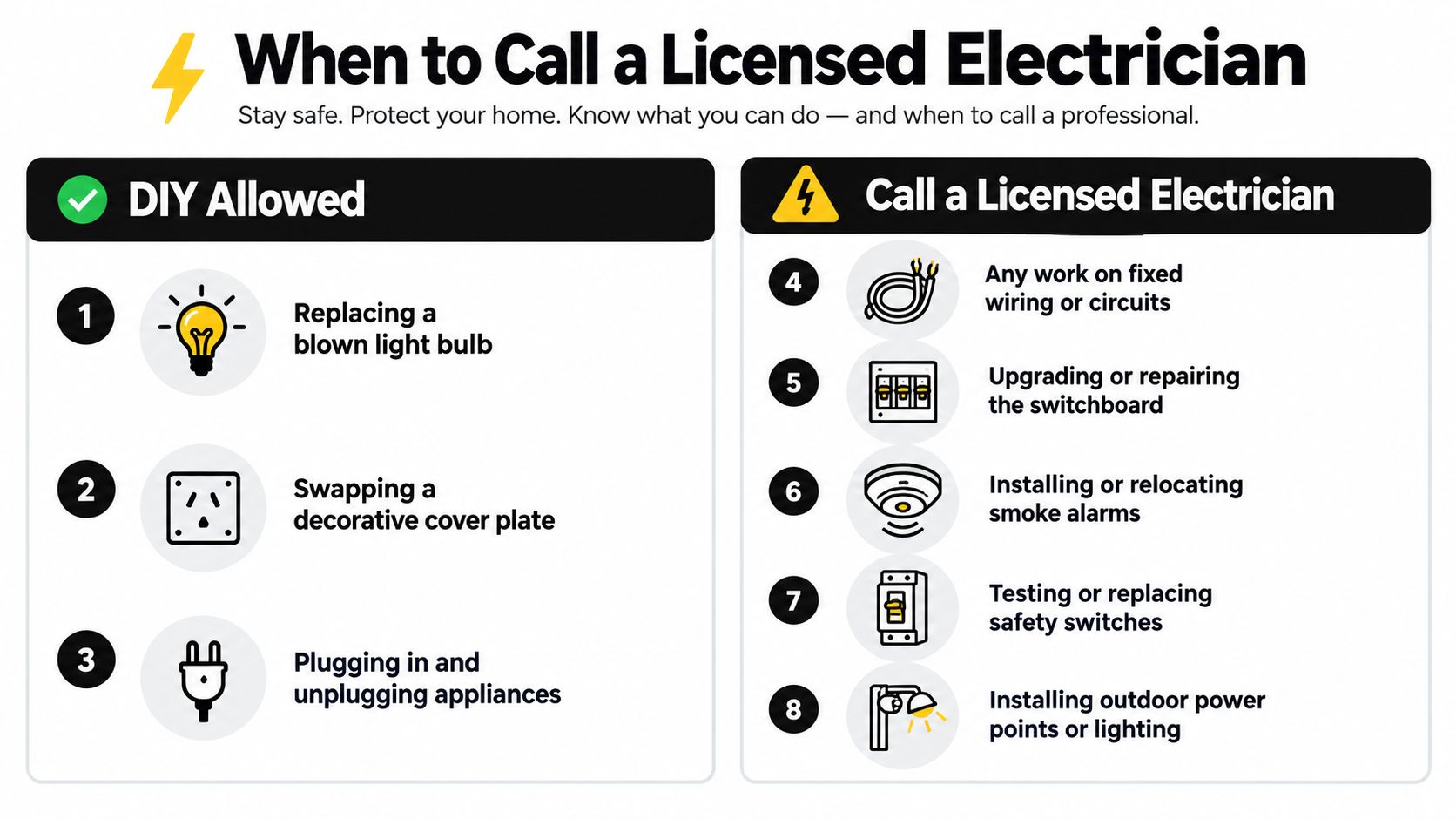
Homeowners can replace a light bulb, plug in an appliance and change a decorative cover plate. The boundary arrives when the task involves fixed wiring, a circuit, a switchboard, an outdoor power point or a 240-volt smoke alarm connection.
Queensland guidance requires safety-switch protection on all general-purpose socket-outlet circuits in domestic rental accommodation within 90 days of a tenancy agreement starting, as set out by Queensland Electrical Safety. Any work inside the switchboard or alteration to fixed wiring belongs with a licensed electrical worker. Landlords should treat a new kitchen, laundry, outdoor outlet or renovated room as a reason to reassess the relevant circuit protection, not just the visible fitting.
The cheapest quote can become the most expensive when it leaves out testing, protection or enabling work. A low figure may cover a fitting swap while excluding access, cable repairs, switchboard changes, certification or making good the wall. Compare scope, not just the total.
Use the questions to ask an electrician before hiring as a preparation list. You can also use the video below to help frame the conversation before a quote.
A professional shouldn't pressure you into unrelated upgrades. They should explain the immediate risk, the compliance position and the practical consequence of waiting.
Electrical pricing changes with the actual work. Access through a tiled wall or tight roof space takes a different approach from an exposed garage run. Switchboard condition, cable distance, component quality, testing, certification, travel, urgency and work outside ordinary hours can all affect the final price.
A representative service visit might start with a flickering kitchen light. The electrician tests the fitting and circuit, finds heat at a connection, then checks the switchboard and discovers that the circuit labelling is incomplete. The homeowner may need a connection repair immediately, while a switchboard tidy-up or additional safety-switch work can be quoted as a separate scheduled task.
That separation is valuable. It prevents a genuine safety repair from being delayed, while giving the owner time to compare planned improvement work. It also makes clear whether the initial price includes access, patching, replacement parts and follow-up testing.
A useful quote should identify:
Don't treat a free quote as proof that the scope is complete. A free assessment can still be useful when the contractor documents assumptions and exclusions. Ask whether the recommendation is a repair, replacement or upgrade, and whether the quote allows for existing conditions that weren't visible during the first inspection.
Compliance paperwork also has practical value. Keep certificates, test records and product information with the property's maintenance documents. They can help during future repairs, renovations, insurance discussions or a sale.
The right question isn't “How cheap is the quote?” It is “What safe, tested and documented result am I actually buying?”
A tripping safety switch, warm outlet or flickering light can point to a fault beyond the fitting itself. Before calling, note the affected room, what was running, which breaker moved, and any heat, smell, noise or visible damage. That detail helps the electrician judge urgency and decide whether the wider home electrical system needs checking.
A practical residential electrician service usually follows this order:
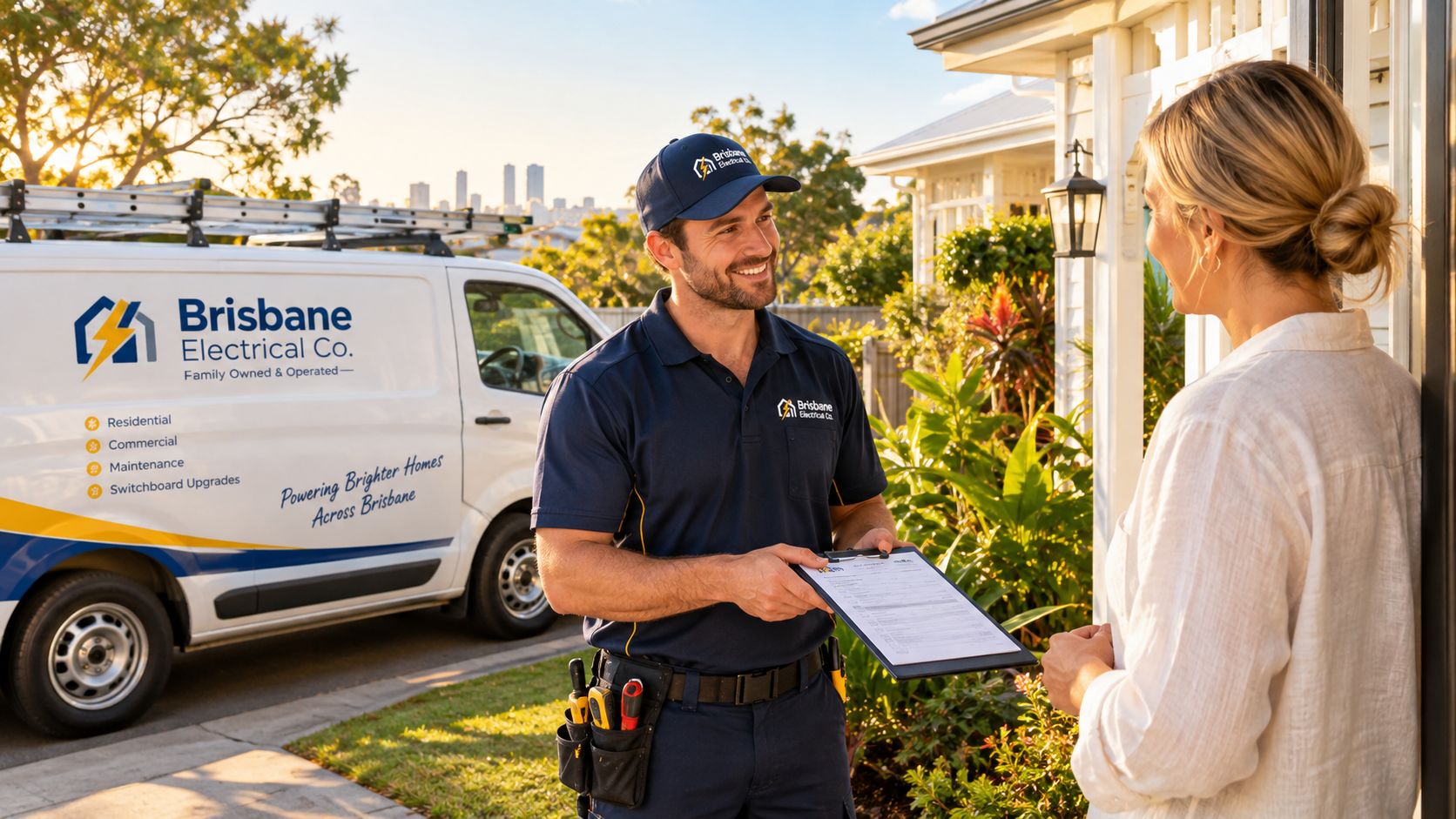
DLG Electrical is a family-owned Brisbane contractor providing residential installations, repairs, switchboard work, smoke-alarm services, safety inspections, appliance connections, lighting and data cabling. The team operates Monday to Friday from 7:30 am to 4:00 pm, serving North Brisbane, Grange, Windsor and surrounding areas. Homeowners, landlords and renovators can use the DLG Electrical service to request a quote and discuss which work should happen first.
Start with the visible risk, then have the electrician assess the system behind it. Queensland compliance requirements may determine what must be addressed before other improvements can wait.
Contact DLG Electrical for a residential electrical assessment covering repairs, switchboards, smoke alarms, lighting, appliance connections and planned upgrades. Describe the issue, request a written scope, and arrange work that protects the home now while allowing for future needs.

Master Electrician with over 30 years of experience. Founded DLG Electrical in 2005 after international project work including electrical installations at Stamford Bridge Stadium, London(Home of Chelsea FC).

Local Electricians that can fix all Electric Hot water Systems.
Motion sensor lights are a versatile addition to any home, offering nu
