83 Jean St, Grange QLD 4051
Mon-Fri 07:30 AM - 04:00 PM - Sat - 8:00 - 12 - Sunday Closed
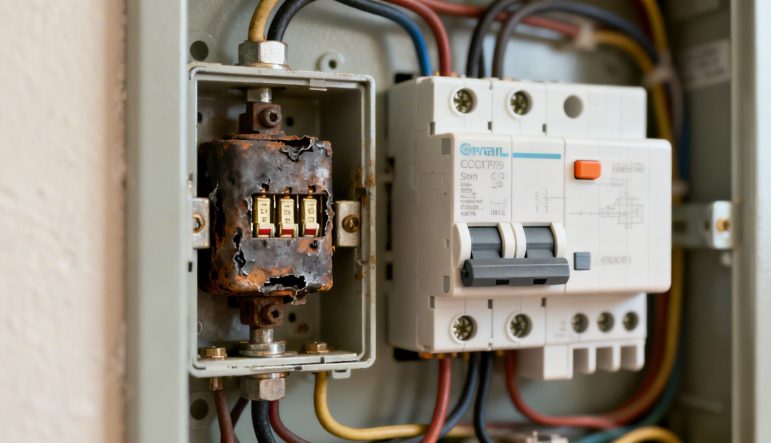
The Difference Between Fuse and Circuit Breaker Explained: At its heart, the difference between a fuse and a circuit breaker comes down to reusability and how they work. A fuse is a single-use safety device containing a metal strip designed to melt and permanently break a circuit during an overload. Once it’s gone, it needs a full replacement. A circuit breaker, on the other hand, is an automatic, reusable switch that simply ‘trips’ (disconnects) when it detects a fault and can be reset with a flick of a switch.
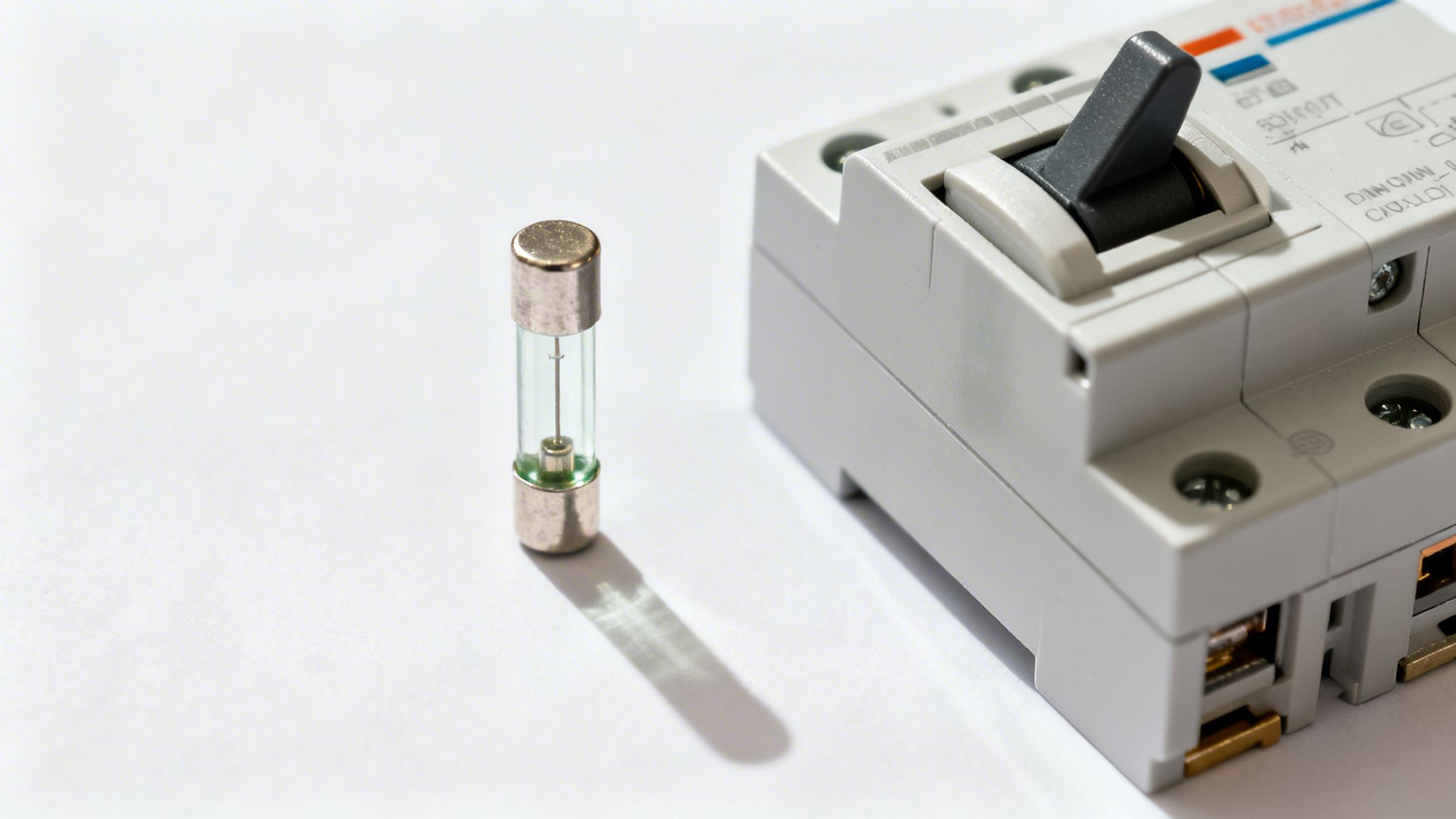
For homeowners here in Brisbane, understanding the difference between a fuse and a circuit breaker isn’t just trivia—it impacts everything from the convenience of restoring power to your long-term safety and costs. While both are built to protect your electrical system from dangerous overloads and short circuits, their methods and the implications for you are worlds apart.
A fuse works on a simple, sacrificial principle. The thin metal wire inside is calibrated to melt and break the connection the instant an electrical current surges past a safe level. This action is incredibly fast, but it’s also permanent. The fuse has done its job, and now it needs replacing.
A circuit breaker is a more sophisticated mechanical switch. It uses one of two methods: either a bimetallic strip that bends with heat during a slow, steady overload, or an electromagnet that reacts instantly to a major short circuit. This mechanism ‘trips’ the switch, cutting the power without damaging the device itself.
For most property owners, the most practical difference is what you have to do when the power goes out. This quick-reference table breaks down the fundamental attributes separating these two essential safety devices.
| Attribute | Fuse | Circuit Breaker |
|---|---|---|
| Operation | Melts a metal filament to break the circuit (sacrificial). | Trips an internal switch to break the circuit (mechanical). |
| Reusability | Single-use. Must be replaced after it blows. | Reusable. Can be reset many times. |
| Convenience | Requires a spare fuse and manual replacement (often in the dark). | Simple to reset by flipping a switch back on. |
| Sensitivity | Extremely fast reaction to major faults. | Calibrated to handle a range of overcurrents and shorts. |
| Upfront Cost | Very low per unit. | Higher initial installation cost. |
| Safety Features | Provides basic overcurrent protection only. | Modern versions can include advanced RCD/RCBO shock protection. |
The most important thing to grasp is that a circuit breaker isn’t just a reusable fuse.
It’s an advanced safety switch offering predictable, reliable, and far more user-friendly protection that aligns with modern Australian electrical standards.
While both fuses and circuit breakers are designed to protect your home from electrical dangers, they get the job done in fundamentally different ways. The real difference between a fuse and a circuit breaker comes down to how they handle overcurrents—one makes a sacrifice, while the other uses a clever mechanical switch.
A fuse works on a simple but incredibly effective principle: thermal sacrifice. Inside every fuse is a small strip of metal, carefully engineered to melt at a precise electrical current. When the current surges past that safe limit, like during a major short circuit, the wire heats up and vaporises almost instantly. We’re talking as fast as 2 milliseconds.
This sacrificial act breaks the circuit for good, stopping the dangerous flow of electricity in its tracks. It’s a one-time-use device; its own destruction is what keeps you and your property safe. That extreme speed is why fuses are still brilliant at protecting highly sensitive electronics from sudden, catastrophic power spikes.
On the other hand, a circuit breaker is a far more sophisticated and reusable device. It doesn’t destroy itself. Instead, it acts like an intelligent, automatic switch that you can simply reset. If you’d like to explore this in more detail, you can learn more about what a circuit breaker is and its different forms in our dedicated guide. Modern breakers use a smart, dual-action mechanism to tackle two very different kinds of electrical faults.
1. Thermal Protection for Overloads:
For those slow-burn overloads—like when you run the heater, kettle, and microwave all at once on the same circuit—the breaker uses a bimetallic strip. As the current gradually climbs, this strip heats up and starts to bend. If the overload persists, the strip eventually bends far enough to physically trip the internal switch, cutting the power.
2. Magnetic Protection for Short Circuits:
For the sudden, violent current spikes from a short circuit, the breaker calls on an electromagnet. The massive, instantaneous rush of electricity generates a powerful magnetic field that yanks a lever, tripping the switch immediately. This magnetic response is much, much faster than the thermal one, giving you rapid-fire protection exactly when it’s needed most.
This dual system is a key reason circuit breakers are the modern standard. They are calibrated to distinguish between a harmless, momentary power spike and a genuine, persistent danger, reducing nuisance trips while providing comprehensive protection.
This mechanical sophistication is what truly sets a circuit breaker apart from a fuse. While a fuse provides brute-force, one-shot protection, a circuit breaker delivers a more nuanced, resettable safety net designed for the diverse demands of a modern home’s electrical system.
When deciding between a fuse and a circuit breaker, we need to look past the basic definitions and get into the nitty-gritty of what actually keeps your property safe and running smoothly. The real difference between them becomes clear when we compare them on speed, accuracy, and long-term convenience—especially in a practical Brisbane setting.
Both are designed to cut power when things go wrong, but they react differently. Fuses are famous for their sheer speed. In a catastrophic short circuit, a fuse’s thin metal wire can vaporise in as little as 2 milliseconds. This near-instantaneous shutdown is perfect for protecting highly sensitive electronic components from sudden, massive power surges.
Modern circuit breakers, on the other hand, are engineered with a bit more intelligence. They use a dual-action mechanism that can tell the difference between a harmless power-up surge (like when you turn on a big appliance) and a genuine, sustained fault that poses a real danger. This clever calibration provides better protection across a wider range of common electrical problems and stops the frustrating, unnecessary power cuts that an overly sensitive fuse might cause.
This is where the circuit breaker really pulls ahead. When a fuse blows, it’s gone for good and needs to be completely replaced. This usually means fumbling around in the dark for a torch, finding your switchboard, and then hoping you have the right size replacement fuse on hand. If not, it’s an inconvenient trip to the hardware store.
A circuit breaker, in contrast, just needs to be reset. A quick flip of a switch, and your power is back on. What could have been a major hassle becomes a minor inconvenience. This simple reusability is a huge reason why the Australian circuit breaker and fuse market has grown to an estimated value of around USD 15 million. Miniature Circuit Breakers (MCBs) dominate this market, especially in homes and businesses, because they eliminate the need for spare parts and offer significant long-term savings, even if they cost a bit more upfront. You can explore more data on this market trend to see why circuit breakers are becoming the standard.
Both fuses and circuit breakers are designed to protect against two main types of electrical faults, as this diagram shows.
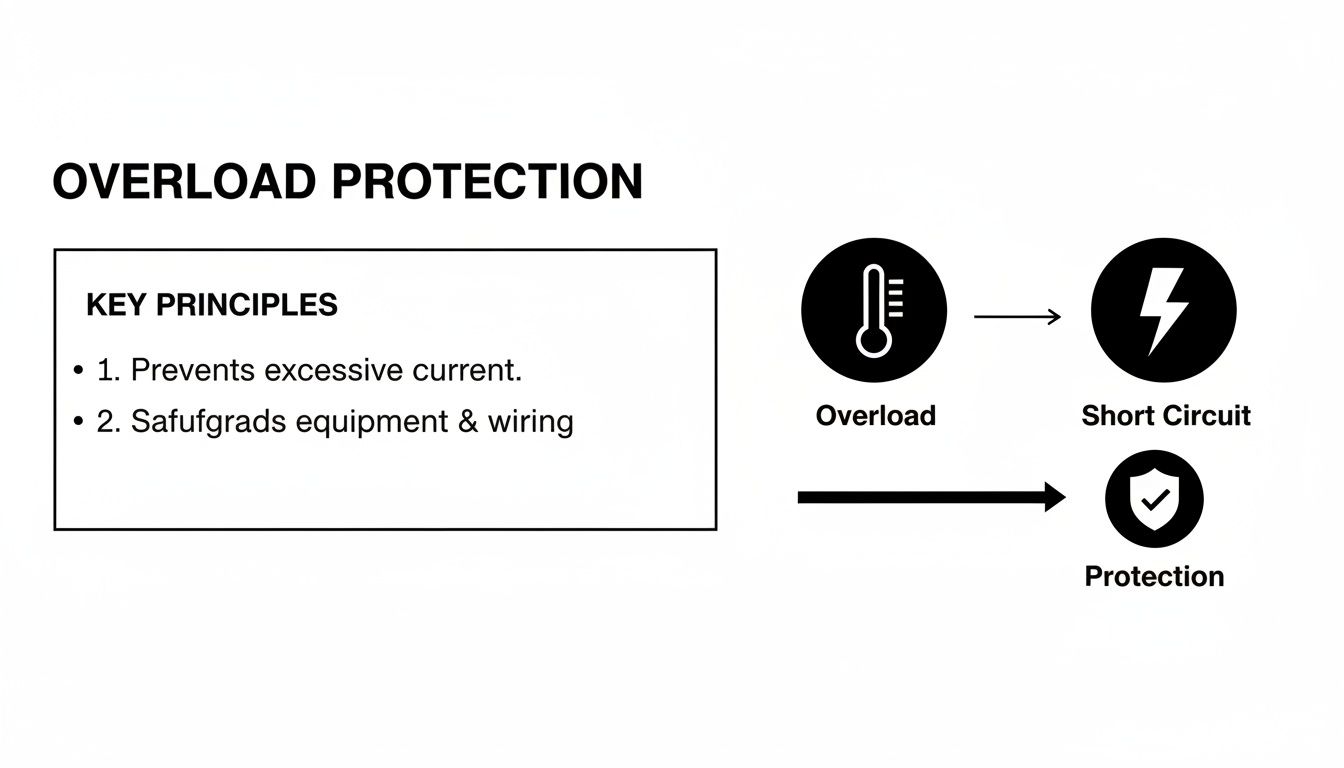
The image highlights how these devices have to handle both slow-building overloads and the sudden, intense danger of a short circuit to provide complete electrical safety.
Perhaps the most critical difference, and the one we electricians worry about most, is protection accuracy. A circuit breaker has a precise, factory-set trip rating that can’t be tampered with. When we install a breaker, it’s specifically rated for the wiring it’s protecting, guaranteeing it will trip at the correct amperage every single time. For modern electrical safety, this precision is non-negotiable.
Fuses, however, open the door to dangerous human error. If a 15-amp fuse blows, it’s all too common for a homeowner to grab whatever is available and mistakenly slot in a 20-amp or even a 30-amp fuse. It seems like a small mistake, but it’s incredibly dangerous.
By installing a higher-rated fuse, you are effectively giving the circuit wiring permission to carry more current than it was ever designed for. This allows the wires hidden inside your walls to overheat, dramatically increasing the risk of an electrical fire. This is a common and serious hazard our DLG Electrical technicians find in older Brisbane homes still running on outdated fuse boxes.
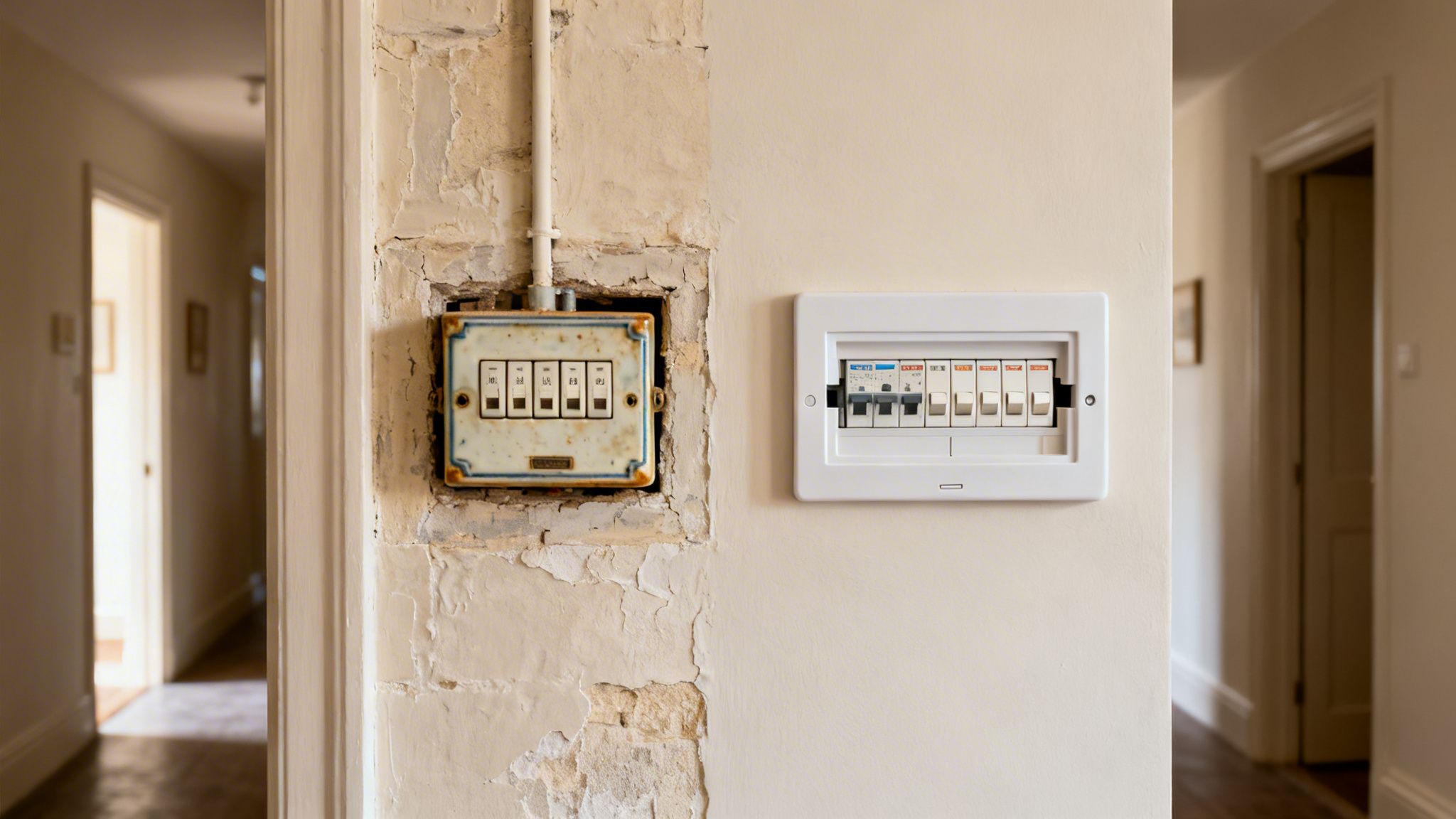
The practical difference between a fuse and a circuit breaker often comes down to the age of your property. Here in Brisbane, you can pretty much tell what you’ll find just by looking at the house. Older character homes almost always have fuses, while circuit breakers are the undisputed standard in modern buildings.
If you live in a classic “Queenslander” or a pre-1990s home in suburbs like Paddington or Ascot, there’s a good chance you still have an original ceramic fuse box. These systems were the peak of safety technology for their time, but their presence is a dead giveaway that the home’s electrical system hasn’t seen a major upgrade in decades.
While they might still be functional, these old fuse boxes represent an outdated approach to electrical safety. Their continued use can carry some pretty serious safety and insurance implications.
On the flip side, any new build or significant renovation in Queensland today will exclusively feature a modern switchboard packed with circuit breakers. This is non-negotiable. From sprawling new estates in North Lakes to the high-rise apartments dotting the Gold Coast, circuit breakers are the only option.
This shift is driven by Australian electrical standards (AS/NZS 3000), which mandate advanced safety features that old fuse boxes simply can’t offer. Modern switchboards must include special types of circuit breakers known as Residual Current Devices (RCDs), more commonly called Safety Switches.
An RCD is a life-saving device. It’s designed to protect you from a serious electric shock by tripping in just milliseconds if it senses a dangerous current leak. This is now a legal requirement for power and lighting circuits in all new homes and major renovations.
Even if your home has a modern switchboard, fuses haven’t completely vanished. You’ll still find them in specific, targeted roles where their incredibly fast-acting nature is a real benefit.
Despite their declining role in residential switchboards, fuses are still a vital part of the wider electrical landscape. Here in Brisbane, where DLG Electrical has been upgrading home electrical systems for over 19 years, the demand for fuses remains strong. The Australia electric fuse market was valued at USD 99.68 million in 2024 and is projected to hit USD 187.11 million by 2033, showing just how much ongoing investment there is in electrical infrastructure. Find out more about Australia’s electric fuse market.
When it comes to your home’s electrical protection, the decision isn’t just about technology. It’s a balancing act between upfront costs, long-term expenses, and the critical safety rules we have to follow here in Queensland. For Brisbane property owners, the financial and legal side of things draws a pretty clear line between old-school fuses and modern circuit breakers.
It’s easy to see why fuses might seem like the cheaper way to go. A single replacement fuse will only set you back a few dollars, which feels like nothing. The problem is, this overlooks the hidden, ongoing costs. Every single time a fuse blows, it adds up. If you don’t have the exact right replacement on hand, you’re looking at a trip to the hardware store or, worse, a call-out fee for an electrician if you’re not sure what caused it. These little, unpredictable expenses can really start to become a financial headache over time.
Switching your old fuse box over to a modern switchboard with circuit breakers does require a larger initial investment. There’s no getting around that. This upfront cost covers the new enclosure, all the individual breakers, and the labour for a licensed electrician to get it installed safely and up to code.
But here’s the thing: once it’s in, the ongoing cost of circuit breakers is practically zero. You don’t buy replacements. A trip is fixed by a simple flick of a switch, which means no more call-out fees for simple overloads. That one-time investment quickly pays for itself in reliability and pure convenience, giving you a predictable and much more cost-effective solution for the life of your home.
A circuit breaker upgrade isn’t just an expense; it’s an investment in your property’s safety, functionality, and compliance. It eliminates recurring costs and significantly reduces the risk of electrical faults turning into major hazards.
Beyond just the cost, the legal requirements here in Queensland are a massive factor. The Australian Wiring Rules (AS/NZS 3000) are the bible for all electrical work, and they have very strict rules for new builds, major renovations, and switchboard upgrades.
These standards make it law to install Residual Current Devices (RCDs)—you might know them as safety switches—on all power and lighting circuits. An RCD is a special type of circuit breaker built to prevent a fatal electric shock by tripping in a fraction of a second if it detects a current leak. This is a life-saving feature that old fuse boxes just don’t have.
This means any modern switchboard upgrade legally must use circuit breakers to incorporate this protection. For landlords, making sure your property meets these standards is also non-negotiable for getting an electrical safety certificate for landlords. At the end of the day, upgrading to circuit breakers isn’t just about convenience—it’s about following essential safety laws that protect you, your family, or your tenants.
Understanding the theory behind fuses and circuit breakers is one thing. Knowing when your old fuse box has crossed the line from outdated to dangerous? That’s far more important.
For homeowners in Brisbane, there are a few tell-tale signs that your electrical system is struggling to keep up with the demands of modern life. If you find yourself frequently replacing blown fuses, that’s a crystal clear signal your circuits are overloaded. It’s a problem that won’t just go away on its own.
Persistent electrical hiccups are your home’s way of asking for help. It’s crucial not to ignore these signs, as they often point to underlying dangers that need a licensed electrician’s eye.
Crucially, any DIY work on a switchboard is not only illegal in Queensland but also extremely dangerous. A single mistake could lead to electrocution or a devastating electrical fire.
This is a job strictly for the professionals.
If these signs sound familiar, it’s time to take action. As Brisbane’s trusted experts in electrical safety, DLG Electrical can assess your system and carry out safe, compliant electrical switchboard upgrades. Contact us to schedule a professional consultation and secure your property’s electrical future.
When it comes to the difference between fuses and circuit breakers, we often get practical questions from Brisbane residents about their home’s safety. Here are the answers to a few of the most common ones we hear at DLG Electrical.
The easiest way to know for sure is to take a look at your electrical panel, or what we call a switchboard.
If you open it up and see neat rows of switches that look like small light switches, you have circuit breakers. These can be flipped on and off manually.
On the other hand, if your panel is filled with small, round plugs that you have to unscrew, you’ve got fuses. Sometimes these are larger black cartridges that you pull straight out. The round ones are usually ceramic or have a little glass window on the top.
An old fuse box isn’t inherently dangerous, but only if it has been perfectly maintained and never tampered with. The reality is, these older systems come with significant risks by today’s standards. Most importantly, they completely lack the mandatory RCD safety switches required now, which are what provide crucial protection against electric shock.
The biggest danger with old fuse boxes is simple human error. Accidentally replacing a blown fuse with one of the wrong amperage is a common mistake. Doing so can allow the wiring inside your walls to overheat, creating a serious fire hazard. An upgrade is always the safest path forward.
No, you can’t just pull out an individual fuse and pop in a circuit breaker. This is a common misconception we run into. The entire switchboard enclosure must be professionally upgraded to a modern one that is specifically designed to house circuit breakers safely.
This complete upgrade ensures the new system complies with the current Australian electrical standards (AS/NZS 3000), which includes the mandatory installation of RCDs. A licensed electrician must carry out this work—it’s the only way to guarantee it’s done safely and is legally compliant.
If you’re unsure about your current setup or thinking about an upgrade for better safety and compliance, the fully licensed team at DLG Electrical is here to help. Contact us for a free quote and get expert advice on safeguarding your Brisbane property.

Master Electrician with over 30 years of experience. Founded DLG Electrical in 2005 after international project work including electrical installations at Stamford Bridge Stadium, London(Home of Chelsea FC).

Local Electricians that can fix all Electric Hot water Systems.
Motion sensor lights are a versatile addition to any home, offering nu
