83 Jean St, Grange QLD 4051
Mon-Fri 07:30 AM - 04:00 PM - Sat - 8:00 - 12 - Sunday Closed
Ever wondered what the real cost of running aircon is? For a typical Australian home, a standard split system will set you back between $0.36 and $0.70 per hour. Over an eight-hour day, that adds up to roughly $2.88 to $5.60.
Of course, that’s just a ballpark figure. The final number that shows up on your electricity bill depends on a bunch of factors, like your system’s size, its energy efficiency rating, and even which state you live in.
Watching your energy bill climb as the summer heat intensifies can be a bit unsettling. Many of us see our air conditioner as a necessary evil—we can’t live without it for comfort, but it’s often a major source of financial anxiety. The good news is, understanding the cost of running your aircon doesn’t have to be a guessing game. This guide will give you a clear financial snapshot of what it really takes to stay cool in Australia.
Before we get into the nitty-gritty of what pushes those costs up or down, it helps to have a baseline. The numbers vary quite a bit depending on your unit’s size, which is measured in kilowatts (kW). A small unit for a bedroom will just sip power, whereas a large ducted system designed for a whole house is going to be much, much thirstier.
Let’s zoom out for a moment and look at the bigger picture of energy use in Australian homes. It’s no secret that heating and cooling are two of the biggest expenses, often accounting for a huge chunk of your quarterly power bill.
In fact, air conditioning is responsible for 20% to 50% of all energy consumption in Australian households, depending heavily on the local climate. Despite millions of families planning to cut back, national spending on air conditioning still hit $3.1 billion last summer. The average home spent around $305 for the season. You can explore more about these national energy trends and what they mean for your wallet.
This just goes to show how much of an impact home cooling has on both the national energy grid and our household budgets. To help you get a practical idea of what to expect, the table below provides a more detailed breakdown based on your system’s size.
This table breaks down the typical running costs for common air conditioner sizes across Australia. We’ve based these numbers on an average electricity price to give you a straightforward comparison.
| Aircon Size | Average Hourly Cost | Average Daily Cost (8 hours) | Estimated Summer Cost (90 days) |
|---|---|---|---|
| Small (2.5kW) | $0.36 – $0.45 | $2.88 – $3.60 | $259 – $324 |
| Medium (5kW) | $0.65 – $0.80 | $5.20 – $6.40 | $468 – $576 |
| Large (7kW) | $0.90 – $1.10 | $7.20 – $8.80 | $648 – $792 |
| Ducted System (10kW) | $1.40 – $1.70 | $11.20 – $13.60 | $1,008 – $1,224 |
Think of these figures as a starting point. Your actual costs will shift based on your electricity tariff, your home’s insulation, and how you use your system.
Ever glanced at your power bill after a hot summer and wondered why your cooling costs seem so much higher than your neighbour’s? You’re not alone. The final number on that bill isn’t some random figure plucked from thin air; it’s a direct result of several key factors all working together.
Think of it like fuelling up your car for a road trip. The total cost depends on the car’s fuel efficiency, the price of petrol, how big the engine is, and whether you’re climbing steep hills or cruising on a flat highway. Your air conditioner works on very similar principles.
Let’s lift the bonnet on your energy bill and unpack the main drivers behind your cooling expenses. Once you understand these, you can start to see where your money is really going and, more importantly, how to keep more of it in your pocket.
First and foremost is your air conditioner’s power consumption, which is measured in kilowatts (kW). This number tells you exactly how much electricity the unit chews through in one hour of operation.
A small 2.5kW unit designed for a bedroom is like a zippy little hatchback—it sips power. On the other hand, a big 10kW ducted system built to cool an entire house is more like a gutsy V8 ute. It’ll do the heavy lifting, but it’s going to be a whole lot thirstier. You can usually find this kW rating on the compliance label on your indoor or outdoor unit.
The next piece of the puzzle is what you actually pay for that power. Electricity tariffs, measured in cents per kilowatt-hour (c/kWh), vary a surprising amount across Australia. What someone pays in South Australia could be quite different from the rates in Queensland or Victoria.
Your specific energy plan matters, too. Some plans have a single flat rate, while others use “time-of-use” tariffs. With these, power is cheaper during off-peak hours (like the middle of the night) and gets more expensive during peak demand in the late afternoon and evening.
The physical size and cooling capacity of your unit—often measured in British Thermal Units (BTU) or kilowatts (kW)—play a huge role in its running cost. It’s a classic Goldilocks situation: you need one that’s just right. An undersized unit will have to run flat-out constantly just to try and cool a large space, which is incredibly inefficient and costly.
But an oversized unit is just as bad. It will blast the room with cold air, cool it down too quickly, and then shut off. This constant starting and stopping, known as “short cycling,” not only wastes a heap of energy but also puts a lot of extra strain on the system’s components, which can lead to a shorter lifespan.
This one’s a no-brainer. Your location has a massive impact on your bill. An air conditioner in tropical Cairns is going to work a lot harder and for more months of the year than the exact same unit installed in a home down in milder Hobart.
Here’s how the climate comes into play:
Finally, and this is a big one, how you actually use your air conditioner can make or break your budget. Your daily habits can cause huge swings in your final bill. If you’re scratching your head over energy expenses, it’s always worth looking into all the reasons why your electricity bill might be so high, because personal usage is almost always a major factor.
Setting the thermostat to a frosty 18°C will cost a whole lot more than a comfortable 24°C. In the same way, running the unit for 12 hours a day will naturally be more expensive than just using it for a few hours to get through the worst of the afternoon heat.
It’s one thing to have a vague idea of what your aircon costs to run, but it’s another to know the exact figure. Getting to that precise number is actually much easier than you might think. While things like the day’s weather and your own usage habits will always cause some variation, a simple formula can give you a crystal-clear picture of your hourly running cost.
This knowledge is powerful. It lets you make smart, informed decisions that balance your comfort with your budget. The whole process comes down to one core equation.
The Core Formula: (Power Consumption in kW) x (Electricity Price in $/kWh) = Hourly Running Cost
This simple calculation takes the two most important factors—your aircon’s power draw and your electricity tariff—and tells you exactly what you’re paying for every hour the unit is on. Let’s break down how to find these two numbers and put them to use.
First up, you need to figure out how much power your air conditioner actually uses. This is measured in kilowatts (kW) and is almost always printed on the compliance label or sticker on the unit itself. Check the side of the indoor unit or on the big outdoor compressor.
You’re looking for a figure listed as “Power Input,” “Rated Input,” or just “Input.” It will be shown in either Watts (W) or kilowatts (kW). If the number is in Watts, just divide it by 1000 to get kilowatts. For example, a 2500W unit is the same as a 2.5kW unit. That’s the first half of our equation sorted.
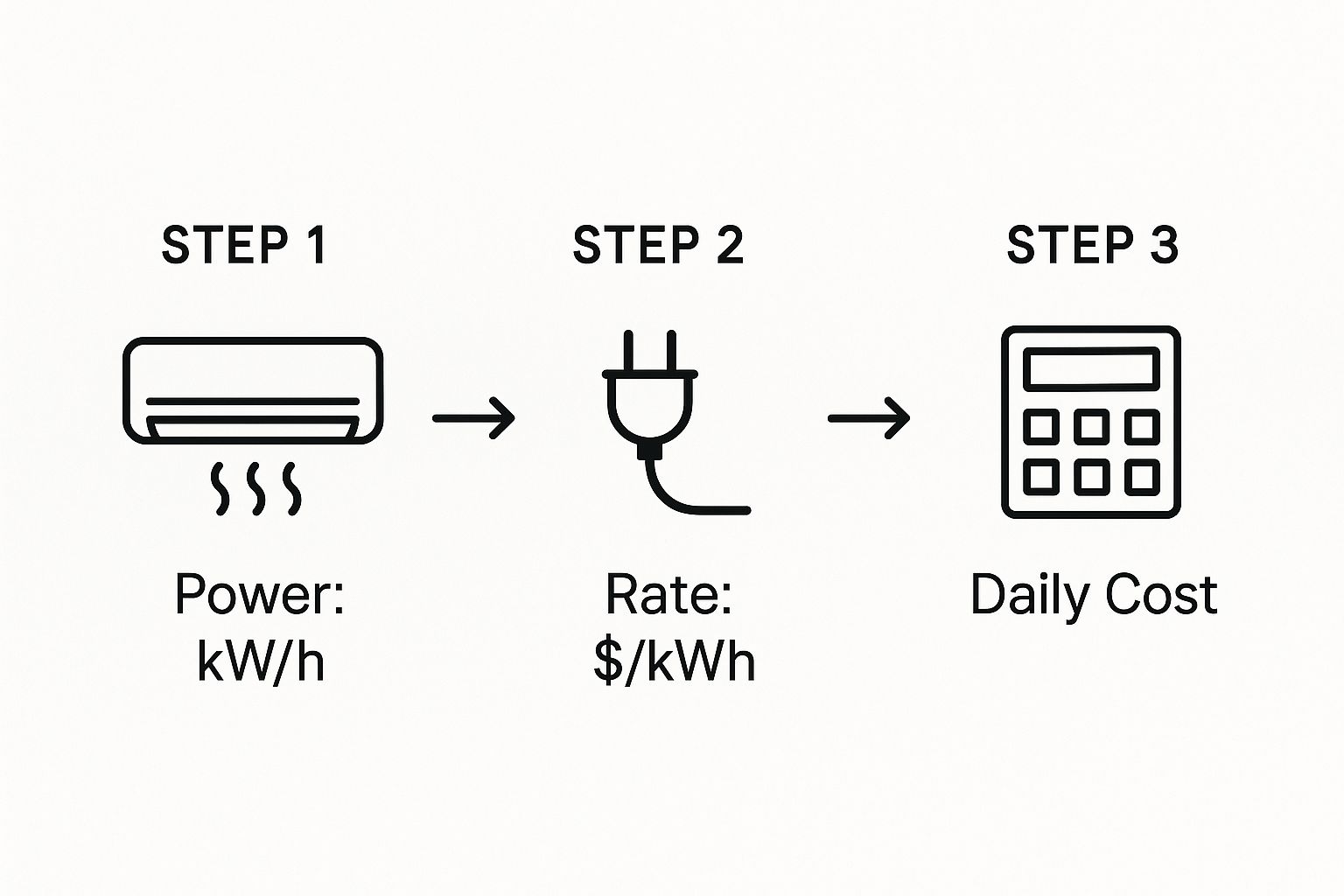
This simple infographic sums it up perfectly. Find your power rating, find your electricity rate, and you have everything you need to calculate your daily cost.
Next, you need to find the price you pay for electricity, which is measured in cents or dollars per kilowatt-hour ($/kWh). The easiest place to find this is on your latest power bill, usually under a heading like “usage charges” or “tariff details.” Across Australia, the average residential cost sits at around $0.319 per kWh, but your specific rate will vary depending on your provider and plan.
Knowing this figure is more important than ever. In 2023, it was projected that Australians would spend over $12.4 billion on air conditioning alone. This huge number was driven by soaring wholesale electricity prices and more frequent heatwaves. For a more detailed guide on finding and understanding your usage, check out our article on how to calculate electrical energy consumption.
Once you have both numbers—your aircon’s power consumption and your electricity price—you’re ready to plug them into the formula. To make it concrete, let’s run through a few real-world examples using a standard electricity rate of $0.32 per kWh.
The table below shows just how different the costs can be, from a small portable unit to a large ducted system.
| Aircon Type | Power Consumption (kW) | Calculation (per hour) | Hourly Cost | Daily Cost (8 hours) |
|---|---|---|---|---|
| Small Portable Unit | 1.5 kW | 1.5 kW x $0.32/kWh | $0.48 | $3.84 |
| Medium Split System | 5.0 kW | 5.0 kW x $0.32/kWh | $1.60 | $12.80 |
| Large Ducted System | 12.0 kW | 12.0 kW x $0.32/kWh | $3.84 | $30.72 |
As you can see, the cost of running aircon varies dramatically based on the unit’s power. A large ducted system can cost eight times more per hour than a small portable one. By applying this simple calculation to your own appliance and energy bill, you can get a precise, actionable number that truly helps you manage your household budget. No more guesswork.
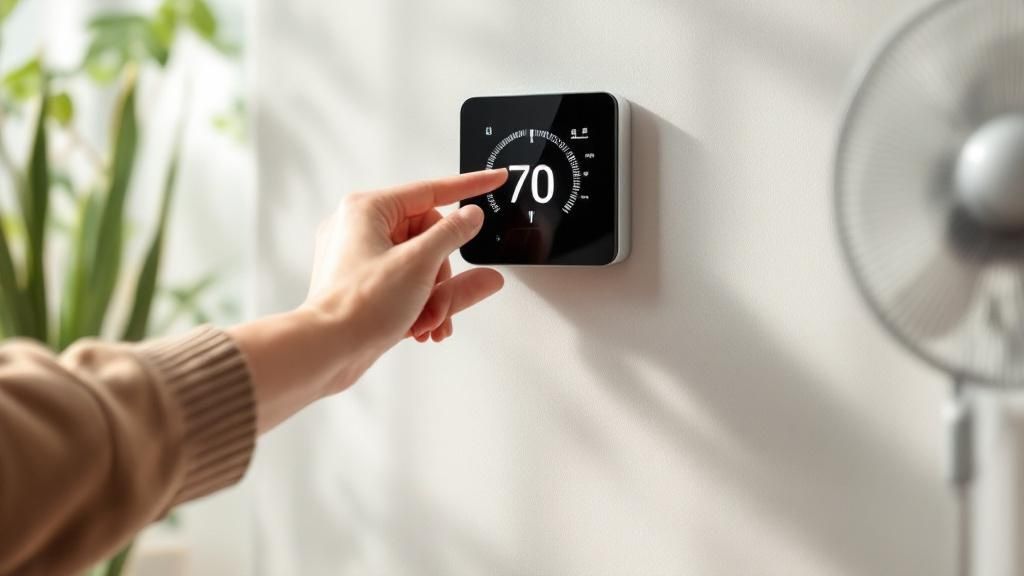
The single most effective way to manage the cost of running aircon happens long before you even feel that first blast of cool air. It happens at the point of purchase. Picking an energy-efficient model is an upfront investment that directly slashes your electricity bills for years to come.
Think of it like buying a car. You could grab a cheap, fuel-guzzling model that gets you from A to B, but you’ll feel the pain at the petrol station every single week. Or, you could invest a bit more in a hybrid and enjoy the long-term savings. High-efficiency air conditioners work exactly the same way.
While they might have a higher price tag initially, their lower power consumption means they eventually pay for themselves. It’s a proactive choice that gives you lasting control over your cooling expenses.
When you’re shopping for a new air conditioner in Australia, your best friend is the Zoned Energy Rating Label (ZERL). This isn’t just another sticker; it’s a powerful tool designed to show you exactly how an air con unit will perform in your specific climate.
Unlike the old star rating system which gave a single, one-size-fits-all score, the ZERL breaks down efficiency across three distinct Australian climate zones: hot, average, and cold. This lets you compare models based on how they’ll actually run where you live, not in some generic lab setting.
Here’s a sample ZERL so you know what to look for.
The main thing to remember is to focus on the star rating that matches your climate zone. That’s how you get a true picture of long-term running costs.
Let’s break down what you’re seeing on that label:
When comparing two models, look at the star rating for your zone. The more stars a unit has, the less energy it uses to do its job, which means a lower cost of running aircon for you. Even a single star difference can translate to a 10% reduction in running costs.
Another important choice you’ll face is the type of system. While cooling-only units are available, reverse-cycle air conditioners are incredibly popular in the Australian market, and for good reason. These units are multitasking marvels, giving you efficient cooling in summer and effective heating in winter from a single appliance.
This dual functionality isn’t just convenient; it’s also highly efficient. Government initiatives like the NSW Energy Savings Scheme and the Victorian Energy Upgrade have been actively promoting these systems. In 2023 alone, these programs helped with the installation of over 24,000 high-efficiency units, generating an estimated $513 million in net bill savings for residents. You can find more insights about the evolving Australian air conditioning market and its current trends.
By choosing a reverse-cycle system, you’re investing in year-round comfort, often with better overall energy performance than running separate heating and cooling appliances.
Knowing how to pick an efficient air conditioner and work out its running costs is half the battle. The other half really comes down to your daily habits and your home’s environment. Simple, practical adjustments can make a huge difference to your energy bill, giving you more control over the cost of running aircon without having to sweat through summer.
We’re not talking about expensive renovations or complex technical fixes here. These are low-cost, high-impact strategies you can start using today. By making smarter choices about how and when you cool your home, you can lock in some serious savings while still living comfortably. Let’s dive into the most effective ways to do it.
One of the easiest yet most powerful changes you can make is right at your fingertips: the thermostat. It’s so tempting to crank it down to a frosty 18°C on a scorching day, but this forces your system to work overtime and sends your energy consumption through the roof.
The sweet spot for balancing comfort and cost is usually between 24°C and 26°C. For every single degree you raise the thermostat in summer, you can save between 5% and 10% on your cooling costs. It’s a tiny change that adds up to big savings over a whole season.
Think of your air conditioner like a car engine on a long trip. Flooring it constantly burns way more fuel than cruising at a steady, efficient speed. Setting your thermostat to a moderate temperature lets your unit run more efficiently, reducing wear and tear while saving you money.
Your air conditioner’s filter is its first line of defence, trapping dust, pollen, and other gunk from the air. Over time, that filter gets clogged, which is like forcing the system to breathe through a straw. It has to work much harder just to pull air through, which wastes energy and drives up your bills.
Cleaning or replacing your filters is a simple job that pays off massively. A clean filter can boost your air conditioner’s efficiency by as much as 15%. For most homes, this just means checking the filter once a month during the high-use seasons and giving it a clean or swapping it out.
Ceiling fans and portable fans don’t actually lower a room’s temperature, but they do create a wind chill effect that makes you feel several degrees cooler. This is an absolute game-changer for cutting back your reliance on the air conditioner.
By using fans at the same time as your aircon, you can comfortably nudge your thermostat setting up by a few degrees without even noticing a difference. Since fans use a tiny fraction of the energy an air conditioner does, this one-two punch is a super-effective cost-saving strategy.
Here’s how to get the most out of them:
Your home’s worst enemy during a heatwave is the sun. Sunlight streaming through windows can rapidly heat your indoor spaces—a process known as solar gain. This forces your air conditioner to work much harder just to keep things cool.
Closing blinds, curtains, and awnings during the hottest parts of the day, especially on sun-facing windows, can cut indoor temperatures dramatically. For more lasting solutions, exploring effective shade options for your home, like well-placed trees or deck covers, can seriously lower your home’s overall heat load.
On top of that, hot air loves to seep in through gaps around doors and windows. Sealing these drafts with weather stripping is a cheap and easy DIY project that stops cool air from escaping and hot air from getting in, keeping your home comfortable for longer. For a deeper dive into improving your home’s thermal performance, you can find a lot of great energy efficiency tips from a Northside electrician that cover everything from insulation to appliance use.
Knowing the basics of how air con costs are calculated is one thing, but what about the real-world questions that pop up when you’re staring at the thermostat on a sweltering day? We get it. You want straight answers to those common cooling dilemmas.
Let’s dive into the queries we hear most often about the cost of running aircon. Think of this as your go-to guide for making smarter, more cost-effective decisions every single day.
This is the big one, the age-old debate among homeowners, and the honest answer is: it depends. The right strategy really boils down to two key factors—how well-insulated your home is and what kind of air conditioner you have.
Picture your home as a thermos. A modern, well-insulated home is like a high-quality thermos; it does an excellent job of holding its temperature. In this case, it can actually be cheaper to leave your aircon running at a steady, moderate temperature (say, 24°C). The unit just ticks along gently to maintain the cool, instead of having to work flat-out to bring down the temperature of a hot, stuffy house from scratch.
On the other hand, if your home is older, a bit draughty, or poorly insulated—more like a leaky paper cup—leaving the aircon on all day is a recipe for a sky-high power bill. All that precious cool air is constantly escaping, forcing your unit to run nonstop just to play catch-up. For these homes, it’s far more economical to only turn the air conditioner on when you’re actually there to enjoy it.
The technology inside your unit is the other half of the puzzle.
Comparing the running costs of a ducted system versus a split system is a bit like comparing a bus to a taxi. Both will get you to your destination, but they’re designed for very different jobs and have very different running costs.
A split system is your taxi. It’s built to cool a single room or one specific zone. Because its focus is on a much smaller area, its power consumption is relatively low. This makes it an incredibly cost-effective way to cool just a bedroom overnight or a living room in the afternoon.
A ducted system is the bus. It’s designed to cool your entire house at once through a network of hidden ducts. As you’d expect, its central unit is much larger and more powerful, which means it uses significantly more energy per hour than a single split system.
The key takeaway here is that on a per-hour basis, a single split system is always cheaper to run than a full ducted system. However, the true cost comes down to how you live. If you need to cool three or four separate rooms, running three or four individual split systems at the same time could end up costing you more than running one zoned ducted system smartly.
Here’s a quick breakdown to put it in perspective:
| System Type | Typical Hourly Cost | Best Use Case |
|---|---|---|
| Split System | $0.65 – $1.10 | Cooling a single, specific room or area. |
| Ducted System | $1.40 – $3.80+ | Cooling multiple rooms or an entire house. |
The most economical choice really depends on your lifestyle. If you generally only cool one or two rooms at a time, multiple split systems will be your cheapest bet. But if the whole family is home and spread throughout the house, a modern, zoned ducted system might be the more practical and efficient choice.
Yes, it absolutely does. That “Eco” or “Economy” mode on your air conditioner isn’t just a marketing gimmick; it’s a feature specifically engineered to reduce the cost of running aircon, and it works by being clever.
When you switch on Eco Mode, your air conditioner tweaks its operation in a couple of smart ways. First, it usually raises the set temperature just a little bit, often by one or two degrees over an hour, until it settles at a more energy-efficient level. You probably won’t even notice this subtle change, but it makes a real difference to your power consumption.
Next, the system slows the compressor and fan speed down to the lowest setting needed to maintain that new, slightly higher temperature. Instead of running at full tilt, it just sips power gently. This is especially effective for inverter models, which can fine-tune their output with incredible precision.
The trade-off, of course, is slightly less powerful cooling. On a truly scorching day, Eco Mode might not feel like it’s quite enough. But for most days, and especially for overnight use, it keeps things comfortable while noticeably cutting your electricity usage—often by up to 30%. Think of it as putting your aircon on a sensible budget; it still gets the job done, just more frugally.
Navigating your air conditioning needs and ensuring your home’s electrical system can handle the load safely and efficiently is crucial. For expert advice on installations, maintenance, or any electrical upgrades, trust the team at DLG Electrical. Visit us at https://dlgelectrical.com.au to get a free quote and ensure your home stays cool and safe.

Master Electrician with over 30 years of experience. Founded DLG Electrical in 2005 after international project work including electrical installations at Stamford Bridge Stadium, London(Home of Chelsea FC).

Local Electricians that can fix all Electric Hot water Systems.
Motion sensor lights are a versatile addition to any home, offering nu
