83 Jean St, Grange QLD 4051
Mon-Fri 07:30 AM - 04:00 PM - Sat - 8:00 - 12 - Sunday Closed

When you ask, “how long do LED downlights last,” the simple answer is usually between 25,000 and 50,000 hours. That’s a pretty staggering number, but what does it mean in the real world? For an average Aussie home using them for about eight hours a day, you’re looking at a lifespan of anywhere from 9 to over 17 years.
This impressive durability is exactly why LEDs have become the go-to standard in modern lighting. They simply outlast everything else.
Thinking about an LED downlight’s lifespan is a bit like thinking about a car’s longevity. It’s not just about the kilometres on the clock; it’s about how it was driven and cared for. The true lifespan of your downlights hinges heavily on the quality of the unit you buy and even where you live in Australia.
This image really puts it into perspective, showing just how far ahead LEDs are compared to the old lighting technologies.
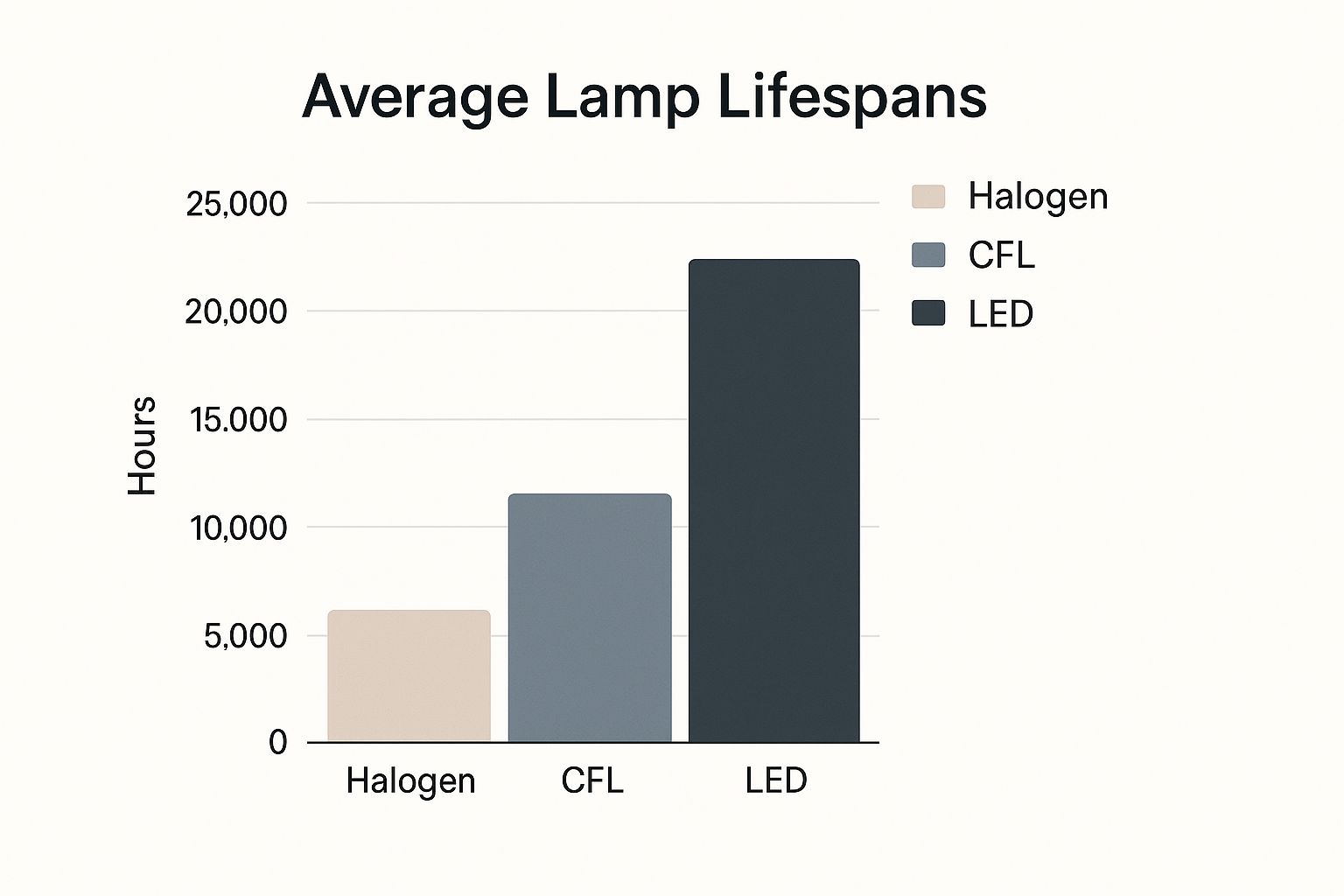
As you can see, the difference is night and day. A good quality LED can last more than twelve times longer than a standard halogen bulb.
That 25,000 to 50,000-hour figure isn’t just some marketing gimmick; it’s a realistic reflection of the performance you can expect under normal conditions. However, several factors here in Australia can push that number one way or the other.
A downlight’s quality is probably the biggest factor. Cheaper, entry-level models will land you closer to the 25,000 to 30,000-hour mark. If you invest in premium options, especially those with smart controls, you can expect them to push past 50,000 hours.
Your local climate also has a say. Downlights installed in the milder climates of Melbourne or Perth tend to have a longer, happier life. On the other hand, the relentless heat and humidity in places like Brisbane or Darwin can shorten their lifespan.
To help you get a clearer picture, we’ve put together a table that breaks down expected lifespans based on quality and typical Australian climate zones.
| LED Quality Tier | Average Lifespan (Hours) | Estimated Years (8 hours/day) | Best Suited Climate (AU) |
|---|---|---|---|
| Entry-Level | 25,000 – 30,000 | 8.5 – 10 years | Temperate (Sydney, Melbourne) |
| Mid-Range | 30,000 – 40,000 | 10 – 13.5 years | All climates, good performance |
| Premium | 40,000 – 50,000+ | 13.5 – 17+ years | Ideal for hot/humid (Brisbane, Darwin) |
This table gives you a solid starting point for what to expect. As you can see, investing in a higher-tier product makes a lot of sense if you live in a harsher climate, as they are built with better heat dissipation and more durable components.
Of course, the final performance always comes down to the specific fixture you choose. Making sure you understand the differences between the various models is key before you hand over any money. If you want to dive deeper, you might find our homeowner’s guide to types of downlights helpful. It’s designed to help you make a more informed choice for your home.
It’s easy to look at the impressive lifespan figures for an LED chip and think that’s all that matters. But when you’re asking, “how long do LED downlights last?”, focusing only on the chip is a common mistake. The reality is, an LED downlight is a complete system, and just like any system, it’s only as strong as its weakest link.
Think of it like building a high-performance race car. You could have a phenomenal Formula 1 engine (the LED chip), but what happens if you pair it with the gearbox from a regular family sedan (a cheap electronic driver)? The whole car becomes unreliable. The engine has massive potential, but the system is destined to fail long before the engine itself gives out.
This analogy is a perfect fit for LED downlights. The components that truly dictate how long your light will last are the supporting cast: the driver, the housing, and the overall build quality.
The electronic driver is the unsung hero of the downlight. It’s the brains and the power supply, responsible for converting the high-voltage AC power from your home into the precise, low-voltage DC power that the LED chip needs to function. This conversion process is demanding—it generates heat and puts a lot of stress on the driver’s internal electronics.
This is where cheap downlights cut corners. A poorly made driver built with low-quality capacitors and other components will almost always fail before the LED chip even starts to lose its brightness. That flickering, buzzing, or sudden death of a cheap downlight? You can usually point the finger straight at the driver.
A high-quality LED chip is engineered to last for tens of thousands of hours, but the driver is often the first component to fail, making it the most critical factor in a downlight’s true lifespan.
Here in Australia, industry testing tells a clear story. While LED chips can push past 60,000 hours, the lifespan of the entire fixture is often dragged down by its other parts. Components like drivers and even plastic enclosures frequently give up the ghost between 10,000 and 30,000 hours. This just goes to show why quality construction is so important. You can discover more insights about LED lifetime testing in Australia on enlighten.com.au to see the data for yourself.
So, when you invest in a quality downlight, you’re not just paying for a better chip. You’re paying for a tough, well-engineered driver and superior materials that are built to go the distance.
Ever had an LED downlight give up the ghost years before its promised lifespan? It’s frustrating. While it’s tempting to point the finger at a faulty product, the real culprit is often hiding in plain sight: the environment where the light operates. Several hidden stressors can quietly sabotage your lighting, dramatically cutting short how long your downlights last.
Think of it this way: installing an LED in a hot, uninsulated ceiling is like forcing your laptop to run inside a sealed esky on a summer day. It’s just not going to end well. Understanding these key factors is the secret to getting the most out of your investment and avoiding the hassle of early replacements. The four main offenders are almost always excess heat, poor power quality, demanding usage, and—of course—subpar components in cheaper units.
Heat is the arch-nemesis of all electronics, and LED downlights are no different. While they’re incredibly efficient compared to old halogen globes, LEDs still generate some heat. The problem is that this heat needs a way to escape. When a downlight is crammed into a ceiling cavity packed with insulation, that heat gets trapped, slowly cooking the fixture from the inside out.
This constant thermal stress breaks down the sensitive electronic driver and the LED chip itself, leading to a much shorter life. For this reason, proper ventilation around the downlight is absolutely non-negotiable if you want it to last.
Your home’s electrical supply plays a bigger role than you might think. Power surges from the grid or even small but constant voltage fluctuations can place huge strain on the delicate driver inside the downlight, causing it to fail prematurely.
On top of that, how you use your lights matters. Although LEDs are built to handle being switched on and off far better than older lights, flicking them on and off dozens of times a day, every day, can still contribute to wear and tear on the driver’s internal components over the long run.
The combination of poor ventilation in ceiling cavities, frequent switching, and low-quality drivers are the primary reasons for premature LED downlight failure in Australian homes.
This is a key driver behind the big switch from power-hungry halogens to more durable and efficient LED options. As more households upgrade, understanding these factors has become crucial for getting real value out of the new technology. A detailed breakdown in our article on LED lights vs halogen explores this transition further.
Unlike the dramatic pop and flash of an old incandescent bulb burning out, LED downlights tend to die a much slower, more gradual death. This slow decline can be easy to miss if you’re not looking for it, but knowing the warning signs means you can act before you’re suddenly left fumbling in the dark.
Think of these as the early symptoms for your home’s lighting system. Spotting them early helps you maintain consistent, high-quality light and sort out problems proactively, rather than waiting for a complete failure. If you notice one or two lights acting up, it’s a good signal to check the others, as they were likely all installed around the same time.
Keep an eye out for these subtle but clear indicators that a downlight is on its way out. Catching them early can save you the hassle of an unexpected blackout in a key area of your home, like the kitchen or bathroom.
Here are the most common signs:
Recognising these telltale signs is crucial. A flickering or discoloured LED is more than just an annoyance; it’s a clear indicator that the internal components, particularly the driver, are failing and the entire fixture will soon need replacement.
Getting the most out of your LED downlights isn’t just about buying a quality product; it’s about the small, smart decisions you make during and after installation. A little proactive care goes a long way, adding years to their lifespan and saving you the hassle and cost of premature replacements.
Think of it like servicing your car to keep it running smoothly. Creating the right operating environment for your downlights is the key to ensuring they perform reliably for their full expected life.
The most effective strategies are often the simplest. By focusing on the environment and the components that support your downlights, you can make a huge difference in their longevity.
Here are a few critical steps to discuss with your electrician:
A bit of effort upfront can add years to a downlight’s life. Focusing on ventilation, compatible dimmers, and surge protection is the smartest way to protect your investment and ensure long-term performance.
It’s also worth looking at the bigger picture of your home’s energy system. Integrated solar energy solutions can deliver cleaner, more stable power, which further protects all sensitive electronics from grid volatility. This approach creates a more resilient and cost-effective lighting setup for the long haul.
These same principles of smart design apply elsewhere, too. If you’re thinking about outdoor illumination, you can learn more by checking out our guide on planning your garden lighting.
To wrap things up, let’s go through some of the most common questions we get from homeowners about their LED downlights. Getting your head around these will give you the confidence to manage your home’s lighting like a pro.
In most cases, yes. Dimming your LEDs reduces the amount of power running through the fixture. This means both the electronic driver and the LED chip itself operate at a lower temperature.
Given that heat is the number one enemy of an LED’s lifespan, keeping things cooler almost always translates to a longer, more reliable life.
This is a great question. Unlike old-school fluorescent lights, modern LEDs aren’t really bothered by being switched on and off frequently. That old myth doesn’t apply here.
However, leaving them running for hours and hours on end creates constant heat, which will slowly degrade the components. The best approach is to simply use them when you need them. Flick them off when you leave a room to minimise heat and save a bit on your power bill, but don’t stress about the switching itself causing any harm.
It really depends on what kind of downlight you have. Some older styles might have a replaceable GU10 bulb that you can twist out, but the vast majority of modern LED downlights are integrated units.
With an integrated fixture, the light source and the housing are manufactured as a single, sealed piece. If the internal driver or the LED chip fails, the entire unit needs to be replaced by a licensed electrician. You can’t just pop in a new “bulb.”
This all-in-one design has become the industry standard because it’s far better at managing heat and is generally more reliable. The first step is always to identify which type you have before you think about repairs.
If you’re running into issues with your current lighting or thinking about an upgrade to modern, long-lasting LEDs, the expert team at DLG Electrical is here to help. For safe, reliable, and professional electrical services across Brisbane, contact us for a free quote.

Master Electrician with over 30 years of experience. Founded DLG Electrical in 2005 after international project work including electrical installations at Stamford Bridge Stadium, London(Home of Chelsea FC).

Local Electricians that can fix all Electric Hot water Systems.
Motion sensor lights are a versatile addition to any home, offering nu
