83 Jean St, Grange QLD 4051
Mon-Fri 07:30 AM - 04:00 PM - Sat - 8:00 - 12 - Sunday Closed
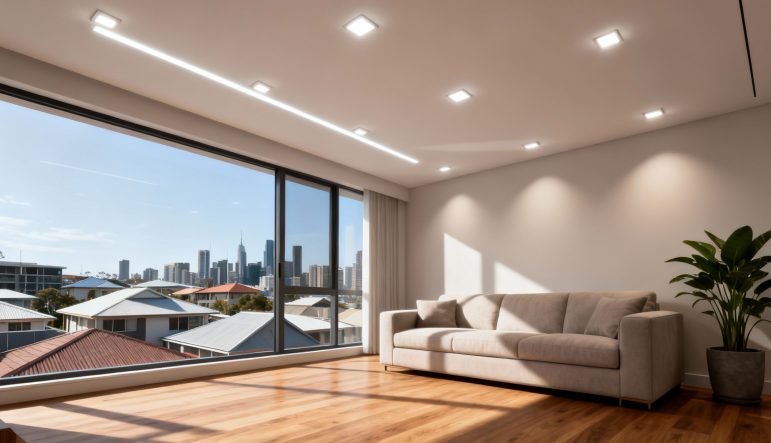
Imagine completely changing the feel of your home with a simple flick of a switch. You could make rooms feel brighter, more modern, and genuinely inviting. That’s the kind of immediate impact you get when you swap out old, inefficient halogen bulbs for modern LED down lights. It’s a straightforward change that can take a space from dated to sophisticated in an instant.
Have you ever felt your home’s lighting was harsh, unflattering, or just driving up your power bill? You’re definitely not alone. For years, traditional halogen downlights were the norm, but they came with a long list of problems, from getting incredibly hot to burning out far too quickly. Today, homeowners across Brisbane are making a smart switch for reasons that go well beyond just lighting up a room.
Think of old halogen lights like a classic, fuel-guzzling car—sure, it gets the job done, but it’s inefficient, expensive to run, and always seems to need a bit of work. In contrast, LED down lights are the sleek electric vehicle of the lighting world. They deliver far better performance, cost a fraction to run, and are built to last. This upgrade is easily one of the most effective ways to modernise both your home’s look and its running costs.
One of the best things about LED down lights is their clean, minimalist design. Unlike bulky, old-school light fixtures that hang down and clutter your ceiling, downlights are recessed. This means the main body of the light is tucked away inside the ceiling cavity, leaving only a neat, flush trim visible.
This clever, integrated design offers a few key advantages:
In essence, LED down lights let you design with light itself, instead of just designing with the light fixtures. This control turns lighting from a basic utility into a powerful part of your home’s interior design, boosting both its atmosphere and its overall property value. It’s a shift that explains why they’ve become the gold standard in new builds and renovations all over Brisbane.
Picking the right LED down lights can feel like you need an engineering degree just to read the box. With all the talk about lumens, Kelvin, and beam angles, it’s easy to get lost. But here’s the good news: you only need to get your head around a few key ideas to light any room perfectly, and they’re much simpler than they sound.
First things first, forget everything you know about watts. For decades, we were taught that watts equal brightness, but that’s a throwback to old, power-hungry incandescent bulbs. In the world of LEDs, the only number that really matters for brightness is lumens (lm).
Think of lumens as the raw “amount” of light a bulb puts out. The more lumens, the brighter the light. This is a crucial shift because LEDs are incredibly efficient; a modern 10W LED down light can easily shine as brightly as an old 75W halogen, which means big savings on your power bill.
Once you’ve sorted out how bright you need your lights, the next question is about the feel of the light. This is where colour temperature comes in, and it’s measured in Kelvin (K). It’s basically a simple scale that tells you how warm (yellowish) or cool (bluish) the white light will look.
Choosing the right colour temperature is probably the most important decision you’ll make, as it directly sets the atmosphere of a room. Get it right, and your space feels welcoming and thoughtfully designed. Get it wrong, and it can feel sterile or just plain dull.
A low Kelvin rating, for instance, gives off a warm, cosy glow perfect for relaxing, while a high Kelvin rating produces a crisp, energising light that’s great for getting things done.
To make things even easier, here’s a quick guide to help you match the colour temperature to different rooms in your Brisbane home.
| Colour Temperature | Kelvin (K) Range | Best For | Mood |
|---|---|---|---|
| Warm White | 2700K – 3000K | Living rooms, bedrooms, dining areas | Cosy, relaxing, and inviting |
| Natural White | 4000K | Kitchens, bathrooms, home offices, laundries | Neutral, clear, and focused |
| Cool White | 5000K+ | Garages, workshops, commercial spaces | Bright, energising, and clinical |
As you can see, an LED’s Kelvin rating can completely transform a space, taking it from the laid-back warmth of a lounge room to the clean, functional clarity of a workspace.
Another important spec to consider is the beam angle. Picture holding a torch. If you narrow the beam, you get a small, intense circle of light that’s perfect for highlighting one specific thing. Widen it, and the light spreads out to cover a larger area, though less intensely. The beam angle on an LED down light works in exactly the same way.
Getting the right mix of beam angles is key to a well-rounded lighting design. If you want to dive deeper into the different physical designs, our guide on the types of downlight has some great insights.
Making smart LED choices really pays off, giving you everything from brighter, more inviting rooms to lower power bills and even a boost in your home’s value.
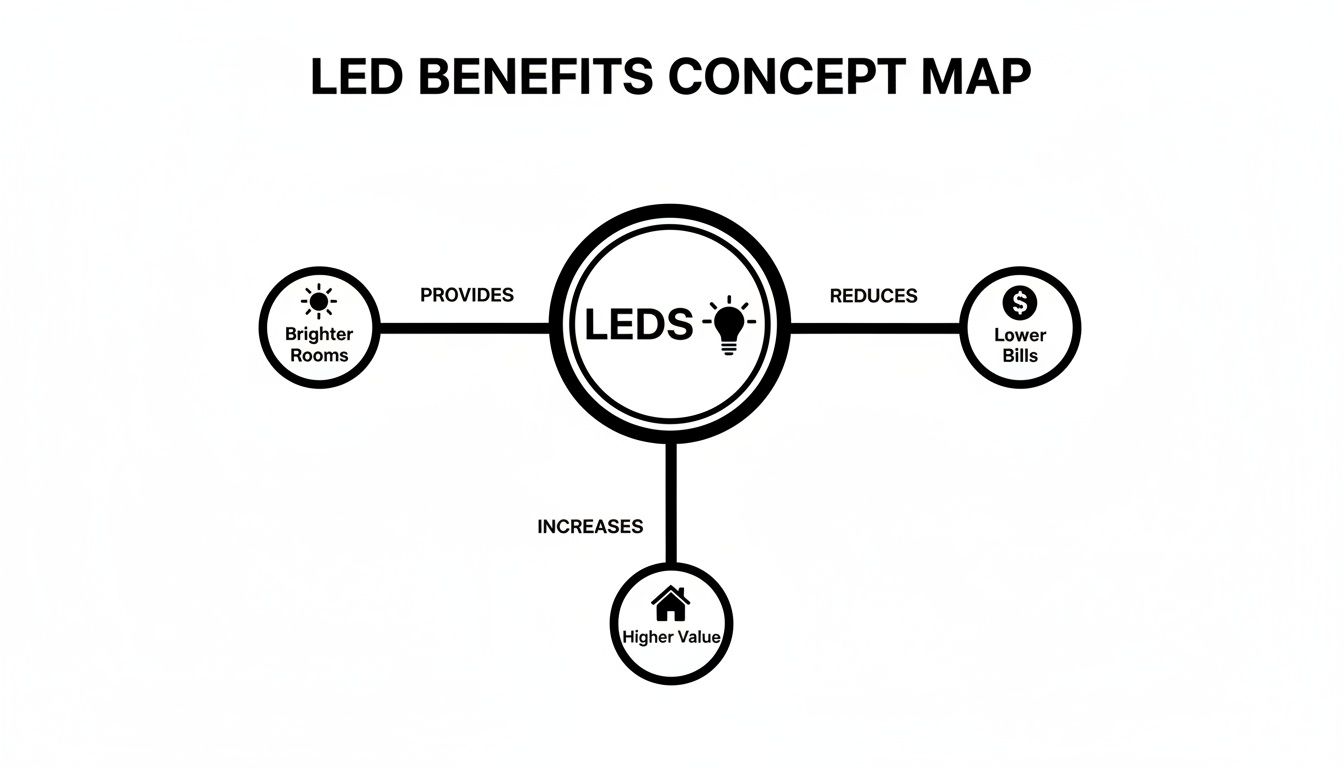
Ultimately, understanding these specs gives you the power to create a lighting plan that’s not just functional but genuinely beautiful, enhancing every part of your home.
Finally, let’s talk about the Colour Rendering Index (CRI). Ever noticed how some colours can look a bit dull or “off” under cheap fluorescent lights? That’s because of a low CRI. The index simply measures how accurately a light source shows the true colours of objects, rated on a scale of 0 to 100, where 100 is the same as natural sunlight.
For anywhere in your home, you should always look for LED down lights with a CRI of 80 or higher—and 90+ is the gold standard. A high CRI makes sure your furniture, paint colours, and even the food in your kitchen look vibrant and exactly as they should. It’s a subtle detail, but it makes a massive difference to the overall quality and feel of your home’s lighting.
When it’s time to modernise your home’s lighting, you’ll find yourself at a fork in the road. Do you simply upgrade what’s already there, or do you wipe the slate clean and start fresh with a completely new layout? The right answer really comes down to your budget, what you want to achieve, and the scope of your project.
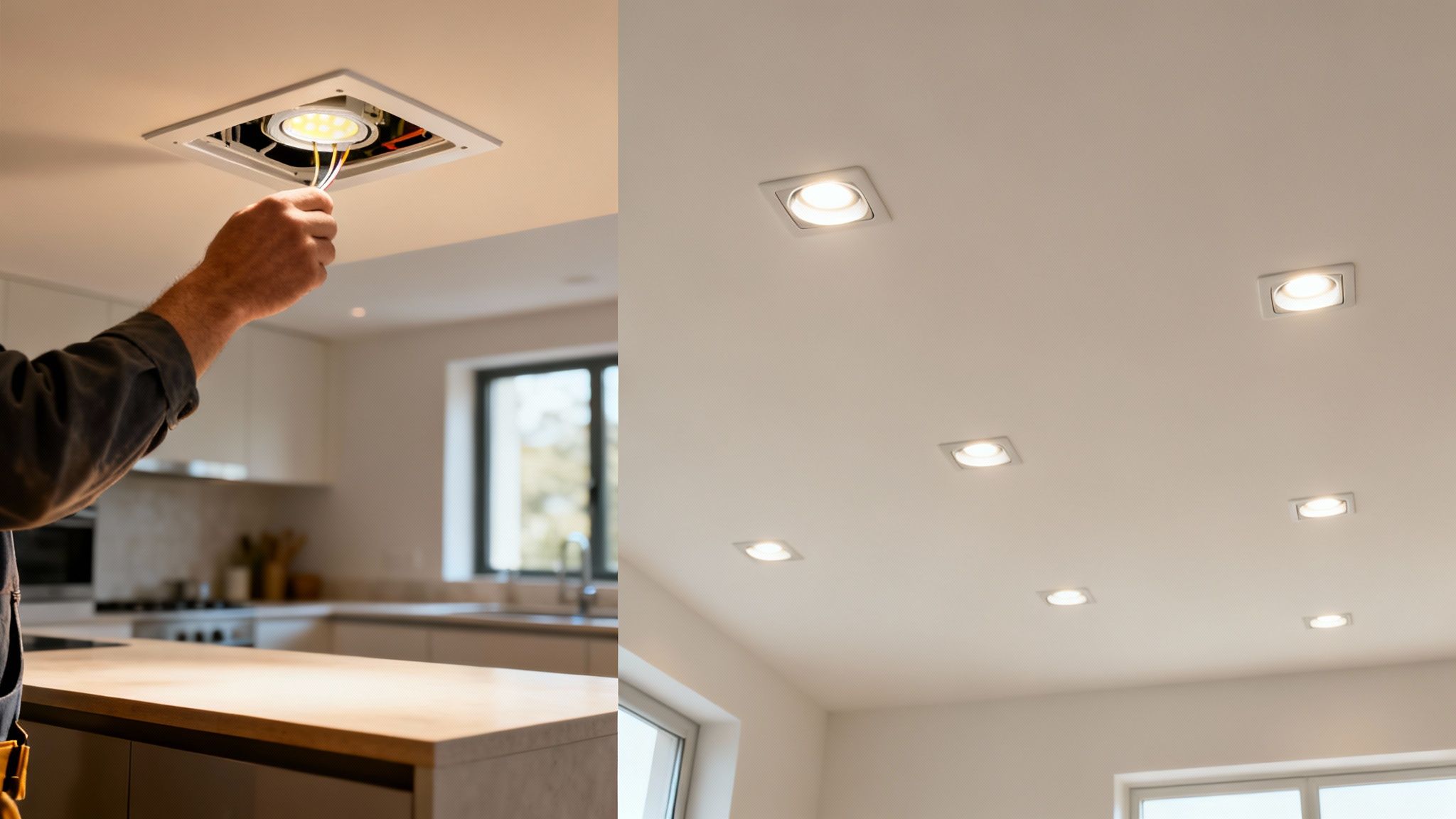
Both paths will get you to a brighter, more efficient home, but knowing the difference between a retrofit and a new installation is the key to making a choice you’ll be happy with for years to come.
A retrofit is the most direct and budget-friendly way to jump to LED down lights. You can think of it like changing the tyres on your car—you’re keeping the main structure but swapping out old, worn parts for new, high-performance ones. In lighting terms, this means replacing your old halogen bulbs and their clunky, inefficient transformers with modern, integrated LED units.
The biggest win here is convenience. A retrofit uses the existing cutouts in your ceiling, which massively cuts down on installation time, mess, and cost. It’s the perfect solution if you’re generally happy with your current light placement but just want the perks of LED technology, like lower power bills and much better quality light.
But retrofitting isn’t without its limits. You’re essentially locked into the original lighting layout, which might not be ideal. If the old lights left dark corners or were spaced awkwardly, the new ones will be in the exact same spots.
A retrofit is an upgrade in technology, not necessarily in design. It’s an excellent choice for a fast, cost-effective improvement but won’t fix underlying issues with a flawed lighting plan.
A new installation, on the other hand, is like designing a room from a blank canvas. This approach involves planning a brand-new lighting layout from scratch, cutting fresh holes in the ceiling, and running new wiring. It’s the go-to choice for new builds, major renovations, or any time the existing lighting just isn’t cutting it.
The freedom this gives you is enormous. You can put your new LED down lights precisely where they’re needed most—ensuring perfect task lighting over kitchen benches, creating a beautiful ambient glow in the living room, or highlighting architectural features. This is also your chance to bring in the latest smart lighting technology, like app-controlled dimmers or colour-changing lights, for a truly modern home experience.
Of course, this level of customisation takes more work. A new installation is more complex, takes longer, and comes with a higher upfront investment for labour and materials. But the payoff is a flawless, cohesive lighting scheme that’s perfectly matched to how you actually live in your home.
Here’s a simple breakdown to help you decide:
| Consideration | Retrofit | New Installation |
|---|---|---|
| Best For | Quick upgrades, budget-conscious projects | Renovations, new builds, correcting poor layouts |
| Cost | Lower | Higher |
| Installation Time | Faster | Slower and more involved |
| Flexibility | Limited to existing cutouts | Complete design freedom |
| Outcome | Improved light quality and efficiency | A perfectly customised and optimised lighting plan |
No matter which path you choose, electrical safety is non-negotiable. Both retrofitting and new installations involve working with your home’s wiring and must be done by a licensed electrician. This ensures all connections are secure, drivers are compatible, and the work complies with strict Queensland safety standards, protecting your home and family.
It’s easy for anyone to throw around generic claims about “energy savings,” but what does an LED upgrade actually mean for your wallet? Let’s get past the vague promises and look at the real-world dollars and cents you can save on your Brisbane power bill by switching to LED downlights.
The difference isn’t just noticeable; it’s substantial.
The heart of the savings boils down to one simple fact: LEDs are dramatically more efficient than the old halogen bulbs they’re designed to replace. For years, the traditional 50W halogen downlight was the standard. Today, a modern 7W LED can produce the same amount of light—or even more. That means it’s using almost 85% less electricity to do the exact same job.
When you multiply that efficiency gain across every single light fitting in your home, the numbers start to add up, fast. For many Brisbane households, lighting can be a surprisingly large chunk of the quarterly electricity bill, especially during the darker winter months or in homes with less natural light.
Let’s run the numbers for a typical Brisbane home with 20 halogen downlights. This is a pretty common setup for a living area, kitchen, and hallway.
Here are a few simple assumptions for our calculation:
With the old halogen lights, the daily energy consumption is 4 kWh (1,000W x 4 hours). That works out to $1.20 per day just for lighting. Over a year, that’s a whopping $438.
Now, let’s switch to the new LED downlights. Their daily consumption is just 0.56 kWh (140W x 4 hours), which costs a mere $0.17 per day. Annually, the total comes to just $62.
That’s an annual saving of $376 from a straightforward lighting upgrade. For a larger home or a small business, this figure could easily double or triple, putting hundreds of dollars back into your budget each year.
This massive drop in energy use is precisely why so many people are making the switch. In Queensland, where hot summers already mean high power bills, LEDs can cut lighting consumption by up to 75% compared to old-school lights, saving families a significant amount of money year after year.
The financial perks of LED downlights go far beyond your electricity bill. The second, equally important factor is their incredible lifespan. A quality LED downlight is rated to last up to 50,000 hours. To put that in perspective, a typical halogen bulb might give you just 2,000 hours if you’re lucky.
What does this mean in practical terms?
This long-term reliability makes LED downlights a smart, “fit and forget” investment. The initial cost of the upgrade is often paid back within just a couple of years through energy savings alone. After that, you just keep saving money for the entire lifespan of the lights, making it one of the best value-for-money home improvements you can make.
If you’re interested in the nitty-gritty, you can learn more about how to calculate electrical energy consumption to see how different appliances contribute to your bill. And to truly maximise your savings across the board, it’s worth exploring the various energy efficient lighting options available for your entire home.
When it comes to getting any electrical work done in your home, safety isn’t just a friendly suggestion—it’s the law, and in Queensland, the standards are rightly strict. Following these rules means your new LED downlights will be more than just stylish and efficient; they’ll be completely safe for your home and family. It’s not about jumping through hoops; it’s about eliminating serious risks like electrical faults and house fires.
One of the most important safety terms you’ll come across is the IC rating, which stands for Insulation Contact. This little code tells you if a downlight can be safely covered by or installed right up against your ceiling insulation. Get this wrong, and the heat from the light fitting could create a genuine fire hazard.
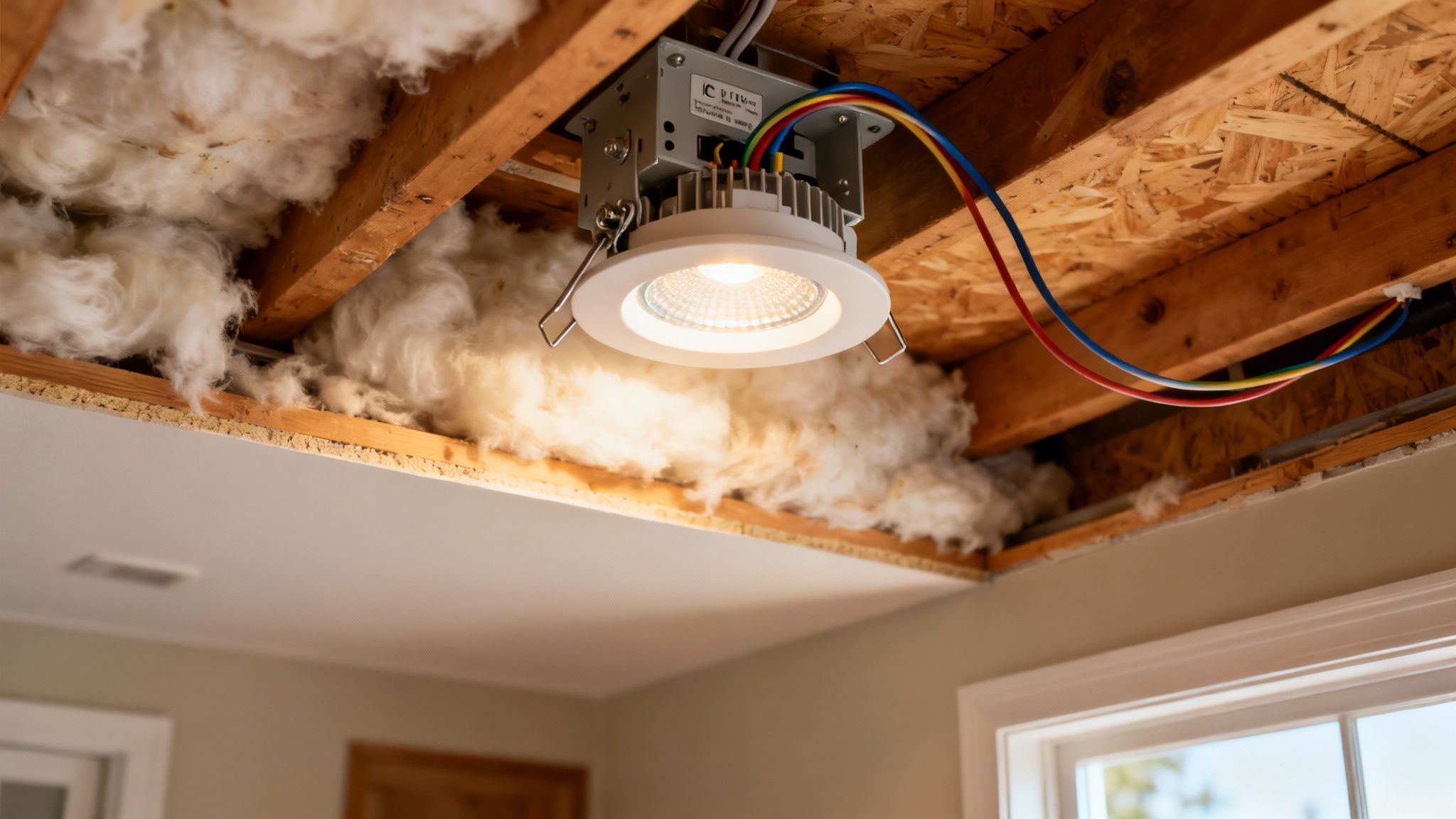
Most homes in Queensland have thermal insulation stuffed into the ceiling to help us cope with the sweltering summers and the odd chilly winter morning. If you install the wrong type of downlight in an insulated ceiling, you’re creating a recipe for disaster.
For absolute peace of mind, always insist on IC-rated LED downlights. It takes all the guesswork out of the equation and makes your installation inherently safer, especially for a well-insulated Brisbane home.
This level of detail is non-negotiable. For anyone managing a property, compliance is a massive deal, with 95% of Australian rentals now requiring LED-compliant lighting under state tenancy laws. Failing to comply can lead to hefty fines of up to AUD 10,000. And with Queensland’s commercial sector booming, the use of downlights has shot up by 25% in new urban projects. You can find out more about the growth of Australia’s LED market to see where the trends are heading.
Beyond choosing the right products, Queensland law is black and white on this: all electrical work, including something that seems as simple as installing LED downlights, must be done by a licensed and insured electrician. This isn’t a recommendation; it’s a legal requirement enforced by bodies like the Queensland Building and Construction Commission (QBCC).
Bringing in a professional isn’t just about convenience—it’s a critical investment in your home’s safety and your own peace of mind. A qualified electrician guarantees:
Trying to DIY electrical work or hiring an unlicensed handyman not only voids your home insurance but also introduces hidden dangers that could have devastating outcomes. Choosing a qualified professional from a trusted local team like DLG Electrical ensures your project is done right, integrated safely, and will stand the test of time.
The temptation to tackle a home improvement project yourself is always strong, but when it comes to electrical work, it’s a whole different ball game. Hiring an experienced electrician for your LED downlight upgrade isn’t just an extra cost—it’s a critical investment in your home’s safety, the lifespan of your new lights, and the quality of the final result.
Trying to install LED downlights on your own can open up a can of worms. You might end up with annoying buzzing or flickering from mismatched dimmer switches, or worse, face the very real danger of an electrical fire from incorrect wiring. A licensed professional takes all these risks off the table, making sure every connection is secure, every part is compatible, and the whole setup is safely integrated into your home’s circuits.
A qualified electrician does a lot more than just hook up a light. They handle the hidden complexities that guarantee a perfect, long-lasting installation. They’re responsible for ensuring your new lighting is fully compliant with the strict Australian Standards (AS/NZS 3000), which is not only a legal requirement but also essential for keeping your home insurance valid.
This professional oversight includes:
Ultimately, hiring an expert turns a simple product installation into a cohesive system design. It’s the difference between lights that simply switch on and a lighting scheme that genuinely enhances how your home looks and feels for years to come.
This professional approach is more important than ever. Sustainability goals have driven a huge shift, with LED downlights now making up over 50% of Australian commercial retrofits since 2020. With Queensland leading the charge in infrastructure spending, the demand for correctly installed, energy-efficient lighting is only going to increase.
Choosing a professional installer is really about buying long-term peace of mind. A certified installation gives you a guarantee of safety and quality, so you know your investment is protected. While our guide focuses on LED downlights, the same logic applies to other lighting upgrades, like a professional exterior LED strip lighting installation.
For Brisbane homeowners, it means knowing your family is safe and your home meets all the right standards. If you ever need help, knowing how to find the best electrician in Brisbane is the first step toward a brilliant and secure lighting project.
Making the leap to modern lighting often brings up a few questions. That’s perfectly normal. Here, we’ll walk through some of the most common queries we get from Brisbane homeowners about LED down lights, giving you clear, straightforward answers to help you feel confident about your upgrade.
Yes, the vast majority of modern LED down lights are designed to be dimmable. However, it’s not just a matter of swapping the light and hoping for the best.
For smooth, flicker-free dimming, you need a perfect match between three key components: the downlight itself, its driver (the little power supply for the LED), and the dimmer switch on the wall. A common mistake is trying to use an old dimmer built for power-hungry halogens with a new, low-wattage LED. This mismatch is what usually causes that annoying buzzing or flickering. A licensed electrician will ensure all three parts are fully compatible, giving you seamless control over your room’s ambience.
One of the most incredible benefits of LED technology is its lifespan. A quality LED downlight is typically rated for a massive 50,000 hours of use.
Let’s put that into real-world terms. If you had that light on for an average of five hours every single day, it would keep shining for over 27 years. It’s a true “fit and forget” solution. This means you’re not just saving money on your power bill, but also on the cost and hassle of constantly buying and replacing bulbs. Think of it as a long-term investment in your home.
The longevity of LED down lights offers significant long-term value. This extended lifespan reduces maintenance needs and provides a consistent, reliable lighting solution for decades, unlike traditional bulbs that require regular replacement.
Even though it might look like a simple swap, replacing any light fitting means you’re working directly with your home’s 240V electrical wiring. Under Queensland law, this isn’t a DIY job—it must be done by a licensed electrician.
Trying to do it yourself is not only illegal but incredibly dangerous, creating a serious risk of electric shock or even fire. It can also completely void your home insurance policy. For your safety and to stay compliant, always bring in a professional for any downlight installation, whether it’s a simple retrofit or a brand-new layout.
Flickering is almost always a tell-tale sign of an incompatibility issue or a problem with the wiring. The most common culprits we see are:
A qualified electrician can get to the bottom of it fast. They’ll check all the connections, test each component, and make sure your entire lighting circuit is stable and correctly set up, getting rid of that flicker for good.
Ready to upgrade your home with safe, stylish, and energy-efficient LED down lights? The expert team at DLG Electrical is here to help. Contact us today for a free, no-obligation quote and let’s create the perfect lighting solution for your Brisbane home.

Master Electrician with over 30 years of experience. Founded DLG Electrical in 2005 after international project work including electrical installations at Stamford Bridge Stadium, London(Home of Chelsea FC).

Local Electricians that can fix all Electric Hot water Systems.
Motion sensor lights are a versatile addition to any home, offering nu
