83 Jean St, Grange QLD 4051
Mon-Fri 07:30 AM - 04:00 PM - Sat - 8:00 - 12 - Sunday Closed
A lot of Brisbane electrical jobs start the same way. A light flickers during a storm, a circuit trips when the kettle and air fryer run together, or a renovation uncovers wiring that clearly belongs to another era. In older suburbs such as Grange and Windsor, that is common. In newer homes, the issues are different. More appliances, more air conditioning, more charging, and more demand on switchboards that were never designed for today’s load.
Customers typically do not need more jargon. They need straight answers. Is it dangerous, does it need to be fixed now, what will it cost, and who should they trust to do it properly.
That is where a good brisbane electrician earns their keep. Good electrical work is not just about getting the lights back on. It is about safe fault finding, compliant installations, sensible upgrades, and knowing when a small symptom points to a bigger problem.
Brisbane homes put electricians in front of a wide mix of problems. One day it is a post-war home with an old fuse board and no spare circuit space. The next it is a modern house that needs extra power, smart lighting, security cameras, and an EV charger in the garage. Both need the same thing. Safe work done by someone who understands local housing stock, storm conditions, and Queensland compliance.
The local industry is busy for a reason. As of 2024, Brisbane has approximately 822 licensed electricians, with growing demand linked to urban growth and newer services such as solar, smart home systems, and EV charging, according to this Brisbane electrician industry overview. That sounds like plenty of choice, but it also means homeowners need to sort experienced, licensed trades from everyone else.
A practical way to use this guide is to think about your property in three layers:
If your home has nuisance tripping, old ceramic fuses, warm outlets, non-working smoke alarms, or patchy DIY-looking wiring, those are not cosmetic problems. They are signs the system needs attention.
For a broader look at common household jobs and what they involve, this guide to residential electrical services in Brisbane is a useful starting point.
Tip: If you are unsure whether a problem is urgent, treat burning smells, buzzing switchboards, repeated tripping, and water-affected fittings as same-day issues.
A house electrical system works like a network, not a list of separate parts. When one section is weak, the symptoms often show up somewhere else. A tripping breaker might look like a single faulty appliance. Sometimes it is. Sometimes it is the switchboard telling you the whole circuit is overloaded.

Fault finding is the trade skill that matters most when something is not working and the cause is unclear. The goal is not to swap random parts and hope. The goal is to test the circuit, isolate the fault, and fix the underlying cause.
Common examples include:
What does not work is guessing. Replacing a switch because a light flickers may do nothing if the core issue is in the ceiling connection or switchboard.
The switchboard is the heart of the home’s electrical system. It distributes power and provides protection when something goes wrong. If it is old, cramped, or missing modern protection devices, the rest of the house suffers.
A switchboard upgrade is often needed when:
In practical terms, upgrading a board gives you safer protection, cleaner circuit separation, and room for future additions. It also makes fault finding much easier the next time something goes wrong.
Key takeaway: If your home is older and you are adding new appliances, ask about the switchboard before you ask about extra power points. The board often decides what is possible.
These jobs look simple from the outside. They are not always simple in the wall or ceiling.
Adding a power point can involve checking circuit capacity, cable routes, wall construction, and whether the location is suitable for the appliance load. Installing downlights may sound cosmetic, but the work still needs correct cable support, safe connections, and thought about insulation, access, and switching layout.
Ceiling fans are another good example. A fan installation is not just “swap old for new”. The electrician needs to assess support, wiring arrangement, wall control compatibility, and whether the existing point is suitable.
Three practical rules help homeowners avoid frustration:
That saves time and helps the quote reflect the job.
Safety systems should be treated like critical infrastructure, not add-ons. Smoke alarms need correct type, placement, interconnection, and testing. Security systems need reliable power supply, sensible camera positions, and clean cable runs.
For homeowners and landlords, the best result usually comes from planning these together. If an electrician is already onsite for a switchboard or renovation job, that is often the right time to review alarm coverage, external lighting, sensors, and camera power.
Some of the most important site visits start as “just a quick one”. Replace one broken outlet, fit one exterior light, fix one tripping circuit. Once testing starts, the underlying problem emerges.
That is normal in residential work. Electrical systems age unevenly. One failed fitting may sit beside wiring that is still sound, or beside gear that should have been upgraded years ago. A capable brisbane electrician explains that difference clearly and fixes what matters first.
Hiring on price alone is where many property owners go wrong. Cheap electrical work can become expensive very quickly when it has to be redone, fails inspection, or creates a safety issue in a rental or family home.
The first filter is simple. Only deal with licensed, insured electrical contractors.
In Brisbane, electricians must complete the UEE30820 Certificate III in Electrotechnology Electrician and a four-year apprenticeship under a licensed supervisor before they can obtain an ERAC electrical contractor licence and work unsupervised, as outlined by Courses.com.au’s Brisbane electrician pathway guide. That matters because it tells you the trade has a formal competency pathway. This is not casual handyman work.
Ask for:
If someone becomes vague at this stage, move on.
A quote should tell you what is being installed, what is being tested, and what is excluded. Good quotes reduce disputes because they describe the actual work.
Look for detail such as:
A one-line quote for a complex job is a warning sign. It leaves too much room for assumptions.
Not every electrician works comfortably across older Queenslanders, renovated family homes, unit blocks, and newer builds. Brisbane homes vary a lot. Roof access, asbestos-era materials, brittle insulation, mixed generations of wiring, and previous renovation shortcuts all change how a job should be approached.
That is why local experience matters more than many people realise. A contractor used to working in inner and northside suburbs is less likely to be surprised by what sits behind the wall.
For homeowners comparing providers, this article on choosing a local electrician gives a solid benchmark for what to ask before booking.
Reviews help, but only if you read beyond the star rating.
Pay attention to patterns:
One glowing review means little. A repeated pattern of clear communication and tidy, safe work means far more.
Tip: Ask one direct question before approving the job. “If you open this up and find something unsafe, how will you handle it and how will you let me know?” Good contractors answer that calmly and clearly.
Electrical pricing makes more sense when you separate the tradesperson’s wage from the contractor’s charge-out rate. They are not the same thing.
In Brisbane, the average hourly pay for electricians is AU$35.89, while contractors typically charge clients AU$80 to AU$120 per hour, with master specialists charging up to AU$150, according to PayScale’s Brisbane electrician rate data. The gap covers vehicles, insurance, compliance, tools, training, admin time, and the cost of standing behind the work.
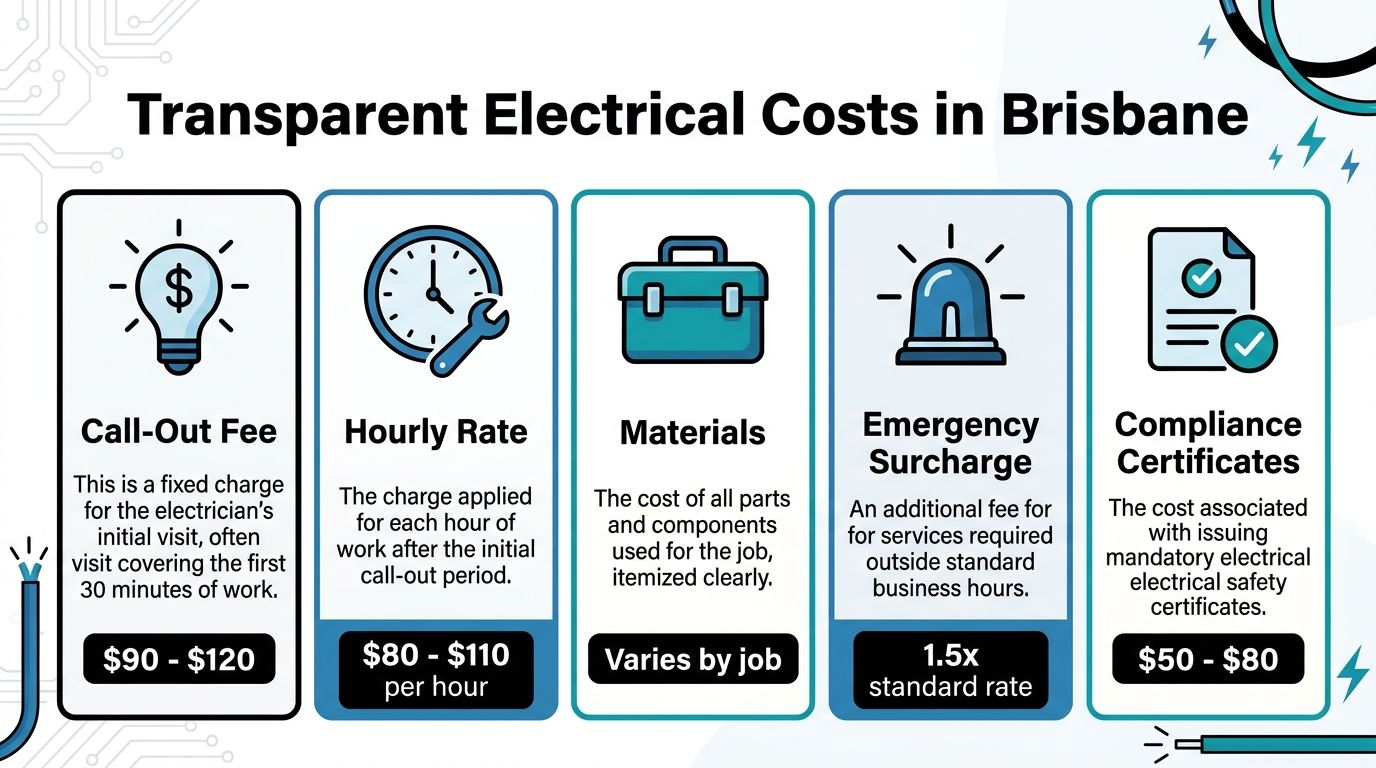
Two jobs can look similar on paper and price very differently onsite. The reason is usually one of these factors:
When clients feel blindsided by electrical invoices, it is often because the quote was too vague. A transparent quote usually answers these questions:
| Quote item | What to check |
|---|---|
| Scope of work | Exactly which rooms, fittings, or circuits are included |
| Materials | Whether fittings are client-supplied or electrician-supplied |
| Labour basis | Fixed price, hourly rate, or staged pricing |
| Variations | How hidden faults or extra work will be handled |
| Certification | Whether required compliance documents are included |
Precise job pricing varies too much by access, materials, and existing conditions to give reliable fixed numbers without a site inspection. For that reason, the safest way to read cost ranges is by relative complexity, not invented dollar figures.
| Service | Estimated cost range (incl. GST) |
|---|---|
| Replace a standard power point | Lower range for straightforward like-for-like work, higher if cabling or circuit changes are needed |
| Install a new power point | Moderate range, depending on wall type, cable path, and switchboard capacity |
| Replace a smoke alarm | Lower to moderate range, depending on alarm type and access |
| Upgrade smoke alarms for compliance | Moderate to higher range, depending on number of alarms, interconnection method, and property layout |
| Install a ceiling fan | Moderate range, higher where support, new wiring, or difficult ceiling access is involved |
| Install LED downlights | Moderate range, usually shaped by quantity, layout, and roof access |
| Fault finding for tripping circuits | Variable range, because diagnosis time depends on how quickly the fault can be isolated |
| Switchboard upgrade | Higher range, especially where the existing board is outdated or the installation needs broader compliance work |
| EV charger installation | Moderate to higher range, depending on charger type, cable route, and whether supply upgrades are required |
Practical advice: Ask for a site inspection for anything involving a switchboard, smoke alarm compliance across a whole home, or EV charging. Those jobs depend heavily on what is already installed.
Compliance work is often treated like paperwork. It is not. It is the point where safety rules meet homes, tenants, and inherent risk.
In Brisbane, that matters most in older homes, rental properties, and houses that have been renovated in stages. A property can look tidy and still fail badly on protection, alarm coverage, or hidden defects.
Under AS/NZS 3000:2018 Wiring Rules and Queensland requirements, smoke detector installations are safety-critical. The standard for interconnected photoelectric sensors includes a target of less than 5% false alarms per year, and non-compliance is linked to a significant share of Brisbane’s annual electrical fires, as noted in this Brisbane electrical compliance discussion.
That matters for one reason above all others. People ignore alarms that cry wolf, and they are unprotected by alarms that do not activate together.
In practical terms, good smoke alarm work means checking:
Landlords should pay close attention here. If the property is tenanted, the cost of delay is not only legal risk. It is occupant safety.
A modern switchboard does two jobs. It distributes power and it disconnects dangerous circuits when something goes wrong. If the board is outdated, cramped, or missing modern protection, the system may still “work” while offering poor protection.
Common warning signs include:
Safety switches, also called RCD protection, are one of the most important parts of a modern installation. They are there to reduce the chance of serious electric shock when a fault occurs.
Sales, new tenancies, renovations, and insurance questions often expose electrical issues that have sat untouched for years. Owners usually have three choices at that point. Repair the obvious item only, patch around the issue, or fix the system properly.
The first two options often cost more over time. They lead to repeat call-outs, failed inspections, and piecemeal upgrades that never quite solve the root problem.
Key takeaway: The cheapest-looking compliance decision is often the most expensive one after the next inspection, the next storm, or the next tenant complaint.
A safety-focused brisbane electrician should explain what is required, what is recommended, and what can reasonably be staged. Those are three different categories, and good advice keeps them separate.
EV charging is where older Brisbane housing stock and modern electrical demand collide. Many owners want a charger in the garage or carport, but the home was built long before anyone imagined overnight vehicle charging.
That is why EV work needs more than a product brochure. It needs a proper look at your supply, switchboard, cable path, and how the charger will fit your actual driving habits.
Queensland EV registrations surged 85% in 2024-25, and homeowners need better guidance on Energex requirements, application timelines of 10 to 20 business days, and the difference between single-phase and three-phase upgrade paths, as outlined on DLG Electrical’s EV charger guidance.
The first question is not “which charger brand do you want?” It is “what can the house support safely?”
A site assessment usually focuses on:
In many Brisbane homes, especially older ones, the switchboard decision comes before the charger decision.
For many households, a single-phase charger is the practical starting point. It is often simpler, easier to integrate, and enough for overnight charging habits. Three-phase can suit some homes better, but it is not automatically the smarter option.
What works well is matching the charger to how the car is used. A homeowner doing regular local driving has very different needs from someone covering long distances and needing faster turnaround at home.
This explainer gives a useful visual overview of how home EV charging setup works in practice.
Energex approval and older homes. Many projects slow down at this point. In some homes, particularly older properties in Grange and Windsor, the charger itself is straightforward but the network and supply side are not. The home may need assessment before a larger upgrade can proceed.
That is why the sequence matters:
A rushed install that ignores supply limitations is what does not work. It creates nuisance tripping, messy retrofit work, or a charger that cannot be used as intended.
Tip: If your home already struggles with peak load in summer, mention that before you ask for charger options. Load behaviour helps shape the right design.
Electrical work is one of those trades where local knowledge changes the outcome. Brisbane homes are not all built the same, and the safest solution on one property can be the wrong one on another. Older inner-north homes, family renovations, rental upgrades, and newer builds all need a different eye.
That is why many homeowners prefer a local contractor with long-term experience in Brisbane conditions. Storm exposure, ageing switchboards, smoke alarm compliance, security systems, and EV charging all sit inside the same practical reality. The work needs to be safe, compliant, and done without guesswork.
A family-owned contractor with significant experience, current licensing and insurance, and a clear quoting process gives owners something useful. Accountability. If the job involves switchboard upgrades, smoke alarms, security systems, hot water repairs, or EV charging, the best result usually comes from a team that handles those jobs regularly rather than occasionally.
DLG Electrical is one Brisbane option for residential and commercial electrical work, including installations, maintenance, repairs, smoke detector compliance, switchboard upgrades, and EV charger installs. For owners comparing providers, those are the practical categories worth checking against any contractor’s actual service list.
The right brisbane electrician should make decisions easier, not murkier. Clear advice, proper testing, compliant work, and realistic pricing matter more than sales talk.
Treat it as urgent if you notice a burning smell, smoke, sparking, exposed live parts, water affecting electrical equipment, a switchboard making unusual noise, or repeated tripping with no obvious appliance cause. Loss of power to critical equipment can also justify urgent attendance, especially in a rental or business setting.
If there is immediate danger, turn off power if it is safe to do so and keep people away from the area.
No. In Queensland, electrical work is not a DIY category for homeowners. Even jobs that look minor, such as replacing outlets, altering fixed wiring, or changing hardwired fittings, carry legal and safety risk.
The danger is not just electric shock. Poor terminations, wrong connections, and missing protection can sit hidden for months before they cause heat damage or failure.
There is no one-size-fits-all answer. A newer home with no issues may only need attention when additions or faults arise. An older home, a rental property, or a house with recurring tripping, ageing fittings, or renovation history benefits from more regular review.
A good trigger for an inspection is any major appliance upgrade, planned renovation, property purchase, or persistent electrical nuisance.
Usually one of three things is happening. A circuit is overloaded, an appliance is faulty, or there is a fault in the wiring or connected equipment. Resetting the breaker repeatedly is not a fix.
If the trip happens more than once, stop and have it tested properly.
If you need straight advice on a fault, upgrade, compliance issue, or EV charger project, contact DLG Electrical for a free quote and practical help from a licensed Brisbane team.

Master Electrician with over 30 years of experience. Founded DLG Electrical in 2005 after international project work including electrical installations at Stamford Bridge Stadium, London(Home of Chelsea FC).

Local Electricians that can fix all Electric Hot water Systems.
Motion sensor lights are a versatile addition to any home, offering nu
