83 Jean St, Grange QLD 4051
Mon-Fri 07:30 AM - 04:00 PM - Sat - 8:00 - 12 - Sunday Closed
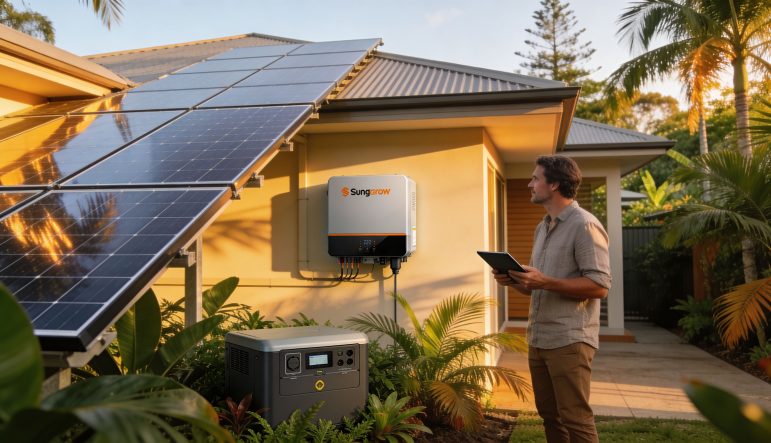
You’re probably looking at a familiar Brisbane problem. Your roof has good sun for part of the day, then a gum tree, a neighbour’s second storey, or your own roofline starts cutting into output. At the same time, power bills keep climbing, and when storms roll through, the grid doesn’t always stay where you want it.
That’s where a sungrow hybrid inverter starts to make sense. It doesn’t just convert solar power for use in the home. It also manages battery charging, battery discharge, and backup supply when the grid drops out. For Brisbane homes, that combination matters more than most guides admit.
A lot of solar articles stay too general. They talk about “energy independence” but skip the local details that change the result: shading across multiple roof faces, Energex export limits, and the extra installation work that can catch owners off guard. If you’re in Grange, Windsor, Red Hill, Kedron, or anywhere else with older housing stock and tricky roof geometry, those details affect system design from day one.
A hot afternoon blackout in Brisbane feels different from a mild outage down south. The house heats up fast. Ceiling fans stop. The fridge goes quiet. If you’re home with kids, tenants, or elderly family, comfort turns into a practical problem within minutes.
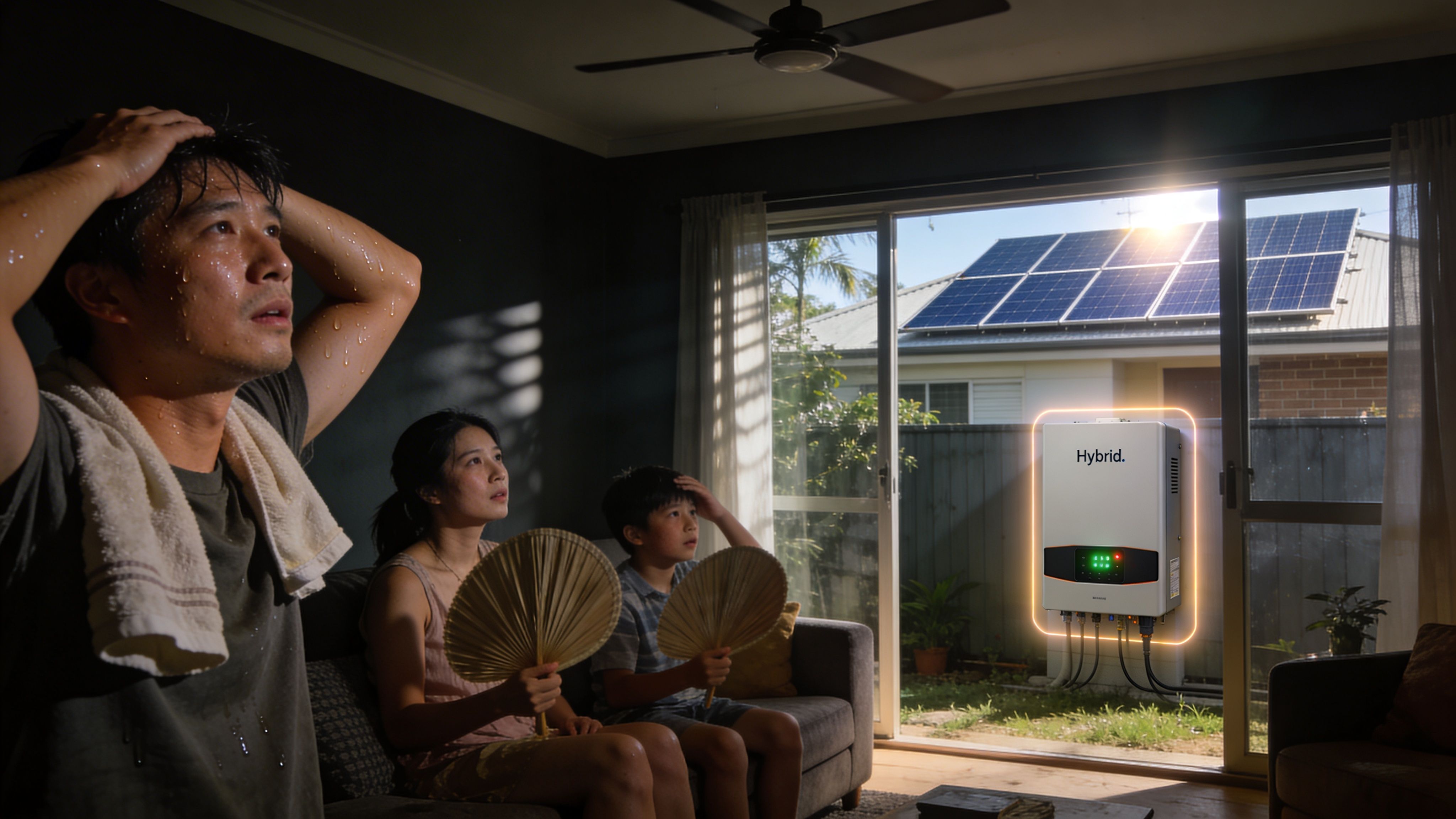
A standard solar system helps during the day, but only while the grid is available and only if the inverter is designed for that use case. Many homeowners assume solar panels alone will keep the lights on during an outage. They won’t. The panels may still be on the roof, but without the right inverter and backup setup, the system shuts down for safety.
A hybrid inverter changes that setup. It sits between the solar array, the battery, the home, and the grid. During normal operation, it decides where energy should go. Use it in the house, store it in the battery, or export it if the network allows. During a blackout, the right backup configuration can keep selected circuits running.
If you’d like a simple refresher on the moving parts, this overview of how a solar power system works is a useful starting point before you compare hybrid options.
Sungrow has become hard to ignore in the Australian market. Sungrow hybrid inverters, particularly the SH-RS series, rank as the second biggest-selling solar inverter by volume in Australia, offering up to 200% PV oversizing and 6 kW backup power, according to Clean Energy Reviews.
That popularity isn’t just about branding. Brisbane homes often need flexibility more than headline size. One roof face might be north-west. Another might be east. A section could be shaded for part of the afternoon. A hybrid inverter that can juggle those conditions properly is often more useful than one that looks great only on a clean, unshaded roof diagram.
Practical rule: In Brisbane, the best solar-storage setup usually isn’t the biggest one. It’s the one that still performs when clouds build, shade moves, and export limits cap what you can send out.
Most homeowners first hear “hybrid inverter” and think it’s just a regular inverter with a battery port added on. That’s too simplistic. A Sungrow hybrid unit acts more like a traffic controller for energy.
Your solar panels make DC electricity. Your house uses AC electricity. The inverter converts one to the other, but that’s only part of the job.
A sungrow hybrid inverter also decides:
That last point is where people often get confused. Backup doesn’t mean every appliance in the house will run as if nothing happened. Backup design depends on the inverter model, the battery, the load selection, and the switchboard setup.
Sungrow models use MPPT trackers. Think of each tracker as a smart supervisor watching one section of the roof and constantly adjusting to get the best result from it.
If your east-facing panels wake up earlier and your west-facing panels perform later, separate trackers let the inverter manage those groups properly instead of forcing them to behave like one big mismatched string. That matters in Brisbane, where many roofs aren’t a neat single plane.
The SH-RS series uses dual MPPT trackers, and newer higher-capacity single-phase models include 4 MPPTs in the larger sizes. For a home with shade from trees or split roof orientations, that can make the design far more forgiving.
Homeowners sometimes worry that putting more panel capacity on the roof than the inverter’s AC rating sounds wrong. In many cases, it’s exactly the right move.
Sungrow SH-RS models support up to 200% PV oversizing, and the design is tied to 25–35% higher self-consumption in the referenced Australian benchmarks, with a battery voltage range of 80 V to 460 V on the SH-RS range, according to the Sungrow SH-RS datasheet. On a Brisbane roof with moving shade, oversizing can help the system keep useful production going for longer parts of the day.
If that sounds technical, use this analogy. A shaded roof is like a small team where some people are unavailable at different times. Oversizing gives you more team members so the job still gets done even when part of the group is slowed down.
The goal on a shaded roof isn’t perfection at solar noon. It’s steadier useful output across the full day.
Efficiency figures matter because every conversion step loses a little energy. If an inverter is efficient, more of the power from the roof and battery ends up doing real work in your home.
Sungrow hybrid models sold in Australia are commonly noted with efficiencies in the 97.7% to 98.6% range in local review material, and they’re sold with 10-year warranties in the Australian market, as covered by SolarQuotes’ Sungrow hybrid inverter review.
For homeowners, that translates into a simple question. When your solar system generates power, how much of it do you get to use? A good hybrid setup improves that answer.
Once you understand what a hybrid inverter does, the next question is which model suits the house. Many buyers get stuck because product pages often mix residential and larger three-phase gear in a way that makes comparison harder than it should be.
For single-phase homes, the conversation often starts with the SH3.0RS to SH6.0RS range and then moves to the newer SH8RS and SH10RS options for larger loads or more complex roofs. For bigger homes and some mixed residential-commercial sites, Sungrow also has the SH15/20/25T three-phase series.
One useful benchmark: In 2023, Sungrow became Australia’s top-selling solar inverter brand, with SH5.0RS offering 5 kW nominal (expandable to 10 kW AC-coupled), 12 kW solar input, and 6.6 kW charge/discharge, backed by a 10-year warranty and 98% efficiency, according to SolarQuotes’ 2023 review.
| Model | AC Capacity | MPPT Trackers | Battery Voltage Range | Backup Power |
|---|---|---|---|---|
| SH3.0RS to SH6.0RS | 3.0 to 6.0 kW | 2 | 80 V to 460 V | 6 kW |
| SH5.0RS | 5 kW nominal, expandable to 10 kW AC-coupled | 2 | Not specified here beyond SH-RS range family guidance | 6 kW in on-grid mode |
| SH8RS | 8 kW | 4 | 150 V to 600 V | Peak backup available on newer large single-phase models |
| SH10RS | 10 kW | 4 | 150 V to 600 V | Peak backup of 13.6 kW for 10 seconds on the 10 kW model |
| SH15/20/25T | 15, 20, 25 kW | Not listed in the assigned comparison data | Not specified in the assigned comparison data | Full-house backup features with built-in bypass on this three-phase line |
If your house is a typical single-phase Brisbane home with moderate loads and a standard battery plan, the SH5.0RS usually sits in the middle of the conversation for a reason. It’s large enough for many households without jumping straight into a bigger and more expensive setup.
If your roof is awkward, though, the SH8RS or SH10RS can become more attractive because 4 MPPTs give the installer more ways to split roof sections. That matters on homes with:
For larger properties or sites with three-phase supply, the SH15/20/25T line enters the frame. That’s a different category of installation and often changes the switchboard and backup discussion.
Don’t pick a model by roof size alone. Match it to four things:
Your supply type
Single-phase and three-phase homes need different thinking from the start.
Your roof complexity
More roof faces usually means more value from additional MPPT flexibility.
Your backup expectations
“Keep the lights and internet on” is a different brief from “run most of the home normally”.
Your battery plan
Some owners install the hybrid inverter now and add or expand storage later.
A lot of buyers go wrong by shopping only on inverter output. In Brisbane, roof layout often decides more than raw inverter size.
Sizing a hybrid system isn’t about chasing the largest number you can afford. It’s about matching the inverter, the roof, the battery, and the house so they work together.
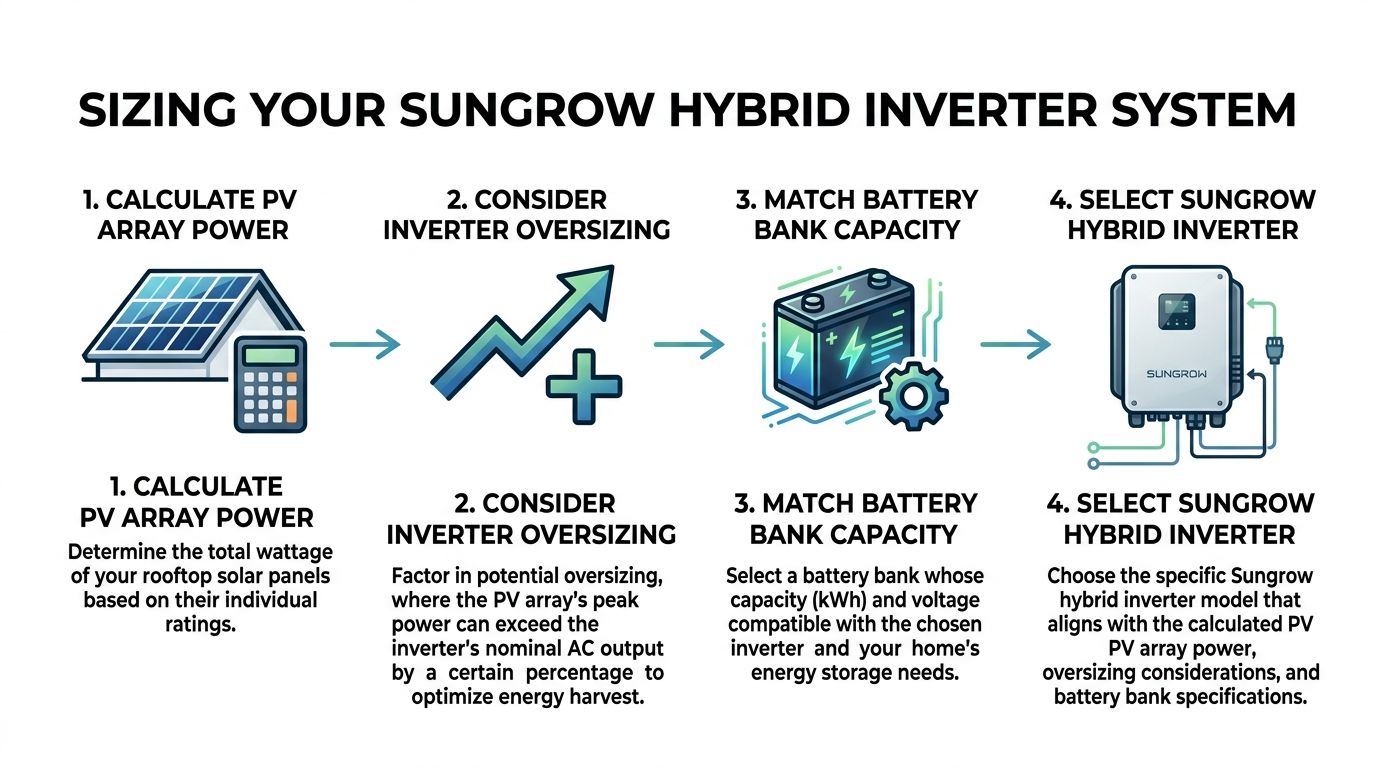
Look at the roof in sections. A Brisbane worker’s cottage with a rear extension might really be three different solar zones, not one roof. A modern home with a high parapet can cast its own shade late in the day. If there are trees nearby, note whether they affect only winter mornings, summer afternoons, or both.
Then total your proposed panel capacity. That gives the installer the raw PV array size to work with.
If roofing work is part of the project, timing matters. Homeowners planning reroofing or storm repairs often benefit from reviewing a guide on solar panel roof replacement before locking in inverter and panel placement, because roof changes can alter string design, cable runs, and mounting choices.
On the SH-RS range, Sungrow allows up to 200% PV oversizing, and the models use a battery range of 80 V to 460 V with dual MPPTs designed for variable irradiance. In the referenced Australian benchmarks, that setup is associated with 25–35% higher self-consumption, as detailed in the SH-RS datasheet.
That doesn’t mean “oversize as much as possible”. It means use extra panel capacity where the roof pattern justifies it. On a shaded or multi-orientation Brisbane roof, more DC on the roof can help the battery get charged earlier and more consistently.
People often make one of two mistakes. They either undersize the battery and wonder why it’s empty by late evening, or they oversize it and never fill it properly because the roof or export settings don’t support the plan.
A sensible sizing flow looks like this:
Map daytime use
Work out what the house uses while the sun is up. Pool pumps, air-conditioning, home offices, and cooking loads all change the picture.
Map evening use
Battery value usually shows up after sunset, when the house starts drawing from the grid.
Decide what backup really means
Essential loads only, or broader coverage.
Check battery voltage compatibility
The inverter and battery must operate in the same acceptable voltage window.
For homeowners still working through storage size, this guide on what size solar battery do I need helps frame the battery side of the decision.
Say a household has a rooftop array around the size many families consider for all-day usage, and they want enough battery support to cover evening lighting, refrigeration, internet, and part of their cooling load. If the roof has one clean north-west face and one partly shaded eastern face, the design question isn’t only “how many kilowatts?”
It becomes:
Those are the decisions that shape results. Not the headline inverter label alone.
Installer’s view: The right hybrid system feels balanced. The roof can feed it properly, the battery suits the household pattern, and the backup plan matches what the owners actually expect during a blackout.
A Brisbane family can look at the same hybrid quote and get two very different outcomes. One home has a clear roof, little evening air-conditioning use, and decent export access. Another has afternoon shade from a neighbour’s tree, an Energex export limit, and a switchboard that needs rework before a battery can even be connected. The inverter may be the same. The bill and the payback often are not.
A useful market reference puts a Sungrow hybrid system at about $15,041 plus installation, based on Australian retail pricing discussed in a SolarQuotes Sungrow hybrid review.
Treat that as the shelf price, not the drive-away price.
Hybrid installs usually involve extra labour and extra parts because the system has to do more than convert solar power. It may also need to charge a battery, manage backup circuits, and follow export settings approved for your address. That is where hidden costs show up, especially in Brisbane homes with older meter boards or awkward battery locations.
Common cost drivers include:
Switchboard upgrades
Older boards often need changes before backup and battery equipment can be connected safely.
Battery location
A cool, protected battery position may need longer cable runs or more wall preparation.
Backup circuit separation
If you want selected lights, the fridge, internet, or a garage door on backup, those circuits usually need to be split out and rewired.
Metering and export control hardware
Homes affected by Energex export limits often need careful setup so the inverter behaves properly on site.
Roof layout and shade-related design changes
A roof with mixed orientation or late-afternoon shade can push the installer toward extra panel strings, longer runs, or more setup time.
These items are easy to miss in package ads. They are common on real Brisbane jobs.
A hybrid system saves money in two simple stages. During the day, the house uses solar power first. If there is extra solar, the battery stores some of it for the evening. That is a bit like filling a rainwater tank before the dry part of the day starts. The value comes from using your own stored supply later instead of buying from the grid at night.
That matters more in Brisbane than many guides admit. Afternoon shade can cut the clean solar window short. Energex export limits can also reduce the value of sending excess power back out to the street. In those cases, the battery’s job shifts. It is not there just to catch leftovers. It helps keep more of your solar inside the house, where the savings are usually better.
Exports and savings vary sharply from home to home. A bright, unshaded roof may produce plenty of surplus. A roof with western tree shade may have less spare energy to store by late afternoon, even if the total system size looks good on paper. That is why headline savings estimates can mislead if they ignore roof shape, shade pattern, and local export limits.
The long-term numbers matter too.
Sungrow’s own battery warranty documentation sets out a performance floor of 60% remaining capacity after 53.76 MWh throughput for the relevant battery terms, which gives a clearer picture of expected wear over time than marketing copy alone. You can check the wording in Sungrow’s battery warranty document.
That figure helps homeowners compare batteries in a practical way. A battery is a working part, more like a car tyre than a brick wall. It does not stay at day-one condition forever. What matters is how much useful energy it can deliver across years of normal charging and discharging.
For most Brisbane homes, the financial result comes down to three questions:
If you are still weighing the numbers, this guide on whether solar batteries are worth it for Brisbane households gives a practical way to compare bill savings, backup value, and upfront cost.
Installer’s view: the strongest battery payback usually shows up in homes that use a lot of power after sunset, cannot export much during the day, or would otherwise waste solar because shade cuts production at the wrong time.
Brisbane solar design doesn’t happen in a vacuum. The roof, the switchboard, the local network, and the latest compliance rules all shape what’s possible.
A lot of homeowners still approach solar as if the only goal is to put as many panels up as possible and export the excess. In some areas, that’s no longer the full picture.
If your export is limited, the system has to work harder inside the property boundary. That shifts the design focus toward self-consumption, battery charging strategy, and careful load planning. A hybrid inverter can help, but only if the installer sets the system up for local conditions rather than using a generic package design.
This is one reason Brisbane’s shading problems and export limits often interact. A roof with mixed orientation might still produce useful daily energy, but if the network restricts export, the battery and inverter settings become more important than the raw export number.
Since August 2025, AS/NZS 4777.2:2020 Amendment 2 has tightened export limiting and anti-islanding rules, causing over 25% of Brisbane solar retrofits to require inverter upgrades for Energex compliance, according to the manufacturer compliance document at Sungrow’s AC plug compliance reference.
That matters most in retrofit jobs. If a homeowner is adding a battery to an older solar system, replacing an inverter, or trying to combine new gear with existing equipment, compliance can become the deciding issue.
Retrofitting sounds simple on paper. In practice, it can mean:
Older Fronius-based systems, mixed-brand additions, and staged renovations can all create extra planning work. None of that means the project shouldn’t go ahead. It just means the design needs to be led by compliance and site reality, not brochure logic.
Shading in Brisbane often comes from things homeowners stop noticing because they’ve lived with them for years. Trees on the boundary. A high-set neighbour. A gable that casts a late shadow across one string. Even a television antenna can create a small but repeatable issue.
A Sungrow hybrid inverter can help manage those conditions through multiple MPPT inputs and flexible array design, but it can’t erase bad panel placement. The roof still needs a proper shading assessment.
A good installer will usually check:
| Site factor | Why it matters |
|---|---|
| Roof orientation | It affects when the system produces strongest output |
| Seasonal shade | Winter and summer shade patterns can differ sharply |
| Switchboard condition | Backup and hybrid integration often depend on board suitability |
| Meter position | Export-limiting and monitoring setup can hinge on this |
| Battery location | Heat, access, cable path, and compliance all matter |
Brisbane homeowners get the best result when the installer treats the site like a custom electrical project, not a standard solar package.
Hybrid systems don’t need constant attention, but they do need occasional checks. The good news is that most of the important maintenance is straightforward if the system was installed properly in the first place.
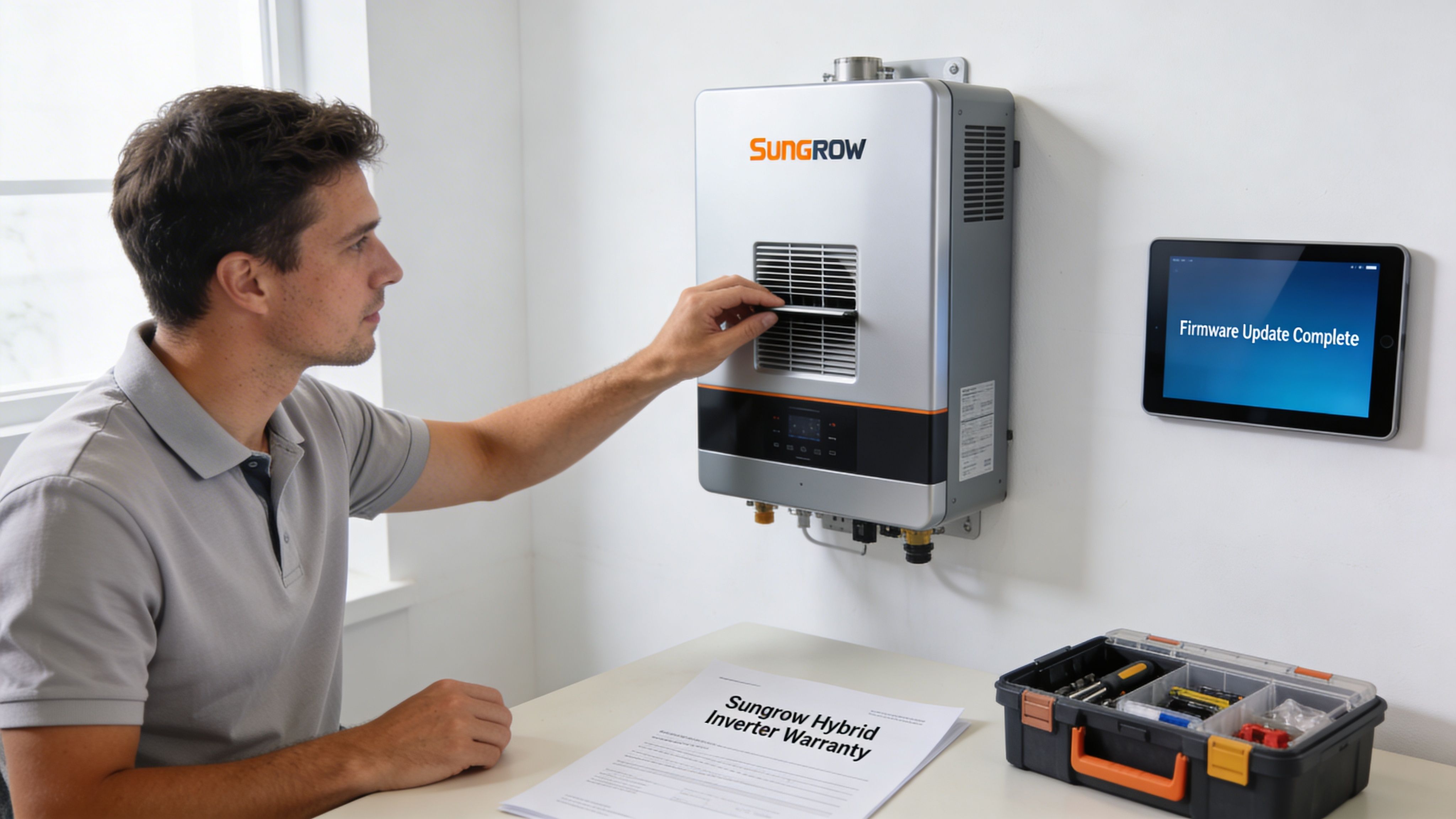
Brisbane conditions are tough on outdoor equipment. Heat, humidity, summer storms, and coastal air in some suburbs can all affect long-term performance.
A simple maintenance routine usually includes:
Visual inspection
Check the inverter area for dirt build-up, blocked airflow, signs of water entry, or physical damage.
Monitoring review
Look at the app or monitoring portal from time to time. Sudden drops in production or charging behaviour can flag a fault early.
Post-storm check
After major weather, inspect the area around the inverter and battery for debris, leaks, or obvious damage.
Panel cleanliness awareness
If your roof collects dust, leaf debris, or bird mess, panel condition can affect charging performance. A practical solar panel maintenance checklist can help homeowners understand what to look for before calling for service.
For larger three-phase sites, Sungrow’s SH15/20/25T three-phase hybrids offer 10 ms backup switching, corrosion-resistant IP65/C5 casing, and 50 A fast-charge currents, reducing maintenance visits by 40% in coastal Brisbane environments, according to the relevant SH15/20/25T datasheet.
That’s a useful reminder that enclosure quality and corrosion resistance matter. A tidy spec sheet isn’t just marketing. In a humid Queensland setting, build quality affects how often somebody needs to come back.
Firmware updates can matter more than people think. Hybrid systems rely on software for battery control, monitoring, and grid interaction. If an installer or service technician recommends an update, it’s usually worth understanding why.
Warranty protection is easier when owners keep records organised:
Keep the commissioning documents
These show what was installed and how the system was configured.
Save warranty paperwork and serial numbers
You don’t want to chase this down after a fault appears.
Document any service visit
A simple record helps if a later claim depends on prior work.
After a proper inspection, many routine concerns turn out to be settings, monitoring, or shading-related rather than hardware failure.
For a visual overview of Sungrow hybrid equipment and setup, this clip is useful:
A hybrid solar project works best when the electrical side is handled by a team that understands more than panels and inverters. In Brisbane homes, the hard part is often the integration. Switchboards, backup circuits, smoke alarm compliance, and safe routing all need to line up.
DLG Electrical brings that broader electrical background to the job. As a family-owned Brisbane contractor with more than 19 years in residential and commercial electrical work, the team handles the practical parts homeowners and landlords usually worry about most. Site assessment. Existing electrical condition. Compliance. Clean installation. Ongoing support.
That matters if you’re renovating, retrofitting a battery onto an existing system, or managing a rental property where backup, safety devices, and neat documentation all count. It also matters if your roof isn’t straightforward and your project needs proper coordination rather than a one-size-fits-all package.
For North Brisbane homeowners, Grange and Windsor property owners, and developers juggling site constraints, the value is simple. You get an electrician-led approach that treats the sungrow hybrid inverter as part of the whole property electrical system, not as a standalone gadget bolted to the wall.
If you want clear advice on whether a Sungrow hybrid setup suits your roof, battery goals, and Energex conditions, contact DLG Electrical. Their Brisbane team can assess the site, explain installation requirements, and provide a practical quote without the usual solar sales spin.

Master Electrician with over 30 years of experience. Founded DLG Electrical in 2005 after international project work including electrical installations at Stamford Bridge Stadium, London(Home of Chelsea FC).

Local Electricians that can fix all Electric Hot water Systems.
Motion sensor lights are a versatile addition to any home, offering nu
