83 Jean St, Grange QLD 4051
Mon-Fri 07:30 AM - 04:00 PM - Sat - 8:00 - 12 - Sunday Closed
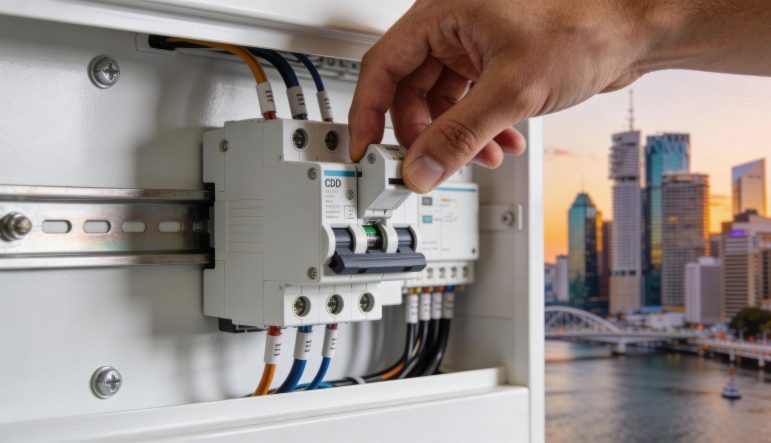
If you’re in an older Brisbane home and the lights dip when the air-con starts, a breaker trips every time too many appliances run at once, or the switchboard looks like it’s still from another era, you’re not overreacting by being concerned. Those are the kinds of warning signs that often show up before a switchboard becomes a genuine safety problem.
Electrical switchboard upgrades aren’t cosmetic work. They’re about making the home safer, bringing it into line with Queensland requirements, and giving the property enough capacity for the way people live today. That matters even more in North Brisbane suburbs with a lot of older housing stock, including Grange and Windsor, where many homes were built long before modern appliance loads, safety switches, solar systems, or EV charging were part of everyday life.
Your switchboard is the control point for the entire property. Every lighting circuit, power circuit, appliance feed, and safety device relies on it doing its job properly.
In a newer home, that usually means a neat board with clearly labelled circuit breakers and modern protection. In an older Brisbane home, it can mean ceramic fuses, limited capacity, poor circuit separation, and no proper residual current protection where it’s needed. That gap is where risk builds.
A lot of homes weren’t designed for today’s electrical demand. Even without major renovations, households now run more air-conditioning, more kitchen appliances, more electronics, and often solar equipment or plans for an EV charger.
Historically, older fuse systems gave way to breaker-based boards as household demand increased. The move from the fuse systems common earlier in the century to circuit breakers became the standard as appliance use grew, and over 40% of older Queensland homes still rely on outdated systems that contribute to 25% of Brisbane residential electrical incidents, according to this industry history of panel evolution.
That doesn’t mean every old board is about to fail. It does mean age matters, and old switchboards deserve a proper inspection rather than guesswork.
A proper upgrade usually improves three things at once:
Practical rule: If the switchboard is old enough that you’re unsure whether it has compliant RCD protection, stop treating that as a minor maintenance issue and get it inspected.
Electrical switchboard upgrades also make future work simpler. If you’re planning a renovation, adding an induction cooktop, replacing an old hot water system, installing ducted air-conditioning, or preparing for solar and battery integration, the switchboard is usually where the conversation starts.
What works is a full inspection of the existing board, the consumer mains, the earthing, the circuit layout, and the actual load requirements of the home.
What doesn’t work is replacing one nuisance breaker, swapping a fuse carrier, or adding another circuit onto an already crowded old board and hoping that solves the bigger issue. Those patch jobs can delay the decision, but they rarely fix the root problem.
In Brisbane homes, especially older timber or post-war properties, the smartest approach is to look at the board as part of the home’s overall safety system, not as an isolated box on the wall.
Old switchboards usually give warnings before they become dangerous. The important part is recognising the warning for what it is.
In Queensland, 42% of homes with pre-1980s panels experience frequent circuit tripping, and 28% report burning smells or flickering lights, according to this switchboard market report. Those aren’t small annoyances. They’re common reasons people start asking for inspections.
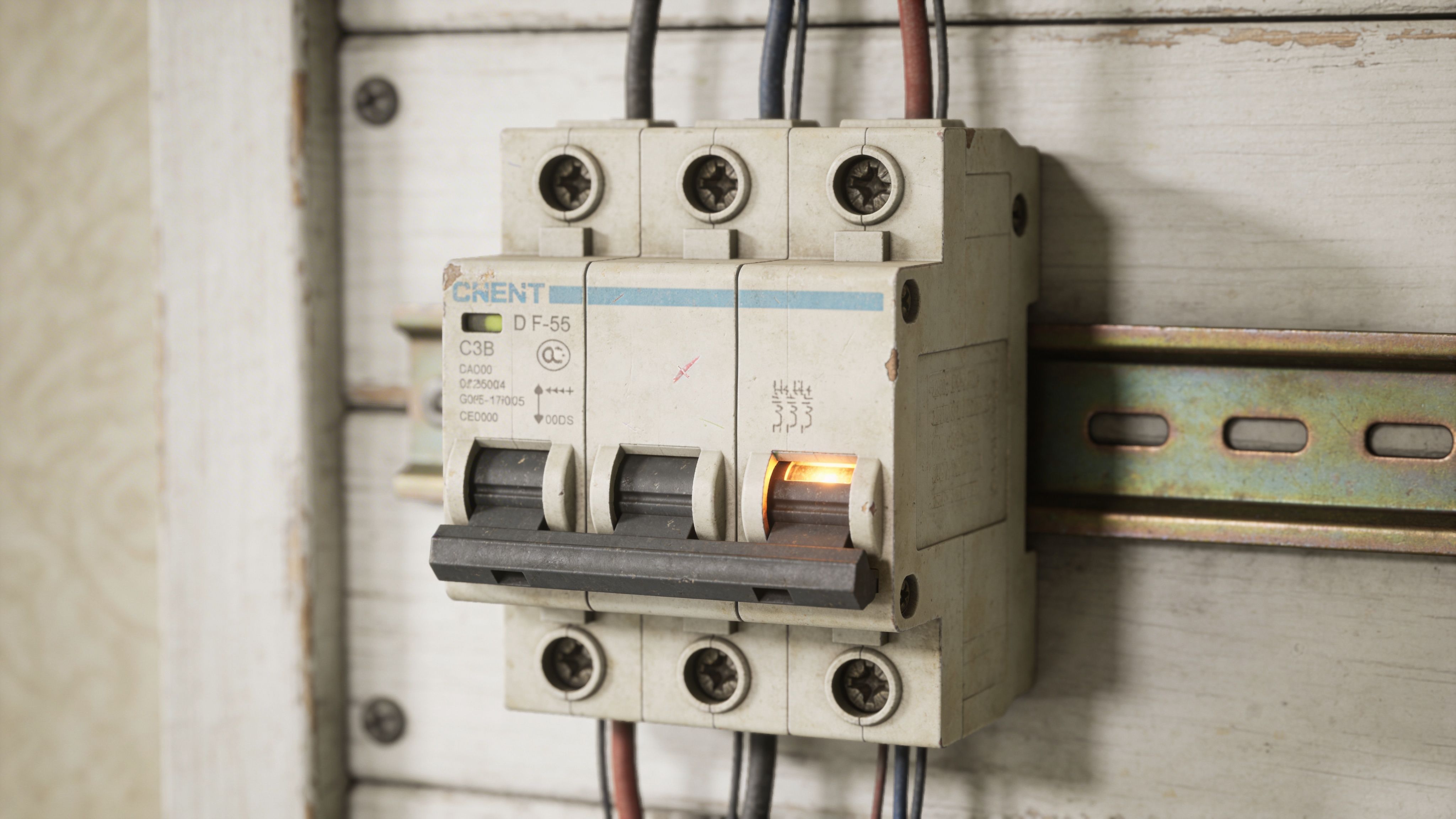
Frequent tripping often tells us the board is struggling to manage the current load, or that circuits were laid out in a way that no longer suits how the home is used.
Burning smells are more serious. They can indicate overheating terminals or deteriorated equipment inside the enclosure. That’s not a watch-and-wait issue.
Ceramic fuses deserve special mention because they can create a false sense of normality. Plenty of people say, “It’s always been like that.” That’s exactly the problem. Long-term familiarity with an old switchboard doesn’t make it safe.
A switchboard should fail safe. It shouldn’t rely on the homeowner noticing a smell, a buzz, or a warm panel cover.
Use this simple check before calling an electrician:
| Check | What to notice | Why it matters |
|---|---|---|
| Visual age | Old fuse holders, mixed hardware, damaged cover | Age often tracks with outdated protection |
| Everyday behaviour | Tripping, dimming, inconsistent appliance performance | Suggests load or fault issues |
| Safety devices | Presence of clearly identified RCDs or safety switches | Modern protection is essential |
| Expansion needs | Solar, EV charger, new air-con, renovation plans | Future demand may exceed current setup |
If any of those points raise concern, the next step isn’t DIY investigation inside the board. It’s a licensed inspection.
Switchboard work in Queensland isn’t optional guesswork. It’s regulated electrical work, and the compliance side matters as much as the physical hardware.
All Australian switchboard upgrades must comply with AS/NZS 3000:2018, and that standard requires RCDs on all final sub-circuits in homes. Those devices detect leakage currents as low as 30mA and trip within 40ms, which is why they play such an important role in reducing electrocution and fire risk, as outlined in this summary of switchboard upgrade standards and regulations.
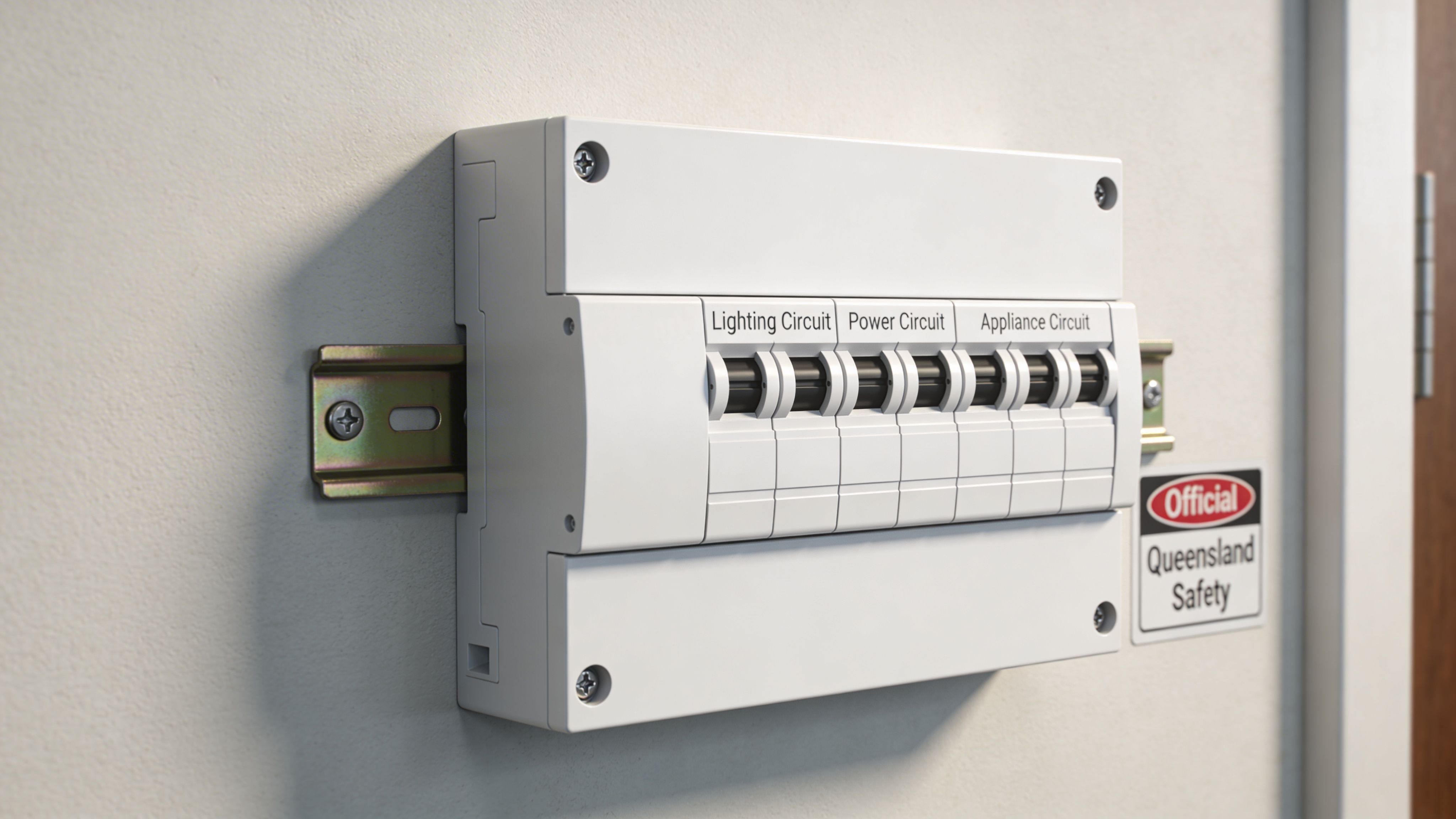
A compliant upgrade isn’t just “new breakers in a new box”. It usually involves:
That’s why homeowners should ask what standard the work will be done to, what testing is included, and what documentation they will receive at the end.
For many Brisbane property owners, the paperwork matters almost as much as the hardware. If you want a clear explanation of what’s issued after electrical work, this guide to a Certificate of Compliance is useful background.
Rental properties have less room for “we’ll deal with it later”. Landlords carry a safety obligation, and an outdated board can quickly become a compliance issue rather than just a maintenance issue.
Queensland-specific guidance matters here because many generic online articles talk in overseas terms and miss local obligations like safety switch expectations, smoke alarm coordination, and proper certification after electrical work.
For owners of rentals in North Brisbane, the main point is simple. If the switchboard is old, undocumented, or visibly outdated, it should be assessed before it causes a tenancy problem, an insurance problem, or a safety incident.
Compliance takeaway: A switchboard upgrade should leave you with safer protection, tested circuits, and the right documentation. If any of those are missing, the job isn’t complete.
The most common mistake is treating compliance as something that can be handled later. It can’t.
You can’t separate switchboard safety from Queensland electrical rules. If the board is being upgraded, the work has to meet the current benchmark. That includes the devices installed, the testing carried out, and the way the result is documented.
Most homeowners are less worried about the upgrade itself than they are about not knowing what will happen on the day. The process is straightforward when it’s planned properly.
Early in the job, the work is usually mapped out in stages so there are no surprises around shutdown, access, circuit identification, or reconnection.
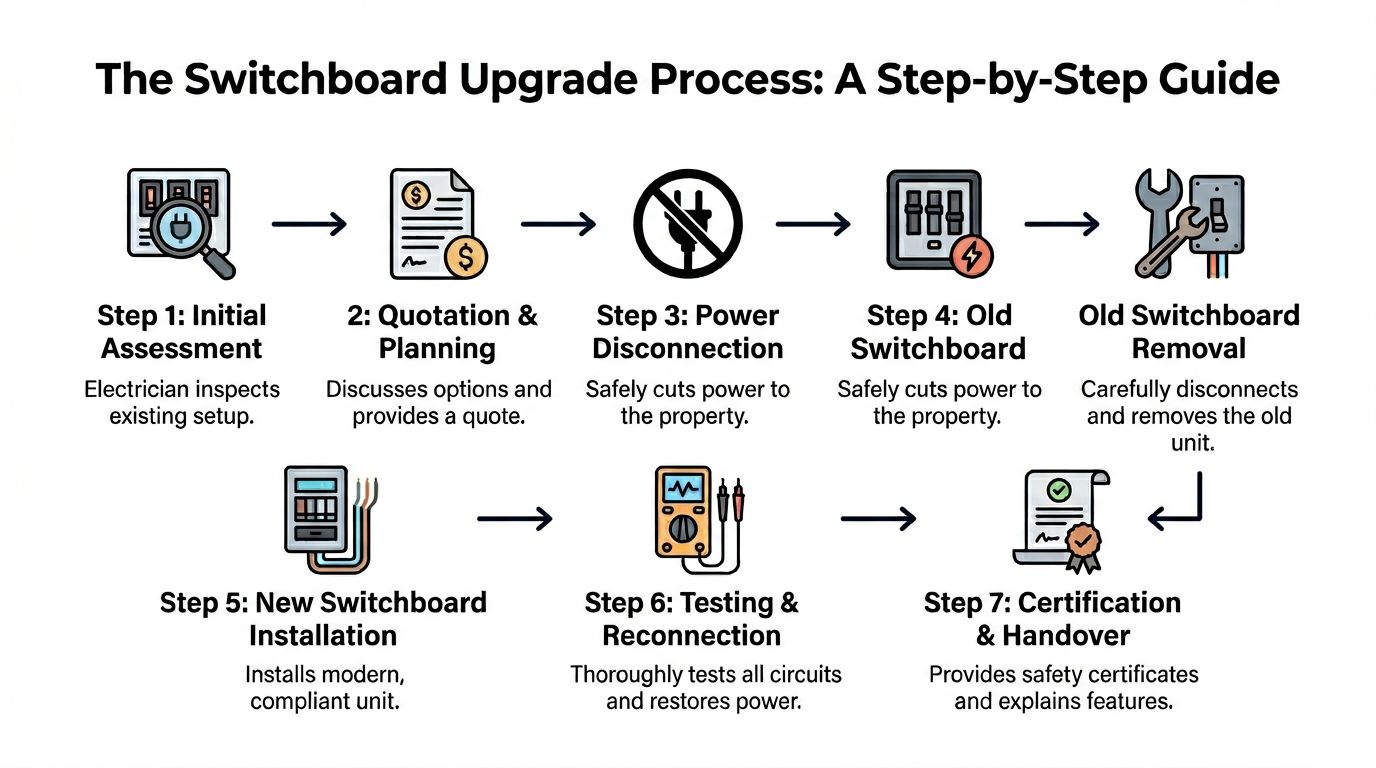
The first step is an on-site assessment. That includes the age and condition of the existing board, the number of circuits, how the home is supplied, and whether there are obvious issues with capacity, layout, or compliance.
At that point, the electrician should also ask about future plans. A home that will soon add ducted air-conditioning, a pool circuit, solar changes, or EV charging needs different planning than a home with no planned load increase.
If higher-demand equipment is part of the picture, a three-phase option may need to be considered. For homes with substantial electrical demand, a 3-phase switchboard upgrade provides a 400V supply and helps prevent voltage drops that can reduce appliance efficiency by 20-30%. It’s also important for loads such as large air-conditioners, spas, or EV chargers that exceed single-phase limits, as explained in this switchboard upgrade guide.
For homeowners comparing supply options, this explanation of the difference between single-phase and three-phase power helps frame that decision.
Once the job is scheduled, power is isolated so the existing board can be removed safely.
The general sequence looks like this:
A well-run job isn’t rushed. Neat circuit layout, accurate labelling, and proper testing matter because they affect every future fault-find, renovation, or appliance addition.
This video gives a useful visual overview of the kind of work involved:
A proper upgrade looks at the complete system around the switchboard. That includes the existing circuits, the protection strategy, and whether the board still makes sense for the home.
A patch job focuses only on the failed part. Sometimes that’s enough for a minor fault. Often it isn’t.
In practice, the most useful comparison for homeowners is to look at documented project flow. Even though it’s not Brisbane-specific, an electric upgrade case study from SnapFixNow shows why sequencing, documentation, and staged coordination matter on electrical upgrade work.
DLG Electrical carries out switchboard upgrades in Brisbane with the same practical focus: inspect first, identify the actual constraints, then upgrade the board to suit the property rather than forcing a generic template onto every house.
Price matters, but the cheapest number on a quote usually tells you the least. With electrical switchboard upgrades, the actual cost depends on what the existing installation reveals.

The final amount usually shifts based on factors like:
If you want a local pricing breakdown, this guide on electrical switchboard upgrade cost is a useful starting point.
Older switchboards tend to hide complexity. A homeowner might expect a simple swap, but old boards can involve mixed generations of work, inconsistent circuit identification, brittle cabling around the enclosure, or no sensible spare capacity.
That links back to the age of the housing stock. As noted earlier in the article, many older Queensland homes still rely on outdated systems, and those older boards remain tied to a meaningful share of Brisbane residential incidents.
Budget for the board you actually have, not the one you hope is behind the cover.
The installation work itself is often completed within a single scheduled visit, but the overall timeline depends on planning, approvals, material selection, and coordination for disconnection and reconnection.
For homeowners, the better question isn’t “How fast can it be done?” It’s “What needs to be checked before power goes back on?” That’s the part that protects the household.
A realistic quote should explain both the physical works and the administrative steps around them. If a quote is vague about testing, certification, or reconnection, ask for detail before accepting it.
A switchboard upgrade day runs more smoothly when the homeowner does a bit of prep first. That doesn’t mean doing electrical work. It means making the site safe, accessible, and easy to work in.
| Task | Why It’s Important | Done |
|---|---|---|
| Clear access to the switchboard | The electrician needs safe room to isolate, remove, install, and test equipment | ☐ |
| Move stored items away from the area | Boxes, bins, tools, and garden gear slow the job and can create hazards | ☐ |
| Plan for a temporary power outage | Fridges, internet, garage doors, medical devices, and work-from-home setups may be affected | ☐ |
| Unplug sensitive electronics | This reduces risk to devices during shutdown and reconnection | ☐ |
| Make note of known electrical issues | Tripping circuits, flickering lights, or problem appliances help with diagnosis | ☐ |
| Secure pets and keep kids clear | The work area needs to stay controlled and interruption-free | ☐ |
| Confirm access to all relevant areas | The electrician may need to inspect related circuits, meter positions, or appliance locations | ☐ |
Write down any recurring issue before the day. If the oven trips one circuit, the air-con affects another, or one power point has been unreliable, mention it early. Small observations often help identify how the circuits are behaving.
Also plan around the outage. Charge phones, keep a torch handy, and think about anything in the home that depends on mains power during the work window.
If access is blocked, the power shutdown catches you by surprise, and no one mentions the long-running faults until handover, the day gets harder than it needs to be.
Good preparation doesn’t change the technical work. It does make the job cleaner, safer, and less disruptive.
Homeowners usually ask the same practical questions, and they’re the right ones to ask.
Sometimes a small repair is appropriate. A failed breaker, a damaged enclosure component, or one isolated fault doesn’t always mean the whole board must be replaced.
The decision changes when the board is old, lacks modern protection, has no usable capacity, or shows multiple warning signs at once. In those cases, repeated minor repairs often cost more in the long run and still leave the home with the same underlying safety limitations.
The exact outage window depends on the scope of work and site conditions.
What matters most is that the shutdown, testing, and reconnection are handled in the right order. A shorter outage isn’t a good outcome if the work is rushed. The goal is a safe and properly tested result.
Landlords should focus on compliance, tenant safety, and documentation.
For Queensland landlords, compliance under the Electrical Safety Act 2002 is critical. Over 30% of homes in North Brisbane suburbs like Grange and Windsor have non-compliant switchboards, and upgrades must include RCDs and be documented with a Certificate of Compliance, according to this Queensland-focused switchboard upgrade overview.
If the property is older and the board hasn’t been reviewed in years, that review should be moved up the priority list.
Not always, but those additions often expose capacity or protection issues that were already there.
The right answer comes from load assessment and inspection, not guesswork. Some homes can accommodate additions with circuit changes. Others need a more substantial upgrade so the switchboard matches the actual demand.
Yes, if the current board is outdated or non-compliant.
A lot of switchboard risk is silent. Fault protection isn’t something you judge by appearance alone. People often assume a board is fine because “the power still works”. That’s not the same as saying the board provides the level of protection expected today.
Ask these questions:
Those questions usually tell you whether you’re getting a proper upgrade or a bare-minimum swap.
If your home in North Brisbane, Grange, Windsor, or the surrounding suburbs has an ageing switchboard, recurring electrical faults, or compliance concerns, speak with DLG Electrical. The team handles switchboard upgrades, safety compliance, and practical inspections for Brisbane homes and rental properties, with clear advice on what needs to be done and what doesn’t.

Master Electrician with over 30 years of experience. Founded DLG Electrical in 2005 after international project work including electrical installations at Stamford Bridge Stadium, London(Home of Chelsea FC).

Local Electricians that can fix all Electric Hot water Systems.
Motion sensor lights are a versatile addition to any home, offering nu
