83 Jean St, Grange QLD 4051
Mon-Fri 07:30 AM - 04:00 PM - Sat - 8:00 - 12 - Sunday Closed
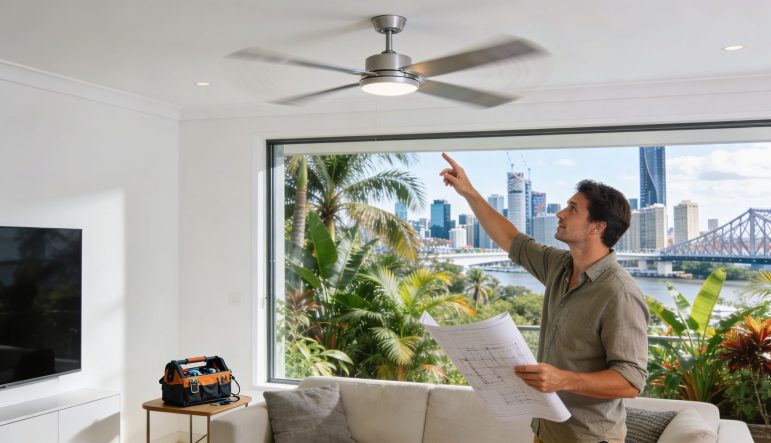
Many Brisbane homeowners begin searching for ceiling fans following a familiar type of afternoon. The house feels heavy, the air conditioning is costly to operate, and one room always seems warmer than the others. In older Queenslanders, the high ceilings provide little relief unless the air is moving. In newer homes, sealed rooms can feel stuffy even when the system is technically working.
That's where a well-chosen ceiling fan earns its keep. In Brisbane's subtropical climate, a ceiling fan can create comfort similar to a 3°C temperature reduction without lowering room temperature, which is why they're such a practical cooling option in Queensland homes (Staticelectrics ceiling fan guide). Used properly, a fan doesn't replace every other cooling method, but it often reduces how hard the rest of the system has to work.
What matters is getting the whole job right. The fan has to suit the room, the mounting method has to suit the ceiling, and the wiring has to be compliant. That's especially important in Brisbane homes where ceiling types vary so much, from flat plasterboard ceilings in modern estates to raked timber-lined ceilings in renovated Queenslanders.
On a humid Brisbane evening, the difference between a comfortable room and an irritating one often comes down to airflow. You can have insulation, blinds and air con, but if the air feels still, the room won't feel right. A ceiling fan fixes that specific problem well.
The reason ceiling fans work so well here is simple. They move air across your skin and make the room feel cooler without the heavy electricity draw of refrigerated cooling. For many households, that makes them the sensible first step before leaning harder on more expensive cooling options.
Ceiling fans aren't just for summer. In Brisbane, they make sense through most of the year because they improve comfort without the running cost associated with air conditioning. If you're comparing options, DLG Electrical has a useful breakdown of the cost of running aircon that helps put those decisions into context.
There's also a practical maintenance side to this. Dusty blades throw off balance, reduce performance and make a fan look older than it is. If you want a straightforward cleaning routine between services, South Mountain Window Cleaning's guide is a handy reference.
A ceiling fan works best when it's treated as part of the room's comfort setup, not as an afterthought bolted in after summer has already arrived.
Some fans make a room feel noticeably better. Others spin fast and do very little because they're the wrong size, mounted too high, or installed in the wrong position. In Brisbane homes, the best results usually come from matching the fan to three things:
That's the trade-off many people miss. A fan can be cheap to buy and still be poor value if it wobbles, hums, or never really cools the room. A better unit, installed correctly, usually feels better from day one and causes fewer call-backs later.
A ceiling fan that works well in Brisbane has to do more than look good in a showroom. It needs to handle long humid summers, suit the way the room is used, and perform properly in the kind of homes we see across the city, from low-set brick houses to Queenslanders with high ceilings and decorative mouldings.
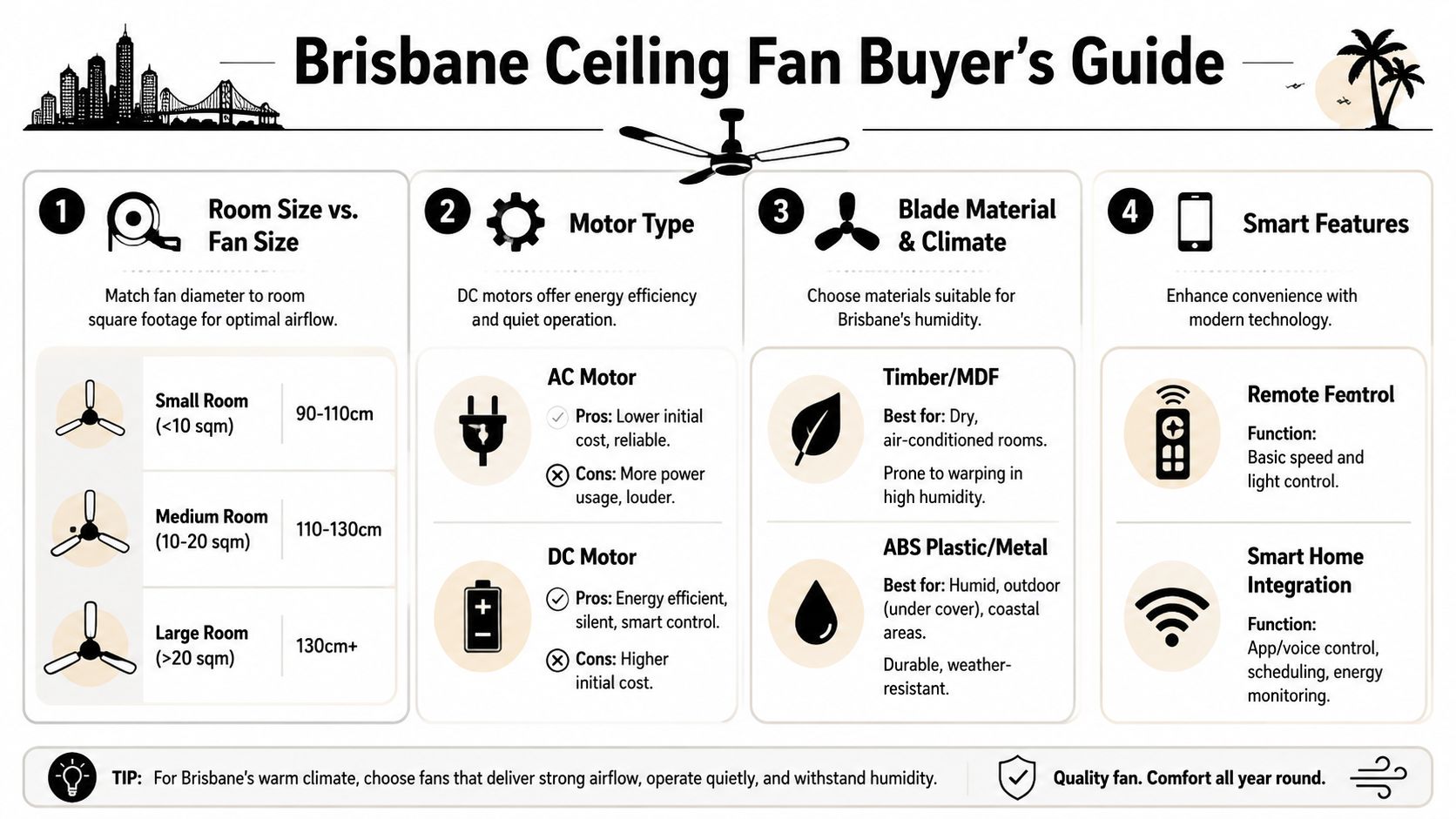
Style matters, but performance comes first. In Brisbane, an undersized fan is one of the most common buying mistakes. It may look neat on the ceiling, yet still leave the edges of the room hot and still.
Small rooms suit smaller blade spans. Larger bedrooms, combined living areas, and open-plan kitchen spaces usually need a larger fan with enough airflow to cover the room, not just the spot directly underneath it. In practical terms, I tell homeowners to stand in the room and judge how they use it. Sleeping, working, watching TV, and cooking all call for different airflow patterns.
A simple shortlist helps:
Motor type affects running cost, noise, and how the fan feels day to day. AC fans are common and usually cheaper to buy. DC fans usually run quieter, use less power, and offer more speed settings.
That trade-off matters more in Brisbane than in cooler parts of the country because many households run fans for months at a time. A fan that costs more upfront can still be the better buy if it runs daily in bedrooms or the main living area. The power draw is low compared with air conditioning, so even a modest improvement in efficiency adds up over a long subtropical summer.
If you want a practical side-by-side breakdown, DLG Electrical explains the differences in this guide to DC ceiling fan vs AC ceiling fan.
Practical rule: For a guest room or occasional-use space, an AC fan can be perfectly reasonable. For a main bedroom or family room used every day, DC is often worth the extra spend.
Brisbane's humidity changes what makes sense. Timber blades can suit character homes beautifully, especially in Queenslanders and renovated workers cottages, but appearance is only part of the decision. In moisture-prone areas, blade stability and finish durability matter just as much.
ABS plastic is often the safest all-round choice for indoor living spaces and covered outdoor areas. It handles humidity well, is easy to clean, and tends to stay looking tidy with less maintenance. Timber or MDF blades can still work indoors, though I'd be more selective about where they go, particularly in homes near the bay or in rooms that stay warm and damp.
| Material | Best use | Main trade-off |
|---|---|---|
| Timber or MDF | Dry indoor rooms, character homes, decorative spaces | More sensitive to moisture and long-term movement |
| ABS plastic | Bedrooms, living areas, covered outdoor zones | Less natural in appearance |
| Metal | Modern interiors, some exterior applications | Harder visual finish, can feel less suited to traditional homes |
Control choice often gets left until the end, but it affects daily use. A remote is handy in a bedroom. Wall control can be better in a hallway or rental. App and smart-home control make sense in high-set homes where the ceiling is well above reach, or where one room has multiple fans.
For Brisbane homeowners with raked ceilings, mezzanine spaces, or large open-plan areas, better control options are not just a convenience. They make it easier to fine-tune airflow through changing weather, especially during those sticky afternoons when you want air movement without dropping the room temperature too hard with air conditioning.
The right fan is the one that fits the room, handles Brisbane conditions, and costs the right amount to run over time. A cheap fan that gets replaced early or never cools properly is rarely the cheaper option in the end.
The same fan won't mount the same way in every Brisbane house. That catches a lot of people out. A fan that looks perfect online can become the wrong choice as soon as you look at the actual ceiling it's going into.
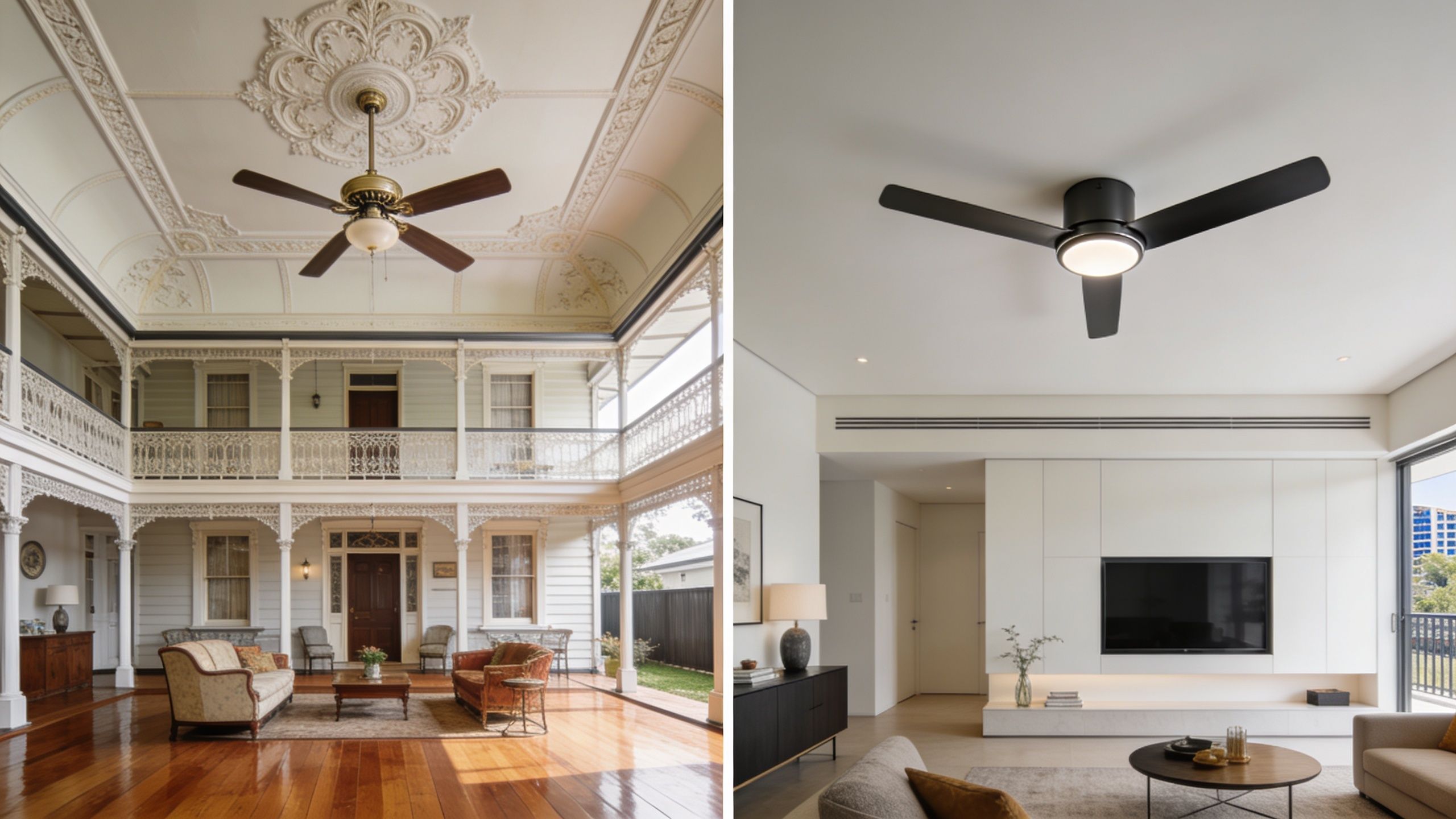
In a standard low-set home with a typical flat ceiling, a flush-mount or low-profile fan is often the right answer. These sit close to the ceiling and help maintain required clearances where ceiling height is limited. They're common in bedrooms, studies and smaller living areas.
This style works well when the ceiling height doesn't leave much room to drop the fan lower. It's practical, tidy and usually the cleanest install visually.
A Grange or Windsor Queenslander is a different story. High ceilings look great, but a fan mounted too high won't move air where people live. That's where a downrod makes the difference.
The goal isn't to hang the fan low for appearance. It's to bring the motor and blades into a better operating zone for airflow and comfort. In older homes, that usually gives a much better result than mounting the fan tight to the ceiling and hoping the height alone will help.
A few common Brisbane scenarios:
Raked ceilings are common in Queenslander renovations, loft conversions and some newer architectural builds. Many poor installs happen in these spaces. The fan might physically fit, but the mount, angle and bracing aren't right for long-term stability.
For slopes over 15°, Queensland Building Code updates effective January 2026 require a licensed electrician to install ceiling fans to reduce vibration failures, and incorrect mounting on angled ceilings can also void warranties (Fans R Us sloped roof mount information).
That matters because a sloped ceiling isn't just a cosmetic variation. It changes the load path, the hanging point and the way the fan behaves once it's spinning at speed.
Here's a useful visual overview before making a mounting decision:
If a fan on a raked ceiling isn't mounted with the right kit and support, the problem usually shows up later as wobble, noise or repeated loosening.
A few shortcuts almost always cause issues:
An on-site assessment matters more than product specs. Ceiling fan brisbane installs often look simple from the floor. They're not always simple once the ceiling cavity and framing are inspected.
On a hot Brisbane night, a ceiling fan should be the part of the room you never have to think about. It should start cleanly, operate smoothly, and stay solid above your head through summer after summer. That only happens when the electrical work, mounting support, and clearances are handled properly from the start.
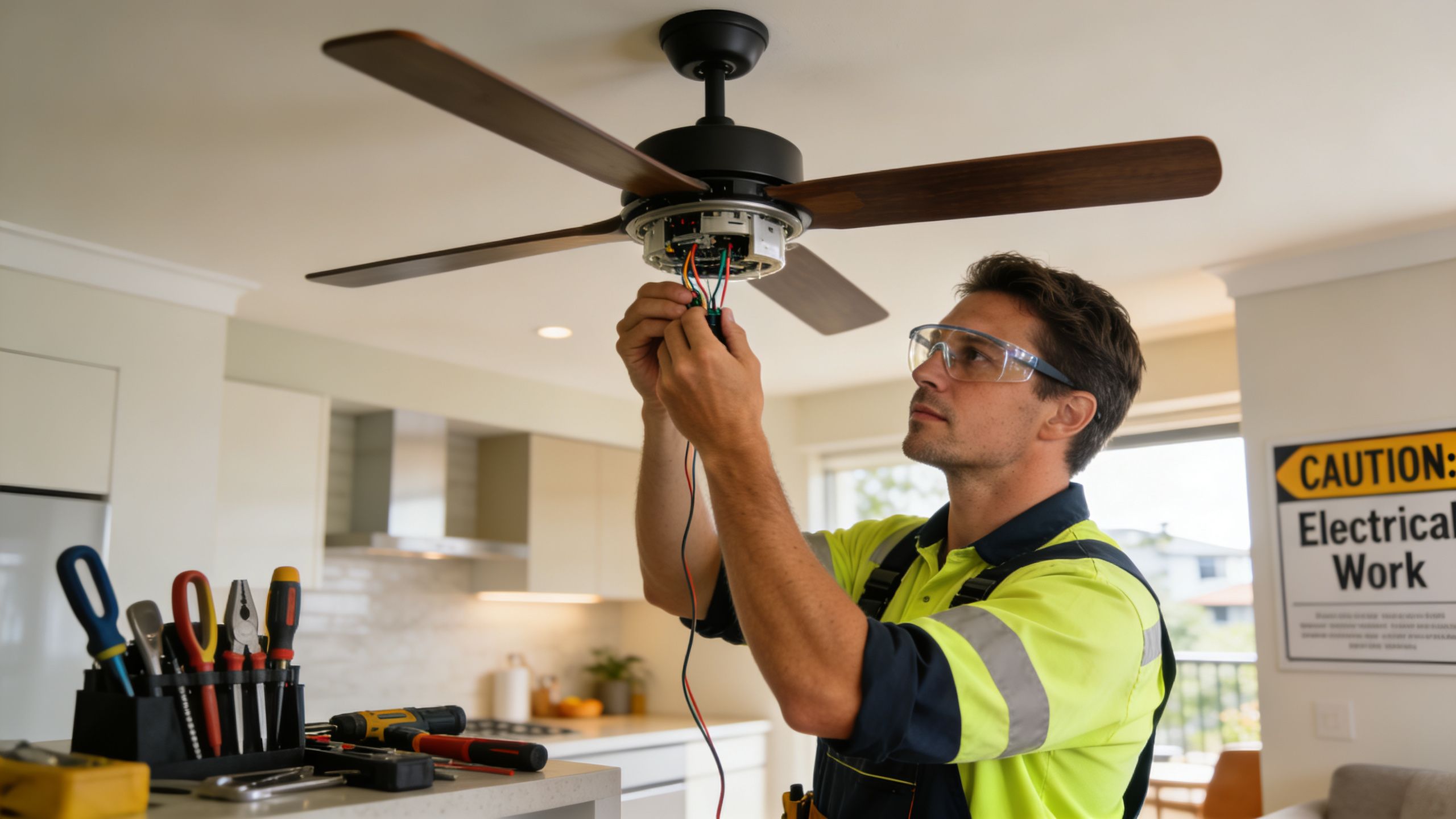
Australian requirements set minimum installation clearances for ceiling fans, including blade height above the floor and separation from the ceiling. Those numbers affect safety first, but they also affect airflow. In Brisbane homes with lower ceilings, loft conversions, or furniture pushed hard against wall lines, the available space can narrow quickly.
I see this regularly in older Queenslanders and renovated post-war homes. On paper, the room looks suitable. Once the fan diameter, bed height, built-ins, and walkway are considered, a different model or a different location is often the safer choice.
A ceiling fan installation involves fixed electrical wiring. In Queensland, that work must be carried out by a licensed electrician. The fan also needs to be secured to suitable support that can handle the weight and movement of a rotating appliance, not just a static light fitting.
The risk is rarely obvious from ground level. A fan can appear fine during installation and still develop wobble, noise, loose fixings, or switch problems once it has been running for a few weeks in a warm, humid roof space.
A proper install usually includes:
Many Brisbane homeowners encounter a common issue. Replacing an old fan sounds straightforward, but once the existing fitting comes down, the actual condition of the point becomes clear.
Common problems include undersized or damaged support, brittle insulation in older wiring, shared switch wiring that limits control options, and previous work that was acceptable decades ago but does not suit a new fan setup. In subtropical conditions, corrosion around metal components and roof-space heat can add another layer of wear.
That is why inspection comes first on many call-outs.
If a licensed electrician completes the work, you should receive the relevant paperwork. For homeowners, that matters well beyond the day of installation. It creates a record if you sell, renovate, manage a rental, or need to show that the electrical work was completed correctly. If you want a clearer explanation, DLG Electrical's guide to a Certificate of Compliance is a useful reference.
Insurance is another practical reason to get this right. Electrical faults, non-compliant alterations, and undocumented work can complicate claims, even when the original issue was not the fan itself. There is also a broader home efficiency angle. This guide on how energy efficient appliances impact home insurance gives useful context for homeowners looking at appliance upgrades across the property.
A ceiling fan is one of the cheaper cooling improvements you can make in South East Queensland. It still needs to be installed as electrical equipment, not treated like a simple hardware swap.
A common Brisbane scenario is a family room that stays stuffy from October to March, even with air conditioning running. In that situation, the question is not just what the fan costs to buy. The question is what it costs to install properly, and how quickly it starts saving money in a subtropical home.

For a standard professional installation in Queensland, the typical cost is $300 to $600, and in many homes the payback period can be 12 to 18 months once energy savings are factored in (DLG Electrical ceiling fan and installation cost guide).
That price usually applies to a straightforward replacement or a simple install where access is good and the existing point is suitable. Brisbane homes often push costs up for practical reasons. Roof spaces can be tight and hot, older houses may need extra checking before a fan goes up, and raked ceilings in Queenslanders usually need specific mounting hardware and more labour.
Here is where quotes usually separate:
| Installation type | What usually affects the price |
|---|---|
| Standard replacement | Existing location, accessible wiring, suitable support |
| New fan point | More labour, switching changes, new wiring path |
| High or raked ceiling | Extra hardware, access complexity, ceiling-specific mounting |
The fan itself also changes the total. A basic bedroom fan and a larger DC fan for an open-plan living area are different jobs with different supply costs. In Brisbane, getting the size right matters because an undersized fan can leave the room feeling flat and force the air con to do the heavy lifting anyway.
The running-cost case for ceiling fans is usually strong in South East Queensland because they work well with, not against, air conditioning. The same DLG Electrical guide notes that fans can reduce cooling costs by 20 to 30%, which works out to roughly $150 to $250 per year for many households based on current tariffs.
That saving is easiest to understand in real use. If a fan lets you raise the air conditioner set point while still feeling comfortable, the fan has done its job. In a Brisbane summer, that often matters more than the purchase price.
Three common examples:
Return on investment is not only a power-bill calculation. It is also about whether the room gets used more often, whether sleep improves in a hot bedroom, and whether the house feels better through a Brisbane summer.
There is also a broader household-cost angle. If you are reviewing upgrades across the property, Cover Club's article on how energy efficient appliances impact home insurance gives useful context.
From a trade point of view, the cheapest quote can be the expensive option later. A poor-quality fan, the wrong mount on a raked ceiling, or extra labour hidden outside the quote can wipe out the saving fast.
A good quote should state whether it includes labour only or supply and install, what wall control or remote arrangement is included, and whether any extra hardware is needed for the ceiling type. That matters in Brisbane because the gap between a simple plasterboard bedroom and a renovated Queenslander with timber lining boards is real.
If homeowners want one rule of thumb, it is this. Compare total installed cost against likely use, not shelf price alone. In a subtropical climate, a well-chosen fan that is installed correctly usually earns its keep faster than people expect.
A Brisbane summer usually makes the decision for you. The bedroom is sticky at 9 pm, the lounge room feels still even with windows open, and the fan that looked fine online suddenly needs to work in a real subtropical home. At that point, the job is not just buying a fan. It is making sure the fan suits the room, the ceiling can carry it properly, and the wiring is done legally.
A proper ceiling fan installation is about long-term performance. The fan should run smoothly, stay stable, deliver useful airflow, and hold up in humid conditions. In Brisbane, that standard is especially important in older homes with timber framing, renovated Queenslanders with raked ceilings, and newer builds where appearance often hides limited access above the ceiling.
The same problems come up again and again. A fan gets chosen on looks alone. An old light point gets reused without checking support. A remote is added as an afterthought. The ceiling angle is ignored until install day.
Those mistakes usually end up as one of four issues:
I see this most often in replacements. Homeowners assume swapping an old fitting for a new fan will be straightforward, but older Brisbane homes rarely give that kind of clean, simple access.
A good installer checks the fixing point before anything is mounted. They confirm whether the existing support is suitable, whether the switch arrangement needs to change, and whether the chosen fan suits the room size and ceiling height.
They should also explain any trade-offs. A DC fan may be quieter and cheaper to run, but the controls and compatibility can differ from older AC setups. A fan on a raked ceiling may need extra hardware and more labour. A remote can be convenient in a bedroom, but some homeowners still prefer a wall controller for reliability and ease of use.
Those are practical decisions, not sales points.
DLG Electrical is one Brisbane option for homeowners who want supply and installation handled together, including ceiling fan work in local residential settings.
A ceiling fan should disappear into the room once it's installed. You should not have to think about vibration, clicking, weak airflow, or whether it was wired correctly.
DLG Electrical has been operating in Brisbane for over 19 years, and the business is family-owned, fully licensed and insured, with free quotes for residential work based on the publisher information provided. That local experience is useful because Brisbane ceiling work is rarely one-size-fits-all. Queenslanders, modern estates, townhouse renovations, and rental upgrades all come with different access, mounting, and wiring constraints.
If you are planning a ceiling fan brisbane installation, keep the next step simple. Choose the fan to suit the room, have the ceiling assessed properly, and use a licensed electrician to install it safely and compliantly.
If you want a practical quote for a new fan, a replacement, or advice on the right setup for a Queenslander or modern home, contact DLG Electrical. They can assess the room, explain the mounting and wiring requirements, and provide a free, no-obligation quote for a safe professional installation.

Master Electrician with over 30 years of experience. Founded DLG Electrical in 2005 after international project work including electrical installations at Stamford Bridge Stadium, London(Home of Chelsea FC).

Local Electricians that can fix all Electric Hot water Systems.
Motion sensor lights are a versatile addition to any home, offering nu
