83 Jean St, Grange QLD 4051
Mon-Fri 07:30 AM - 04:00 PM - Sat - 8:00 - 12 - Sunday Closed
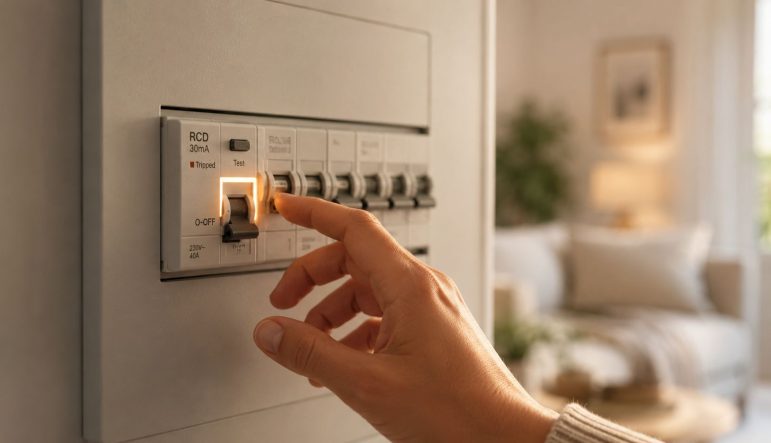
You're halfway through dinner, the oven clock goes blank, the kitchen lights die, and the fridge falls silent. You head to the switchboard, flip the switch back on, and it trips again. For most homeowners, that moment is equal parts nuisance and worry.
That kind of sudden blackout is often residual current device tripping. The important thing to know is that an RCD usually isn't being “annoying”. It's reacting to something it sees as unsafe. Sometimes that's a real fault, like water in an outdoor power point or a damaged appliance lead. Sometimes it's a harder-to-spot issue, such as several modern electronic devices leaking tiny amounts of current that add up.
In Australia, RCDs have been mandatory on power circuits since 1991 and on light circuits since 2000, with Queensland requiring them in new homes from 1992 according to this Residual current device overview. If your Brisbane home was built after that point, RCD protection is a basic part of how the home is meant to stay safe.
An RCD often first makes its presence known when it cuts power at the worst possible time. One minute everything is normal. The next, part of the house or the whole switchboard has shut down, and there's no obvious clue why.
That confusion makes sense. An RCD trip can be caused by a genuine danger, but it can also come from a build-up of small leakages that no single appliance makes obvious. A kettle may not look faulty. A bank of LED lights may seem fine. A smart appliance may work perfectly and still contribute to the problem.
A tripping RCD is a warning sign, not just an inconvenience.
Homeowners often mix up an RCD with an ordinary circuit breaker. They're not the same thing. A breaker protects wiring from overload and short circuit. An RCD protects people by watching for electricity leaking where it shouldn't.
That's why it helps to slow down and read the behaviour of the switchboard properly. Does it trip only when one appliance runs? Does it trip during wet weather? Does it reset, then trip again later? Those patterns matter.
An RCD, often called a safety switch, watches the electricity going out on the active conductor and compares it with the electricity returning on the neutral. In a healthy circuit, those two should stay balanced.
If some current leaks away, often to earth, the RCD sees the mismatch and disconnects power fast. That missing current might be going through wet concrete, a metal appliance body, damaged cable insulation, or in the worst case, a person.
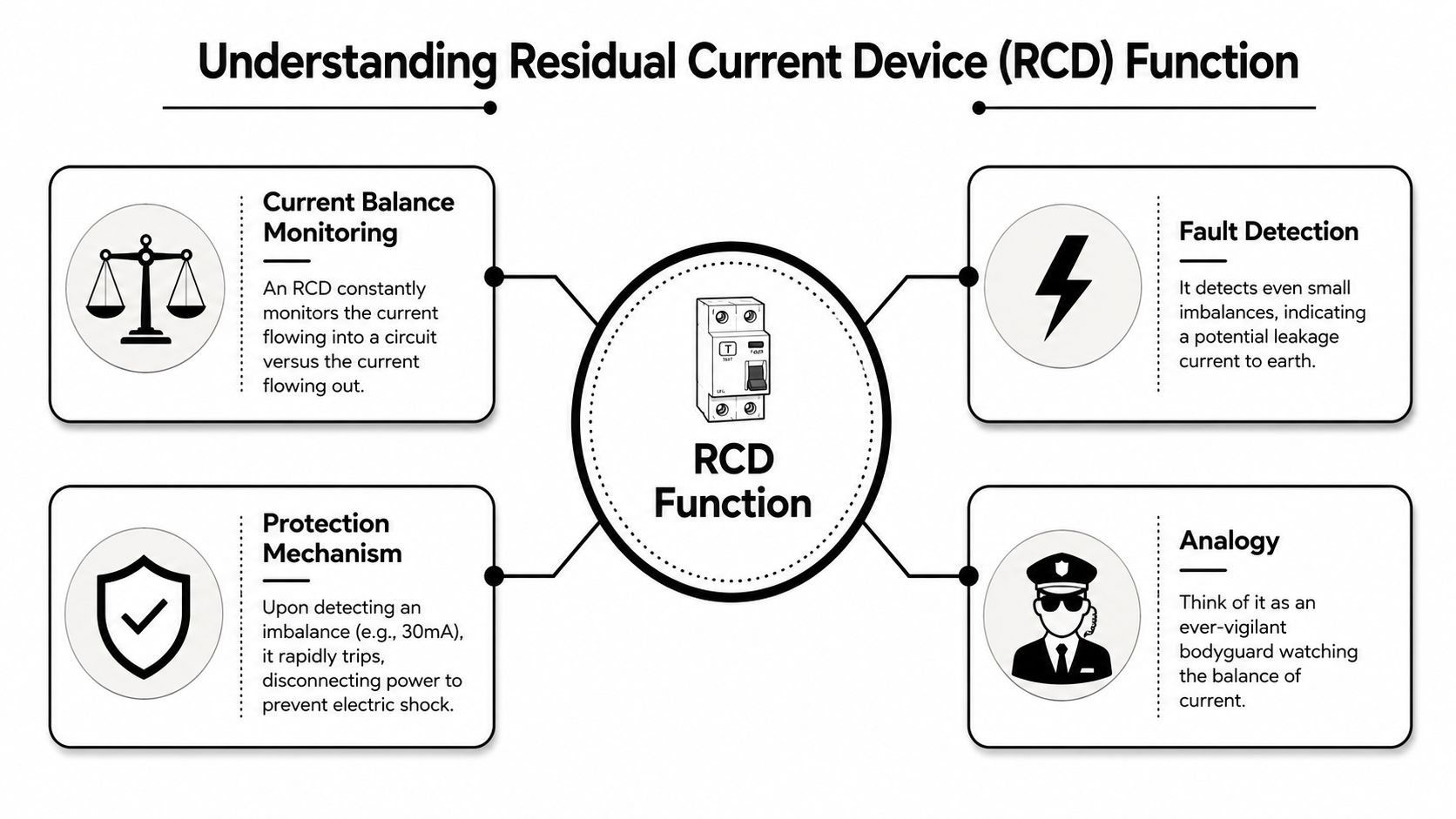
A simple way to picture it is a set of kitchen scales with equal weight on both sides. If both sides match, nothing happens. If one side suddenly drops, the imbalance is obvious.
That's what the RCD is doing constantly. It isn't waiting for smoke or a dramatic short circuit. It's looking for a small difference that says, “Some of this electricity is escaping the normal path.”
For personal protection, an RCD under AS/NZS 3000 must operate at 30 mA and disconnect within 300 ms at that current, with faster trip times at higher leakage, as outlined in this AS/NZS 3000 RCD guide. That sensitivity is the whole point. It reacts to leakage that can be dangerous to a person, not just damage to wiring.
Most homeowners see two parts on the front of the device:
If the TEST button doesn't trip the device, treat that seriously. It suggests the unit may not be operating as intended.
For a plain-English backgrounder, DLG has a useful article on what a residual current device is.
Electric shock risk isn't just about “big” faults. Even small leakages can be dangerous if they pass through the body in the wrong circumstances. That's why RCDs are designed to act quickly and why they can feel “overly sensitive” when they start tripping.
Practical rule: If the RCD trips, assume it saw something real. The next step is finding out whether the problem is a dangerous fault or a nuisance condition.
An RCD trip can feel random. You boil the kettle, switch on a light, or plug in a charger, and the power drops out. The easy conclusion is to blame the last thing you touched. In practice, the actual cause is often sitting in the background, building up gradually until one more device tips the circuit over the edge.
A useful way to sort the problem is this. Some trips come from a clear fault, like water getting into an outdoor socket. Others come from small leakages adding together across several appliances and electronic devices. Both make the RCD react. The difference is in what is causing that leakage and how obvious it is.
These are the causes that deserve immediate respect because they can point to damaged equipment or unsafe wiring.
| Cause | What it looks like at home | Why it trips |
|---|---|---|
| Damaged appliance | Trips when one item is plugged in or switched on | Current leaks to earth through internal damage or worn insulation |
| Moisture ingress | Trips after rain or in wet areas like outdoor sockets | Water creates a path for leakage |
| Wiring fault | Trips even when portable appliances are unplugged | Fixed wiring or a fitting is leaking current |
| Damaged flex or lead | Intermittent trips when a cord is moved | Insulation or conductor damage creates leakage |
A few common examples catch homeowners out. An outdoor powerpoint can look perfectly normal from the front while the back of the outlet is damp. A washing machine may run through the first part of a cycle and only trip once heat, vibration, and moisture rise together. Older exhaust fans, rangehoods, garden tools, and light fittings can do the same thing. They still appear to work, but some current is escaping where it should not.
Modern homes often have dozens of small electronic power supplies working at the same time. LED drivers, phone chargers, computers, TVs, smart home hubs, induction appliances, and whitegoods with electronic controls all contain components that can let tiny amounts of current leak to earth during normal operation. Engineers at Schneider Electric explain this in their guidance on earth leakage currents and electronic equipment.
A single device usually is not the problem. The better comparison is a bucket filling from several slow drips. Each drip looks minor on its own. Put enough of them together on one RCD and the total leakage can get close to the trip threshold.
This is why nuisance tripping often starts after changes such as:
Nothing has to be badly broken for this to happen. The combined leakage can become too high for that RCD arrangement.
If the problem began after a renovation or after adding more electronics, that pattern matters. It often points toward cumulative leakage rather than one dramatic fault. For a plain-English guide to tracing patterns like this, DLG Electrical has a helpful article on electrical fault finding around the home.
This part gets overlooked a lot.
Older switchboards may still have Type AC RCDs, which were designed around simpler alternating current fault shapes. Many modern appliances do not leak current in that simple form. They can produce pulsating DC residual current because of the electronics inside them. If the RCD type is poorly matched to those loads, you can end up with nuisance tripping, unreliable operation, or both.
A good way to picture it is a smoke alarm tuned for one kind of smoke pattern while your home now has a different kind of fire source. The alarm still matters, but the sensing method also has to suit what it is watching for.
Manufacturers such as Hager note in their guide to RCD types that Type A devices are intended for circuits where pulsating DC residual currents may be present, while Type B devices are used for more complex equipment such as certain EV chargers, drives, and inverter-based systems. For homeowners, the practical point is simple. If your home now includes induction cooking, variable-speed motors, solar-related equipment, EV charging equipment, or lots of modern electronics, the age and type of the RCD may be part of the story.
The pattern of the trip often gives the first clue.
The main lesson is simple. An RCD that keeps tripping is rarely being “fussy” for no reason. It is reacting to leakage. The job is to work out whether that leakage is coming from one fault, several small electronic loads adding together, or an older RCD that no longer suits the equipment connected to it.
You don't need test instruments to do the first round of fault finding safely. You do need patience and a method. Randomly resetting the switch over and over won't tell you much.
Start with the safest checks. If at any point you smell burning, see heat damage, or the switchboard won't reset at all, stop and call a licensed electrician.
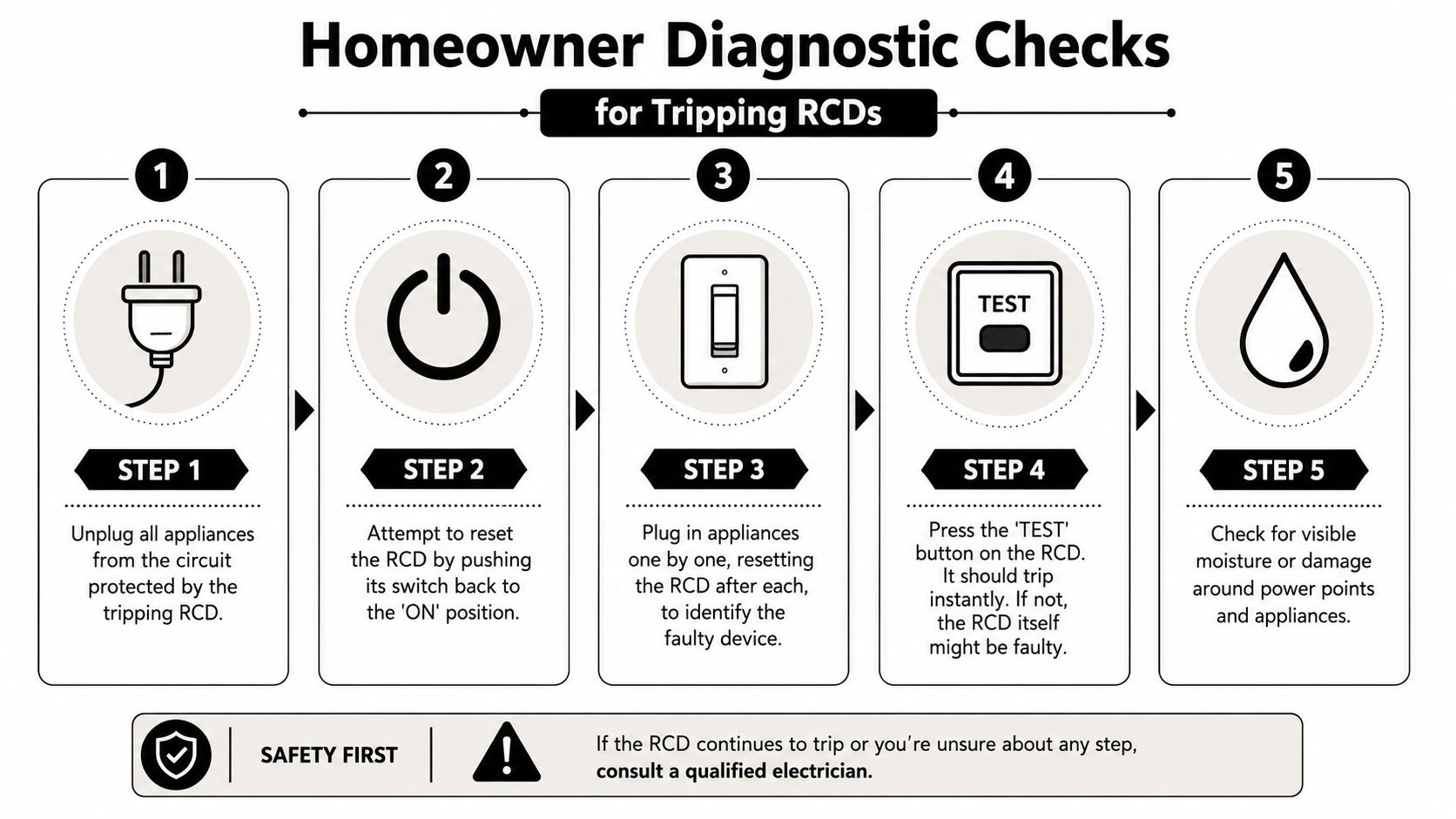
Unplug what you can
Remove portable appliances from the affected area. That includes kettles, toasters, chargers, washing machines, fridges on accessible outlets, lamps, and outdoor equipment.
Reset the RCD
Push the switch fully back to ON. Don't do this repeatedly if it snaps straight back off.
Reconnect items one at a time
Plug appliances back in individually. Give each one a moment, especially anything with a motor, heating element, or power supply.
Use the TEST button
Press the test button only when it's safe to interrupt the circuit. The device should trip. If it doesn't, the RCD itself may need attention.
Check for obvious moisture or damage
Look at outdoor sockets, extension leads, bathroom heaters, laundry appliances, and any place water or steam is common.
A detailed overview of this process also appears in DLG's article on electrical fault finding.
Here's a quick visual walkthrough if you prefer to see the process in action:
Different outcomes point in different directions.
| What happens | Likely meaning | What to do next |
|---|---|---|
| RCD resets after everything is unplugged | One unplugged item may be the cause | Reconnect one by one |
| RCD trips when one item returns | That appliance or lead is suspect | Leave it unplugged |
| RCD trips with nothing portable connected | Fault may be in fixed wiring or hard-wired equipment | Call an electrician |
| TEST button doesn't trip it | RCD may not be functioning correctly | Arrange professional testing |
Some faults hide in circuits people overlook:
Don't judge an appliance by whether it “still works”. A faulty item can keep operating and still leak enough current to trip protection.
A few habits make diagnosis harder and less safe:
If you reach the point where portable appliances are ruled out, you've already done the useful homeowner checks. After that, instrument testing is what separates a guess from a diagnosis.
There's a clear line between sensible homeowner checks and work that needs a licensed electrician. Unplugging appliances and pressing the TEST button are fine. Measuring trip performance, checking insulation resistance, and assessing switchboard compatibility are not DIY jobs.
That difference matters because many tripping issues look the same from the front of the switchboard. A faulty appliance, a damp outlet, an ageing RCD, and a fixed wiring fault can all produce the same symptom. Professional testing sorts them apart.
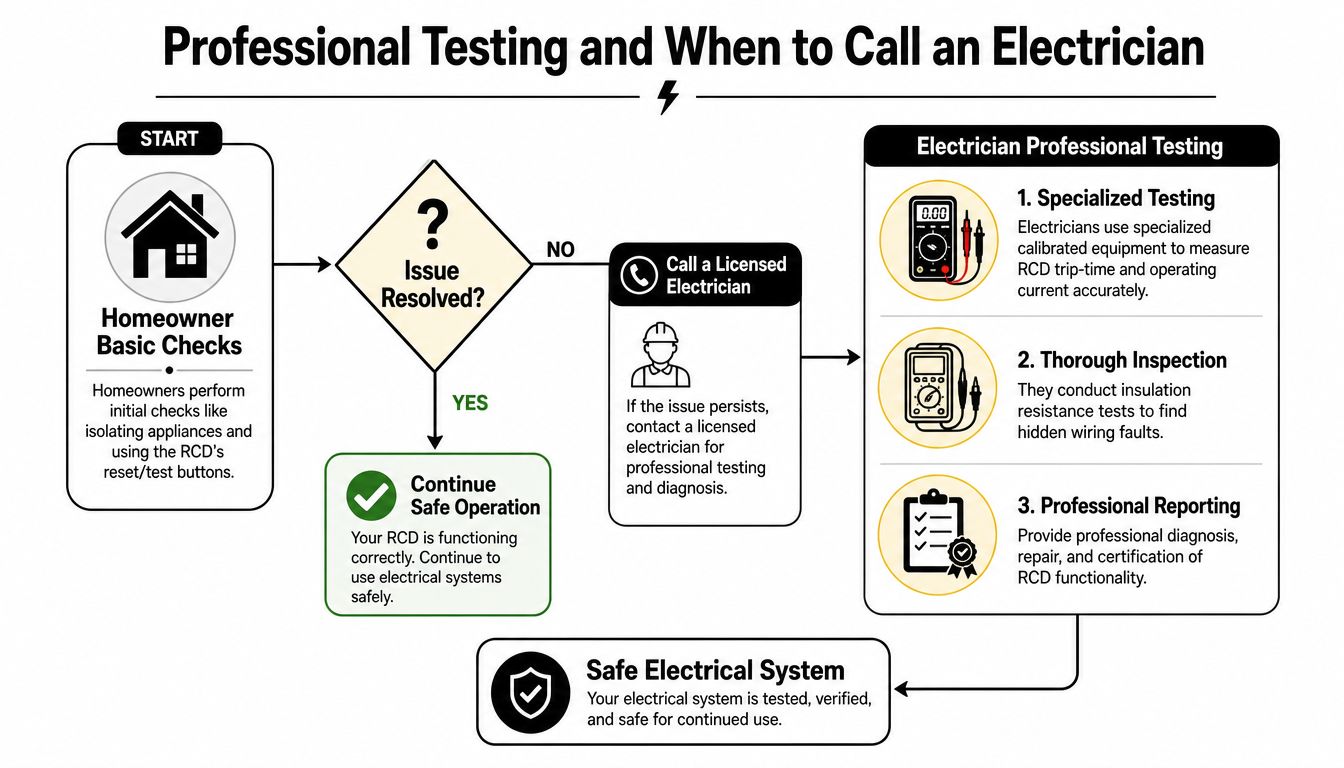
A licensed electrician can use calibrated equipment to check whether the RCD trips within required limits and whether the actual operating current is where it should be. They can also test circuits for hidden leakage and insulation breakdown.
Typical professional checks include:
Portable RCDs must undergo a timed trip test every three months under AS/NZS 3760, and electricians in Queensland are expected to carry out calibrated trip-time testing annually, as outlined in Safe Work Australia's managing electrical risks code of practice.
Call an electrician promptly if any of these apply:
If you want a broader check of the home's condition, DLG also has a useful overview of an electrical safety inspection.
A good electrician doesn't just reset the switch. They identify whether the cause is appliance leakage, fixed wiring, moisture, ageing protection, or the wrong RCD type for the load.
You add a new air fryer, swap halogen lights for LEDs, plug in a few chargers, and install a smart doorbell. Nothing seems dramatic. Then the safety switch starts tripping once every few days. That pattern catches many homeowners off guard because the cause is often not one big fault, but several small leakage paths adding up.
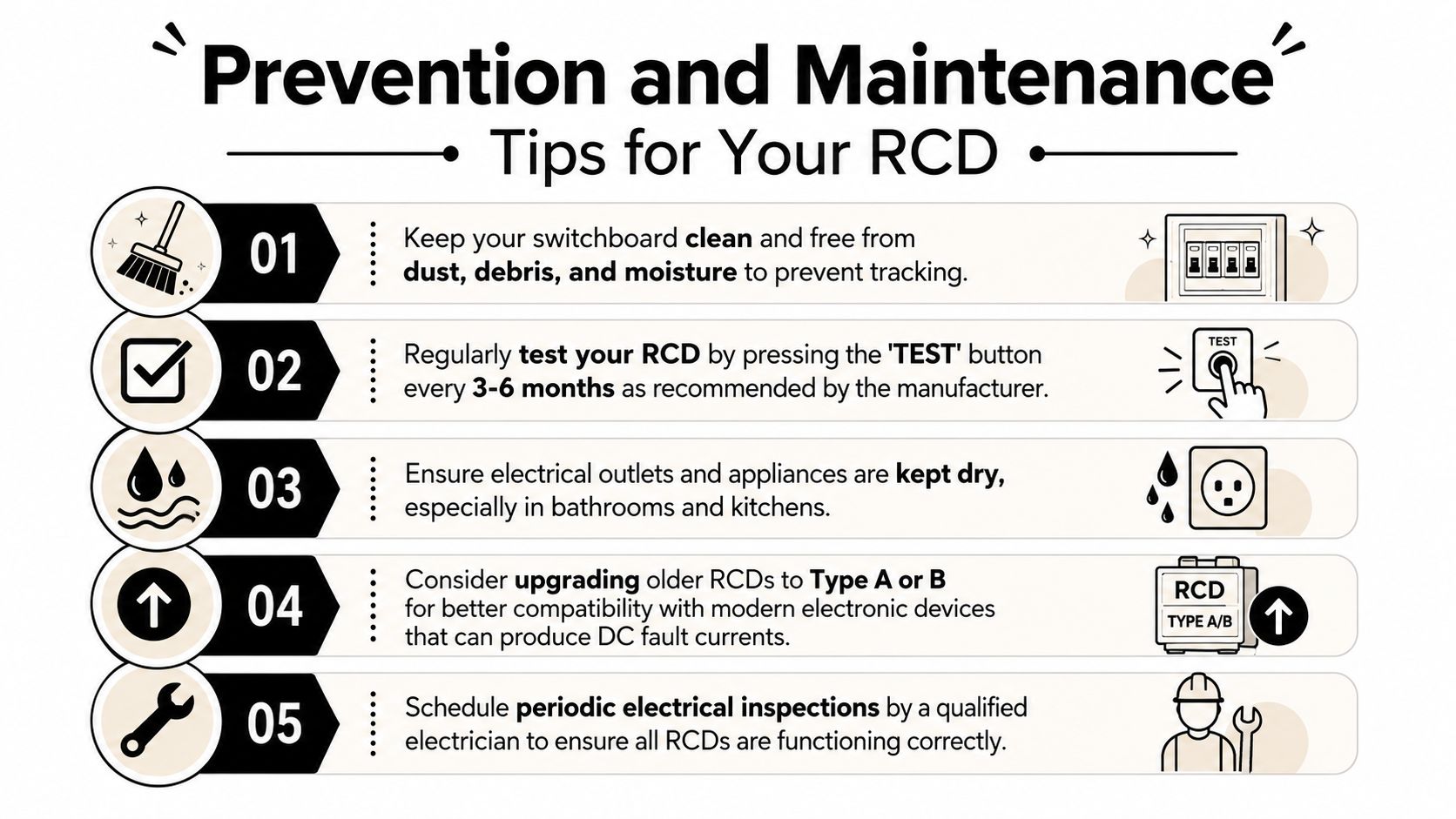
Prevention is really about keeping the electrical system predictable. An RCD works like a security guard counting everyone in and everyone out. If a little current slips away through water, damaged insulation, or electronic filters, it trips. Modern homes often have more of that background leakage than older homes did, even when nothing looks broken.
Start with the simple habits that keep small issues from turning into recurring nuisance trips.
That last point is easy to miss. Many modern devices contain filters that leak a tiny amount of current to earth during normal operation. One device may be harmless. A whole group on the same RCD can push the circuit closer to the trip point, especially in an older home.
If your switchboard has older protection, ask an electrician whether the RCD type matches the loads now connected to it. This is one of the most overlooked causes of nuisance tripping.
Older Type AC devices were suited to simpler loads. Newer appliances and electronics can produce pulsating DC leakage, which Type A and, in some cases, Type B devices are designed to handle better. That does not mean every tripping problem needs a major upgrade. It does mean the protection device itself should be part of the diagnosis, particularly after renovations, solar-related additions, EV charging, LED lighting upgrades, or a jump in smart devices around the home.
As noted earlier, current compliance guidance has moved away from Type AC RCDs for new installation work. In practical terms, an older switchboard may still function, but it may not be the best fit for the electronics now using it.
A quick check every so often can save a lot of frustration later:
Random tripping is often not random at all. It is just hidden.
If you work in a trade and are curious how service businesses explain technical problems clearly online, this guide on digital marketing for tradies gives a practical example of how expertise is presented to homeowners.
Small changes in a home add up over time. A quick maintenance routine, a bit of attention to moisture and damaged leads, and the right RCD type for modern electronics can prevent a lot of unnecessary shutdowns.
When a switch keeps tripping, most homeowners don't need sales talk. They need someone to work through the fault properly and tell them whether the issue is an appliance, the wiring, moisture, or the protection device itself.
That's where a local licensed electrician is useful. For Brisbane homeowners, landlords, and renovators, DLG Electrical handles fault diagnosis, switchboard work, repairs, and electrical upgrades using the normal testing process a licensed contractor would apply. If the problem points to compatibility with newer loads, that can be assessed at the same time as the fault finding rather than treated as a separate mystery.
DLG Electrical is a family-owned Brisbane contractor, fully licensed and insured, and offers free quotes for residential and commercial work. Their scope includes switchboard upgrades, maintenance, repairs, and broader safety-related electrical services that often connect with recurring RCD issues.
If you run a trade business yourself and you're curious how electrical companies build visibility online, this guide on digital marketing for tradies gives a practical look at how service businesses present their expertise and reach local customers.
If your safety switch keeps tripping and you want a clear diagnosis instead of guesswork, contact DLG Electrical. A licensed electrician can test the RCD, isolate the fault, and help you decide whether the fix is a faulty appliance, a wiring repair, or a switchboard upgrade.

Master Electrician with over 30 years of experience. Founded DLG Electrical in 2005 after international project work including electrical installations at Stamford Bridge Stadium, London(Home of Chelsea FC).

Local Electricians that can fix all Electric Hot water Systems.
Motion sensor lights are a versatile addition to any home, offering nu
