83 Jean St, Grange QLD 4051
Mon-Fri 07:30 AM - 04:00 PM - Sat - 8:00 - 12 - Sunday Closed
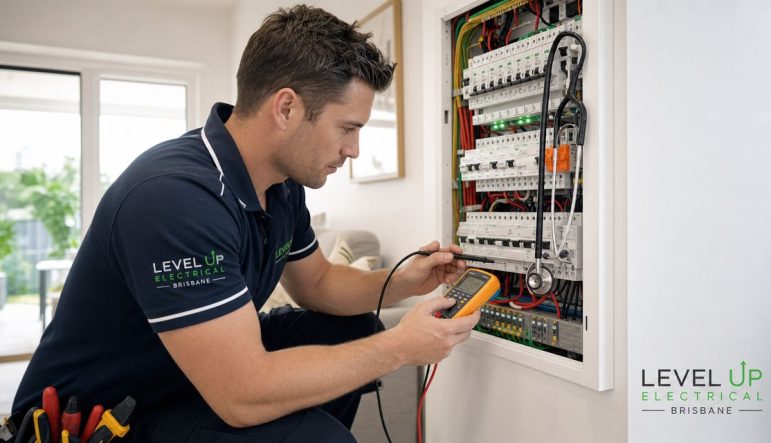
You're usually not thinking about your wiring until something feels off. A breaker trips when the kettle and toaster run together. A light flickers in the hallway. A powerpoint in the laundry feels warm. Nothing looks dramatic, but that's exactly why electrical problems catch people out.
In Brisbane homes, a lot of electrical risk sits behind plaster, above ceilings, under floors, and inside the switchboard. You can't judge it properly from the couch, and you can't fix it with guesswork. A proper electrical safety inspection gives you a clear picture of what's safe, what's aging, what's non-compliant, and what needs attention now versus later.
That matters whether you own the place, manage a rental, are planning a renovation, or you've just moved in and want to know what you've inherited. It also matters because a standard inspection has limits. A pass doesn't mean every possible fault has been found. It means the property met the scope of that inspection on that day.
A good electrical safety inspection is a health check for the electrical system of the property. It's not just someone opening the switchboard, having a quick look, and saying everything seems fine. It's a structured assessment of the parts of the installation that protect the home, the people in it, and the appliances connected to it.
In a typical Brisbane house, that means the switchboard, safety switches, wiring condition, earthing, outlets, fixed electrical equipment, and any signs that previous work was done poorly or without proper verification. In older homes, it often also means checking what's been added over time. Extensions, shed circuits, air conditioning, hot water systems, cooktops, pool gear, and garden lighting all change the load and complexity of the installation.
A lot of homeowners call after they notice one small symptom. Maybe a bathroom light cuts out now and then. Maybe the oven circuit trips once a month. Maybe there's a burnt smell near the board after heavy use. If you ever notice that kind of warning sign, it helps to know the emergency steps for electrical issues before an electrician arrives.
Practical rule: An inspection is most useful before a fault turns into an urgent repair, not after.
The point isn't to scare people. The point is to replace assumptions with tested facts. You want to know whether the system is safe today, whether recent work was properly completed, and whether there are hidden defects that could become expensive or dangerous if they're ignored.
An inspection also gives you better questions to ask. Is the switchboard suitable for the current load? Are the protective devices working as intended? Is this a one-off defect, or a sign the installation needs a broader upgrade?
Electrical safety in Queensland isn't just a matter of personal preference. It sits inside a compliance framework that expects electrical work to be tested, verified, and properly documented. In Brisbane, that matters for homeowners, landlords, renovators, and anyone buying or altering property.
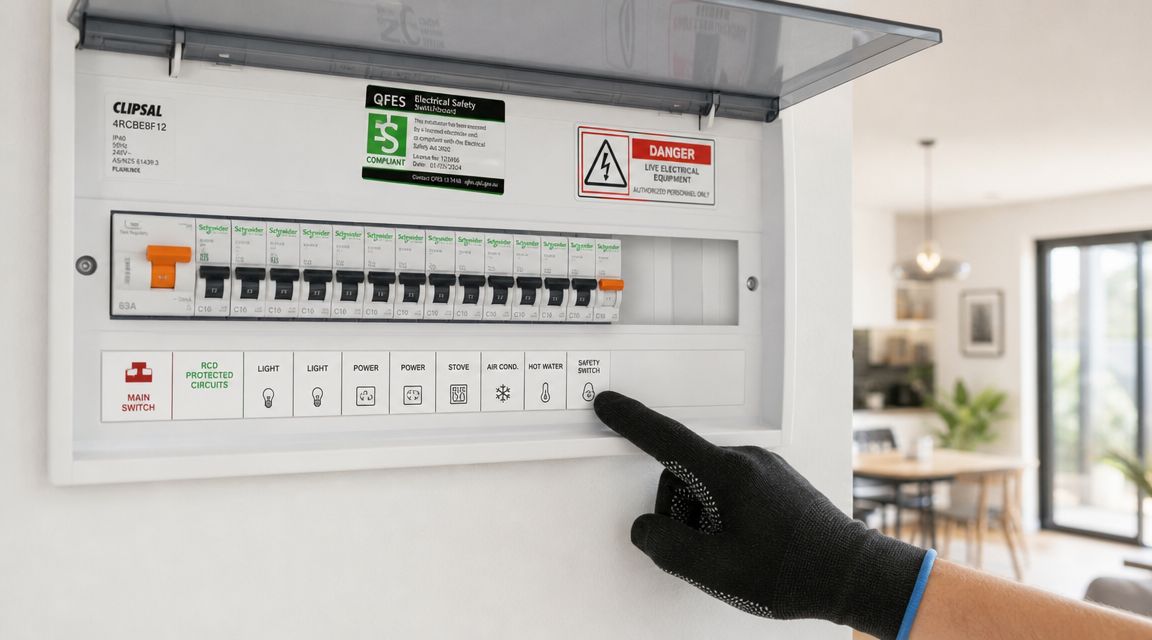
In Queensland, electrical safety regulation is specifically administered under the Electrical Safety Act 2002 and Electrical Safety Regulation 2013, creating a legal basis for inspections, testing, and certification of electrical work, anchored in preventing fire and detecting defects before they become shock incidents, as outlined in this Queensland electrical safety framework reference.
That practical reality catches people by surprise. They think an inspection is optional unless something has already gone wrong. It isn't that simple. If electrical work has been carried out, the expectation is that the work is not only installed, but also checked and verified against the relevant requirements. For many jobs, the paperwork matters almost as much as the physical work itself.
If you've had recent electrical work done and want to understand the paperwork side properly, this guide to an electrical certificate of compliance is worth reading.
The system in your home has one job. It must supply power safely under normal use and protect people when something goes wrong. That means faults need a reliable path to earth, insulation needs to hold up, polarity needs to be correct, and protective devices need to disconnect dangerous conditions fast enough.
When those basics fail, the risk isn't abstract. Regulators and safety bodies consistently point to damaged insulation, loose connections, overloaded circuits, and missing protection as recurring hazards in homes and small businesses. Those aren't exotic failures. They're everyday defects electricians find in real properties.
Here's the trade-off homeowners face:
A switchboard can look tidy and still have poor testing results. Clean presentation isn't the same thing as proven safety.
Queensland property owners often focus on visible items like smoke alarms, tenancy handover cleaning, or paintwork after a renovation. The electrical side gets left until a fault appears. That's the wrong order.
In rentals, changed occupancy and changed responsibility increase the need for a documented, repeatable process. In renovated homes, the risk is different. New circuits, new appliances, and modified layouts can all affect the original installation. An inspection confirms that the changed system still works safely as a whole, not just that the new fitting turns on.
Most homeowners only see the electrician at the switchboard and assume that's the whole job. It isn't. A proper electrical safety inspection follows a test sequence because each step checks a different failure mode.
This visual gives a quick overview of the main inspection areas.
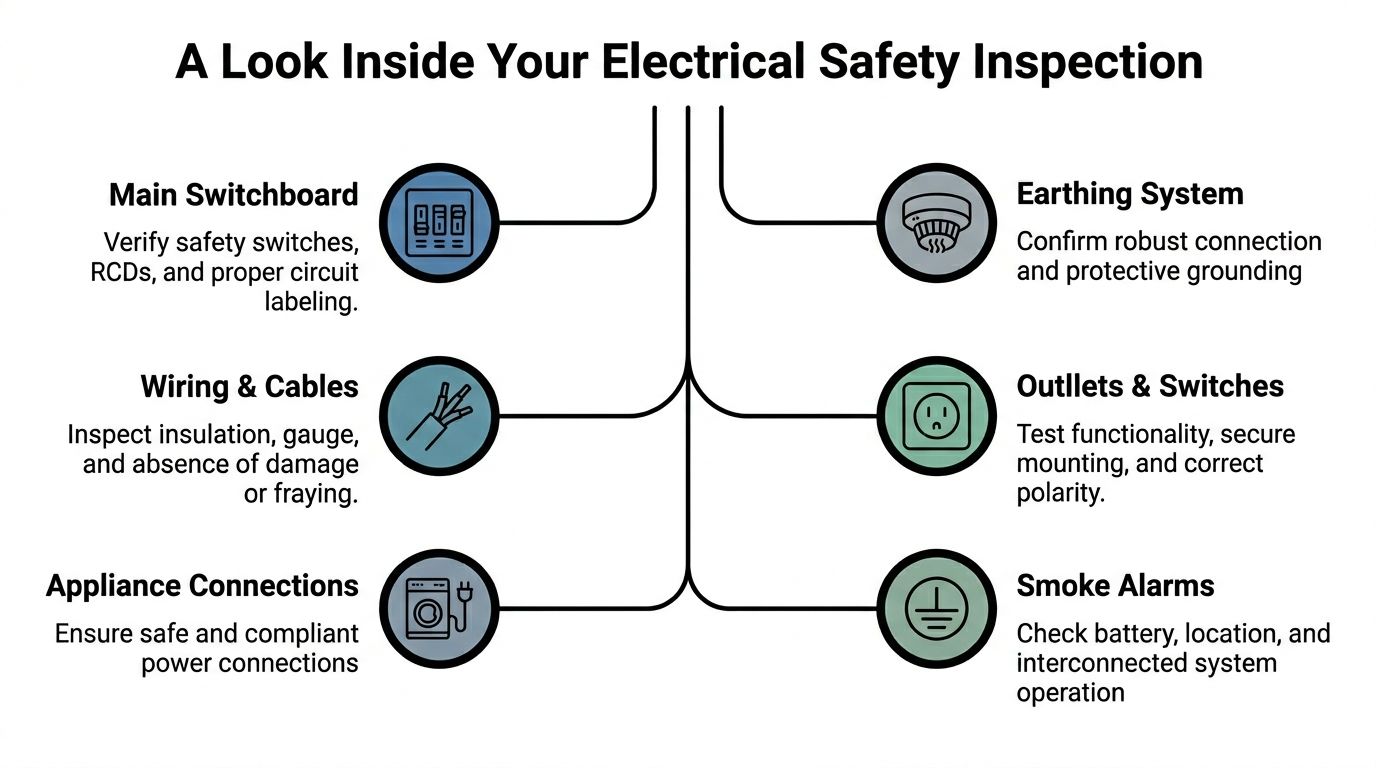
A thorough inspection follows a risk-based test sequence. It starts with visual checks for damage, then validates earthing for fault paths, insulation resistance against degradation, polarity to prevent reversed connections, and RCD operation to ensure protective devices trip fast enough to prevent fatal shocks, as described in this overview of electrical safety testing methods.
The switchboard tells you a lot about the health of the installation. An electrician checks the condition of breakers and enclosures, looks for heat damage, verifies circuit identification, and checks whether safety switches are fitted where they should be.
If the board has poor labelling, mixed generations of gear, damaged covers, unused openings, or signs of DIY alterations, that's a red flag. The board is where many serious defects first become visible.
This guide on RCDs and circuit breakers is useful if you want the plain-English difference between those protective devices.
Wiring checks aren't about admiring neat cable runs. They're about condition and suitability. The inspector looks for damaged insulation, exposed conductors, unsupported cabling, poor joins, moisture effects, and signs that the circuit has been altered badly.
In roof spaces and under floors, this is often where hidden age shows up. Heat, rodents, old repairs, and later additions can leave the installation functioning, but not in a condition you'd want to trust long term.
These two checks are less visible to homeowners, but they're critical. Earthing confirms there's a dependable path for fault current. Polarity checks make sure active and neutral aren't reversed at outlets or fittings.
If polarity is wrong, equipment may still appear to work normally, which is exactly why testing matters. A fault that isn't obvious to the user can still create a dangerous condition.
On site: The most dangerous defects are often the ones that don't stop the lights from working.
A safety switch isn't there for decoration. It has to trip correctly under test conditions. During an electrical safety inspection, the device is tested to confirm it responds as intended, not just that the test button clicks.
Homeowners sometimes assume that because a switchboard has modern-looking gear, protection is sorted. That's not always true. Devices fail, circuits get added incorrectly, and older boards can have patchwork upgrades that leave gaps in protection.
To see the broader testing process in action, this video is a helpful visual reference.
This part of the inspection picks up the issues people notice day to day. Loose outlets, cracked plates, discoloured switches, failed accessories, poor mounting, and abnormal operation all matter. So do fixed appliance connections for items like ovens, cooktops, air conditioners, and hot water systems.
The point isn't cosmetic perfection. The point is whether those connections are safe, secure, and suited to the load being placed on them.
Modern homes often have more than basic lighting and power circuits. They may include interconnected smoke alarms, CCTV, alarms, gate motors, solar components, and battery-related equipment. These additions create interfaces between systems, and those interfaces need scrutiny.
A practical inspection asks questions such as:
The question most homeowners ask is simple. How often should this be done? The honest answer is that timing matters more than a blanket interval.
For Queensland landlords, inspection timing is critical and event-driven. It's not just a one-off audit. Obligations are tied to tenancy changes, smoke alarm compliance deadlines, and post-renovation verification, making a property lifecycle approach more effective than a generic “every few years” check, as discussed in this guidance on electrical safety inspection timing.
The best time for an electrical safety inspection is usually when the property changes in a meaningful way. That includes a purchase, renovation, switchboard modification, major appliance upgrade, recurring fault, or rental turnover.
For owner-occupiers, the priority isn't chasing an arbitrary date. It's recognising when the risk profile has changed. If you've added air conditioning, upgraded the kitchen, installed a new hot water system, or inherited an older switchboard, that's a stronger trigger than the calendar alone.
| Property Type / Scenario | Recommended Frequency |
|---|---|
| Owner-occupied home with no known issues | Periodically, and sooner if the property is older or the electrical load has changed |
| Before buying a home | Before settlement where possible |
| After a renovation or switchboard modification | Immediately after work is completed and verified |
| Rental property in Queensland | At key compliance and tenancy events, not as a one-off |
| After a fault, burning smell, or repeated tripping | As soon as possible |
| After adding major appliances or changing usage | Promptly, to confirm the installation still suits the load |
There isn't one fixed Brisbane price that fits every job, and it's better not to trust ultra-cheap headline pricing. The cost depends on what the electrician is including.
A basic inspection on a small, modern home with easy access is a different task from a full inspection on an older Queenslander with roof access issues, multiple additions, and an unlabeled board. Travel, testing depth, reporting detail, and whether defects need immediate make-safe work all influence the final figure.
A practical way to compare quotes is to ask:
The cheapest inspection often becomes the expensive one if it misses the defect you actually needed identified.
A good inspection starts before the electrician arrives. If access is poor, details are missing, or nobody in the house can answer basic questions, time gets wasted and the result is often less thorough than it should be.
This checklist makes the visit smoother.
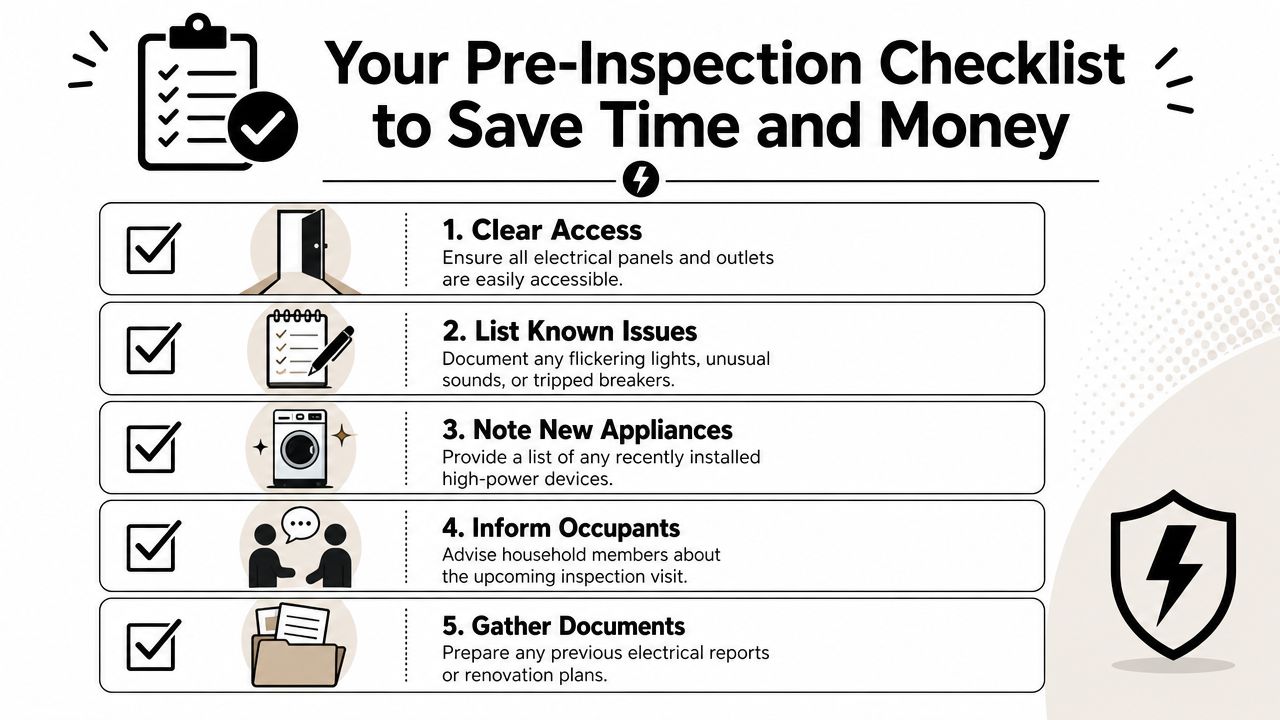
Inspections are part technical work and part detective work. Access, history, and occupant observations often reveal the cause of a fault faster than a cold start on site.
That's one reason property managers rely on repeatable inspection processes. Even though it's a different jurisdiction, this overview of CA rental inspection compliance is a good example of how preparation and documentation improve outcomes at handover and routine property checks.
If an electrician can't reach the board, can't identify prior work, and doesn't know which fault happens where, you're paying for time that could have gone into testing.
A tidy prep list won't remove the need for proper inspection. It does help the electrician spend more time assessing the installation and less time moving storage boxes or chasing missing information.
A lot of people hear “passed inspection” and assume the property is fully safe, full stop. That's not how electrical work functions in reality.
A passed visual inspection is not a guarantee of total safety. It is a snapshot that may miss intermittent faults, hidden loose terminations, or load-related issues. For that reason, reliability guidance often suggests combining visual checks with methods like thermal imaging or torque checks to uncover hidden risks, as noted in this article on common electrical inspection mistakes.
Some faults only appear when the system is under stress. A loose termination may behave normally at low load, then heat up when multiple appliances run together. A circuit may look fine during a quick daytime visit, then trip in the evening when the air con, oven, and hot water are all in play.
That's why a visual-only check has limits. It can spot obvious deterioration, but it can't always reveal what's happening inside a loaded connection, behind a termination, or in a fault that comes and goes.
Instead of asking “Did it pass?”, ask better questions:
A pass means the inspection found no fail item within its scope. It doesn't mean the property is future-proof.
That isn't a criticism of inspections. It's just honesty about what they are. A standard inspection is a strong starting point. In some homes, especially older properties or homes with layered renovations, deeper diagnostic work is the smarter move.
The quality of an electrical safety inspection depends heavily on who performs it. Two electricians can spend the same amount of time on site and deliver very different outcomes. One will tick boxes. The other will identify risk, explain priorities clearly, and leave you with a useful plan.
Australian data highlights the stakes, with an electrical fatality rate of 0.9 deaths per 100,000 workers, which helps explain why modern electrical safety inspection has shifted from a reactive repair model to a preventive compliance model where licensed practitioners test and verify against safety codes to prevent incidents, according to the NFPA's discussion of safety for electrical inspectors.
Start with the basics, then go one step deeper.
A well-presented electrical company site can also tell you something about how a business communicates its work. As one example of how electrical firms present technical services online, Website Builder Australia's Prolec project is worth a quick look.
A reliable electrician doesn't just tell you something is wrong. They tell you what is unsafe now, what should be upgraded soon, what can be monitored, and what paperwork you should retain.
If you're comparing providers, this guide on choosing licensed electricians near me gives a sensible checklist for narrowing the field.
In Brisbane, the best fit is usually someone who understands local housing stock, rental compliance pressure, renovation realities, and the difference between a minor fault and a system that's due for broader attention. That kind of judgement matters more than polished sales talk.
If you want a practical, no-pressure assessment of your home's electrical safety, DLG Electrical can help. Their Brisbane team has over 19 years of local experience, is fully licensed and insured, and handles everything from switchboard upgrades and smoke alarm compliance to fault finding, hot water systems, and residential electrical repairs. If you'd like clear advice, a free quote, and work done properly the first time, get in touch with DLG Electrical.

Master Electrician with over 30 years of experience. Founded DLG Electrical in 2005 after international project work including electrical installations at Stamford Bridge Stadium, London(Home of Chelsea FC).

Local Electricians that can fix all Electric Hot water Systems.
Motion sensor lights are a versatile addition to any home, offering nu
