83 Jean St, Grange QLD 4051
Mon-Fri 07:30 AM - 04:00 PM - Sat - 8:00 - 12 - Sunday Closed
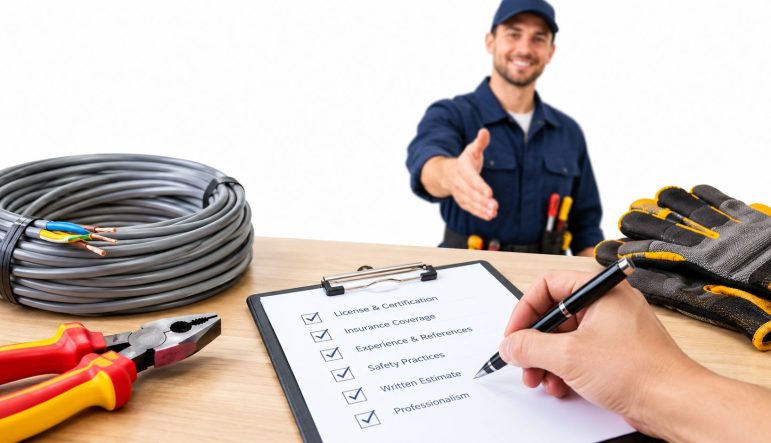
Before you hand over the keys, ask yourself one question: what can this electrician prove, rather than just promise? A quick price, a neighbour's recommendation, or a friendly phone manner doesn't confirm that the contractor is licensed for your exact job, insured, experienced with your type of property, or prepared to document the finished work.
The right questions to ask an electrician before hiring reveal how the job will be scoped, priced, tested, scheduled, and supported afterwards. They also help Brisbane homeowners identify work that carries extra compliance obligations, such as switchboard upgrades, safety switches, or interconnected smoke alarms.
Use the checklist below before approving any work. Ask for written answers where possible, compare like-for-like quotes, and keep the licence details, insurance evidence, scope of work, warranty terms, and completion documents together. If a contractor avoids straightforward questions or gives vague answers, treat that as useful information before the job begins.
Start with credentials, not price. Queensland law requires anyone performing electrical work to hold an electrical work licence, and the Electrical Safety Office says DIY electrical work is dangerous and illegal. The state also says electricians must carry at least $5 million in public liability insurance, including a $50,000 consumer protection component. You can confirm these requirements through the Queensland Electrical Safety Office's licensing and insurance guidance.
Ask for the electrician's current licence number and confirm that it belongs to the business or individual who'll perform the work. Don't assume that a contractor who is licensed for one type of service is automatically authorised for every electrical task. A credible answer should explain the licence class, the work it covers, and who'll supervise the job if a team member or subcontractor attends.
For a Brisbane renovation or switchboard replacement, verbal reassurance isn't enough. Save copies of the licence information and insurance certificate with the quote. A useful explanation of why contractor registration and credential checks matter is available in this guide to electrical contractor registration.
Practical rule: Don't allow electrical work to start until you can identify the licensed person responsible for the job and confirm the insurance evidence in writing.
“Can you do electrical work?” is too broad a question. A smoke alarm installation, an electric hot water repair, a switchboard upgrade, and a custom lighting design may all involve different equipment, testing steps, access issues, and compliance decisions. Ask, “What similar jobs have you completed, and what complications should we plan for in this property?”
A strong answer will be specific. For example, an electrician quoting for a security installation should be able to discuss sensor placement, power requirements, cabling routes, device compatibility, and how monitoring will be configured. Someone assessing an older Brisbane home should also explain how they'll inspect existing wiring before connecting new equipment.
Request references, photos, or examples from projects with a similar scope. You don't need a long portfolio. You do need enough detail to tell whether the contractor has handled the particular work you're commissioning.
Ask:
A contractor with relevant experience should be comfortable explaining what they'll look for, not just naming a service. Brisbane homes vary considerably in age, construction, access, and electrical configuration, so experience with Brisbane's varied home designs can be relevant when you compare providers.
For example, a North Brisbane homeowner seeking a monitored security system shouldn't evaluate a general maintenance electrician and a security-focused contractor on the same criteria. Compare their experience with the complete system you want installed.
References help you test the gap between a contractor's sales pitch and the customer's experience. Ask for recent clients whose projects resemble yours, then ask those clients about punctuality, cleanliness, communication, problem-solving, and whether the final paperwork arrived as promised.
Don't ask only, “Were you happy?” That usually produces a polite and limited answer. Ask whether the quote matched the final invoice, whether unexpected issues were explained before extra work began, and whether the electrician returned promptly if something needed attention.
Online reviews can show recurring strengths or complaints, but read them as a group. Consistent comments about clear explanations, tidy work, and reliable follow-up are more useful than one enthusiastic review. Repeated concerns about missed appointments, unexplained extras, or difficulty reaching the contractor deserve attention.
A portfolio can also reveal practical standards. Look for neat cable management, labelled switchboards, sensible equipment placement, protected finishes, and work that appears properly completed rather than staged for a photograph. You can ask whether a completed project is available for inspection, but respect the previous customer's privacy and don't expect access to someone's home without permission.
Ask references what happened after the invoice was paid. Aftercare often reveals more about a contractor than the initial quote.
For a homeowner in Grange considering a switchboard upgrade, useful questions include whether power interruptions were explained, whether the electrician protected floors and walls, and whether test results and compliance documents were supplied. DLG Electrical's own Brisbane electrician guidance can help you frame those questions, but you should still perform your own checks.
A low number isn't necessarily a low-cost job. Ask whether the electrician charges by the hour, provides a fixed quote, uses a project price, or combines labour and materials under different rates. Then ask what the price includes and what could cause it to change.
For a switchboard upgrade, a useful written quote should identify the inspection, equipment, labour, testing, isolation of power, removal of old components where relevant, and compliance documentation. For a security installation, it should make clear whether equipment, configuration, cabling, monitoring setup, programming, and customer instruction are included.
Request itemised written quotes from suitable electricians and compare the same line items. A quote that looks cheaper may exclude testing, disposal, access equipment, travel, or remedial work discovered after opening the existing installation.
Check these points before accepting:
Free quotes can make comparison easier, but “free” doesn't replace a proper site assessment. Be cautious if a contractor gives a firm price without asking about access, existing wiring, the switchboard, the number of outlets or alarms, or the condition of the installation.
A good quote gives both sides the same reference point. Keep the accepted version, along with any approved variations, so the final invoice can be checked against the agreed scope.
Before accepting a quote, ask: what does the contractor guarantee about workmanship, and which manufacturer warranty applies to the products supplied? Request the answer in writing, because these protections cover different risks. Workmanship coverage may address an installation fault, while a manufacturer warranty may apply only to a switch, alarm, hot water component, security device, or other specified product.
A credible warranty statement should identify the coverage period, inclusions, exclusions, claim process, and responsibility for inspection or return-visit costs. It should also explain whether the electrician contacts the supplier or expects you to manage a product claim yourself.
For an electric hot water repair, coverage may apply to the replaced component and associated labour, rather than every part of the existing system. A security installation should separate faults caused by installation from equipment defects, internet or monitoring problems, and later changes made by another provider.
Use the project details to test the answer:
Ask for the accepted quote, warranty terms, product model details, and supplier instructions before work starts. After completion, keep them with the invoice, test records, product manuals, and compliance documents.
A promise to “come back if anything goes wrong” leaves too much undefined. The paperwork should show what the electrician will rectify, what belongs to the manufacturer, and how a Brisbane homeowner starts a claim. This distinction can prevent a dispute when a fault appears months later or another contractor has altered the installation.
Before accepting a quote, ask which safety requirements apply to your property and how the electrician will prove the work meets them. A reliable answer should identify the tests, relevant standards, certificates, and handover documents, not just promise that everything will be compliant.
Queensland requires property owners to use a licensed electrician. The Electrical Safety Office's published guidance also connects licensing with post-work compliance and safety enforcement. Ask the electrician to provide their licence details and explain which compliance record will be issued for your project.
Safety-switch obligations depend on the property and the work. Owners must ensure an approved safety switch is installed within 90 days after taking possession of a property. For a recently purchased Brisbane home, ask whether the switchboard has the required protection and request the inspection result in writing.
The age of the home can affect socket-outlet protection. Safety switches have applied to general-purpose socket-outlet circuits in new Queensland homes since 1992. Broader requirements apply to new homes built or extended after 2000. If your home predates 1992, ask the electrician to confirm whether existing socket circuits have safety-switch protection before any repair or renovation begins.
Queensland requires interconnected photoelectric smoke alarms in every bedroom, each connecting hallway, and on every level of the home. The requirement is scheduled to extend to all homes by 1 January 2027, according to Queensland Government smoke alarm guidance.
For a landlord, renovator, or owner of an older Brisbane property, a simple repair may reveal additional alarm work. Ask whether the electrician will check the licence number, identify affected alarms, confirm interconnection requirements, and list any extra work separately in the quote.
Before work starts, request:
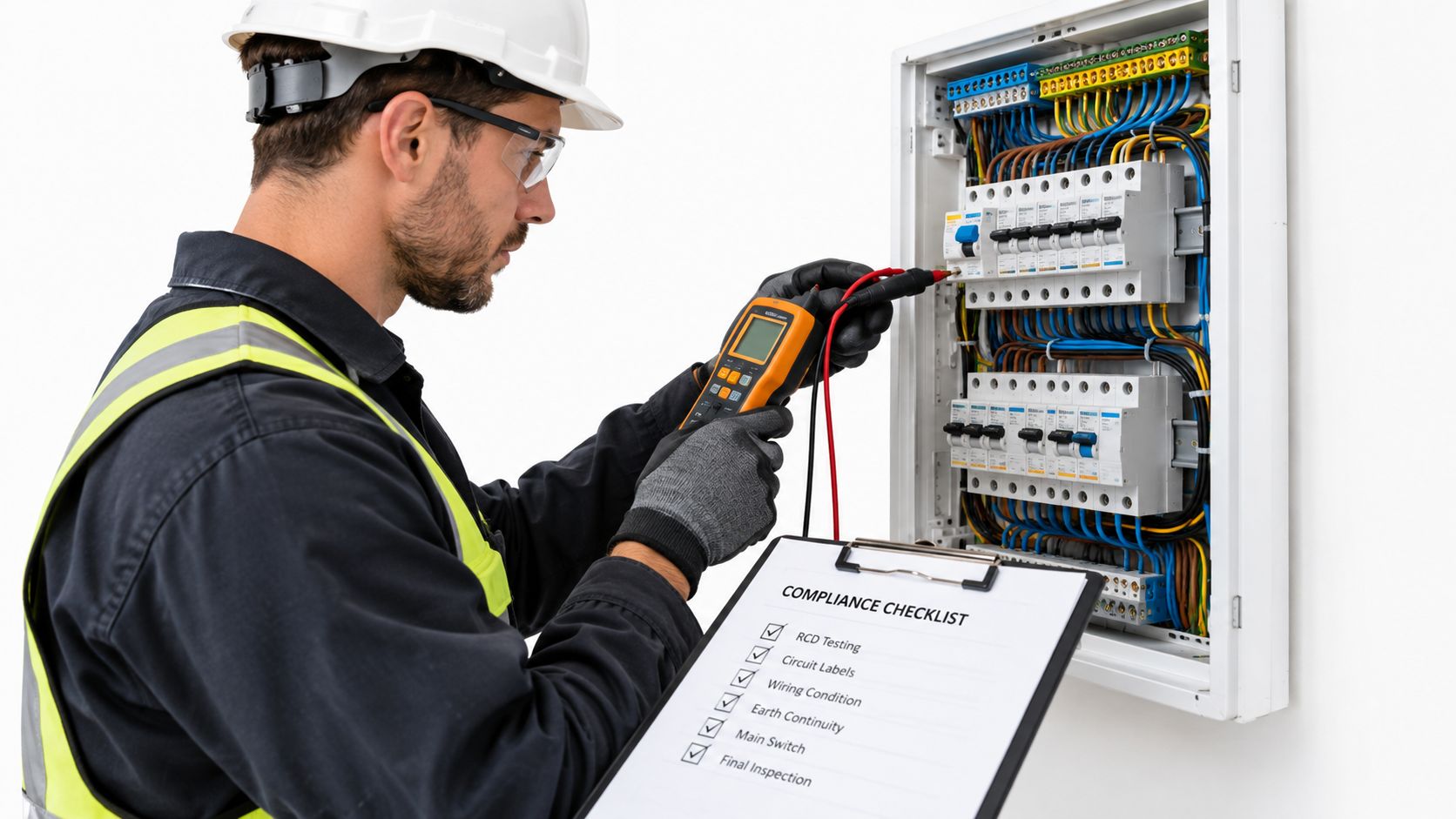
A visual check alone does not demonstrate that an installation is safe. Ask what measurements, fault checks, and functional tests will be completed, and keep the certificate with the final invoice. The Electrical Safety in the Community webinar provides regulator context on electrical risks for homeowners.
Before booking, ask for a realistic start date, expected completion date, and the events that could change the schedule. A useful estimate separates installation from inspection, testing, cleanup, and paperwork. It should also state when you must provide access and whether power will be isolated.
Match the timetable to the job. Exposed wiring needs a faster response than a planned lighting upgrade. A switchboard replacement may require access to the board and several rooms, while smoke alarm work can involve bedrooms, hallways, ceilings, and multiple levels.
Ask the electrician to walk through a typical workday. Their answer should explain what happens first, where delays commonly occur, and how you will be told about a change.
Record these details in the quote or booking confirmation:
A very early start date can conceal missing preparation, unavailable equipment, or an estimate that leaves no time for testing. A careful electrician may inspect first, source compliant equipment, coordinate access, or explain a variation before proceeding. Compare the schedule, assumptions, and paperwork, not just the first available appointment.
Write down the after-hours contact process before work begins. If the business does not offer emergency service, confirm who to call when power fails again or a problem appears after the job is complete.
Who will answer your questions once the work begins? Ask how the electrician communicates, who your main contact will be, and how decisions are recorded when damaged wiring, restricted access, outdated equipment, or work outside the agreed scope is found.
A credible answer should cover urgent phone contact, written approval for variations, updates during longer jobs, and plain-English explanations of technical findings. Ask the electrician to explain why a recommendation is needed and what happens if you decline it. Clear communication matters more than technical vocabulary.
For a Windsor homeowner arranging smoke alarm work, request a practical handover plan. Confirm which alarms will be interconnected, where they will be installed, how testing will be completed, and what routine maintenance involves. For a monitored security system, ask who will explain the controls, how monitoring will be activated, and who handles questions after installation.
Before booking, agree on these points in writing:
Ask for the final paperwork before the electrician leaves. It should identify what was changed, what was tested, any remaining issue, and where certificates, instructions, and warranty information are stored. Check that labels and controls match the explanation you were given.
A good handover leaves you knowing what was changed, what was tested, what remains outstanding, and where the paperwork is stored.
The first conversation provides useful evidence. An electrician who documents the scope, flags uncertainty, and answers patiently is more likely to manage the job clearly than one who leaves every detail verbal.
| Item | Implementation complexity 🔄 | Resource requirements ⚡ | Expected outcomes ⭐ / 📊 | Ideal use cases 💡 | Key advantages ⭐ |
|---|---|---|---|---|---|
| Are You Licensed, Insured, and Qualified? | 🔄 Low, simple verification | ⚡ Low, documents/checks | ⭐⭐⭐ 📊 Legal protection, safety assurance | 💡 Every electrical hire, insurance claims | Compliance, accountability, reduced legal/risk exposure |
| What Is Your Experience With My Specific Type of Project? | 🔄🔄 Medium, project-specific expertise | ⚡⚡ Medium, specialised tools/skills | ⭐⭐⭐⭐ 📊 Higher quality, fewer delays/errors | 💡 Switchboard upgrades, security, hot water, custom design | Faster completion, accurate estimates, problem prevention |
| Can You Provide References and Show Me Your Previous Work? | 🔄🔄 Medium, verification effort | ⚡ Low, time to check reviews/refs | ⭐⭐⭐ 📊 Confidence in workmanship and reliability | 💡 Renovations, high-value or unfamiliar contractors | Verifiable track record, customer satisfaction evidence |
| What Is Your Pricing Structure and Do You Offer Free Quotes? | 🔄🔄 Low–Medium, comparing quotes | ⚡⚡ Low, time to obtain itemised quotes | ⭐⭐ 📊 Budget clarity, cost comparison | 💡 Large projects, cost-sensitive decisions | Price transparency, reduces scope disputes, better budgeting |
| Do You Guarantee Your Work and What Is Your Warranty Coverage? | 🔄 Low, request written terms | ⚡ Low, documentation and record-keeping | ⭐⭐⭐ 📊 Post-service protection and recourse | 💡 Major installs (switchboards, system installs) | Remedy for defects, peace of mind, clear claims process |
| How Do You Handle Safety Compliance and Certifications? | 🔄🔄🔄 High, technical compliance required | ⚡⚡⚡ High, testing, certification, training | ⭐⭐⭐⭐ 📊 Legal compliance, reduced hazard risk | 💡 Smoke detector compliance, council approvals, upgrades | Code adherence, insurer acceptance, safer installations |
| What Is Your Timeline and Availability? | 🔄🔄 Medium, scheduling and contingencies | ⚡ Low, coordination and communication | ⭐⭐ 📊 Predictable scheduling, minimized disruption | 💡 Time-sensitive repairs, phased projects | Planning convenience, clearer expectations, fewer delays |
| How Do You Communicate and What Is Your Customer Service Approach? | 🔄 Low, set expectations upfront | ⚡⚡ Low–Medium, responsiveness resources | ⭐⭐⭐ 📊 Smoother experience, quicker issue resolution | 💡 Complex projects requiring coordination | Clear updates, faster problem resolution, higher trust |
Use these questions in order of risk. First, verify the current Queensland licence and insurance. The state requires electrical workers to be licensed, and its guidance says electricians must carry at least $5 million in public liability insurance, including a $50,000 consumer protection component. Don't approve work until you know who holds responsibility and what the cover applies to.
Next, compare experience with the exact project, not just years in the trade. A contractor who regularly handles switchboards may be a better fit for a switchboard upgrade than one whose work mainly involves small repairs. Likewise, smoke alarm compliance, electric hot water repairs, security systems, and custom electrical design each deserve specific questions about process, equipment, testing, and handover.
Then compare written quotes on scope. Check labour, materials, access, testing, cleanup, certificates, exclusions, variations, payment terms, and any separate call-out or after-hours charges. The cheapest quote can be poor value if it leaves out the work required to make the installation safe and properly documented.
Compliance deserves its own approval step. Ask whether the job affects safety switches, smoke alarms, switchboards, or other regulated elements. Queensland requires interconnected photoelectric smoke alarms in specified areas of homes, and the requirement is being extended to all homes by 1 January 2027, so older properties and rental homes may need a broader assessment than the initial request suggests. Confirm the electrician's exact licence class and request the compliance certificate or other required completion documentation.
Before the first day, write down the start date, access requirements, expected interruptions, communication method, variation process, warranty terms, and after-hours contact process. After the job, keep the accepted quote, invoice, licence and insurance evidence, warranty information, product manuals, testing records, and certificates in one property file.
DLG Electrical is one Brisbane option to consider. Its supplied business information describes a family-owned and operated contractor offering residential and commercial electrical services, including switchboard upgrades, electric hot water repairs, security systems, smoke alarm work, and custom design. It also states that the business provides free quotes, uses licensed and insured electricians, and operates Monday to Friday from 7:30 AM to 4:00 PM. Those details are useful starting points, but you should still verify the current licence, insurance, scope, pricing, and documentation before approving any work.
The best electrician won't resent careful questions. They'll answer them clearly, identify risks early, put the scope in writing, and give you the records needed to understand and maintain the finished installation.
DLG Electrical provides licensed and insured Brisbane electrical services, including switchboard upgrades, smoke alarm compliance, security system installations, repairs, and free quotes. Review your project requirements and contact DLG Electrical to discuss the questions, documentation, and practical scope you should confirm before hiring.

Master Electrician with over 30 years of experience. Founded DLG Electrical in 2005 after international project work including electrical installations at Stamford Bridge Stadium, London(Home of Chelsea FC).

Local Electricians that can fix all Electric Hot water Systems.
Motion sensor lights are a versatile addition to any home, offering nu
