83 Jean St, Grange QLD 4051
Mon-Fri 07:30 AM - 04:00 PM - Sat - 8:00 - 12 - Sunday Closed

A Brisbane body corporate can have a clean-looking foyer, a tidy switchboard and a contractor's invoice in the filing cabinet, yet still discover a failed exit fitting during a blackout. The problem often isn't that nobody cares. It's that everyone assumes somebody else checked the battery, recorded the result and followed up the defect.
That assumption creates risk for the landlord, body corporate committee, property manager or business owner who has to demonstrate that the system is being maintained. Checking emergency lighting is both a technical task and an ownership task. The person responsible for the premises needs a reliable process, not just a test button and a green indicator.
The Queensland approach is practical once the responsibilities are separated. A suitably qualified person carries out the regulated service, the owner verifies the technician's licence scope, staff perform sensible visual checks, and every defect and repair stays attached to the building's records. Guidance for planning an evacuation plan for event organizers can also help clarify how lighting fits into the wider evacuation arrangement, particularly where several people share responsibility for a site.
A failed fitting is often found in an ordinary place. It might be halfway down a shared stairwell, above a rear exit or outside a plant room that rarely gets visited. During a routine inspection, the technician isolates the circuit and one fitting stays dark while the others come on. The building may look compliant from the ground, but the escape route has a gap exactly where occupants need reliable guidance.
In a Brisbane apartment building, an early-morning outage can expose that gap quickly. Residents leave their units and find that part of the stairwell is dim, an exit sign is unreadable or several luminaires stop operating before the backup period ends. By that point, the issue isn't a maintenance item. Owners may be dealing with an incident review, an insurance question, an audit finding or difficult conversations about who knew what and when.
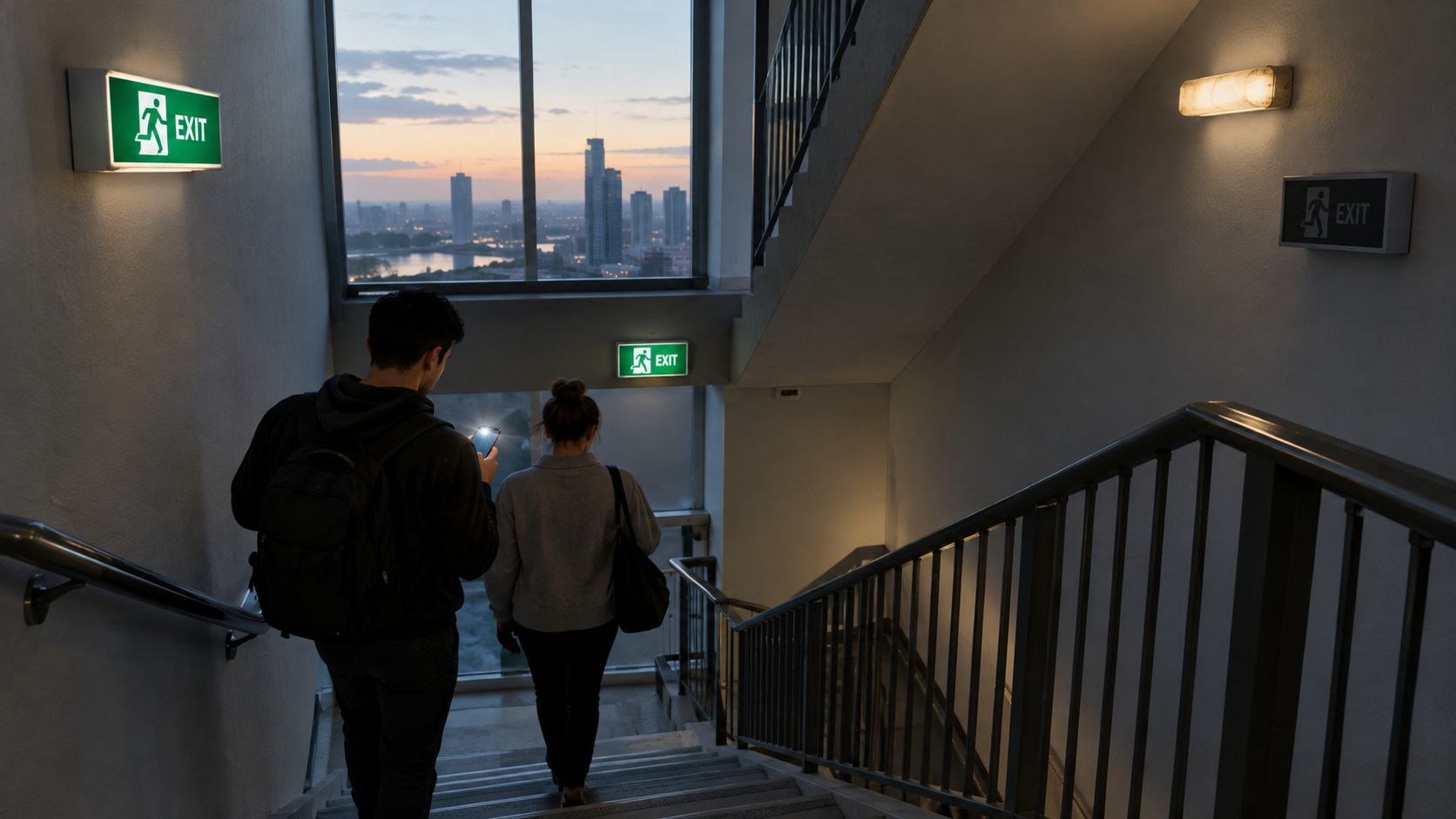
The licensed tester doesn't own the whole risk. The building operator or occupier still needs to make sure inspections occur at the required intervals, defects are addressed and records can be produced. That applies whether the property is a commercial tenancy, a multi-residential complex, a rental property with shared facilities or a small business premises.
A sensible owner's process answers five questions:
Monthly walk-throughs can help identify visible problems between formal services, but they don't replace the structured six-monthly and annual inspections required under the Queensland maintenance approach. The useful distinction is simple. Routine observation finds obvious trouble early. Qualified testing demonstrates system performance.
The rest of the process should be easy for a non-electrician to supervise. You don't need to perform the discharge test yourself, but you should know what a real test looks like, what evidence should come back and what happens when a fitting fails.
Emergency-lighting checks sit within AS/NZS 2293.2, Emergency lighting and exit signs for buildings, Part 2: Routine service and maintenance. The standard sets the maintenance framework, while Queensland requirements determine how inspection milestones and licensing apply locally. An owner does not need to recite the standard, but should know which requirements the contractor is applying and whether the technician is authorised to perform the work.
Queensland's licensing arrangement changed on 1 May 2021. The former emergency-lighting “inspect and test” licence class was replaced by the dedicated electrical-stream “inspect and test, emergency lighting” class. The Queensland Building and Construction Commission's licensing guidance states that the former licence transitioned automatically, the work scope changed and transitioned licensees did not need additional upskilling.
The practical risk is treating any electrical visit as proof that the regulated inspection has been completed. Installation experience, a general electrical licence or a quick walk-through does not by itself confirm the correct inspection-and-testing authority.
Before booking, ask the contractor to provide the technician's current Queensland licence category and confirm that the service follows AS/NZS 2293.2 and applicable Queensland guidance. Ask what the six-monthly test includes, particularly the sustained battery check, and how every luminaire and exit sign will be identified and tested.
Request a sample report or logbook entry as well. It should make clear what was tested, what failed, where the fitting is located and what action follows. This gives the owner something practical to compare when quotes differ, rather than choosing on price while assuming the scope is identical.
A written scope also prevents a common site failure: a contractor tests accessible fittings, records a clean result and leaves unlisted units outside the job. If coverage is not defined before attendance, the gap may only become visible after an incident, lease dispute or compliance review.
Before the test starts, confirm the precise licence class, test method, fitting coverage and records to be supplied. A quote that says only “emergency-lighting check” leaves too much room for different interpretations. Ask for the missing details in writing, then keep the agreed scope with the service records.
A tenant reports a dark corridor during a power interruption. On inspection, an exit sign is still mounted above the door, but a new partition blocks its view and dust has covered the diffuser. A quick site walk can catch that kind of ownership failure before the next formal service.
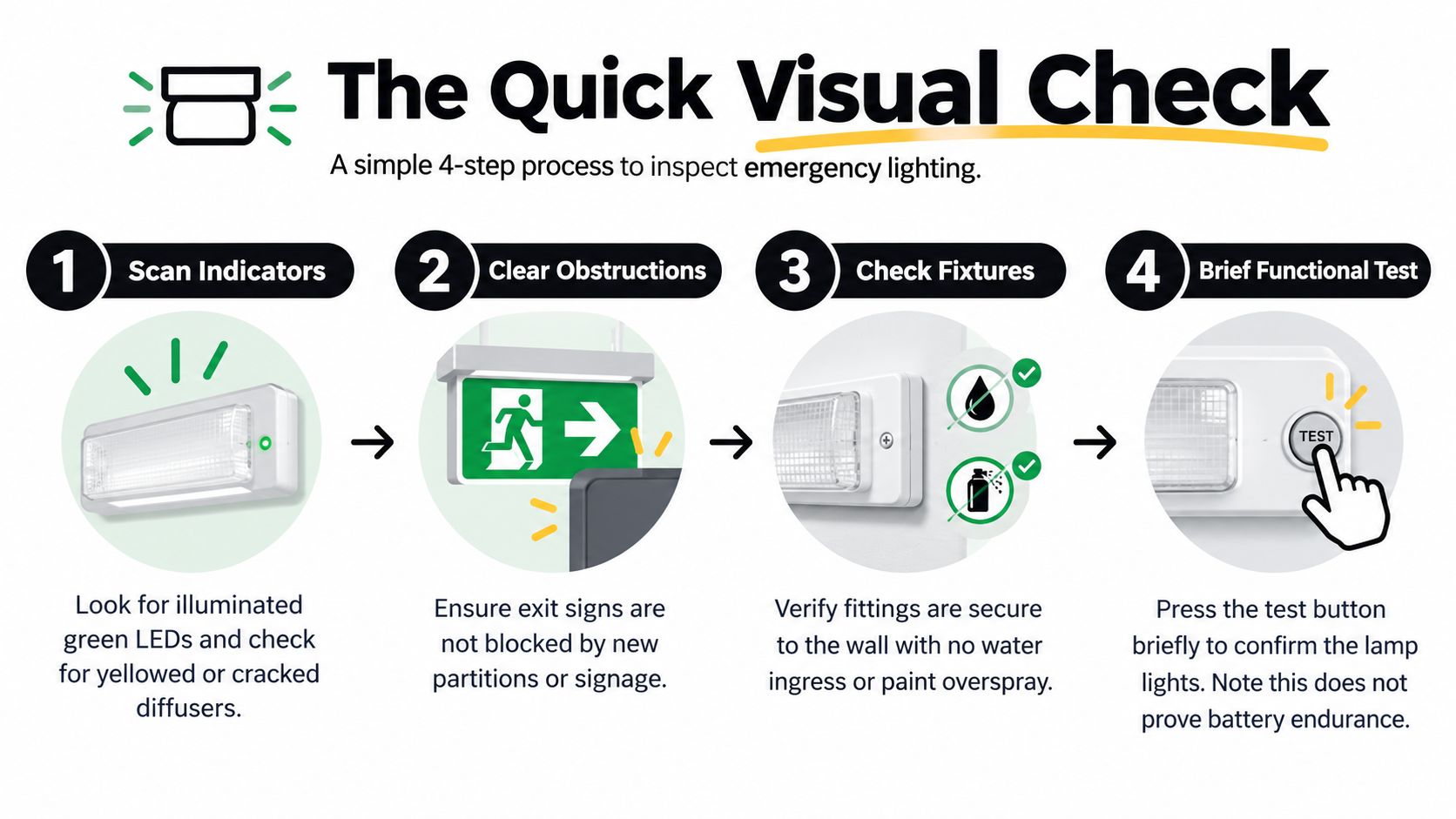
A cleaner, caretaker, landlord or property manager can follow the escape route and look for damaged, obstructed or disconnected fittings. This check supports the licensed inspection and testing program. It does not replace it.
Use the same route each time, starting near the distribution board and continuing through corridors, stairs, lobbies and exits. Look above recent fit-out work and behind stored items. Partitions, promotional signs, shelving and paint can hide an exit sign while leaving the electrical unit apparently operational.
Check the condition and visibility of each fitting:
A brief functional check can use the fitting's test button or the designated test switch at the distribution board. Operate it only long enough to confirm that the lamp transfers to battery operation and illuminates. It does not test battery endurance or prove the fitting will remain lit during a prolonged outage.
The Queensland Government's emergency-lighting inspection and maintenance guidance explains why a push-button test is limited. It may confirm charging or lamp operation, but it cannot establish how long the battery will operate. Staff can use a home electrical safety checklist to organise other visible household hazards, while keeping regulated emergency-lighting checks within the licensed service process.
What this check proves: the fitting is present, visible and responds briefly.
What it doesn't prove: the battery will sustain emergency operation for the required duration.
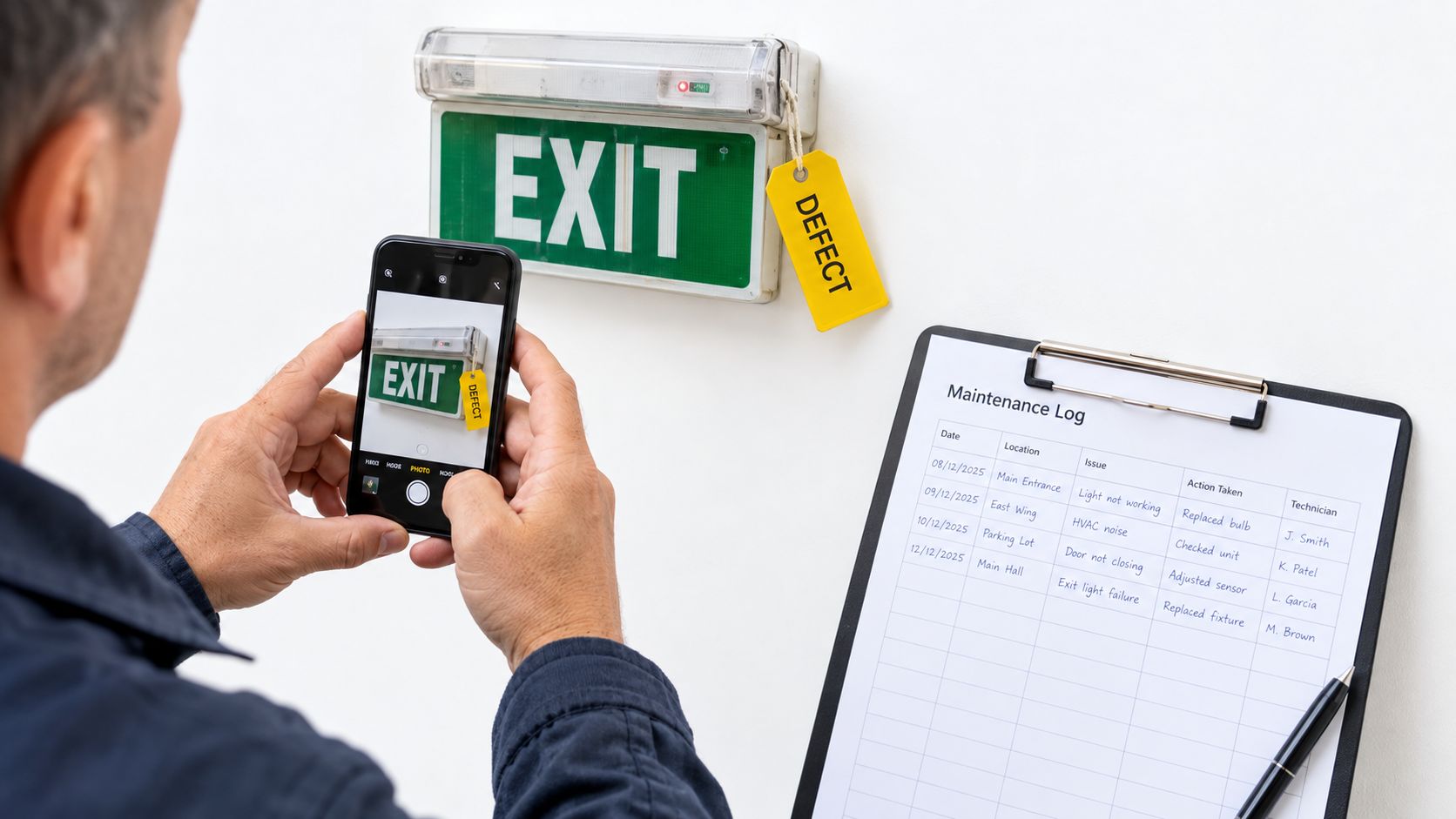
Record the date, the person who walked the route and every fitting needing attention. Photograph obstructions, water damage and layout changes. Send the record to the owner or manager, assign someone to arrange the repair, and keep the defect open until its resolution is documented.
A six-monthly discharge test shows whether the emergency-lighting system will keep working after normal power fails. A technician simulates that failure, checks the installation on battery supply and records what happens to each fitting. A quick button press is not an equivalent service because it does not test battery endurance.
For systems installed since 1997, the technician uses the test timer at the electrical distribution board or isolates the emergency-lighting circuit. The method should reproduce a normal-supply failure in a controlled way, without bypassing safe isolation procedures. The owner's responsibility is to confirm the scope, use a properly licensed contractor and make sure the result is documented.
The report should make the sequence easy to follow:
The test must cover every luminaire and exit sign, not a convenient sample. Representative testing can miss an isolated battery failure, loose connection or local circuit fault. The contractor should be able to explain how each unit was identified, tested and marked as passed or failed.
Owners should not interfere with safe isolation or live electrical work. Supervision means agreeing the scope before the visit and checking the evidence afterwards. The report should identify the site, service date, fittings tested, pass or fail results, defects and corrective actions.
The emergency-lighting test guidance explains the difference between a brief functional response and a sustained discharge test. If the contractor only presses a button, tests a handful of fittings or leaves the duration blank, ask for clarification before approving the invoice.
A fitting can illuminate at the start and still fail before the test ends. Batteries may accept charge and produce short-term light while no longer sustaining the required output. Keep the test record with the property files, assign someone to resolve defects and leave the issue open until the repair or retest is documented.
The annual visit doesn't replace the six-monthly discharge test. It repeats the operational work, then adds the physical inspection and cleaning that reveal problems a battery check may not expose.
Technicians should inspect fittings for damage, clean diffusers and reflective surfaces, check signs and labelling, and verify the condition of batteries, chargers, switches and circuit identification. These tasks matter because a fitting can remain electrically responsive while dirt, a degraded diffuser, physical damage or altered surroundings reduces the light reaching the escape route.
Dust and paint residue are easy to dismiss as cosmetic. They aren't. A dirty diffuser can reduce useful illumination, while a damaged or yellowed cover can change how light spreads. Reflective surfaces also need attention because the fitting's effectiveness depends on more than whether the lamp turns on.
The annual service should also catch site changes. New partitions, stored materials, revised doorways and replacement signs can alter visibility. Circuit identification that made sense during the original installation can become confusing after switchboard work or renovations, which creates a problem when somebody needs to isolate or restore the correct supply.
For a more technical route-lighting check, use a calibrated light meter. The cited WorkSafe Victoria construction-site method measures horizontally at approximately 1 m above floor level, beginning 1 m from the route start and continuing at 1 m intervals, while avoiding shadows across the sensor. The readings are averaged, and the referenced method states that the average shouldn't be below 20 lx (WorkSafe Victoria's emergency-lighting guidance).
That benchmark belongs to the cited construction-site method, so it shouldn't be copied uncritically onto every Queensland building. The practical lesson is broader: measure consistently, use calibrated equipment and don't compare readings taken at different heights or with a shaded sensor.
An annual service that only reports “all lights operational” leaves too much out. Owners should expect the report to show that the fitting condition, cleanliness, labels, battery, charger and surrounding route were considered.
The hard part starts after the failed fitting is found. Queensland fire-safety guidance says maintenance records must be kept and shown to authorised local government officers or Queensland Fire and Emergency Services officers. It also puts responsibility for keeping prescribed fire-safety installations maintained and tested at the required intervals on the occupier or building operator (Queensland fire-safety maintenance guidance).
A contractor's last visit does not shift that responsibility away from the occupier. If the logbook is patchy, the building operator may be left trying to prove what was tested, what failed, who was asked to repair it and whether the repair was finished.
A clean defect trail makes handovers easier. It also keeps arguments down when ownership changes or a property manager inherits old problems.
Record each failed fitting separately, even if the contractor issues a service report as well. Photograph the fitting, the surrounding area and any damage or obstruction. Use a location reference that still makes sense to someone new to the site, such as a corridor, stairwell, level or unit number.
Then describe the failure plainly. Say whether it failed to light, dropped out early, dimmed, showed a charging fault or had a damaged diffuser. Note whether the fitting sits on a required evacuation path or in a less critical area. That detail changes how fast the issue should be acted on.
A practical workflow is simple: assign the repair to a suitably qualified person with the right Queensland licence scope, then close the loop with the repair date, the work completed, replacement details where needed and the person responsible for the fix. Keep the next service date tied to the same record. If the job is closed without that, the reminder gets lost and the same defect can sit around until the next audit.
| Situation | Risk Level | Response Time | Documentation Required |
|---|---|---|---|
| Dead fitting in a low-traffic area away from a required evacuation path | Routine, but still a recorded defect | Arrange qualified rectification promptly through the maintenance process | Location, photograph, failure type, repair record and next test date |
| Inoperative fitting on a designated exit route | Urgent safety issue | Do not leave it until the next six-monthly visit. Assess the route and arrange immediate qualified action | Defect details, route assessment, interim decision, repair evidence and updated logbook entry |
The divide is not between important and unimportant faults. It is between a defect that is tracked, owned and closed out, and one that leaves people without reliable light on a route they may need in an evacuation.
Property managers should keep reports where the next manager can find them fast. A clear electrical inspection report process helps connect observations, recommendations and completed work, but the emergency-lighting logbook still needs to stay complete and accessible.
A missing record is not proof that the test never happened. It becomes a serious problem when the owner has to prove that it did.
A simple calendar keeps emergency-lighting work from drifting. Book the six-monthly discharge test into a fixed slot, such as the financial-year cycle or insurance-renewal period, so defects can be found and dealt with before they turn into paperwork headaches. Put the annual service in a window where the building is easy to access and occupancy is lighter. Keep a quick route check in normal site walks, so blocked fittings or damage are picked up before the contractor arrives.
A usable owner checklist stays short and clear:
The shortcuts are predictable. Owners trust the green LED, accept the cheapest quote without checking the licence class, let records lapse when a property manager changes, then scramble for evidence during a sale or audit.
The better habit is ownership. Keep the logbook tidy, keep defects tied to a person and a due date, and verify the contractor's licence before the work starts. That way the next responsible person can see what was found, what was fixed, and what still needs attention. A missing record leaves the owner reconstructing the building's maintenance history under pressure.

Master Electrician with over 30 years of experience. Founded DLG Electrical in 2005 after international project work including electrical installations at Stamford Bridge Stadium, London(Home of Chelsea FC).

Local Electricians that can fix all Electric Hot water Systems.
Motion sensor lights are a versatile addition to any home, offering nu
